Company Brain (Second Brain): What It Is and Why You Need One
11 min read · AstraLoop Studio
Your AI is only as smart as what it can read about your business. That's a blunt statement, but it's the starting point for everything that follows. If you and a competitor both open ChatGPT and ask the same question with no context about your companies, you get roughly the same answer. No edge, no difference. Square one.
The leap happens when AI stops reasoning "in general" and starts reasoning about your business: your customers, your procedures, the decision made in a meeting six months ago, the exact way your top salesperson closes a deal. To do that, though, it needs something to read. That something is the company brain, also called a second brain.
In this article we'll cover what it is (in business terms, not software terms), what concrete problem it solves, why building it now beats waiting, and how it works at a high level. It's the entry point to our series on the topic - from here you can dig into whichever aspects matter to you.
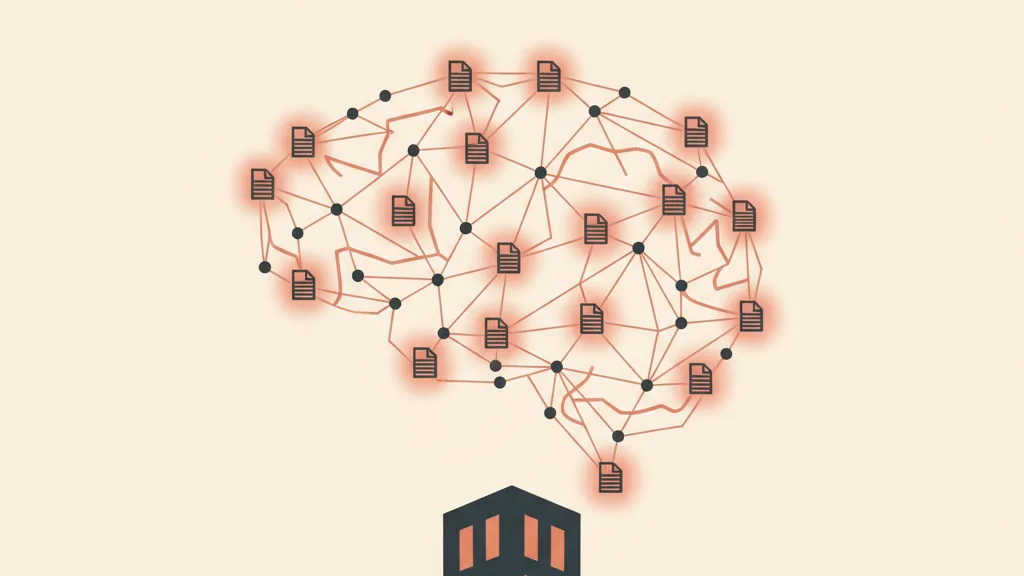
What a company brain is
A company brain is a large, interconnected digital brain that gathers all of a company's knowledge and that an AI works on. It isn't a tidier shared folder, and it isn't yet another wiki. The difference lies in what it's built for: it's meant to be read and navigated by an AI, not just consulted by a person.
It has one trait no static archive has: it gets better with use. The more you use it, the more it knows about your business, and the better the answers it gives you. It's a memory that grows over time instead of aging. A wiki, by contrast, tends to go stale the day after you stop updating it.
If you want the working definition and the real distinction from the tools you already use, we've dedicated two deep dives to how an AI second brain works and to the real difference between a second brain, a wiki, and Notion.
The problem: your company's knowledge is scattered
Before talking solutions, let's pin down the problem. In any company, knowledge lives in three places, and none of the three is actually usable.
1. Scattered across chats, emails, and documents
Decisions made in a Slack thread, attachments buried in an email, notes in a Google Doc nobody can find again. That knowledge exists, but it's effectively unrecoverable: buried under thousands of messages, with no index, no place where it "lives." When you need it, you either rebuild it from scratch or you lose it.
2. Inside people's heads
Your top performer is worth their weight in gold. They know how to handle that difficult client, they know the history of every account, they carry the "how it's done" in their head that's written down nowhere. The problem is obvious: if they leave, that knowledge walks out the door with them. And as long as they stay, they become a bottleneck. Every new hire's onboarding runs through them, every question runs through them, growth is capped by their availability. This is the risk of knowledge loss tied to employees, and it costs more than it looks like it does.
3. Scattered across dozens of different tools
The policy PDF, the revenue spreadsheet, supplier emails, the CRM, the ERP. Every piece of information has its own silo, and nobody uses them together. The knowledge is there, but it's fragmented into pieces that don't talk to each other.
The bill for all this is steep. According to a McKinsey estimate, roughly 19% of the work week - nearly one day in five - is spent looking for information. It's an order of magnitude, not gospel, but it makes the point: nearly 20% of your team's time goes to finding things the company already knows. We quantified the impact in our analysis of the real cost of scattered knowledge in a company.
The concrete benefits: search, onboarding, continuity
Let's look at what changes when that knowledge stops being scattered and gets pulled into a single brain the AI can read.
Instant search
The question "what did we decide with that client back in March?" gets an answer in seconds, source included. That one day in five spent searching shrinks dramatically. It's not a productivity footnote - it's time the team redirects toward work that actually creates value.
Faster onboarding
Here the numbers speak for themselves. A new hire takes on average 8-12 months to become truly productive. The curve varies by person: a top performer gets there in 3-6 months, an average profile in 8-12, a slower one in 14-18 months. The interesting part is economic: in the first stretch of the curve, while they're learning, the employee is effectively "earning"; in the second stretch, once they're up to speed, the company is earning. Shortening the ramp-up shifts that balance in your favor and maximizes the return on every hire.
Faster onboarding has knock-on effects: it enables job rotation (you can move people between roles without starting from zero) and it reduces churn - the attrition rate - because an employee who becomes productive sooner is also a less frustrated employee. We covered both mechanisms in how to cut onboarding time with AI and in how an AI knowledge base reduces turnover.
Continuity that doesn't depend on people
When a salesperson leaves, their knowledge stays. When a team member goes on vacation, the rest of the team doesn't grind to a halt. The company brain turns individual knowledge into company assets. It's the difference between a business that runs on people and one that runs on processes.
The real reason: your competitive edge is in your data
This is the heart of the matter, and it's worth slowing down for. Generic AI is a commodity: everyone uses it the same way and it produces interchangeable results. A slightly better-written prompt doesn't give you a structural edge - it gives you half a step that anyone can catch up on in an afternoon.
The edge comes from exactly one thing: AI trained on your data. This is where data literally becomes the new gold. An AI that knows every one of your deals, every one of your procedures, every one of your decisions can't be replicated by a competitor, because they don't have that data and they can't buy it. We dedicated a full deep dive to this in why company data is the new oil and to how to build a competitive edge with AI on company data.
There's a corollary that applies directly to established companies. If you already have years of processes, history, procedures, and client relationships, you're in the best position to get the maximum return from AI, because you already have the raw material. A startup trying to compete starts with a data deficit that you keep widening every single day.
The arbitrage window
Let's call it what it is: there's an arbitrage window - the gap between what you can do today and what the market will be forced to do tomorrow. Whoever builds their company brain now accumulates an advantage that compounds over time. And the window won't stay open forever: it closes as awareness spreads.
The reason the advantage compounds is a virtuous cycle. The brain knows the company better, so it gives better answers, so the team uses it more, so the knowledge inside the system gets even richer. It's a compound return: the curve of a company with a company brain diverges upward from a company using generic AI like everyone else. We've written two pieces on this that are worth reading together: why adopt a second brain now and the compound returns of a second brain.
Want to find out how much of your company's knowledge you're already losing, and what it would take to gather it into a company brain? Request a no-obligation analysis.

How it works, at a high level
You don't need to know how to build one to understand why it works. But it's worth knowing the key concepts, because they explain where the value actually comes from.
Atomic notes
Knowledge gets broken down into many small notes, one idea per note, all linked to each other. It's the same principle sociologist Niklas Luhmann used - with roughly 90,000 linked index cards, the Zettelkasten method - to write his books. Splitting knowledge into small, linked units makes it reusable across different contexts and, crucially, navigable by an AI. We go into detail in atomic notes for company knowledge.
Taxonomy and ontology
Two technical words, one simple idea. The taxonomy is how you file things away (folders, categories). The ontology is how concepts connect to each other. It's this web of connections that lets the AI "reason," moving from one note to the next instead of reading an isolated document. Without an ontology you have an archive; with one, you have a brain.
Single source of truth
The company brain works as a single company-wide truth, a canon. The AI doesn't make things up: it only reports facts present in the company's knowledge. This drastically reduces "hallucinations" - the invented answers that are the number-one risk of an uncontrolled AI. It's the principle behind a company-wide single source of truth.
Living memory
The system updates itself from day-to-day conversations and work sessions. It isn't an archive frozen at some fixed date - it's a memory that keeps recording. That's why you can ask it what was decided in a meeting months ago and get the answer. We go deeper into the mechanism in the living memory of company AI.
The layer the team actually uses
Sitting on top of the knowledge is a visual layer, typically a dashboard or a Notion-style workspace, that makes the system usable by people and not just by the AI. And there's version control - a history of changes - that guarantees a single up-to-date source even when several people are working on it at once.
RAG, once the documents pile up
As notes grow, RAG (retrieval-augmented generation) comes into play: a semantic search that, across thousands of documents, finds only the information genuinely relevant to the question, efficiently. As a rough rule of thumb (not a hard law): under 500 notes, a content map and a good index are enough; between 2,500 and 20,000 notes you need embeddings and RAG; beyond 20,000 you need a full RAG pipeline. The detail is in RAG for the company knowledge base and in how to scale company knowledge with AI.
"What about my data?" The right question to ask
This is the objection we hear first, and it's a fair one. Two honest points.
The first, uncomfortable one: in most companies the data has already ended up in ChatGPT, pasted in by employees in chats, with no oversight and without you even knowing. A governed company brain, with clear rules, is objectively safer than that de facto situation.
The second: security is handled with concrete tools. Signed DPAs (data processing agreements), GDPR compliance, and version control that doubles as a backup and a single source of truth. It's not something to put off, but it's something addressable with the right method. We've written a dedicated guide on GDPR and second brain security.
Where it actually matters: use cases
| Context | What changes with a company brain |
|---|---|
| Professional firms (lawyers, accountants) | Every client and every case file always at hand: history, documents, decisions. See company brain for professional firms. |
| Sales teams | No knowledge lost when a salesperson leaves, fast onboarding for new hires. More in company brain for sales teams. |
| SMBs and agencies | From scattered-file chaos to one coherent system. See company brain for SMBs and agencies. |
| Customer support and operations | Consistent answers, always-current procedures, less dependence on any one person. |
The insight that changes the picture
With AI you can outsource two things. You can outsource skill: the AI writes the code for you. And you can outsource thinking: the AI proposes an architecture, a strategy, a structure. But there's a third thing you can't hand off: understanding your business. That has to stay yours.
That's why designing a company brain properly isn't a job to improvise. It takes understanding the business to decide how to structure the knowledge, which ontology to build, where to put the quality controls, when RAG is needed, and how to keep everything compliant. It's exactly the kind of work where an experienced partner is the difference between a useless archive and a brain that generates an edge.
When your company is ready
Not every company is ready at the same moment, and that's fine. The clearest signal is when you start hearing phrases like "only he knows how to do that," or when onboarding every new hire costs you months, or when you notice the same question gets different answers depending on who you ask. If that sounds familiar, you're probably ready. We cover it in when a company is ready for a second brain, and if the choice is between building it in-house or handing it to a specialist, the comparison is in second brain: DIY or agency.
The company brain isn't isolated from the rest of your AI strategy. It ties into AI agents for business, which find in the brain the context they need to act, and into lead generation with AI agents, where knowing your customers and deals is the difference between a generic contact and one that converts. It's the same principle, applied to acquisition: AI works better when it knows what it's talking about.
In short
A company brain gathers your business's scattered knowledge into a single digital brain that AI works on. It solves a concrete problem (the 20% of time spent searching, the 8-12 months of onboarding, the knowledge that walks out the door with people) and builds a competitive edge that compounds over time, because no competitor can buy your data. The window to build it with a real advantage is open now. Building it well, though, takes method: structure, atomic notes, ontology, quality controls, RAG, and compliance. That's the work we do at AstraLoop Studio.
Frequently asked questions
What's the difference between a company brain and a wiki or Notion?
A wiki is a static archive meant to be read by people, and it tends to go stale. A company brain is designed to be read and navigated by an AI, built from atomic notes linked to each other, and it improves with use: the more you use it, the more it knows about the company and the better the answers it gives.
Is a company brain safe for sensitive data?
Yes, if it's governed properly. It's worth noting that company data has often already ended up in ChatGPT, pasted in by employees with no oversight: a company brain with clear rules, signed DPAs, GDPR compliance, and version control is objectively safer than that unmanaged situation.
How long does it take to see the benefits?
The search benefits are almost immediate: information becomes retrievable in seconds. Onboarding and continuity benefits show up over the following months, as the system accumulates knowledge. The competitive edge, on the other hand, compounds over time with use.
Is my company too small for a company brain?
It's not a matter of size but of signals: if knowledge lives in the heads of a few people, if onboarding costs months, or if the same question gets different answers depending on who you ask, you're a good candidate. Even an SMB or an agency gets real value from moving from scattered files to a single system.
Do I necessarily need RAG?
It depends on how much knowledge you have. As a rough rule: under 500 notes, a content map and an index are enough; between 2,500 and 20,000 notes you need embeddings and RAG; beyond 20,000 you need a full RAG pipeline. You size the system to the actual scale.
Why isn't it enough to just use ChatGPT well, like everyone else?
Because generic AI is a commodity: without company context, you and your competitor get the same answers. The edge only appears when the AI is trained on your data, which no competitor can buy. A better prompt isn't enough - you need your company's context.
Designing and running a company brain that actually creates an edge takes method: structure, ontology, quality controls, and compliance. Talk to us and let's figure out together how to build it for your business.