Second Brain for SMBs and Agencies: From File Chaos to a System
8 min read · AstraLoop Studio
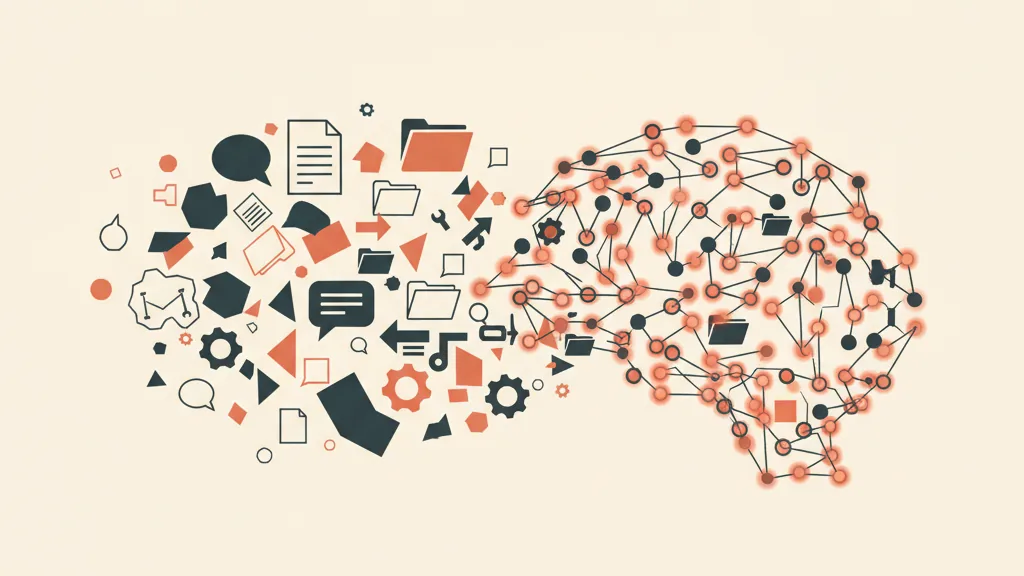
You open your inbox to dig up the returns policy you decided on back in March. It's not there. You search Slack and find half of it, buried in an archived thread. The rest is in Marco's head, and Marco is on vacation today. Meanwhile the client is waiting. If this scene sounds familiar, it's not a people problem: it's a knowledge management problem. In an SMB or an agency, the knowledge is absolutely there - it's just scattered across dozens of places and nobody is managing it.
The good news is that this chaos can be turned into a system. It's called a company brain (or second brain): a single, interconnected digital brain that holds all of a company's knowledge, with an AI working on top of it. In this article we look at why an SMB or agency should build one, what concrete benefits it brings, and how it works at a conceptual level. Not a technical tutorial - the business case.
Where your company's knowledge actually lives (and why you keep losing it)
In almost every structured company, knowledge piles up in three places, and all three are problematic.
- In chats, emails, and scattered documents. A decision made in a Slack thread, an agreement with a supplier buried in a six-month-old email, a project brief in a Google Doc nobody can find. It's real knowledge, but effectively unrecoverable: if you don't already know where to look, it doesn't exist for you.
- In people's heads. Your top performer is worth their weight in gold, but that value is trapped in their memory. If they leave, the knowledge walks out the door with them. And while they're still around, they become a bottleneck: everyone has to ask them, a new hire's onboarding depends on their availability, and growth slows down.
- Spread across dozens of disconnected tools. The policy PDF sitting in the back-office system, the revenue spreadsheet on someone's desktop, quotes in the CRM, contracts in yet another folder. Every piece exists, but nobody uses them together.
The cost of all this isn't theoretical. A widely cited McKinsey estimate puts roughly 19% of the work week - nearly one day in five - into searching for information. Treat it as an order of magnitude rather than gospel, but the point stands: a substantial chunk of your team's time isn't producing value, it's hunting for it. If you want to see just how much this really costs, we wrote a dedicated piece on the cost of scattered knowledge in a company.
What actually changes with a second brain (and what it isn't)
At first glance it looks like "just another wiki" or "one more shared folder." It isn't. The difference comes down to one thing: it's built to be read and navigated by an AI, not just by a person.
A wiki is static. You write it, update it by hand whenever you remember to, and then it just sits there getting stale. A company brain, on the other hand, is alive. The more you use it, the more it knows about your business, and the better the answers it gives you become. It's a memory that grows over time instead of decaying. We've written a dedicated comparison on this exact difference between a second brain and a simple Notion wiki.
In practice, with a well-built company brain you can ask, in plain language, "what did we decide back in March with that client about the returns policy?" and get the exact answer, with context, in seconds. Not because someone happened to remember it, but because the system stored it and can retrieve it.
The advantage nobody sees: your AI is only as smart as what it can read about you
This is the heart of the matter, and it's the point most companies haven't grasped yet. Your AI is only as intelligent as what it can read about your business.
Take an example. You and your competitor both open ChatGPT and ask it to draft a sales proposal. With no company context, you get virtually identical answers: generic, correct, interchangeable. That's the baseline. No competitive edge for either of you. A slightly better-written prompt doesn't change the game.
The advantage only shows up once the AI works with your data: your client cases, your tone of voice, your price lists, your procedures, the decisions you made and why. At that point, the same generic AI stops giving you textbook answers and starts reasoning like someone who genuinely knows your business. Data is the new gold, and the companies that already have structured processes and knowledge are the ones who will get the biggest return from AI. We've written a dedicated piece on why company data is the new oil and how it translates into competitive advantage.
Why build it now, not "in a couple of years"
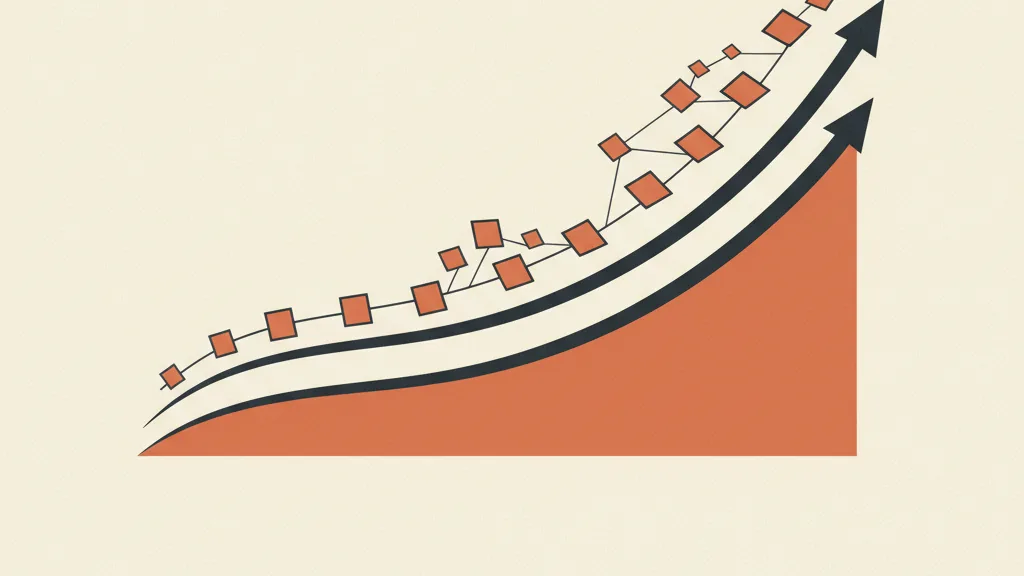
There's an arbitrage window: the gap between what you do today and what the rest of the market will do tomorrow. Whoever builds their company brain now accumulates an advantage that compounds over time. The more the brain knows about the business, the better its answers; the more the team uses it, the more knowledge it gathers. It's a cycle of compound returns where your curve diverges upward from everyone still using generic AI like everybody else.
This window will close as awareness spreads. A startup that wants to compete with you starts with a data gap that you, with your company brain, keep widening every day. If you want to understand the timing, read why you should adopt a second brain now.
How it works at a high level (the value, not the wiring)
You don't need to know how to build it yourself. You need to understand why it works, so you can evaluate it properly. Here are the principles that hold it together.
Atomic notes
Knowledge is broken down into many small notes, one idea per note, all interconnected. It's the same principle sociologist Niklas Luhmann used to write his books, starting from roughly 90,000 interlinked index cards (the Zettelkasten method). Splitting knowledge into small units makes it reusable across different contexts and, crucially, navigable by an AI. We go deeper on this in atomic notes for company knowledge.
Taxonomy and ontology
Taxonomy tells you how to file information; ontology tells you how concepts connect to each other. It's precisely this web of connections that lets the AI "reason" by moving from one note to another, instead of just doing a keyword search.
Single source of truth
One company-wide truth that everything refers back to. The AI doesn't invent anything: it only reports facts present in the company's knowledge base, which drastically cuts the risk of made-up answers (so-called hallucinations). We cover this in the company single source of truth.
Living memory
The system updates itself through everyday conversations and work sessions. It's not an archive you fill by hand: it grows with the company's normal use. This is the concept of living memory for company AI.
Scalability: when you need the "serious" tools
While the notes are few, a good index is enough. Once they number in the thousands, you need semantic search (RAG, retrieval-augmented generation) to efficiently find only what's relevant. As a rough order of magnitude:
| Number of notes | What you need |
|---|---|
| Under ~500 | Content maps and a well-built index |
| ~2,500 - 20,000 | Embeddings and semantic search (RAG) |
| Over 20,000 | A full RAG pipeline |
For an SMB or agency, this means you start light and scale only when you need to. If you want to understand the mechanics, read how RAG scales a company knowledge base.
Want to figure out which piece of your company's knowledge is worth structuring first? Talk to us: we'll look at your case and tell you if - and where - it makes sense to start.
Concrete benefits for SMBs and agencies
That's the theory. Now let's look at where it hits the P&L.
Faster onboarding
A new hire takes on average 8-12 months to become truly productive (top performers 3-6 months, average profiles 8-12, the slowest 14-18). These are industry estimates, but the principle is clear: in the first stretch of the curve, the employee is "earning"; in the second, the company starts earning. Cutting ramp-up time maximizes that return. A company brain lets new hires find procedures, past cases, and decisions on their own, without having to interrupt the resident expert every time. We wrote a dedicated piece on this: cutting onboarding time with AI.
Less risk when someone leaves
Turnover is a fact of life at an agency. The problem is that today, when an account manager or salesperson leaves, they take their client knowledge with them. With a company brain, that knowledge stays put. It reduces the risk of losing knowledge when employees leave, and by cutting ramp-up time it also enables job rotation and helps contain internal churn.
One system instead of ten
For an SMB, this is the most visible shift: from dozens of tools and scattered files to a single point of reference. It doesn't mean throwing away the tools you already use - it means putting a brain on top that reads them all in a coordinated way. The team stops asking "where's that file?" and starts asking for the answer directly.
Stronger customer support and operations
Whoever answers customers draws on the same up-to-date source, with fewer mistakes and fewer "let me check and get back to you." The same goes for operations, where procedures stop living in a single person's head.
"What about our data?" The most common objection
Fair question to ask. Two things need to be said honestly.
First: in most companies, sensitive data has already ended up inside ChatGPT, pasted in by employees with zero oversight, often without you even knowing (the shadow AI phenomenon). A properly governed company brain doesn't increase that risk - it reduces it, by bringing that data back inside a controlled perimeter.
Second: the compliance side is handled through signed DPAs, GDPR alignment, and version control, so you get backups and a single up-to-date source even across teams. We go deeper in GDPR and security for a second brain. This isn't definitive legal advice, but the direction is clear: governed is always better than left to chance.
The limit you need to know: AI doesn't think for you
One honest point to close the loop. With AI you can outsource skill (it writes code, drafts copy) and even thinking (it proposes architectures and solutions). But you can't outsource understanding. Understanding your own business remains your job, and that's exactly why the company brain's structure needs to be designed properly: atomic notes, ontology, quality controls, RAG where it's needed, compliance. Get the foundation wrong and you build a confusing archive - one the AI will give confusing answers about.
This is where it pays to have a partner who designs the right structure instead of leaving you to improvise. If you want to know whether it's better to build it in-house or hand it to an agency, or when your company is ready for a second brain, we have dedicated pieces on both questions.
Where to start
You don't need to digitize everything at once. Start with the knowledge that costs you the most when it's missing: the procedures you explain a hundred times, the recurring client cases, the decisions nobody can ever find again. From there, the system grows alongside the company. For the full picture, the starting point is the pillar article what a company second brain is, and for the technical mechanics there's how a second brain works with AI.
The move from file chaos to a single system isn't an early-adopter indulgence: it's how an SMB or agency turns its knowledge from a liability - scattered, held hostage by individual people - into an asset that compounds over time. The sooner you build it, the wider the gap stays between you and everyone still using generic AI like everyone else.
Frequently asked questions
What's the difference between a second brain and our company wiki?
A wiki is static and needs manual updates: you write it, and then it goes stale. A second brain is built to be read by an AI, grows with everyday use, and lets you ask questions in plain language and get answers with context. It's a memory that improves over time instead of degrading.
We're a small company - is it worth it for us?
Yes, often even more so than for a large enterprise. In SMBs, knowledge is concentrated in a handful of key people: if one of them leaves, the damage is disproportionate. A company brain turns that knowledge from a liability into an asset and speeds up onboarding, which matters a lot in a small team.
How much data do we need to get started?
You don't need to digitize everything right away. Start with the knowledge that costs the most when it's missing (recurring procedures, client cases, past decisions) and let the system grow from there. Under 500 notes, an index and content maps are enough; advanced semantic search (RAG) only becomes necessary once documents run into the thousands.
What about the security of our data?
In most companies, data has already ended up in ChatGPT, pasted in by employees with no oversight. A properly governed company brain reduces that risk by bringing the data back inside a controlled perimeter, with signed DPAs, GDPR compliance, and version control for backups and a single up-to-date source.
Can AI replace the people who understand our business?
No. With AI you can delegate skill (writing code, copy) and thinking (proposing solutions), but not the understanding of your own business. That's exactly why the company brain's structure needs to be designed well: it's a matter of method, not just an archive to fill up.
Why build it now instead of in a few years?
Because the advantage compounds over time: the more the brain knows about the business, the better its answers; the more the team uses it, the more knowledge it gathers. Whoever starts now builds a lead that widens every day compared to those still using generic AI. The advantage window narrows as awareness grows.
AstraLoop Studio designs, builds, and manages the company brain for SMBs and agencies. Request an analysis of your case: we'll show you the path from file chaos to a single system.