Why Using ChatGPT Like Everyone Else Gives You No Advantage
11 min read · AstraLoop Studio
Your AI is only as smart as what it can read about your company. Keep that in mind every time you open ChatGPT to draft an email, review a contract, or put together a proposal. If the model knows nothing about you, your customers, your pricing, and how you actually work, it hands you the same generic knowledge it gives everyone else on earth.
And that's where a problem almost nobody talks about begins: using ChatGPT like everyone else gives you no competitive advantage at all. It gives you convenience, speed on routine tasks, maybe some time saved. But your competitor, with the same subscription and a decently written prompt, gets the exact same answers. You're both at zero. And zero, by definition, doesn't set anyone apart.
In this article we look at why AI's real advantage doesn't live in the model, but in the data you feed it. And why the companies building their own "company brain" right now are quietly stacking up an edge the market hasn't caught up to yet.

ChatGPT with no context puts everyone at the same zero
Run a quick thought experiment. You and your direct competitor sell the same kind of product, in the same area, to the same kind of customer. You both ask ChatGPT: "write me an email to win back a customer who hasn't bought in six months."
What happens? You get two nearly identical emails. Polite, generic, correct. Neither one knows that customer's name, their purchase history, why they stopped buying, the tone that actually works with them, or the offer that would bring them back. They're two textbook emails, written by someone who knows nothing about either of you.
This is the part most business owners miss. However powerful the language model is, it starts from a public knowledge base: everything that was already on the internet, the same for everyone. A slightly better prompt nudges the result a few points, it doesn't transform it. The real difference, the one that moves the numbers, only shows up once the AI is working on your data. Your history. Your way of working.
It's not about which model you use. It's about what that model can actually read about you.
Data is the new gold (and almost every company throws it away)
If data is the fuel behind AI's advantage, the paradox is that almost every company produces tons of it and uses almost none of it in a coordinated way. Today, your company's knowledge lives scattered across three zones, and in all three it's effectively out of reach for an AI.
Zone 1: chats, emails, scattered documents
A decision made in a Slack thread, an agreement settled by email, the file with the correct version of a quote lost in a shared folder. Real knowledge, but fragmented and destined to be forgotten. If eight months from now someone asks "what did we agree with that supplier back in March?", the answer is almost always "I don't remember, let's dig through the emails."
Zone 2: inside people's heads
This is the most dangerous one. Your top performer is worth their weight in gold precisely because they carry things in their head that are written down nowhere: how to handle an objection, which clients need special handling, where the pitfalls are in every case. If that person leaves, the knowledge walks out the door with them. It's the same reason onboarding a new hire is slow and exhausting: they have to rebuild from scratch knowledge the company already has, it was just never written down in a usable way.
Zone 3: dozens of disconnected tools
The PDF with internal policies, the revenue spreadsheet, emails with suppliers, the ERP, the CRM. Every piece of knowledge sits in a different silo, and no system reads them together. The result is that no one, human or AI, has a single view of what the company actually knows. We dug into this problem in what scattered company knowledge really costs you.
What it costs to keep your data out of AI's reach
Before talking about advantage, let's put numbers on the table. These are industry estimates, orders of magnitude, not absolute truths, but they're enough to see what's at stake.
| What | Estimate | Source |
|---|---|---|
| Time spent searching for information | About 19% of the work week (nearly 1 day out of 5) | McKinsey |
| Time to make a new hire truly productive | 8-12 months on average | Industry data |
| Learning curve | Top performers 3-6 months, average 8-12 months, below average 14-18 months | Industry data |
Pause a second on that 19%. It means almost one full workday a week, for every single person, is spent looking for things the company already owns but can't find. Multiply that across your headcount and across twelve months: it's one of the highest hidden costs you have, and it shows up on no balance sheet.
On onboarding, one point is worth adding. In the first stretch of the learning curve, the employee is the one "earning": they collect a paycheck while they learn. In the second stretch, the company starts earning, because the person finally produces more than they cost. Shortening the ramp-up time means pulling forward the moment that person becomes an investment that pays off. A well-built company brain flattens this curve and, as a side effect, makes job rotation easier and lowers turnover, because internal growth becomes simpler. We cover this in detail in how to cut onboarding time with AI.
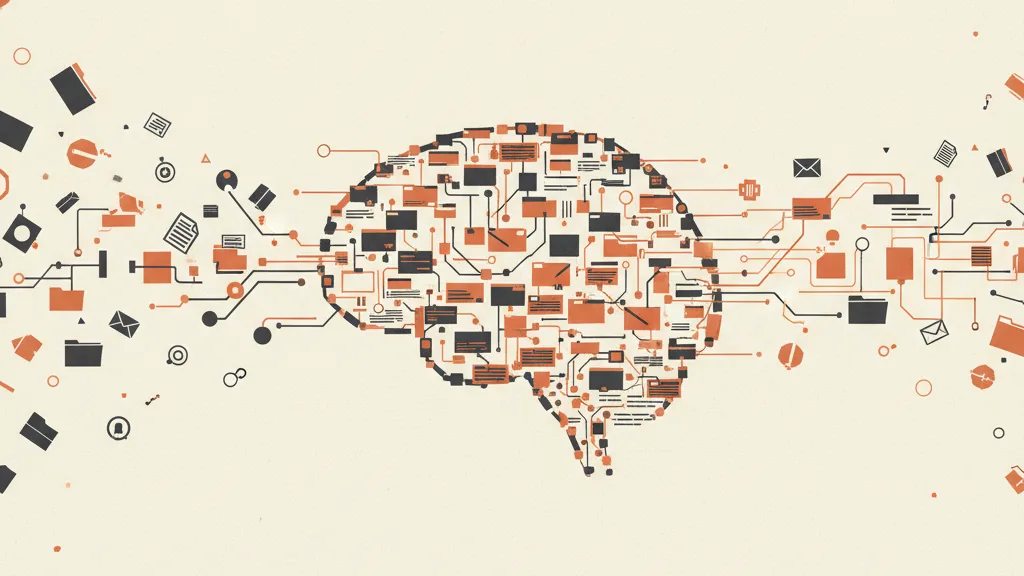
The advantage appears the moment AI reads your data
Back to the opening line, because it's the heart of everything: your AI is only as smart as what it can read about your company. The practical consequence is simple but heavy.
Take all the knowledge scattered across those three zones and bring it into a single system built to be navigated by an AI, and that same win-back email stops being generic. The AI knows who that customer is, what they bought, why they stopped, which offer fits their profile, what tone to use with them. The quality of the answer changes radically, not because the model is different, but because it finally knows what it's talking about.
This is where the competitive gap opens up. Established companies, the ones that already have processes, customer history, and accumulated knowledge, are, paradoxically, the ones who get the highest return from AI: they have more "gold" to feed it. A startup trying to break into your market starts with a data deficit it can't close with a better prompt. If you keep feeding your company brain, that gap widens every month. This is the idea behind company data as the new oil.
Compounding returns: a curve that pulls away
The mechanism works like compound interest. The more the system knows about the company, the better the answers. The better the answers, the more the team uses it. The more it's used, the more knowledge flows into the system. And so the answers keep improving. Companies with a company brain watch their productivity curve pull away and climb, while those using generic AI like everyone else stay flat at zero. This is the subject of the compounding returns of a second brain.
Why the window is open right now: the arbitrage
There's an arbitrage window open at this exact moment. Arbitrage in the literal sense: the gap between what you can do today and what the market will realize it needs to do tomorrow. Whoever builds their company brain now accumulates an advantage that compounds over time. As awareness spreads and everyone else catches on, that window closes.
This isn't early-adopter talk for its own sake. It's math: an advantage that grows through compounding, if you start it earlier, starts from a higher base and pulls further ahead of whoever comes later. Waiting for "the technology to mature" in this case means handing months of compounding to the competitor who started before you. We wrote about this in why it pays to adopt a second brain now.
Want to see how much competitive advantage you can pull from the data your company already produces? Request an assessment: we'll map out where your knowledge lives today and how to make it usable by AI.
How a company brain works, at a high level
You don't need to know how to build it. You need to understand why it works, so you can evaluate it like you would any other investment. Here are the key concepts, no jargon.
Atomic notes: knowledge broken down and navigable
Company knowledge gets broken down into many small notes, one idea per note, all linked to each other. It's the same principle sociologist Niklas Luhmann used to write entire books with his roughly 90,000 interconnected index cards (the Zettelkasten method). Broken down this way, knowledge becomes reusable across different contexts and, crucially, navigable by an AI. We cover this in atomic notes for company knowledge.
Taxonomy and ontology: where the AI "reasons"
Taxonomy is how you file things. Ontology is how concepts connect to each other. It's this web of connections that lets the AI reason by moving between notes, instead of just matching keywords. It's the difference between an archive and a brain.
Single source of truth: the AI doesn't make things up
A well-built company brain has a canon, a single company truth. The AI doesn't pull from its imagination: it only reports facts present in the company's knowledge base. That's how you cut down on hallucinations, the flaw that scares off anyone who wants to use AI for serious work. We go deeper in a single source of truth for your company.
Living memory: the system updates itself
The brain feeds on daily conversations and work sessions, so knowledge grows on its own. That's what lets you ask "what did we decide with that client in March?" and actually get an answer, instead of a "let's dig through the emails." See the living memory of a company AI.
RAG: when documents number in the thousands
Once the notes pile up, RAG (retrieval-augmented generation) comes into play: a semantic search that finds only the genuinely relevant information, efficiently. As a rule of thumb: under 500 notes, content maps and an index are enough; between 2,500 and 20,000, you need embeddings and RAG; beyond 20,000, you need a full RAG pipeline. This is the part that makes the system scale, explained in RAG for your company knowledge base.
"What about my data?" The right question, with an uncomfortable answer
It's the most common objection, and it deserves an honest answer. The uncomfortable truth is that, in all likelihood, a lot of your company's data is already inside ChatGPT: pasted in by your employees, with no oversight, no governance, without you even knowing. That's the real exposure.
A governed company brain is, in practice, safer than that situation. Data handling runs on signed DPAs and GDPR compliance, and version control guarantees backups and a single up-to-date source even with many people working on it. It's not a "trust me": it's a structure that brings order to what's currently a free-for-all. We devoted a piece to GDPR and security for a second brain.
AI's limit: you can outsource everything except understanding
One last point, the most important one for understanding where the value actually sits. With AI you can outsource competence (it writes your code) and even thinking (it proposes architectures, strategies, drafts). But you can't outsource understanding. No model will understand your business in your place.
This is why designing a company brain isn't something you buy off the shelf. It needs a structure built around how you actually work: properly made atomic notes, a sensible ontology, quality controls, RAG sized to the real volume, compliance done right. It's a method, not a plugin. And it's exactly where a partner who's already done it earns the investment.
Where it matters most: some concrete scenarios
- Professional firms (lawyers, accountants): knowing everything about every client and every case, always at hand, without relying on any one person's memory. See a second brain for professional firms.
- Sales teams: no knowledge lost when a salesperson leaves, and much faster onboarding for new ones. Covered in a second brain for the sales team.
- SMBs and agencies: from a mess of scattered files to a single system everyone actually uses.
- Customer support and operations: consistent answers because they're drawn from one source of truth, not from whoever's interpretation is on shift.
If you're wondering whether your company is at the right stage to get started, we cover that in when a company is ready for a second brain. And if you want the full picture, the place to start is our guide on what a company second brain actually is.
In short
Using ChatGPT like everyone else keeps you stuck at zero: same answers, same advantage, meaning none at all. The leap happens when AI stops reading the internet and starts reading your company. Your data is the one thing your competitor can't copy, and a company brain is what makes it readable, secure, and able to compound value over time. The window to build it while it still gives you an edge is open right now. Whoever uses it today is already ahead tomorrow.
Frequently asked questions
Why doesn't using ChatGPT give me an edge over competitors?
Because without company context, the model answers with public knowledge, the same for everyone. You and your competitor, with the same subscription, get nearly identical answers. The advantage only appears once the AI works on your data: customers, history, processes, your way of doing things.
What does it mean that AI is only as smart as my data?
It means answer quality depends on what the AI can read about your company. A powerful model with no access to your knowledge stays generic. With a company brain that gathers and links your data, the answers become specific and genuinely useful to your business.
Why do established companies get more advantage from AI?
Because they already have processes, customer history, and accumulated knowledge, in other words more raw material to feed the AI. A startup trying to compete starts with a data deficit that's hard to close, while a company with a company brain keeps widening that gap over time.
What is this "arbitrage window" about?
It's the gap between what you can do today and what the market will realize it needs to do tomorrow. Whoever builds their company brain now accumulates an advantage that compounds over time. As awareness spreads, the window closes.
Is my company data safe in a system like this?
A governed company brain is safer than the typical situation, where data already ends up inside ChatGPT, pasted in by employees with no oversight. It's managed through signed DPAs, GDPR compliance, and version control for backups and a single source of truth. This is informational, not legal advice.
Can I build my own company brain in-house?
In theory yes, but it takes method: atomic notes, ontology, single source of truth, quality controls, properly sized RAG, and compliance. AI can take on competence and thinking for you, but not understanding your business. That's why a partner who designs the right structure speeds up results and avoids costly mistakes.
If you've realized the real advantage isn't in the model but in your data, the next step is designing the company brain that makes it readable to AI. Write to us at astraloopstudio@gmail.com: we'll tell you exactly where to start, no fluff.