How to Scale Enterprise Knowledge to Thousands of Documents
9 min read · AstraLoop Studio
There's a precise moment when a company's digital brain stops working the way it used to. It isn't at 50 documents, and it isn't even at 200. It happens somewhere around the thousands-of-files mark, when keyword search starts handing you ten useless results and burying the one you actually needed. At that point you don't have an organization problem. You have a scale problem. And scale is solved with a different architecture, not one more folder.
This article explains, at a high level and from a business standpoint, why growing document volumes demand semantic search and RAG (retrieval-augmented generation), and gives you rules of thumb to figure out where you stand. It isn't a technical tutorial. It's the map you need to decide if and when it's worth investing in serious, AI-driven document management.
The problem isn't having lots of documents. It's finding them
In almost every company, knowledge lives scattered across three zones. The first is made up of chats, emails, Slack messages and files forgotten in shared folders: information that technically exists but is, in practice, unrecoverable. The second lives in people's heads, where your top performer is worth their weight in gold while they stay and becomes a bottleneck (or a dead loss) the moment they leave. The third is spread across dozens of different tools — policy PDFs, revenue spreadsheets, vendor emails — that nobody uses in a coordinated way. We covered just how much this dispersion really costs in what scattered knowledge costs a company.
McKinsey estimates that roughly 19% of the work week, almost one day in five, is spent searching for information. It's an industry-level estimate, an order of magnitude rather than a precise figure, but it makes the point: a huge share of your best-paid people's time goes into reconstructing things the company already knows — it's just that nobody can find them fast enough.
As long as documents are few, the problem stays invisible. A well-built wiki, a good index and a bit of discipline are enough. It's when files reach the thousands that the traditional model breaks, and for a technical reason that's worth understanding.
Why keyword search collapses at scale
Classic search looks for literal matches. If you type "vacation," it finds documents that contain the word "vacation." But if the right document talks about "time off," "paid leave" or "scheduled absences," it won't find it — even though that's exactly what you needed. With a handful of files you can compensate manually. With thousands of files it becomes impossible: either you get hundreds of results, or you get zero, and either way you've lost time.
Semantic search reasons by meaning, not by exact words. It converts every piece of text into a numerical representation (an "embedding") that captures what it's about, and when you ask a question it looks for the content closest in meaning, not in spelling. That way, "how do days off work?" and "vacation policy" end up close together even though they share no words at all. This is the capability that lets an AI actually navigate a company's knowledge instead of doing a glorified "find in text."
What RAG is, without the jargon
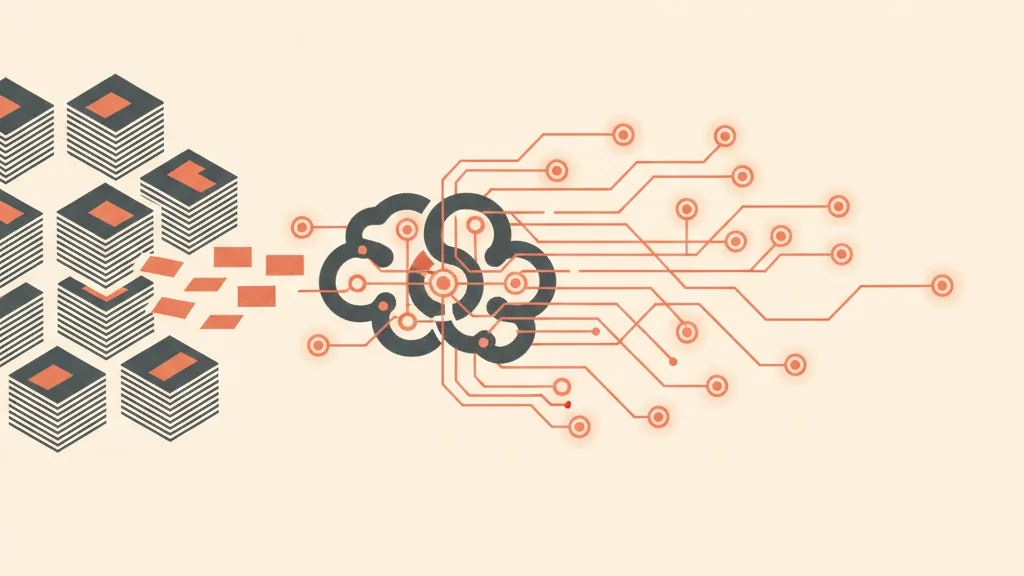
RAG stands for "retrieval-augmented generation." The concept is simple: before answering, the AI first retrieves from your knowledge base only the few documents (or document chunks) truly relevant to the question, and then generates its answer based on those. It doesn't try to "remember" everything by heart — impossible with thousands of files — it fetches the right context on the fly and reasons over it.
The practical benefit is twofold. First, scale: you can have tens of thousands of documents and the AI only consults the handful it needs, efficiently. Second, reliability: the AI answers based on your facts, not on whatever it generically learned from the internet, which meaningfully cuts down on hallucinations. We wrote a deeper piece on how this becomes the foundation of company memory in RAG and enterprise knowledge bases.

Rules of thumb by size: where are you?
Not every company needs a full RAG pipeline from day one. In fact, building one too early is a waste. The golden rule is to size the architecture to the actual amount of knowledge you have. Here are some indicative orders of magnitude — read them as rough thresholds, not sacred numbers.
| Volume of notes/documents | What you actually need | What you don't need yet |
|---|---|---|
| Under ~500 | Content maps and a good index. Clear structure, links between notes. | Embeddings and RAG are overkill: they add complexity with no real benefit. |
| ~2,500 - 20,000 | Embeddings and semantic search (RAG). A manual index no longer holds up; you need retrieval by meaning. | You don't need heavy orchestration yet, but the foundations need to be designed well. |
| Over ~20,000 | A full RAG pipeline: retrieval, filters, quality management, continuous updating. | Nothing to postpone: at this scale, improvising costs more than the system does. |
The message isn't "buy the biggest technology available." It's the opposite: knowing which bracket you fall into tells you exactly how much to invest, and how much not to. A company with 300 documents being sold an enterprise RAG pipeline is throwing money away. A company with 15,000 documents still relying on a shared folder is losing a day a week per person. If you want a cold, data-based read on whether you're ready, we cover it in when a company is ready for a second brain.
Atomic notes: knowledge has to be broken down to scale
There's a structural principle that makes everything else possible. Knowledge has to be broken down into many small units — one idea per unit — all interlinked. These are called atomic notes. It's the same principle sociologist Niklas Luhmann used with roughly 90,000 interlinked index cards (the Zettelkasten method) to write entire books by drawing on his notes.
Why does this matter for AI? Because an atomic block is reusable across different contexts and easy to retrieve with precision. If your "knowledge" is an 80-page PDF, the system either hands you all of it or none of it. If instead it's made up of hundreds of well-linked atomic notes, the AI can pull exactly the right paragraph. We dedicated a whole piece to this in atomic notes for enterprise knowledge.
Above the notes sits the structure of the links. Here's where you distinguish between taxonomy (how you file things, which categories) and ontology (how concepts connect to one another). And it's precisely the ontology's web of connections that lets the AI "reason," moving from one note to another, instead of just finding isolated files.
Why this is a competitive edge, not an IT cost
Here's the point almost everyone underestimates. Your AI is only as smart as what it can read about your company. If you and your competitor both use plain ChatGPT with no company context, you get the exact same answers. That's baseline zero: no edge for either of you. A slightly better-written prompt doesn't move the needle.
The edge only appears once the AI works on your data. And this is where already-structured companies — the ones with processes, history and accumulated knowledge — start ahead: they're sitting on the gold, they just need to make it machine-readable. We wrote about this in company data is the new oil and in AI's competitive edge lives in your data.
There's also a time factor at play. Whoever builds their company brain now accumulates an edge that compounds: the system knows the company better, so it gives better answers, so it gets used more, so it learns even better. The curve of a company with a company brain pulls away from one using generic AI like everyone else. It's an arbitrage window that will close as awareness spreads — a theme we dig into in the compounding returns of a second brain.
Not sure which volume bracket you're in or how much to invest? Request an assessment: we'll evaluate your document knowledge together and tell you what you actually need.
Living memory and a single source of truth
Scaling to thousands of documents isn't just about searching better. It also means having a system that keeps itself up to date. A living memory absorbs day-to-day conversations and sessions, so you can ask "what did we decide with that client back in March?" and get the answer instead of digging through three different people's inboxes. We cover this in living memory for enterprise AI.
Underneath that sits the concept of a canon, or single source of truth: one company-wide truth the AI draws on, without making things up. As knowledge grows, having a single, versioned source (with a history) is what stops three departments from working off three different versions of the same policy. More on this in a company-wide single source of truth.
What about my data? The right question at the right time
Whenever the conversation turns to loading thousands of company documents into an AI system, the objection always comes up: "but what about the security of my data?" It's a fair question, and it has two honest answers.
The first is uncomfortable: a lot of your company data has already ended up in ChatGPT, pasted in by employees with zero oversight. A governed company brain, with clear boundaries and rules, is safer than that status quo — not less safe. The second is operational: it's managed with signed DPAs, GDPR compliance, and version control for backups and traceability. We devoted an entire article to the regulatory side in GDPR and the security of a second brain.
The limit of AI: outsourcing expertise, not understanding
One last thought, because it's the one that separates a project done well from one abandoned after three months. With AI you can outsource expertise (it writes the code for you) and thinking (it proposes an architecture for you). But you cannot outsource understanding: grasping how your business actually works remains your job. The right structure, the right categories, the right quality rules all depend on how your company genuinely operates.
That's why scaling intelligent document management well isn't a matter of buying a tool — it's a matter of designing a structure: atomic notes, ontology, quality controls, RAG sized to your real volume, compliance. That's exactly the work we do with companies, together, without selling enterprise pipelines to someone with 300 files or shared folders to someone with 20,000. The first step, as we cover in our pillar piece on the company second brain, is understanding where you stand today.
If document search inside your company has started to feel like a burden, you're probably in the bracket where RAG and semantic search stop being a luxury and become a necessity. It's worth checking against real data before you invest.
Frequently asked questions
When do you actually need RAG for document management?
As a rough order of magnitude: under ~500 notes, a good index and content maps are enough. Between roughly 2,500 and 20,000 documents you need embeddings and semantic search (RAG). Beyond 20,000 you need a full RAG pipeline. These are approximate thresholds to adapt to your real situation.
What's the difference between semantic search and keyword search?
Keyword search looks for literal matches: if you search for "vacation" it won't find a document about "time off." Semantic search reasons by meaning, so it connects different terms that refer to the same thing. With thousands of documents, semantic search becomes indispensable.
Does RAG reduce AI-generated made-up answers?
Yes, significantly. With RAG, the AI answers based on company documents that were actually retrieved, not on generic knowledge. Grounded in an internal source of truth (the canon), it tends to report facts that actually exist in the company instead of inventing them, cutting down on hallucinations.
Why break documents down into atomic notes?
Because an atomic note (one idea per note) is reusable across different contexts and can be retrieved with precision. An 80-page PDF either gets handed to you whole or not at all; hundreds of well-linked notes let the AI pull exactly the right paragraph.
Is it safe to upload company documents into an AI system?
A governed company brain is safer than the typical status quo, where employees are already pasting data into ChatGPT with no oversight. It's managed with signed DPAs, GDPR compliance, and version control for backups and traceability. This is informational, not legal advice.
How much time is wasted searching for information at work?
According to a McKinsey estimate, roughly 19% of the work week, almost one day in five, is spent searching for information. It's an industry-level order of magnitude, but it illustrates how much scattered knowledge really costs in practice.
If document search at your company has become a bottleneck, talk to us: we design and manage the right structure, sized to your real volume.