How a Company Second Brain Actually Works
8 min read · AstraLoop Studio
You've probably heard of a "second brain" or "company brain" already, but you're still not quite sure what's actually happening under the hood. This article is for you. I won't walk you through installing software or which tool to download. I'll explain how it works at a conceptual level, and above all why the way it works is exactly what makes it useful to your company.
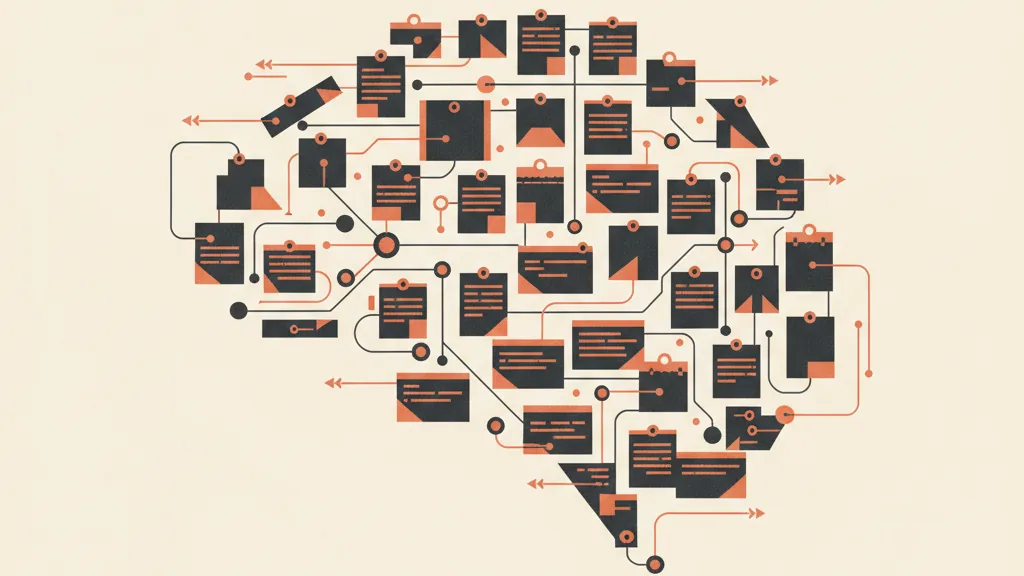
Let's start with an honest definition. A company second brain is a large, interconnected archive of your company's knowledge, built not to be read by a human scrolling through folders, but to be navigated by an artificial intelligence. The difference from a wiki or a shared drive is substantial: a wiki is static, a second brain is alive. The more you use it, the more it knows about your company, and the better the answers it gives you become.
The problem it solves: knowledge scattered across three places
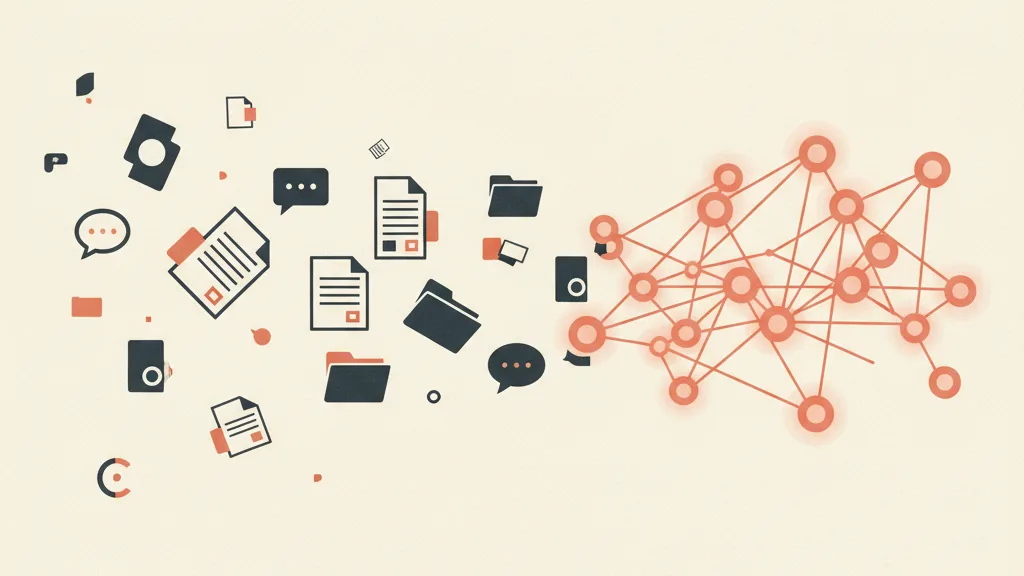
Before getting into how it works, it's worth framing the problem. In every company, knowledge lives in three zones, and none of the three is really accessible.
- In documents and chats. Emails, Slack threads, files on Drive, policy PDFs. Information written down once and then effectively unrecoverable: you know the answer is "somewhere," but finding it costs time.
- In people's heads. Your top performer is worth their weight in gold, but if they leave, they take the knowledge with them. It slows onboarding down and becomes a bottleneck that holds back growth, because everyone has to ask them.
- Scattered across dozens of different tools. A revenue spreadsheet, supplier emails, an ERP, a CRM. Each one lives on its own, and nobody uses them in a coordinated way.
The cost of this fragmentation isn't theoretical. According to a McKinsey estimate, roughly 19% of the work week (nearly one day out of five) goes into searching for information. It's an order of magnitude, not an absolute truth, but it makes the point: a fifth of the time you pay your employees for is spent just finding things the company already knows. We covered this in depth in the article on the cost of scattered knowledge in a company.
How it works, in four concepts
A second brain isn't magic, and it isn't a single algorithm. It's a well-thought-out structure. Four concepts are enough to understand what makes it work and why it creates value.
1. Atomic notes: one idea per note, all linked together
Instead of long, monolithic documents, knowledge gets broken down into many small notes: a single idea per note, each one self-contained and linked to the others. This isn't a recent invention. Sociologist Niklas Luhmann wrote his books using about 90,000 interconnected index cards, the famous Zettelkasten method.
Why does this matter for an AI? Because knowledge broken into small, connected units becomes reusable across different contexts, and above all, navigable. The AI can jump from one note to another by following the links, exactly the way you follow a line of reasoning. If you want to go deeper, you'll find it all in the dedicated article on atomic notes for company knowledge.
2. Taxonomy vs. ontology: the real intelligence lives in the links
Here's the distinction that makes the difference. Taxonomy answers the question "where do I file this?" — the classic folder hierarchy. Ontology answers a different question: "how do these concepts connect to each other?"
It's precisely this network of connections that lets the AI "reason" by moving between notes. A folder tells you where a file is. An ontology tells the AI that this client is linked to this case, which in turn is linked to a decision made back in March, which depends on that policy. The value isn't in archiving — it's in connecting.
3. Canon: a single company truth
The canon (or single source of truth) is the principle that there is one official version of the company's truth. When the AI works from a well-defined canon, it doesn't make things up: it only reports facts that actually exist in the company's knowledge base.
This is what solves the number one fear people have when evaluating AI: the famous "hallucinations." A generic model fills gaps by inventing. A model anchored to a company canon either doesn't answer when it doesn't know, or points you to the source. We go deeper on this in the article on the company single source of truth.
4. Living memory: the system updates itself
A well-built second brain isn't an archive you fill in by hand every time. It's a living memory: it updates itself through everyday conversations and work sessions. That's how you can ask "what did we decide with that client back in March?" and actually get an answer — because that decision was captured while you were working, not archived months later by someone who remembered to do it.
It's the difference between a warehouse and an organism. One stores things, the other grows. We talk about this at length in the article on the living memory of company AI.
Why "how it works" is also "why it pays off"
Here's the part that often gets missed. How a second brain works isn't a technical detail: it's the very reason it produces a competitive advantage.
The rule to keep in mind is simple: your AI is only as smart as what it can read about your company. If you and your competitor use the same generic tool, with no company context, you get the same answers. That's baseline zero, no advantage at all. A slightly better prompt won't save you. The advantage only comes when the AI is trained on your data, your processes, your history with your customers.
That's why people say data is the new gold. Companies that are already well-structured, with accumulated processes and knowledge, are also the ones who'll get the best return from AI. A startup trying to compete starts with a data gap that you, with your company brain, keep widening every day. This is the theme we develop in the article on the competitive advantage of company data and in the one on company data as the new oil.
The compounding-returns mechanism
There's a self-reinforcing effect worth visualizing:
- The brain gets to know the company better.
- So it gives better answers.
- So the team uses it more.
- So the knowledge captured keeps growing.
The curve of a company with a company brain diverges upward compared to one using generic AI like everyone else. Whoever builds it now accumulates an advantage that compounds over time, which is exactly why the moment you start matters. We talk about this in the article on the compounding returns of a second brain and in why adopt a second brain now.
Want to see what a second brain built on your company's own data would look like? Request an analysis: we'll show you where your knowledge lives today and what would change with AI trained on it.
What happens when the notes number in the thousands?
Fair question: if you break everything down into thousands of small notes, how does the AI avoid getting lost? The answer is called RAG (retrieval-augmented generation). In plain terms, once there are too many documents, the system stops reading everything every time: it uses semantic search to pull only the information relevant to the question, efficiently.
As a rough rule of thumb (orders of magnitude, not hard thresholds):
| Number of notes | What's needed |
|---|---|
| under ~500 | content maps and a good index are enough |
| ~2,500 - 20,000 | embeddings and RAG are needed |
| over 20,000 | a full RAG pipeline is needed |
You don't need to know how to implement it. You just need to know the system scales, and that at a certain point the underlying technical structure matters. We've dedicated a piece to RAG for the company knowledge base and one to how to scale company knowledge with AI.
"What about my data?" The right question to ask
It's the first objection you hear in every meeting, and it's a fair one. Two honest points.
First: a lot of company data has already ended up inside generic tools, pasted in by employees into chats with zero oversight (the "shadow AI" phenomenon). A governed company brain, with clear rules, is paradoxically safer than this de facto situation. Second: compliance is handled with standard tools — signed DPAs, GDPR adherence, and version control to keep backups and a single up-to-date source. We go into the regulatory side in the article on GDPR and second brain security.
One principle to hold onto: you can outsource the work, not the understanding
With AI you can outsource skill (writing code) and even thinking (proposing architectures). But you can't outsource understanding your business. You need someone who truly understands how your company works to design the right structure: which notes matter, how they should connect, what counts as canon and what doesn't.
This is exactly what separates a second brain the team actually uses every day from yet another archive nobody opens. It's not a question of which tool — it's a question of method. If you're wondering whether your company is at the right point to get started, read when a company is ready for a second brain.
Where it creates real value
- Professional firms. Lawyers and accountants with every client's and case's history always within reach, without digging through a thousand folders.
- Sales teams. No knowledge lost when a salesperson leaves, and much faster onboarding for new hires.
- SMEs and agencies. From chaos of scattered files to a single, queryable system.
- Customer support and operations. Consistent answers, because they're all drawn from the same canon.
If you want the big picture, the starting point is the cluster's pillar article: what a company second brain is. And if you're wondering whether to build it in-house or hand it to a partner, we cover that in second brain: build it yourself or hire an agency.
In short
A company second brain works by breaking knowledge down into linked atomic notes, letting AI navigate the connections, anchoring everything to a canon as the single source of truth, and maintaining a living memory that grows with use. The "how it works" is also the "why it pays off": this exact architecture is what turns generic AI, the same for everyone, into a competitive advantage that compounds over time. The hard part isn't understanding it — it's designing and maintaining it well. Which is exactly what we do.
Frequently asked questions
What's the difference between a second brain and a normal company wiki?
A wiki is static: someone writes pages that then stay put. A second brain is built to be navigated by an AI, with linked atomic notes and a memory that updates itself through everyday work. The more you use it, the better it knows your company.
How does the AI avoid making up answers with a second brain?
Thanks to the canon, the single source of company truth. The AI only reports facts that actually exist in the company's knowledge, and when the information isn't there, it doesn't invent it: it points to the source or flags the gap. That's the mechanism that reduces hallucinations.
What are atomic notes?
They're small notes that each hold a single idea, all linked to one another. Breaking knowledge into small, connected units makes it reusable across different contexts and navigable by the AI, which jumps from note to note following the links.
Does an SME need a second brain, or is it just for big companies?
It matters most for companies that are already well-structured, with accumulated processes and knowledge: they're the ones who get the best return. But an SME or agency benefits too, moving from a chaos of scattered files to a single, queryable system.
Is my data safe inside a second brain?
A company brain governed by clear rules, signed DPAs, GDPR compliance, and version control is safer than the typical situation, where data ends up in generic chats with zero oversight. Governance is exactly what increases security.
Do I need to understand the technical side (RAG, embeddings) to use it?
No. You just need to know the system scales: under a few hundred notes, simple indexes are enough; beyond the thousands, RAG is needed to surface only the relevant information. The technical design is handled by whoever builds the system for you.
Designing and maintaining a company brain well takes method, not a tool downloaded on a whim. Talk to us: we'll analyze your company's knowledge and tell you where to start.