AI Second Brain vs Wiki and Notion: What's the Difference
10 min read · AstraLoop Studio
If you already have a company knowledge base (an internal wiki, a well-kept Notion workspace, a Drive with tidy folders), it's fair to wonder why you'd need anything else. The documentation is there, the processes are written down, onboarding has its own pages. Everything looks fine.
The problem is that these tools were built for one thing only: to be read by a person. A colleague opens the right page, reads it, interprets it. That works as long as a human is doing the searching and connecting. The moment you want an AI to do the reading and reasoning, the rules change. And so does what you actually need.
In this article we look at the concrete difference between a wiki (or Notion, or shared folders) and a company second brain built for AI. Why the former isn't enough anymore, and what makes the latter a competitive edge instead of just one more archive.
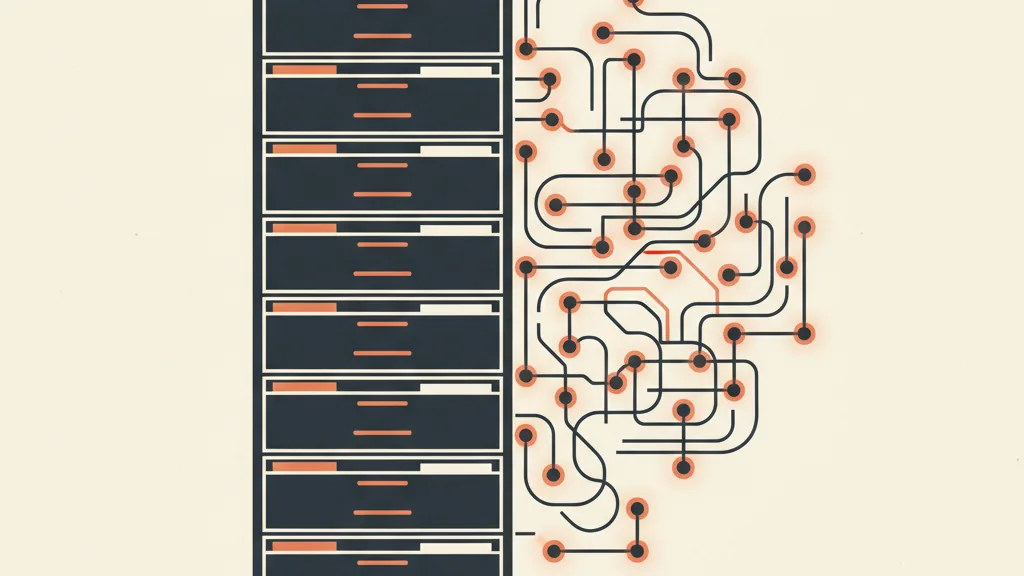
Wikis, Notion, and folders: great archives, poor brains
A wiki or a Notion workspace is a container. It does exactly what it was built for: it stores documents, organizes them into a hierarchy of pages and folders, and makes them searchable with a search bar. For a team of people, that works well. The limit shows up when you ask a different question: what if I wanted an AI to use this knowledge on my behalf?
Here's what happens when you try that with a traditional wiki.
- Knowledge is chunked too large. A wiki page mixes ten different concepts: policy, exceptions, examples, historical notes. A human scans it and finds the piece they need. An AI, on the other hand, struggles to isolate the relevant information when it's buried inside a wall of text.
- Links are for the eye, not for logic. Links between pages say "this page points to that one," but they don't explain why two concepts are connected. AI can't reason its way between ideas if the ideas aren't structured to be traversed.
- Search runs on keywords. If you search "returns" but the document says "refunds," you find nothing. Text search doesn't understand meaning, only the exact string.
- There's no single source of truth. The same information shows up on three different pages, sometimes with inconsistently updated values. A human can guess which one is correct. An AI just grabs the first one it finds, or blends them all together.
The point isn't that Notion or wikis are wrong tools. They remain useful, and as we'll see, they still have a place inside a second brain. The point is that they're a reading layer for people, not a system designed to let a machine reason.
Scattered knowledge: the real reason a wiki isn't enough
There's a second, deeper problem. Even the best-maintained wiki covers only a slice of a company's knowledge. In almost every business, know-how lives in three zones, and only one of them ever makes it into the wiki.
- In scattered documents and chats. Decisions made in a Slack thread, a clarification sent by email, a spreadsheet with revenue by client. Material no one will ever transcribe into a wiki page, and that becomes practically unrecoverable a few months later.
- Inside people's heads. Your best salesperson knows how to handle that difficult client. The operations lead knows the unwritten exceptions. It's valuable knowledge that walks out the door with the person, and it's what makes onboarding a new hire slow and painful.
- Scattered across dozens of tools. Policy PDFs, CRM, ERP, supplier emails. Every piece of information sits in its own silo, with nothing connecting them.
A wiki, by definition, only captures the first type, and only when someone bothers to write it down. The cost of this fragmentation is real and measurable. According to a McKinsey estimate, on average roughly 19% of the work week (nearly one day out of five) goes into searching for information. Not producing it: searching for it. Take it as an order of magnitude rather than gospel, but the point stands: the knowledge exists, it's just hard to retrieve.
The risk of losing knowledge when a key person leaves the company is even more insidious, because it never shows up on any balance sheet until it's too late.
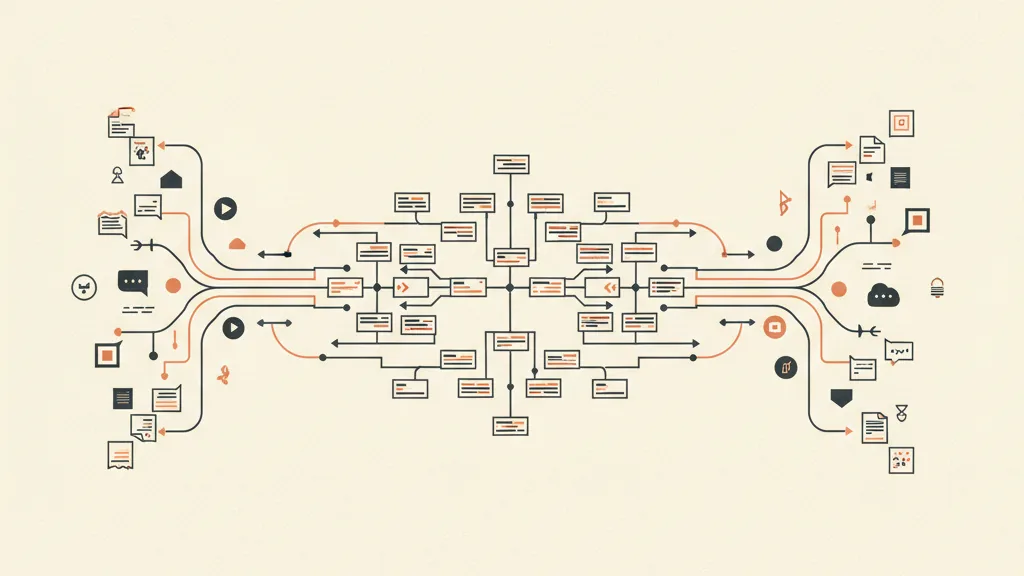
What a second brain does that a wiki doesn't
A second brain (or company brain) is a large, interconnected digital brain that gathers a company's knowledge and structures it so that an AI can read and navigate it. The difference isn't in the content (it's often the same) but in how it's organized. Here are the four elements a wiki lacks, explained at a high level.
Atomic notes instead of monolithic pages
In a second brain, knowledge is broken down into many small atomic notes: one idea per note, all interconnected. It's the same principle sociologist Niklas Luhmann used to write his books, with roughly 90,000 linked index cards (the Zettelkasten method). Breaking knowledge into small units makes it reusable across different contexts and, crucially, navigable: the AI finds exactly the concept it needs, not a 4,000-word page with that concept buried inside.
Ontology: links that actually mean something
A wiki has a taxonomy (how things are filed: folders, categories, tags). A second brain adds an ontology: how concepts connect to each other, and why. It's this web of meaningful connections that lets an AI "reason" by moving from one note to the next, rebuilding a logical path instead of reading isolated pages.
Canon: a single source of truth
A second brain has a single source of truth, one company-wide version of reality. The AI doesn't invent anything, it only reports facts present in the company's knowledge base. That's the mechanism that curbs hallucinations: if a piece of data doesn't exist, it isn't made up, and if it does exist, it's pulled from one updated source instead of three inconsistent pages. A wiki, with its duplication, pulls in the opposite direction.
Living memory that grows on its own
A wiki is static: it only grows when someone sits down and writes. A second brain has a living memory that updates itself from everyday conversations and work sessions. So you can ask "what did we decide with that client back in March?" and get the answer, because the system captured the decision while you were working, with no one needing to document it by hand.
| Aspect | Wiki / Notion / folders | Second brain for AI |
|---|---|---|
| Built for | Being read by people | Being read and navigated by AI |
| Unit of knowledge | Long, multi-concept pages | Atomic notes, one idea each |
| Links | Visual links between pages | Ontology with logical meaning |
| Search | Exact keyword matching | Semantic (by meaning) |
| Truth | Duplicated, sometimes inconsistent | Single source (canon) |
| Updates | Manual, whenever someone writes | Living memory that grows with use |
The real reason it pays off: your AI is only as smart as what it can read
This is the heart of the matter. One sentence to remember: your AI is only as intelligent as what it can read about your company.
If you and your competitor both use ChatGPT the same way, with no company context, you get the same answers. That's the baseline: no competitive edge for either of you. A slightly better prompt doesn't change the game. The real advantage only shows up when the AI works on your data, your knowledge, your way of doing things.
That's exactly why a wiki "for humans" doesn't give you that edge, while a second brain does. Company data is the new gold, and structured companies (the ones that already have processes and accumulated knowledge) are the ones that will get the best return from AI. A startup trying to compete starts with a data gap that you, with your company brain, keep widening.
There's also a compounding-returns dynamic at play: the brain knows the company better, so it gives better answers, so it gets used more, so it accumulates even more knowledge. The curve for a company with a company brain diverges upward compared to one using generic AI like everyone else. A static wiki doesn't trigger that loop; a system built for AI does. That's why it makes sense to move now: there's an arbitrage window that will close as market awareness grows.
Want to find out if the knowledge you already have (wiki, Notion, folders) can become a real company brain for AI? Request an assessment: we'll design, build, and manage it for you.
What about my data? Governance gets safer, not riskier
The most common objection when it comes to feeding company knowledge to an AI is always the same: "what about the security of my data?" It's a fair question, with two honest answers.
First: a lot of company data has already ended up in ChatGPT, pasted in by employees in chats with zero oversight. A governed company brain is safer than the status quo, not riskier, because it centralizes and controls what's currently floating around uncontrolled.
Second: handling data correctly in a second brain means signed DPAs, GDPR compliance, and version control, which guarantees backups and a single, up-to-date source of truth even when a whole team works on it. It's not a leap into the unknown. If anything, it's putting order and rules where there weren't any before.
How far it needs to scale: from maps to RAG
A practical concern: "but if I have thousands of documents, how does the AI avoid getting lost?" This is where RAG (retrieval-augmented generation) comes in, letting the system scale to large volumes by efficiently surfacing only the relevant information through semantic search. As a rough order of magnitude:
- Under ~500 notes: content maps and a good index are enough.
- Between ~2,500 and 20,000 notes: you need embeddings and RAG for semantic search.
- Above 20,000 notes: you need a full RAG pipeline.
These are indicative thresholds, not hard rules, but they explain well why a traditional wiki can't hold up at scale: its keyword search doesn't get better as documents pile up, it gets worse. A second brain, by contrast, is built to scale knowledge while keeping answers precise.
Who benefits the most
The jump from wiki to company brain is felt especially strongly in a few contexts.
- Professional firms (lawyers, accountants): having the full picture of every client and every matter always at hand, instead of rebuilding it from scratch each time. See the case for second brains for professional firms.
- Sales teams: no knowledge lost when a salesperson leaves, and a much faster onboarding. Read more on the second brain for sales teams.
- SMBs and agencies: from a mess of scattered files to a single system. See the take on SMBs and agencies.
The part that doesn't go away: AI can't outsource understanding
With AI you can outsource skill (it writes code, drafts copy) and even thinking (it proposes architectures and solutions). But you can't outsource understanding your own business. Someone has to understand how your company works to design the right structure: which atomic notes, which ontology, which quality controls, where RAG is needed, how to handle compliance.
And this is exactly where a wiki and a second brain part ways for good. You fill a wiki however it comes. A company brain requires method, and it's that method that turns it into a competitive edge instead of one more forgotten archive. At AstraLoop Studio, we design it, build it, and manage it for you, starting from the knowledge your company already has. If you want to know whether the timing is right for you, start with what a company second brain is and when a company is ready.
Frequently asked questions
Can Notion be a company knowledge base for AI?
Notion works great as a visual layer for the team to use the system, and it often keeps its place inside a second brain. On its own, though, it's still an archive built for people: it lacks the atomic-note structure, the ontology, and the semantic search an AI needs to reason over the data.
What's the main difference between a wiki and a second brain?
A wiki is built to be read by people, a second brain to be read and navigated by AI. Everything changes: atomic notes instead of long pages, links with logical meaning, a single source of truth, and a memory that grows with use.
Do I need to ditch my current wiki or Notion setup?
No. The knowledge you already have is valuable material to reuse, and tools like Notion can stay on as a visual layer for the team. A second brain reorganizes and connects that knowledge so an AI can actually put it to work.
Is a second brain riskier for my data than a wiki?
In practice it's safer. A lot of company data already ends up in ChatGPT with no oversight: a governed company brain with signed DPAs, GDPR compliance, and version control puts order and rules where there weren't any before.
How many documents before I need RAG?
As a rough order of magnitude: under ~500 notes, maps and a good index are enough; between ~2,500 and 20,000, you need embeddings and RAG; above 20,000, you need a full RAG pipeline. These are indicative thresholds, not hard rules.
Why does a second brain give a competitive edge and a wiki doesn't?
Because your AI is only as intelligent as what it can read about your company. A second brain trains it on your data and triggers compounding returns (more use, more knowledge, better answers). A static wiki doesn't put the AI to work on your data and stays just an archive.
If you have a wiki or a Notion workspace but want to turn it into a system an AI can actually use, let's talk: we'll work out together the right starting point and structure for your company.