RAG and Enterprise Knowledge Base: The AI That Reasons Over Your Internal Data
10 min read · AstraLoop Studio
You know that chatbot on a website that always replies "I didn't understand your question, try rephrasing"? That thing doesn't reason. It recites. Someone wrote out a list of questions and answers by hand, and the bot fetches whichever one looks closest to what you typed. If your question isn't on the list, the bot has nothing to say.
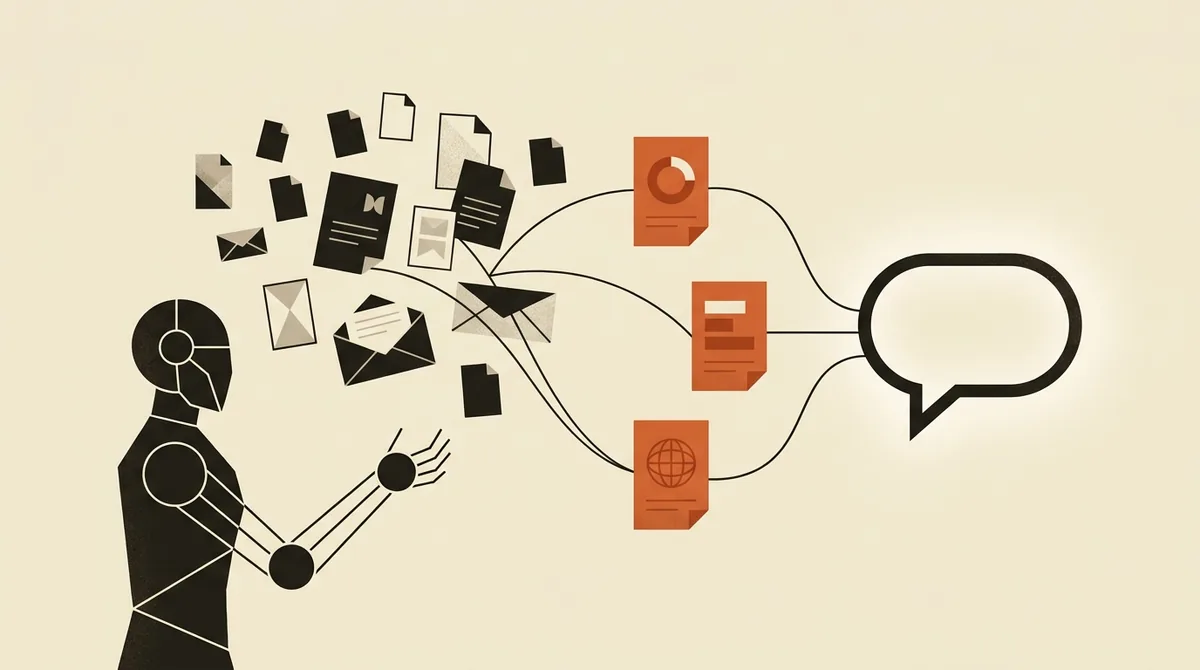
An agent built on RAG works differently. It reads your company documents (price lists, manuals, contracts, procedures, ticket history) the moment the question comes in, finds the pieces that matter, and reasons over them to build the answer. No canned replies: it reasons over your real, up-to-date data. That's the difference that moves an AI project from toy to working tool, and it's one of the core building blocks when we talk about business process automation with AI.
In this guide I'll explain what RAG is without the jargon, why an enterprise knowledge base is the piece most chatbots are missing, and how to figure out if you actually need one or if a simple FAQ will do.
The problem: why classic chatbots fall short
Models like ChatGPT or Claude are trained on an enormous amount of public text, but there are two things they know absolutely nothing about: facts that came after their training cutoff, and your internal data. The model has no idea what your current price list looks like, what the contract terms are with a specific client, or what the return policy you revised last week actually says.
Ask a "pure" model questions about your company and one of two things happens. Either it honestly tells you it doesn't know, or — the dangerous case — it makes something up. In the jargon this is called a hallucination: the model produces an answer that's plausible and well written but completely false. For a business, a wrong answer delivered confidently to a customer is worse than no answer at all.
Companies have tried to plug this gap in two ways, both imperfect.
The FAQ chatbot (hand-written rules)
This is the most common approach. An operator writes out a list of frequently asked questions with ready-made answers. The bot compares the user's question to the list and returns the closest match. It works as long as the customer uses roughly the expected words. It's cheap, but rigid: every time a price or a procedure changes, someone has to update the answers by hand, and any question outside the script sends the whole thing off the rails.
Fine-tuning (retraining the model)
This means "re-stitching" the model onto your data. It's technically possible, but for most small and mid-sized businesses it's the wrong path: expensive, slow, and every time your data changes you have to retrain. It's like printing the entire company encyclopedia into the model's memory — when one page changes, you reprint the whole book.
RAG solves both limitations with a simple idea.
What RAG is, explained with an analogy
RAG stands for Retrieval Augmented Generation — retrieval-boosted generation, in plain terms: first I fetch the right information, then I generate the answer based on it.
Picture a highly competent but forgetful consultant. They haven't memorized your documents. But when you ask them a question, before answering they go check your archive, pull the three or four relevant documents, read them, and only then answer you, citing what they just read. They don't make things up, because the source is right in front of them. And if you update a document in the archive tomorrow, their next answer changes accordingly, with no need to "retrain" anyone.
RAG does exactly this, in three steps:
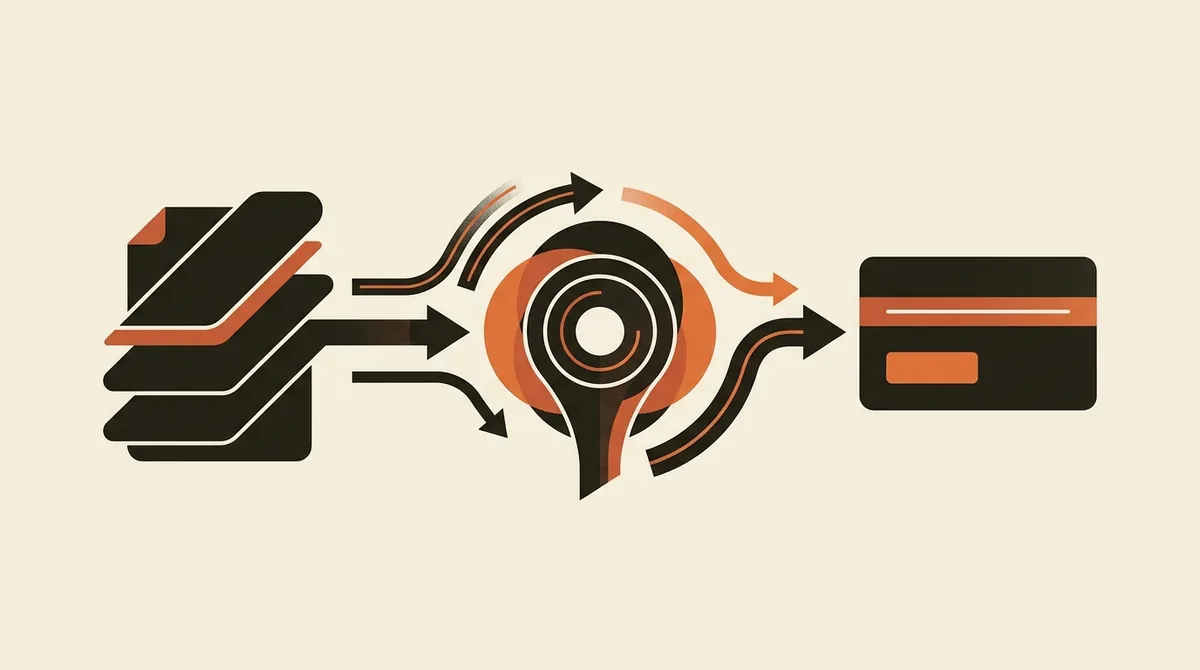
- Retrieval: the system searches your knowledge base for the text chunks most relevant to the question it received.
- Augmentation: those chunks are passed to the AI model together with the question, as reference context.
- Generation: the model writes the answer based on that context, not on its generic memory.
The result: answers grounded in your real, current data, with the ability to cite the source ("I got this from the Returns Policy document, March 2026 version").
What an enterprise knowledge base is and where it comes from
The knowledge base is your company's archive of knowledge, made queryable by AI. Here's the thing: in most companies this knowledge already exists, but it's scattered — PDFs on a drive, emails in a colleague's inbox, procedures in a Word file, answers already given over the years in support tickets, price lists in some management system.
Building a RAG knowledge base means gathering these sources and preparing them. The key technical step is called indexing: documents get split into pieces (chunks), each chunk gets turned into a numerical representation (an embedding) that captures its meaning, and these are stored in a vector database. You don't need to understand the math. Just the idea: the system learns to find things by meaning, not by exact wording. If you ask "can I return a broken product", it finds the document about "defects and complaints", even if it never contains the word "return".
Typical sources for a small business knowledge base:
- Product manuals and spec sheets
- Up-to-date price lists and commercial terms
- Internal procedures and policies (returns, warranties, shipping)
- Support ticket history (a goldmine — these are real questions already solved)
- Contracts and tender documents (for internal, confidential use)
- Existing FAQs and website content
Static FAQ vs RAG agent: the honest comparison
To understand when you actually need a RAG and when you'd be overspending, compare the two approaches on the factors that matter.
| Aspect | Static FAQ chatbot | RAG agent on a knowledge base |
|---|---|---|
| Source of answers | Hand-written list | Your real documents, read on the fly |
| Off-script questions | "I didn't understand" | Reasons and tries to answer from the sources |
| Updating | Manual, one answer at a time | Just update the document in the archive |
| Risk of making things up | None (but limited coverage) | Low, if well configured with source citation |
| Cites the source | No | Yes, can point to which document |
| Starting cost | Low | Medium (indexing plus setup) |
| Ideal for | 10-20 stable questions | A broad, evolving knowledge base |
The practical rule: if your questions are few, stable, and never change, a well-made FAQ is enough and cheaper. If the knowledge base is large, changes often, and customers (or employees) ask unpredictable questions, RAG pays off. It's the same logic as the comparison between a simple chatbot and an AI agent: what changes is the level of autonomy and reasoning.
From "answering" to "doing": when RAG becomes an agent
Here's the leap that happens in 2026. A RAG that only answers is already useful, but the real breakthrough is when data retrieval becomes a tool in the hands of an operational AI agent. The difference is between an AI that talks and an AI that acts.
Take a concrete customer service example. A customer writes "my order 4821 still hasn't arrived, what do I do". A pure RAG cites the shipping policy. A RAG agent, instead:
- Retrieves the delay policy from the knowledge base
- Queries the management system for the actual status of order 4821
- Checks the carrier's tracking via API
- Composes a specific answer ("your package is in transit, delivery expected tomorrow, here's the link")
- If the policy allows it, opens a partial refund ticket
RAG supplies the knowledge, the agent adds the actions. This is the approach behind AI-powered customer care automation that actually works, not a bot that bounces the customer to a form. The same applies internally: an employee asks the agent "how many vacation days do I have left and how do I request them", and the agent pulls the HR policy and checks the actual figure in the attendance system.
Want to find out whether a RAG agent genuinely pays off on your data, or whether a well-made FAQ is all you need? Request a free assessment of your case: we'll look at your document sources and tell you the sensible path, without pushing the more expensive project.
Governance: RAG isn't set-and-forget, it needs supervision
This is the part almost nobody talks about, and where projects fail after launch. A RAG agent in production isn't an appliance you switch on and forget. It needs supervision, because it will get things wrong, and you need to know when and how.
RAG hallucinates less, but not never
Grounding answers in documents drastically reduces made-up answers, but doesn't eliminate them. If the knowledge base contains an old document that was never removed, the agent will cite outdated information in perfectly good faith. The quality of the answers is the quality of your archive: garbage in, garbage out. Maintaining the document base (removing the old, adding the new) is ongoing work, not a one-off project. It's one of the main reasons so many AI projects fail: everyone cares about the launch and neglects what comes after.
What to put in place from day one
- Conversation logs: to understand what users are asking and where the agent struggles.
- Source citation: every answer should indicate which document it came from, so it can be checked.
- Escalation to a human: when the agent can't find an answer with enough confidence, it should hand off to a person rather than improvise.
- Access control: if the knowledge base contains contracts or confidential data, the agent must not expose them to anyone unauthorized.
Internal data and compliance
If you feed company documents to the AI, some of them contain personal data (customers, employees). You need to know where that data ends up: does the model provider use it for training? Does it stay in Europe? With a self-hosted setup (for example orchestrated with n8n, which you can install on your own servers) you keep control of the data, which matters for GDPR. You'll also need a data processing agreement (DPA) with the LLM provider. This isn't legal advice, just a reminder: as of August 2, 2026, the AI Act (EU Regulation 2024/1689) is fully applicable and introduces obligations for small businesses too, including transparency around AI-generated content. If you want the operational checklist, start with our guide on AI Act obligations for small businesses.
What it costs and how to decide: build vs. buy
The options, from cheapest to most tailored:
- Ready-made SaaS platform: upload your PDFs, get a RAG chatbot. Indicative range: €50-300 per month. Fast, but with limits on customization, integrations, and where your data ends up.
- Self-hosted no-code solution: a RAG built with tools like n8n on your own infrastructure. Upfront setup cost, then low ongoing expenses and full control. A good compromise for a small business that cares about its data.
- Custom RAG agent: bespoke development with deep integrations into your ERP, CRM, and internal systems. Higher investment (from a few thousand to several tens of thousands of euros), justified when AI sits at the center of a core process.
The right question isn't "how much does it cost" but "how much is it costing me right now not to have it": staff hours spent answering the same questions over and over, customers lost to slow response times, mistakes from outdated information. If you want to put numbers to that assessment, our guide on how to measure AI ROI helps you build a realistic case before signing anything. And to see where RAG fits into the bigger picture of AI use cases in business, keep in mind it rarely stands alone: it's almost always the knowledge engine inside a larger automation.
In short
An FAQ chatbot recites hand-written answers and breaks down off-script. A RAG agent reads your company documents the moment a question comes in, reasons over them, and answers with real, current data, citing its source. It's not magic: it's retrieval plus generation, grounded in a knowledge base you need to maintain over time. It genuinely pays off when your knowledge is broad, changing, and the questions are unpredictable. If instead you have twenty stable questions, a good FAQ is more than enough. The difference between a RAG project that works and one that disappoints isn't the technology — it's the quality of the archive and the governance after launch.
Frequently asked questions
What's the difference between an FAQ chatbot and a RAG agent?
An FAQ chatbot pulls from a list of hand-written answers and breaks down off-script. A RAG agent reads your company documents the moment a question comes in, reasons over them, and answers with real, current data, and can even cite its source.
Can RAG still make up answers (hallucinate)?
Grounding answers in documents reduces made-up answers a lot, but doesn't eliminate them. If the archive contains an old document that was never removed, the agent will cite outdated data in good faith. Answer quality depends on the quality and upkeep of the knowledge base.
Do I need to retrain the AI model to use it on my data?
No, and that's the advantage of RAG. You don't retrain anything: you update the documents in the archive and the answers change accordingly. Fine-tuning is expensive, slow, and has to be redone with every change, which makes it the wrong path for most small businesses.
How much does it cost to build a RAG on an enterprise knowledge base?
From €50-300 per month with a ready-made SaaS platform, to a more contained setup cost with a self-hosted no-code solution, up to several thousand or tens of thousands of euros for a custom agent with deep integrations into your ERP and CRM.
Is my company data safe with a RAG system?
It depends on the infrastructure. With cloud solutions you need to check where your data ends up and sign a data processing agreement (DPA) with the provider. A self-hosted infrastructure keeps data on your own servers, which matters for GDPR and AI Act obligations.
When is RAG worth it, and when does a simple FAQ suffice?
If you have a handful of stable questions that never change, a well-made FAQ is enough and cheaper. If your knowledge base is large, changes often, and the questions are unpredictable, RAG pays back the investment.
If you've got documents, price lists, and procedures scattered everywhere and your team loses hours answering the same questions, talk to us: we'll work out together whether a custom AI knowledge base makes sense for your business.