Your Data Is the New Oil of AI
10 min read · AstraLoop Studio
If you and your main competitor use ChatGPT the same way, with the same prompts and no context about your company, you get the same answers. It's not a provocation, it's math. A generic model knows nothing specific about you, so it produces average output: good enough for everyone, decisive for no one. That's ground zero for artificial intelligence, and at that level there's simply no competitive advantage to be had.
The advantage appears the moment AI stops answering in the abstract and starts reasoning on your data: your customers, your processes, the decisions made over the years, the way your company solves problems. That's why people say company data is the new oil. It's not a conference-stage slogan. It's that this is the one resource your competitor can't copy and the market can't sell you ready-made. In this article we'll look at why proprietary data is the asset that turns AI from a gadget into a strategic lever, why already-structured companies start ahead, and why moving now opens a gap that then widens on its own.

The rule that changes everything: your AI is only as smart as what it can read about you
There's a sentence worth keeping in mind: your AI is only as smart as what it can read about your company. A language model, however powerful, only reasons on the context you give it. Without business context, it gives you the average answer of the internet. With the right context, it gives you the answer of your company.
Many people think they can solve this with a better prompt. That's an illusion. A more polished prompt squeezes a few extra percentage points out of the same generic model, but it doesn't create knowledge that isn't there. The real difference isn't in how you ask, it's in what the system already knows when you ask it. If the AI has access to your customer history, your price lists, your policies, your meeting notes and the decisions you've made, it answers like an insider. Otherwise, it answers like an outsider.
This is the heart of the concept of a company second brain: a large, interconnected digital brain that gathers the company's knowledge and that AI actually works on. It's not a wiki and it's not a shared folder. It's a structure designed to be read and navigated by artificial intelligence. And it has a property no static tool has: the more you use it, the more it knows your company, and the better the answers get. If you want to dig into the mechanism, we've dedicated a piece to how proprietary data creates competitive advantage.
Why your data is an asset, not a cost
In almost every company, knowledge exists, but it lives scattered across three places that are hard to use.
- In chats, emails and scattered documents. Important decisions buried in a Slack thread from eight months ago, attachments saved in twenty different places. Knowledge that's effectively lost, because it's unrecoverable exactly when you need it.
- In people's heads. Your top performer is worth gold, but their knowledge is an asset that walks out the door every evening. When they leave, they take it with them. And while they stay, they're a bottleneck: everyone has to ask them.
- Scattered across dozens of tools. The policy PDF, the revenue spreadsheet, the supplier emails, the ERP system. Each holds a piece, and none of them are used together.
This fragmentation has a measurable cost. According to a McKinsey estimate, roughly 19% of the work week (nearly one day in five) is spent searching for information. Treat it as an order of magnitude, not gospel, but the point stands: the knowledge is there, it's just enormously expensive to retrieve. We covered this phenomenon in full in how much scattered knowledge costs a company.
A company brain turns this fragmentation into an asset. Knowledge stops being a hidden cost and becomes capital: queryable, reusable, able to produce value every time someone (or the AI) asks a question.
Structured companies come out ahead: the paradox that flips the hype
For years the dominant narrative has been that AI would reward agile startups and put established companies at a disadvantage. On data, the opposite is true.
AI's returns depend on how much real knowledge you can feed it. And real knowledge accumulates over time: years of managed customers, tried-and-tested processes, resolved cases, lessons learned from mistakes. A structured company that already has all this is sitting on a deposit. It just has to extract it and make it readable by AI. A startup trying to compete instead starts with a data lag: it doesn't have the history yet, doesn't have the cases yet, doesn't have the decisions yet. And here's the crux: while the startup tries to close that gap, you, with your company brain, keep widening it.
This is the moment when the asset that felt like a burden (years of documents, emails, processes) becomes your moat. It's not dead weight. It's the raw material of your advantage.
Compound returns: why the gap widens on its own
The second brain isn't a project that finishes. It's a system that feeds itself, and that completely changes the economics.
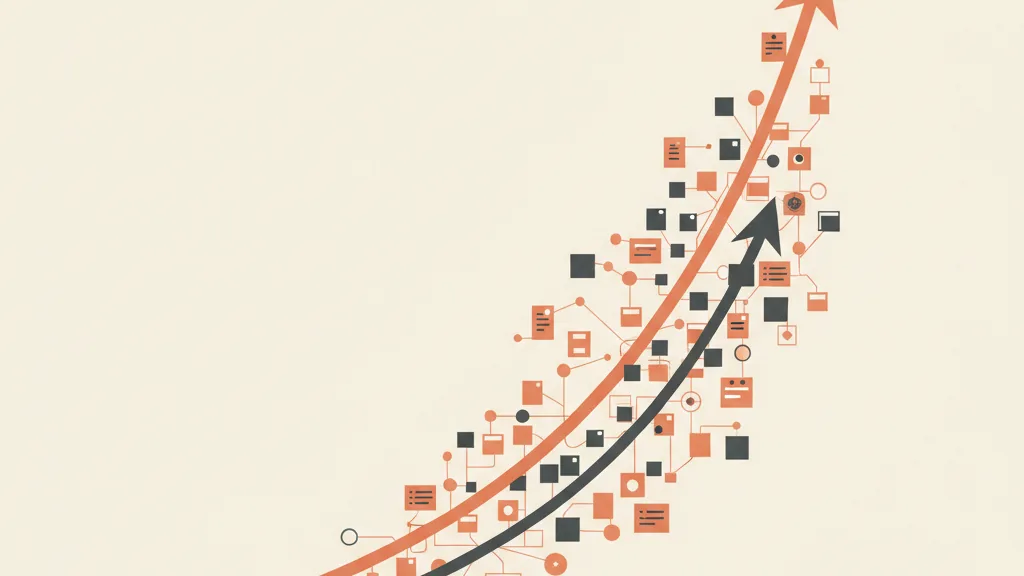
The mechanism is a virtuous cycle: the brain knows the company better, so it gives better answers, so the team uses it more, so the knowledge it gathers grows further, so the answers improve again. It's compound interest applied to knowledge. Whoever uses generic AI like everyone else stays on a flat line. Whoever has a company brain sees their own curve diverge upward, month after month. We dedicated a deep dive to this dynamic in the compound returns of a second brain.
This is also where the idea of arbitrage comes from: the gap between what you do today and what the market will do tomorrow. Today, most companies use AI generically. Whoever builds their company brain now accumulates an advantage that compounds over time. That window won't stay open forever: it will close as awareness grows and adopting a company brain becomes the standard rather than the exception. The moment when arbitrage pays off the most is exactly when few people are doing it. If you're wondering whether now is the time to start, that's the reasoning behind why it pays to move now.
How it works at a high level (to understand the value, not to build it)
You don't need the technical details to understand why a company brain makes the difference. A few principles are enough.
Atomic notes: knowledge broken down and reusable
Knowledge is split into many small notes, one idea per note, all interlinked. It's the same principle sociologist Niklas Luhmann used to write his books, with roughly 90,000 interconnected index cards, the famous Zettelkasten method. Breaking knowledge into small units makes it reusable across different contexts and, above all, navigable by an AI. We go into more detail in atomic notes for company knowledge.
What matters isn't just where you store things, but how you link them
There's a difference between taxonomy (how you file things) and ontology (how concepts connect to each other). It's precisely the structure of the connections that lets the AI reason, moving from one note to another the way an expert would follow a logical thread.
One single source of company truth
The system rests on a canon, a single source of truth. This has a concrete and underrated effect: the AI doesn't make things up. It only reports what's actually present in the company's knowledge base, drastically reducing the risk of hallucination. It answers you with your own facts, not plausible fiction.
Living memory
The system updates itself with everyday conversations and work sessions. So you can ask "what did we agree with that client back in March?" and get the answer, even if whoever was there that day no longer works at the company. This is what we call living memory: knowledge doesn't freeze, it grows.
RAG to scale to thousands of documents
Once the notes pile up, retrieval-augmented generation (RAG) comes into play: a semantic search that, across thousands of documents, fetches only the information relevant to the question. As a rough order of magnitude: under 500 notes, content maps and a good index are enough; between 2,500 and 20,000 notes you need embeddings and RAG; beyond 20,000 you need a full RAG pipeline. If you want to understand the mechanism, we explain it in RAG and company knowledge bases.
Want to understand how much the data your company has already accumulated is really worth? Talk to us: we design and manage your company brain, from structure to compliance.
"But is my data safe?" The most common objection
It's the first question every business owner asks, and it's a fair one. But it deserves an honest look.
First point, uncomfortable but real: in most companies, the data has already ended up inside ChatGPT, pasted in by employees with zero oversight, just to get things done faster. A governed company brain doesn't add a risk, it removes one: it replaces wild, invisible use with a controlled, tracked system. This is the shadow AI phenomenon, and ignoring it doesn't make it less dangerous.
Second point: the issue is managed with the right tools. Signed DPAs, GDPR compliance, version control so you have backups and a single up-to-date source even when a whole team is working on it. Security isn't an obstacle to adoption, it's part of the project from day one, as we cover in GDPR and security for a second brain.
The one thing AI can't do for you
Here's the insight worth taking away. With AI you can outsource expertise (it writes code, drafts documents, analyzes data) and even thinking (it proposes architectures, suggests strategies). But you can't outsource understanding.
Understanding your business, knowing which decisions matter, which data is relevant and how it all connects: that stays yours. And that's exactly why a company brain's structure can't be improvised. The difference between a digital archive nobody uses and a company brain that puts AI to work like an experienced employee of yours comes down entirely to design: well-built atomic notes, sensible ontology, quality controls, RAG sized to the real volume, compliance. It's a job of method, not a plugin you install.
Who gains the most from it
The reasoning applies to any company with knowledge worth preserving, but some contexts gain more than others.
- Professional firms (lawyers, accountants): every client's and every case's history always within reach, without depending on any one person's memory. We cover this in a second brain for professional firms.
- Sales teams: no knowledge lost when a salesperson leaves, and much faster onboarding for new hires. Covered in depth in a second brain for the sales team.
- SMEs and agencies: from a chaos of scattered files to a single, queryable system.
- Customer support and operations: consistent answers, because they're all drawn from the same source of truth.
There's also an effect on people. A new hire takes on average 8-12 months to become truly productive (the curve runs from 3-6 months for a top performer up to 14-18 for someone who struggles more). In the first part of that curve, the employee is the one gaining; in the second, the company starts gaining. Cutting the ramp-up time maximizes the return, and a company brain is exactly the tool that speeds up onboarding by putting knowledge at someone's fingertips from day one. As a side effect, it enables job rotation and reduces churn. The full reasoning is in cutting onboarding time with AI.
In short
Your data is the one asset that sets you apart from a competitor using the same AI tools. A better prompt gets you to ground zero a little faster; a company brain moves you onto a different curve entirely. Structured companies start ahead because they already have the deposit; whoever moves now is exploiting an arbitrage window that will close. And since building it well takes method (structure, atomic notes, ontology, quality controls, RAG, compliance), the sensible path for most companies is to bring in people who design and run it as their actual job.
Frequently asked questions
Why is company data considered the new oil of AI?
Because it's the one resource your competitor can't copy and no one can sell you ready-made. A generic model gives everyone the same average answer; the advantage appears when AI works on your data (customers, processes, decisions), producing answers only your company could get.
Why are structured companies at an advantage over startups?
AI's returns depend on the knowledge feeding it, and that knowledge accumulates over years of customers, processes and resolved cases. An established company is already sitting on this deposit; a startup starts with a data lag it has to close, while whoever has a company brain widens it every day.
Isn't a better prompt enough to get the same result?
No. A more polished prompt squeezes a bit more out of the same generic model, but it doesn't create knowledge that isn't there. The real difference isn't how you ask, it's what the system already knows about your company when you ask it. Without proprietary context, you stay at ground zero, same as everyone else.
What about data security? Isn't it risky to hand my data to AI?
In most companies the data has already ended up in ChatGPT, pasted in by employees with no oversight. A governed company brain reduces that risk instead of adding to it, and it's managed with signed DPAs, GDPR compliance, and version control for backups and a single source of truth.
What does it mean that data generates compound returns?
The system feeds itself: the more it knows the company, the better the answers, the more it gets used, the more knowledge it gathers. It's compound interest applied to knowledge. Whoever uses generic AI stays on a flat line; whoever has a company brain sees their curve diverge upward over time.
How much does timing really matter for getting started?
There's an arbitrage window: today few companies use AI on their own data, so whoever starts now accumulates an advantage that compounds and widens. As the company brain becomes the standard, that window will close. Moving early pays off precisely because few are doing it.
Your data is only worth something if AI can actually read it. Request a free analysis: together we'll assess what competitive advantage you can extract from the knowledge your company already has.