AI Arbitrage: Why You Should Build a Second Brain Now
10 min read · AstraLoop Studio
The question you hear most often from business owners isn't "does AI matter?" but "when is it actually worth adopting seriously?". The practical answer is simple: sooner than you think. And the reason has little to do with technology and everything to do with time. There's a window in which adopting a company second brain generates a disproportionate advantage relative to the effort involved. That window is closing, slowly but steadily, as awareness spreads across the market.
In this article we explain why waiting costs you, what we mean by "arbitrage" applied to AI, and why a digital company brain is an asset that appreciates over time instead of depreciating. This isn't a technical tutorial. It's a business case about a decision that, made too late, is hard to make up for.

What a company brain is, in one sentence
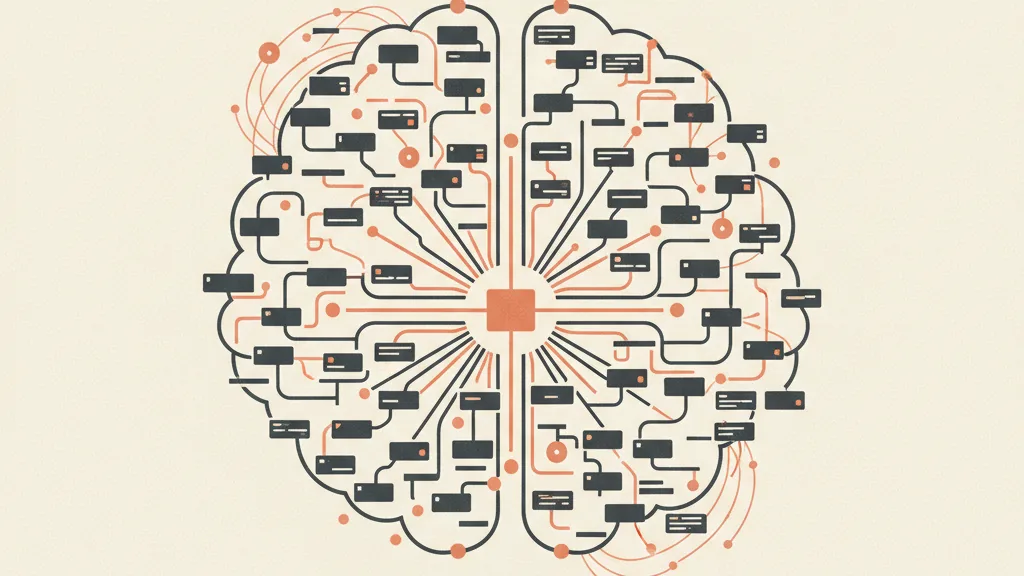
A company brain (or business second brain) is a large, interconnected digital brain that gathers all of a company's knowledge and that an AI works on top of. The difference from a wiki or a shared folder is substantial: it isn't built to be read by a person searching for a file, but to be navigated by an AI reasoning across linked information.
The practical consequence is that the more it's used, the more the system knows about the business, and the better the answers become. It's a memory that grows over time instead of aging. Keep this in mind, because it's the core of the whole arbitrage argument.
Ground zero: if the AI reads what everyone else reads, you get the same answers as everyone else
Let's start with a principle worth carving into stone: your AI is only as smart as what it can read about your company. If you and your competitor both use ChatGPT the same way, without feeding it any context about your business, you get practically identical answers. That's ground zero: no competitive advantage, because you're both drawing on the same generic knowledge available to anyone.
A slightly better-written prompt doesn't change the game. The real leap happens when the AI works on your data: your procedures, your customer history, the decisions you made and why, the tone you use with the market. This is where data becomes the new oil, and it's not just a slogan: whoever already has structured processes and knowledge is the one who will get the best return from AI. We covered this mechanism in depth in our article on how company data is the new oil and on what it means to turn knowledge into competitive advantage.
There's a corollary that often gets missed. A nimble startup can copy your product, your pricing, even your team. But it can't copy the years of operational data you've accumulated. It starts with a knowledge deficit, and if you build a company brain, that gap keeps widening every single day.
The problem the second brain solves: scattered knowledge
Before talking about advantage, let's look at what happens without a system like this. In almost every company, knowledge lives scattered across three zones, and each one has a hidden cost.
- In chats, emails, Slack, and scattered documents. Information someone wrote down once and that, six months later, is effectively unrecoverable. Nobody remembers where it ended up.
- In people's heads. Your top performer is worth their weight in gold, but if they leave, they take with them knowledge that was never written down anywhere. It becomes a bottleneck and turns onboarding into a nightmare.
- Scattered across dozens of different tools. The policy PDF, the revenue spreadsheet, the supplier emails. Everything exists, but nobody uses it in a coordinated way.
This disorder has a measurable price. According to a McKinsey estimate, roughly 19% of the workweek (nearly one day out of five) is spent searching for information. It's an order of magnitude, not an absolute truth, but it gives a sense of how much productive time dissolves into looking for something the company already owns. We dedicated a full analysis to the cost of scattered knowledge in a company if you want to see the economic impact.
Compounding returns: why a second brain is an investment that appreciates
Now for the heart of the matter. A company brain isn't a tool you buy and use at full capacity from day one. It's more like a compound-interest investment. The cycle looks like this:
- The brain knows the company better
- so it produces better answers
- so the team uses it more
- so the system accumulates even more knowledge
- and you're back at step 1, at a higher level.
Every loop makes the system more valuable than the last. This is what we mean when we talk about compounding returns of a second brain: the curve of a company with a business brain doesn't grow linearly, it diverges upward compared to those still using generic AI like everyone else.
The tricky part is that these returns need time to accumulate. You can't compress two years of the system's learning into one week just because you've "finally made up your mind". That's why when you start matters more than it seems.
Arbitrage: the difference between what you can do today and what the market will do tomorrow
In finance, arbitrage means exploiting a price difference that exists only temporarily, before the market corrects it. Applied to business AI, arbitrage is the gap between what you can do today (build your company brain while almost nobody else does) and what will be standard tomorrow, when everyone does it.
Today most companies are still stuck at ground zero: using ChatGPT as a smarter version of Google. Whoever moves now has a window in which the advantage is built at a relatively low cost, because the gap to close relative to competitors is still wide and nobody is closing it. As awareness grows, that window narrows: once everyone has a company brain, having one will no longer be an advantage, just the minimum requirement to stay in the game.
It's the same logic as launching a website in 2000, back when it gave you an edge, versus doing it today, when it just gets you to baseline. The question isn't "whether" to adopt AI seriously, but whether you want to be among those using it while it's still a differentiator, or among those chasing it once it's already table stakes.
The concrete payoff: onboarding, turnover, continuity
Arbitrage isn't an abstract concept. It translates into operational numbers. Take onboarding a new hire. On average, a new employee takes 8 to 12 months to become truly productive, but the curve varies quite a bit:
| Profile | Estimated time to full productivity |
|---|---|
| Top performer | 3-6 months |
| Average profile | 8-12 months |
| Slower profile | 14-18 months |
These are orders of magnitude, not hard rules, but they describe a precise dynamic. In the first part of this curve, it's the employee who's "earning" (the company is investing in them); in the second part, it's the company that earns from their work. Shortening the ramp-up time means moving up the point where you start recouping the investment. A company brain accelerates exactly this shift: knowledge that used to live only in senior employees' heads becomes accessible and queryable from day one. We wrote about this in detail in reducing onboarding time with AI.
There's more. Shortening onboarding time also enables job rotation and reduces employee churn: if people get up to speed faster and don't depend on a single keeper of knowledge, they rotate across roles more easily and stay longer. And above all, it solves the risk of losing knowledge when an employee leaves. If the knowledge lives in the system, it doesn't walk out the door with the person.
The window to build your advantage is open right now. Request a free analysis and let's see together how much knowledge is sitting scattered across your business.
How it works, at a high level (to see why the value is real)
You don't need to know how to build it, but understanding the pillars helps you see why it isn't "a folder with AI inside it". There are a few elements that make the difference between an inert archive and a brain that actually reasons.
Atomic notes and a navigable structure
Knowledge is broken down into many small notes, one idea per note, all linked to each other. It's the same principle sociologist Niklas Luhmann used with his Zettelkasten method to manage 90,000 interconnected index cards while writing his books. Breaking down and linking makes knowledge reusable across different contexts and, crucially, navigable by an AI. If the topic interests you, we have a deeper look at atomic notes applied to business knowledge.
Single source of truth: the AI reports, it doesn't invent
A good company brain rests on a canon, a single company truth. This is what reduces hallucinations: the AI doesn't improvise, it only reports facts present in the governed body of company knowledge. It's the difference between a credible assistant and one that serves you plausible but wrong answers. The concept of single source of truth is the backbone of the entire system.
Living memory and scalability
The system updates itself with daily conversations and work sessions, so you can ask "what did we decide with that client back in March?" and get the answer. Once the documents number in the thousands, RAG (retrieval-augmented generation) comes into play: a semantic search that pulls only the relevant information instead of drowning in volume. As a rough rule of thumb, under 500 notes, indexes and content maps are enough; between 2,500 and 20,000, you need embeddings and RAG for the knowledge base; beyond 20,000, you need a full pipeline. These are indicative thresholds, but they explain why the structure needs to be thought through properly from the start.
"What about my data?" The right question, with an uncomfortable answer
It's the most common objection, and a legitimate one. But it needs flipping around. The reality is that in a huge number of companies, data has already ended up inside ChatGPT, pasted in by employees with zero oversight, every single day. A governed company brain, with defined access levels and clear rules, is more secure than this widespread, invisible shadow AI.
On the formal side, this is managed through signed DPAs, GDPR compliance, and version control to keep backups and a single up-to-date source even when a whole team is working on it. This isn't definitive legal advice, it's the framework within which a serious system gets designed. If you want to go deeper, we have a piece on GDPR and second brain security.
Where the advantage shows up first
Some contexts feel the benefit especially sharply:
- Professional firms (lawyers, accountants): having the full picture of every client and every case always at hand, without depending on any one person's memory. We cover this in second brain for professional firms.
- Sales teams: no knowledge lost when a salesperson leaves, and much faster onboarding for new setters and closers. More in second brain for sales teams.
- SMBs and agencies: the shift from a chaos of files to a single queryable system, with an immediate impact on operations and customer support.
The one thing you can't outsource
Let's close with the insight that should drive the decision. With AI you can outsource skill (it writes code for you) and even thinking (it proposes architectures and options). But you can't outsource the understanding of your own business. That stays yours.
This is why building and running a company brain well takes method: structure, atomic notes, ontology, quality controls, RAG, compliance. It's design work, not a plugin you install. The ROI shows up when the structure is built around your specific reality, and that's exactly what we do at AstraLoop: we design, build, and manage the company brain while you stay focused on the one thing only you can understand, your business. If you want to figure out where to start, the article on how to get started with AI in your business is a good next step.
The arbitrage window is open right now. Every month you wait is a month of compounding returns you're not accumulating, while whoever started earlier keeps widening the gap. It isn't about being an early adopter for the sake of it: it's the arithmetic of time applied to knowledge.
Frequently asked questions
When is it worth adopting artificial intelligence in a business?
Sooner rather than later, because a business second brain generates compounding returns: the longer you use it, the more it knows about your company and the more value it produces. Waiting doesn't freeze the advantage in place, it hands it to whoever started earlier, who keeps widening the gap in the meantime.
What does 'AI arbitrage' mean applied to businesses?
It's the gap between what you can do today (build your company brain while almost nobody else does) and what will be standard tomorrow, once everyone does it. Whoever moves now is exploiting a window in which the advantage is built at a relatively low cost, before the market closes it.
Why isn't ChatGPT alone enough to give me a competitive edge?
Because your AI is only as smart as what it can read about your company. If you and your competitor both use ChatGPT without any company context, you get the same answers. The advantage only appears once the AI works on your specific data, which is exactly why you need a company brain.
How long does it take to see the return on a second brain?
Value grows over time with use, but concrete benefits like shorter onboarding times (moving down from the 8-12 month range) and knowledge continuity start to show up in the early stages already. It's an investment that appreciates, not a tool that delivers everything on day one.
Is my company data safe inside a company brain?
A governed system is more secure than the current situation, where a lot of data already ends up in ChatGPT, pasted in by employees with no oversight. It's managed through signed DPAs, GDPR compliance, and version control for backups and a single source of truth. This isn't legal advice, it's the framework a serious system should be designed within.
Should I build my second brain myself or work with a partner?
With AI you can outsource skill and thinking, but not the understanding of your own business. Building it properly takes method (structure, atomic notes, ontology, quality controls, RAG, compliance), and that's where an experienced partner makes the difference: building the right structure around your reality while you stay focused on the business.
If you want to figure out where to start with your company brain, talk to us: we design, build, and manage the system while you stay focused on your business.