GDPR and Data Security in a Company Second Brain
8 min read · AstraLoop Studio
Every time we propose that a company build its own company second brain, the first question is always the same: "where does my data end up?" It's a fair question, and it shows maturity. The problem is that it almost always starts from a false premise: the idea that company data is safe today, and that introducing AI would expose it for the first time.
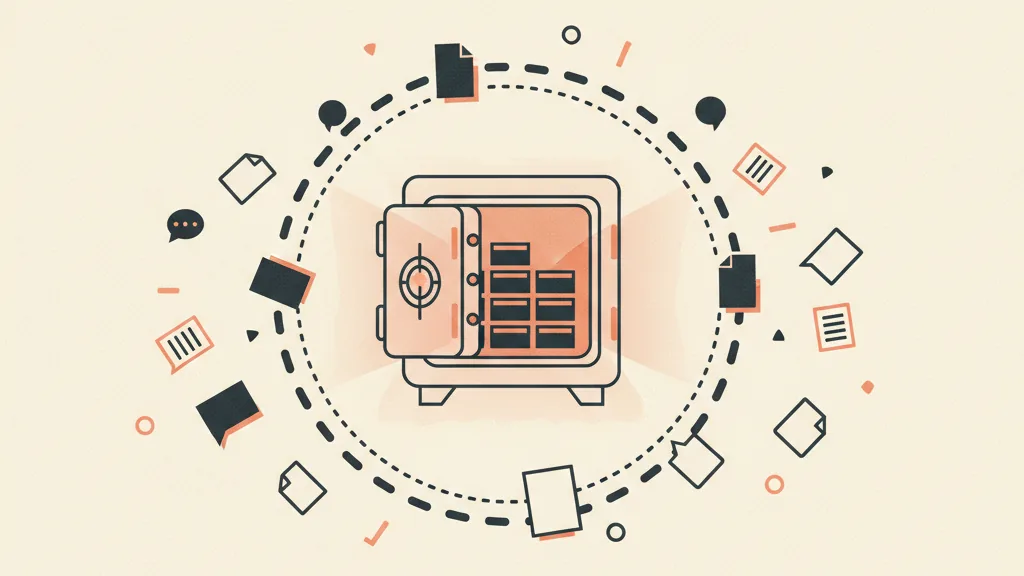
The reality is different, and it's worth looking at head-on. In most Italian companies, sensitive data has already left the perimeter of control. Not because of some AI project, but because employees started pasting contracts, price lists, customer emails and draft quotes into ChatGPT to work faster. No policy, no log, no oversight. In this scenario, a designed and governed company brain isn't the risk — it's the fix for a risk you already have.
In this article we tackle the security objection head-on, from the point of view of someone deciding whether to invest in a company brain. What actually happens to your data today, why a governed system is safer than one left to its own devices, and which tools (DPAs, GDPR compliance, version control) make the whole thing defensible even under an audit.
The risk you already have: shadow AI
Let's start with common sense, even before compliance. When one of your salespeople needs to draft a quote and asks ChatGPT to rephrase the text, what do they paste into the chat? The client's name, the commercial terms, maybe the whole negotiation history. When the admin team wants a contract summarized, they paste in the contract. This phenomenon has a name: shadow AI — employees using AI tools without the company knowing about it, authorizing it, or governing it.
The delicate part isn't that AI is inherently dangerous. It's that this flow of data happens completely outside company control: on personal accounts, with unknown settings, with no contract between your company and the vendor, with no visibility into whether or how that data is retained. From a GDPR standpoint, this is exactly the scenario you want to avoid — processing data (often personal data belonging to clients and suppliers) with no documented legal basis, no accountable controller, and no security measures.
The paradox is obvious. The company that says "I don't want AI, to protect my data" often already has its data scattered across dozens of individual chats. It hasn't eliminated the risk — it's just made it invisible. A company brain doesn't add a new risk: it replaces an uncontrolled risk with a controlled system.
Why a governed brain is safer, not riskier
The difference between scattered data and a designed company brain is the same as the difference between keeping cash under the mattress and keeping it in a bank. It's not that the money "leaves the house" for the first time when it goes to the bank — it's that finally someone is accountable for it, it's tracked and it's protected. Here's why a governed system flips the perceived risk.
1. One perimeter instead of a thousand leaks
With a company brain, the organization's knowledge stops living scattered across personal chats, email attachments and forgotten folders, and converges into a system with a single point of truth (what's technically called a single source of truth). One perimeter is a defensible perimeter: you can decide who accesses what, track who viewed or edited a document, and apply consistent security measures. A thousand leaks — no.
2. Contracts instead of good intentions
When an employee uses ChatGPT from their own account, there is no contract at all between your company and the model provider. In a properly structured project, by contrast, the relationship with technology vendors is governed by a DPA (Data Processing Agreement) — the data-processing agreement required under Article 28 of the GDPR, which spells out in writing what the vendor can do with your data, for how long, and under what guarantees. It's the difference between hoping for the best and having a written, enforceable liability.
3. History and recovery through version control
A well-built company brain tracks the versions of its knowledge base (version control). In practice, every change is logged, an up-to-date and recoverable copy always exists, and you can reconstruct who changed what and when. This covers two needs at once: on one hand, backup and continuity (if something breaks or gets altered, you can roll back); on the other, the traceability GDPR expects when you handle data in a structured way. Trying to reconstruct that same history out of fifty individual chats is simply impossible.
The real reason security matters twice as much here
There's a point that often gets missed in the debate around data security and AI, and it may be the most important one strategically. The value of a company brain lies precisely in the fact that the AI works on your data. As we always tell our clients, your AI is only as smart as what it can read about your company. If you and your competitor use ChatGPT the same way, with no company context, you get the same answers: that's the baseline, no advantage at all.
The leap happens when the AI is trained on your specific company's knowledge. But that means that knowledge — which is your most valuable asset, data now being considered the new oil — has to be gathered and centralized somewhere. That's exactly why security here isn't a bureaucratic box to tick: you're concentrating the company's entire information capital in one place. Doing it right means protecting the very value you're building. Doing it poorly — or not doing it at all and leaving everything to shadow AI — means dispersing that value while exposing it.
Structured companies, the ones that already have processes and accumulated knowledge, are also the ones with the most to protect and the most to gain. We go deeper on this in our articles on the competitive advantage that comes from company data and on why company data is the new oil.
How it stays under control: reducing hallucinations
A recurring fear isn't just about data leaking out — it's about reliability: "what if the AI makes things up?" It's a legitimate concern, because a confidently wrong answer can do real damage. A well-designed company brain tackles this at the root through the concept of canon: a single, defined and verified company truth.
In a properly built system, the AI doesn't draw on its "general knowledge" of the world to answer questions about your company — it only reports what's actually present in the company's knowledge base. When there's a lot of information, RAG (retrieval-augmented generation) comes into play: a mechanism that first retrieves the relevant documents and then has the AI answer based only on those. The result is that hallucinations drop dramatically, because the system is constrained to real company facts. Data security, in this sense, also means reliable answers: not just protecting information, but making sure the right information gets used.
Want to know if the way your company already uses AI is compliant or a hidden risk? Request an assessment: together we'll map out how to build a secure, compliant company brain.
What you actually need to be compliant
Without turning this article into legal advice (for that you need a professional who can assess your specific case), here are the elements that, from our hands-on work, make a company brain defensible from a GDPR standpoint. These are the questions you should ask yourself — or have your privacy advisor ask — when evaluating a project like this.
| Element | What it's for |
|---|---|
| Signed DPAs | Formally regulate data processing in writing with every technology vendor involved (Art. 28 GDPR). |
| Legal basis and purpose | Know what data enters the system, why, and on what legal grounds, especially for personal data belonging to clients and suppliers. |
| Access control | Define who can read what: not everyone in the company needs to see everything. |
| Version control and backup | Change history, recoverability, a single up-to-date source even across a team. |
| Data location and retention | Know where data resides and for how long it's retained. |
| Records of processing activities | Document the system so you're ready in case of an audit by the data protection authority. |
The good news is that none of this is an obstacle — it's exactly what you're missing today if your data is scattered across shadow AI. Designing the company brain is the chance to finally put things in order. If you want to know when your company is ready for this step, we've written a dedicated guide on when a company is ready for a second brain.
A topic we know from both sides
There's a reason we address security head-on, without hedging: data governance isn't an add-on to the project, it's part of its structure. A well-built company brain requires method, and compliance is one of its pillars, alongside knowledge architecture, quality control and choosing the right technology.
It's worth remembering a principle that guides our work: with AI you can outsource execution (AI writes code) and even some thinking (it proposes solutions), but you cannot outsource understanding your own business. Designing a system that's both useful and secure means understanding which data matters, who should access it, and under what guarantees. That's where an experienced partner makes the difference between a project that generates protected value and one that opens up gaps. The topic ties into cybersecurity for SMEs and, more broadly, into serious AI consulting for businesses.
In short
The "what about my data?" objection is entirely legitimate, but it needs to be flipped. The right question isn't "does a company brain expose my data?" but "is my data already exposed today, with no oversight?" In most cases the answer is yes, through the ungoverned use of ChatGPT across the team. A second brain designed with DPAs, GDPR compliance, access control and version control doesn't add risk: it replaces an invisible risk with a traceable, defensible, secure system — one that also turns your knowledge into your real competitive advantage.
Frequently asked questions
Is using an AI-powered company second brain GDPR compliant?
It can be, if the project is built with the right safeguards: signed DPAs with vendors (Art. 28 GDPR), a clear legal basis for the data processed, access control and traceability. It's far more compliant than the more common alternative — employees pasting company data into ChatGPT with zero oversight. For your specific situation, it's still worth involving a privacy advisor.
Does data I put into a company brain end up training public AI models?
It depends on the setup and the contracts. In a governed project you use vendors and plans that, through the DPA, exclude your data from being used to train public models. That's exactly the difference from using free personal accounts, where these guarantees are usually absent.
What is a DPA, and why do you need one in an AI project?
A DPA (Data Processing Agreement) is the data-processing agreement required under Article 28 of the GDPR. It sets out in writing what the technology vendor can do with your data, how long it's retained, and under what security measures. Without a DPA — as is the case with personal accounts — you have no contractual protection at all.
Is a company brain safer than letting everyone use ChatGPT on their own?
A governed company brain is safer. Individual, uncontrolled use of ChatGPT (so-called shadow AI) sends company data out with no contracts, no traceability and no policy. A centralized system concentrates knowledge in a single defensible perimeter, with controlled access and a change history.
How do you stop the AI from making up information about company data?
Through the concept of canon — a single, defined source of company truth — and techniques like RAG (retrieval-augmented generation), which constrain the AI to answer only from documents actually present in the knowledge base. This way the system reports the company's real facts instead of inventing them, drastically cutting down hallucinations.
Who handles the security and compliance side of a second brain project?
In practice, you need a partner who designs the architecture with both usefulness and governance in mind: DPAs, access control, version control and GDPR compliance are part of the system's design, not an afterthought. AstraLoop Studio builds and manages the company brain including these aspects from day one.
Designing a secure company brain takes method, not improvisation. Talk to us: we'll size up your situation and tell you, no fluff, what it takes to do it right.