Single Source of Truth: One Version of the Truth for Your Whole Company
9 min read · AstraLoop Studio
Ask a simple question inside any company: "how much does service X cost?" Sales gives you a number pulled from a March spreadsheet, marketing gives you another one from the brochure, and finance sends you the signed client PDF quoting a third price. Three people, three versions, all "official." Nobody is lying. The same piece of information simply lives in different places, and everyone draws from their own.
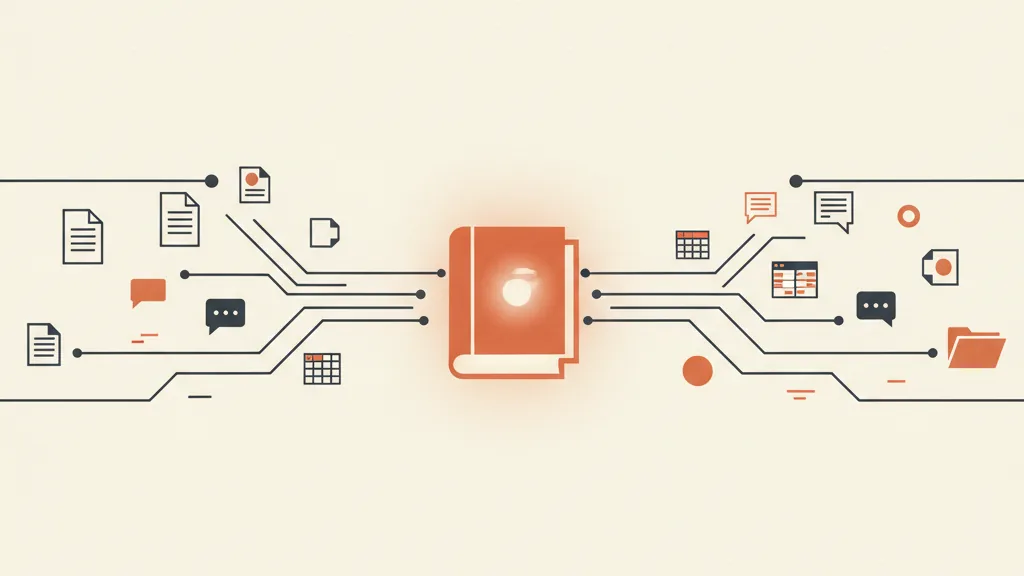
This is exactly the problem a single source of truth solves. One place where information exists exactly once, kept up to date, that everyone — people and software alike — draws from. It's the company's "canon," the same way a franchise establishes what's officially true and what isn't. And today that canon does more than get everyone speaking the same language: it's what makes the AI working on top of it actually trustworthy.
The real cost of conflicting versions
Three different prices for the same service might sound like a minor annoyance. Multiply it across a thousand micro-decisions a day, and it becomes a structural cost. A frequently cited McKinsey estimate puts it at around 19% of the week for knowledge workers — almost one day out of five — spent searching for information. Not producing it: searching for it. Which folder that file ended up in, asking a colleague, reconstructing what was decided in a meeting two months ago.
When information is fragmented, every search has an uncertain outcome. And the worst outcome isn't "I can't find anything." It's "I find the wrong version and act on it." A salesperson quoting an outdated price, a technician following a procedure that's been superseded, onboarding built on a manual nobody has touched in a year. These mistakes don't leave an obvious trail, but they erode margins and trust. If you want the numbers behind this dispersion, we've dug into the real cost of scattered knowledge in a company.
In practice, knowledge lives in three places, and all three work against the idea of a single truth:
- In chats, emails, and scattered documents. Decisions made over Slack or email that nobody ever consolidates anywhere. Retrievable in theory, unretrievable in practice.
- Inside people's heads. The top performer who "just knows how it's done" is gold, but also a bottleneck: if they leave, the knowledge leaves with them, and while they stay, they slow down every onboarding. We go into detail on the risk of losing knowledge when an employee leaves the company.
- Scattered across dozens of tools. The price list in Excel, policies in PDF, contracts in the management software, quotes in the inbox. Each one is "the source" for something, and nothing coordinates them together.
Why it matters even more with AI
So far, this is a problem as old as business itself. What's new is that today there are AI systems that read a company's knowledge and answer on your behalf — to clients, to colleagues, autonomously. And that's where a single source stops being a "nice to have" and becomes a requirement.
An AI has no common sense to figure out which of the three prices is the right one. Feed it a pile of contradictory documents and it will confidently answer with one, picked at random. Or worse, it will fill the gaps by making things up. That's the phenomenon of hallucination: plausible but false answers. The cause isn't always the model. Very often it's the inconsistent knowledge base it's working from.
The company canon flips the logic. You define a single truth and set the AI up so it doesn't invent anything: it only reports facts present in the company's knowledge, and when they're missing, it says so. You go from a creative, unreliable assistant to one that cites its source. That's the mechanism that makes a company second brain usable in contexts where mistakes are costly: quotes, customer support, compliance.
How a single truth gets built (at a high level)
You don't need to know how to build one, but understanding how it works helps you see why it takes method. A well-built single source of truth isn't "one more shared folder." It's a structure designed so a machine can read and navigate it.
Atomic notes instead of giant documents
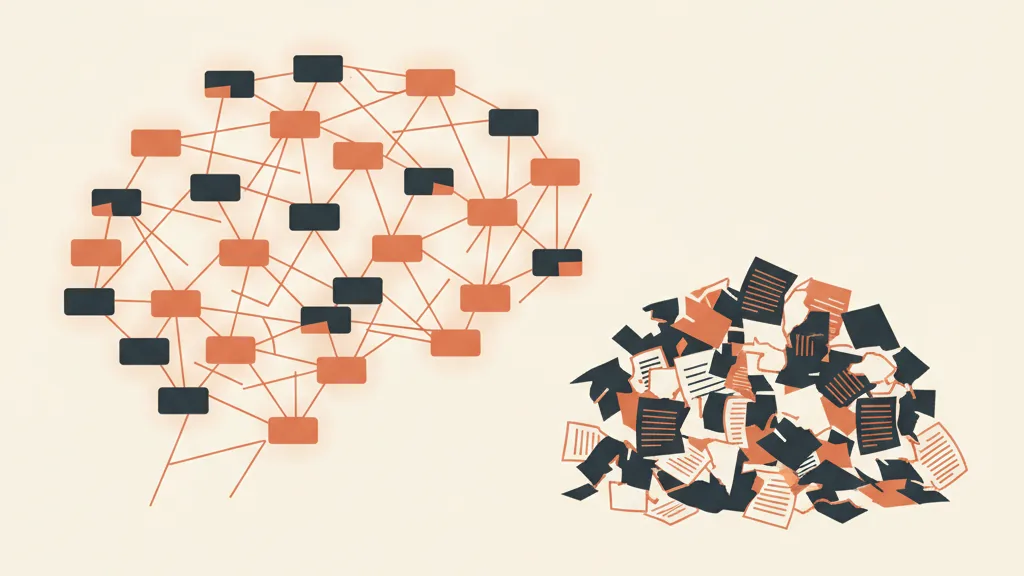
Knowledge is broken down into many small notes, one idea per note, all linked to each other. It's the same principle sociologist Niklas Luhmann used to write dozens of books with his 90,000-note card index (the Zettelkasten method): each concept isolated and reusable in different contexts. For AI, this changes everything. An atomic note like "price of service X: €1,200" is a precise, single-point-of-update truth, instead of a figure buried on page 14 of a brochure. We've dedicated a piece to what atomic notes applied to company knowledge actually are.
Filing well isn't enough — you need connections
Here's the distinction that separates a tidy archive from a brain. Taxonomy is how you file things (folders, tags, categories). Ontology is how concepts connect to each other: this client is tied to this case, which follows this policy, decided in that meeting. It's the web of connections that lets the AI "reason" by moving from one note to another, not just find a file.
A memory that updates itself
The most underrated point: a single source stays single only if it stays current. A well-designed system feeds on day-to-day conversations and work sessions, so the truth grows instead of aging. That's what makes it possible to ask "what did we decide with that client back in March?" and actually get an answer, instead of digging through email. This living memory is what separates a company brain from a wiki nobody touches after three months.
A visual layer and version control
For the team to actually use it, you need a comfortable interface (a dashboard, a Notion-like layer) and, underneath, version control: a history of every change, so you know who changed what and can roll back. In a team, it's version control that guarantees you're left with one up-to-date source, instead of ten diverging copies on everyone's laptop.
When documents grow into the thousands: RAG
With a few hundred notes, a good index is enough. Once knowledge grows large, RAG (retrieval-augmented generation) comes into play: a semantic search that, given a question, pulls only the relevant pieces of knowledge instead of feeding the AI everything at once. As a rough order of magnitude: under 500 notes, content maps and an index are enough; between 2,500 and 20,000, you need embeddings and RAG; beyond 20,000, you need a full RAG pipeline.
If the same information exists in multiple versions across your company and it's hurting your AI, we can help you build a single source of truth. Request an analysis of your company's knowledge.
It's not just tidiness — it's a competitive edge
Here's the point that shifts the conversation from "it would be tidier" to "it pays to do this now." The rule is simple: your AI is only as smart as what it can read about your company.
If you and your competitor use the same off-the-shelf ChatGPT with no company context, you get the same answers. That's the baseline: no advantage. A slightly better-written prompt won't save you. The edge appears when the AI works on your data, your single truth, your accumulated experience. In this sense, company data is the new oil: whoever has more of it, better organized, gets more out of it.
The good part is that whoever is already organized starts ahead. If you have years of processes, decisions, and clients behind you, you already have the raw material — all that's missing is the structure to make it machine-readable. A startup trying to compete starts with a data gap that keeps widening as you build your canon. And the mechanism feeds itself: the more the system knows about the company, the better the answers; the more the team uses it, the more the knowledge grows. It's compounding returns: the curve of whoever has a single source diverges upward against everyone else running generic AI.
There's also a time window at play. Few companies do this today, so the return is high — a kind of arbitrage between what you do now and what the market will do tomorrow. As awareness grows, that edge thins out. Which is why building it now is worth more than building it in two years.
"What about my data?" The most common objection
Fair objection, but it needs context. Chances are your data has already ended up in AI: your employees paste contracts, price lists, and emails into ChatGPT every day, with no oversight and without you knowing. A governed canon is more secure, not less — it's centralized, tracked, and rule-bound. Formally, it's managed with signed data processing agreements (DPAs), GDPR compliance, and version control, which also doubles as a backup and a single certified source. It's a sensitive topic, and we cover it separately in GDPR and security for a company second brain.
Where a single source changes your day-to-day
| Context | What a single source of truth fixes |
|---|---|
| Professional practices (lawyers, accountants) | Every client and case always within reach, without rebuilding the history each time. Covered in depth in the second brain for professional practices. |
| Sales team | No knowledge lost when a salesperson leaves, fast onboarding for new hires. See the second brain for sales teams. |
| SMBs and agencies | From file-and-folder chaos to one searchable system. |
| Customer support and operations | Consistent answers, because everyone — humans and AI alike — draws from the same truth. |
One last point explains why this calls for a partner, not a tool you download. With AI, you can outsource expertise (it writes the code) and even thinking (it proposes architectures). What you can't outsource is understanding: someone has to genuinely understand how your business works to decide what's "true," how concepts should connect, what quality checks are needed. That's where a single source of truth is either built well, or ruined.
Defining the canon, breaking knowledge into atomic notes, designing the ontology, setting up quality checks, configuring RAG, and handling compliance is methodical work. At AstraLoop Studio, we design, build, and manage the company brain for you, so you get the single source of truth without having to become a knowledge architect yourself. If you're not sure you're ready, start with when a company is ready for a second brain.
Frequently asked questions
What does "single source of truth" mean for a company?
It's the principle that every piece of information (a price, a policy, a procedure) lives in a single official, up-to-date place that people and software both draw from. It eliminates conflicting versions of the same data scattered across spreadsheets, PDFs, emails, and people's heads.
Why does a single source reduce AI hallucinations?
An AI can't tell which version of a piece of data is correct: if the knowledge base is contradictory, it either picks one at random or makes something up. With a consistent canon, you set it up to report only facts present in the company's knowledge and cite its source, instead of filling gaps with plausible but false answers.
What's the difference between a wiki and a single source of truth?
A wiki is built to be read by people and tends to go stale. A single source of truth built for AI is structured as linked atomic notes (an ontology), updates itself in real time through daily work, and can be navigated by a machine. We dig into the difference between a second brain and a wiki like Notion in a dedicated article.
Do I need a single source of truth even if my company is small?
Yes, and it often pays off even more. Companies that are already organized have the raw material (processes, clients, decisions) and get the best return. Even an SMB can go from scattered-file chaos to one searchable system, with faster onboarding and less knowledge tied to single individuals.
Is my data safe in a system like this?
A governed canon is safer than the status quo, where employees are already pasting company data into ChatGPT with no oversight. It's managed with signed DPAs, GDPR compliance, and version control that also serves as a backup and a single certified source.
How long does it take to build a single source of truth?
It depends on how much knowledge you have and how organized you are to start with. Under a few hundred notes, a good index is enough; beyond thousands of documents, you need a full RAG pipeline. The time-consuming part isn't technical — it's understanding the business: defining what's true and how the concepts connect.
Want a single source of truth that aligns your team and makes your AI reliable? Talk to us: we design and manage your custom company brain.