How Much Does a Company Second Brain Cost (and What Drives the Price)
9 min read · AstraLoop Studio
When a business owner asks us "how much does a company second brain cost?", the honest answer is the same one you'd give if someone asked how much it costs to open a store: it depends. It depends on how much knowledge you have, where it's scattered today, how many systems you want to connect, and how much you want the system to keep growing on its own over time. In this article we'll lay out the variables that really move the price, give you ranges to reason with (not made-up price lists), and help you evaluate the return, which is really the only question that matters.
One clarification before we start: this isn't about how much "a piece of software" costs. A company second brain isn't a license you buy and install. It's an interconnected digital brain that collects your company's knowledge and that an AI works on top of. The value, and therefore the cost, lives in the design and the ongoing management, not in the tool.

Why there's no price list
A wiki or a shared folder has a predictable cost: you pay a per-user license and that's it. A company brain doesn't work that way, because it isn't built to be read by people but to be navigated and "reasoned over" by an AI. The difference matters: the more you use it, the more it knows about your company, and the better the answers get. It's a system that grows, and anything that grows needs structure and maintenance.
So the cost isn't a fixed number but the sum of four line items: the volume of knowledge to organize, the technical architecture (particularly whether RAG is needed), integrations with your systems, and ongoing management over time. Let's go through them one by one, because understanding what drives the price puts you in a position to ask for the right quote, not one pulled out of thin air.
Variable 1: the volume of knowledge
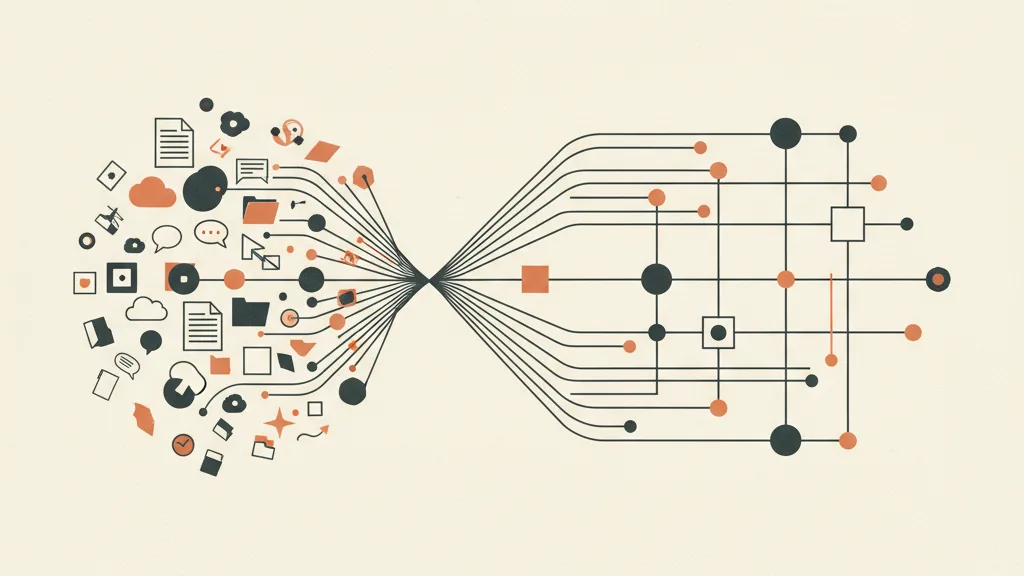
The first factor is how much knowledge you need to bring into the system and what state it's in today. Starting from an already-organized archive is one thing; starting from the typical chaos of many companies, where knowledge lives in three different, disconnected zones, is another: in chats and emails, in people's heads, and scattered across dozens of tools (policy PDFs, revenue spreadsheets, supplier emails).
How the knowledge is structured also matters a great deal. A well-built company brain doesn't just "copy-paste" documents: it breaks knowledge down into atomic notes, small units each holding a single idea, all interconnected. It's the same principle sociologist Niklas Luhmann used to manage his 90,000 index cards to write his books. This work of breaking down and reconnecting is what makes knowledge reusable and navigable by an AI, but it's also real work, and it's the part that weighs the most when the starting volume is large and disorganized.
As a rough order of magnitude: under 500 notes, content maps and a well-built index are enough, and that's the cheapest entry level. Cost rises with volume, but not linearly, because past certain thresholds the technical architecture itself has to change.
Variable 2: RAG and technical architecture
This is the threshold that really moves the quote. Once the notes pile up, simple search stops being enough: you need RAG (retrieval-augmented generation), a semantic search that surfaces only the relevant information efficiently, instead of feeding the AI the entire archive on every question.
As a rule of thumb:
| Note volume | Architecture needed | Cost impact |
|---|---|---|
| Under ~500 | Content maps and index | Entry level, more content |
| ~2,500 - 20,000 | Embeddings / RAG | Technical jump, cost rises |
| Over 20,000 | Full RAG pipeline | Structured project |
The higher the volume, the more the architecture complicates and the more specific technical expertise comes into play. It's no coincidence that the choice between building it in-house or bringing in an agency hinges on exactly this threshold: under 500 notes you can probably manage on your own, above it you need method and infrastructure.
Variable 3: integrations
An isolated company brain is worth less than one connected to your systems. Every integration (the CRM, the inbox, ERP systems, customer support) adds value but also complexity, and therefore cost. The more sources you want to connect, the more connection and normalization work is required.
Then there's the visual layer, for example a Notion-style dashboard that gets the team actually using the system, and version control to keep a history and a single, up-to-date source of truth even when multiple people are working on it. These are things you don't see in the "brain" itself, but they determine whether the system gets genuinely adopted or ends up as a toy nobody opens.
Variable 4: ongoing management
This is the line item companies underestimate the most, and it's the one that makes the difference between a living project and a dead one. A second brain isn't a one-shot build: it's a living memory that updates itself with everyday conversations and sessions. This is exactly what lets you ask "what did we decide with that client back in March?" and actually get an answer.
Maintaining the quality of the knowledge (avoiding duplicates, keeping the ontology, meaning how concepts connect to each other, up to date, making sure the AI only reports facts that are actually there instead of making things up) requires continuous oversight. You can see it as a recurring cost or as what protects the initial investment. A brain left to itself degrades; one that's managed well accumulates value, month after month.
The bill nobody does: what it costs you NOT to have one
Before looking at the quote, look at the cost of standing still. According to a McKinsey estimate, roughly 19% of the work week, nearly one day out of five, is spent searching for information. Multiply that percentage by the labor cost of your skilled staff: that's a cost you're already paying today, every month, it just never shows up on any invoice.
Then there's onboarding. A new hire takes on average 8-12 months to become truly productive (top performers 3-6 months, average profiles 8-12, the slowest 14-18). In the first part of the learning curve the employee is the one "gaining"; in the second part the company starts to gain. Cutting the ramp-up time moves that break-even point forward, and it also opens the door to job rotation and to reducing employee churn.
Finally there's the risk of losing knowledge: your top performer is worth their weight in gold, but if they leave, they take what they know with them. A company brain turns that knowledge from personal capital into company capital. These are all estimates and orders of magnitude, not absolute truths, but the direction is clear: the cost of inaction is real even when it's invisible.
Want to find out what a second brain would really cost for your company? Ask us for an analysis of your knowledge: we start from your actual data, not a price list.
The real return: compounding competitive advantage
There's a return that goes beyond operational efficiency, and it's the most important one. The rule is simple: your AI is only as smart as what it can read about your company. If you and your competitor both use ChatGPT the same way, with no company context, you get the exact same answers. That's the zero level, no advantage. A slightly better prompt isn't enough to make a difference.
The advantage is born when the AI is trained on your data. From that moment on, a compounding mechanism kicks in: the brain knows the company better, so it gives better answers, so it gets used more, so the knowledge improves further. The curve for whoever has a company brain diverges upward compared to whoever uses generic AI like everyone else.
And this is where "how much does it cost" shifts perspective. Whoever builds their company brain now is exploiting an arbitrage window: the gap between what you're doing today and what the market will be doing tomorrow. Companies that are already structured, with consolidated processes and knowledge, are the ones that will see the best return, and the window will close as awareness grows.
What about data security?
The recurring objection is: "but where does my data end up?" Two honest points. First: a lot of company data has already ended up inside ChatGPT, pasted in by employees with zero oversight (the shadow AI phenomenon). A governed company brain is more secure, not less, precisely because it's controlled. Second: the issue is handled with the right tools, signed DPAs, GDPR compliance, and version control for backups and a single source of truth. It's not something to postpone, but it's not a reason to stay still either.
How to think about a quote
Here's the central point: with AI you can outsource expertise (writing code) and even thinking (proposing architectures), but you can't outsource understanding. You need someone who actually understands your business and designs the right structure, because a poorly structured second brain costs the same and delivers far less.
When you're evaluating an investment, look less at the raw number and more at this: how much knowledge volume it handles, whether and how it scales with RAG, which systems it connects to, and who keeps it alive over time. If you go looking for the cheapest "brain", you risk buying a wiki in disguise; if you look for the right partner, you buy an advantage that compounds. It holds equally for professional firms, for sales teams, and for SMBs and agencies.
At AstraLoop we design it, build it, and manage it for you: from atomic-note structure to ontology, from quality control to RAG, all the way to compliance. The right quote comes from an analysis of your actual knowledge, not from a price list.
Frequently asked questions
How much does a company second brain cost?
There's no fixed price because the cost depends on four variables: the volume of knowledge to organize, the technical architecture (whether RAG is needed), the number of integrations with your systems, and ongoing management over time. The right quote comes from an analysis of your company's actual knowledge, not from a number pulled out of thin air.
Why does it cost more than a wiki or Notion?
A wiki is built to be read by people and has a fixed per-license cost. A company brain is designed to be navigated and reasoned over by an AI: it requires interconnected atomic notes, an ontology, quality controls, and often RAG. It's a system that grows and needs maintaining, so the cost sits in the design and the management, not in the tool.
What drives the biggest jump in price?
Note volume, and therefore RAG. As a rule of thumb: under 500 notes, content maps and an index are enough; between 2,500 and 20,000 notes you need embeddings and RAG; above 20,000 you need a full RAG pipeline. Once you cross the threshold, the technical architecture changes, and that's where the cost jumps the most.
Is there a recurring cost on top of the initial one?
Yes, and it's exactly what protects the initial investment. A second brain is a living memory that updates itself through everyday sessions: maintaining knowledge quality, avoiding duplicates, and keeping the ontology up to date all require continuous oversight. A brain left on its own degrades; one that's well managed accumulates value over time.
How do I calculate the ROI of a company brain?
Start with the cost of not having one: according to McKinsey, roughly 19% of the work week is spent searching for information, and a new hire takes 8-12 months to become productive. Add to that the compounding competitive advantage: an AI trained on your data gives better answers than competitors relying on generic AI. These are estimates, but they point in the right direction.
Does it pay to build it in-house to save money?
Under 500 notes, you can probably try it yourself. Above that threshold you need method, RAG infrastructure, and design expertise, and a poorly structured brain costs the same but delivers far less. With AI you can outsource expertise and even thinking, but not the understanding of your own business, which is why an experienced partner is worth the investment.
Talk it through with us: we'll evaluate volume, integrations, and expected return together, and tell you honestly if and when it makes sense to build your company brain.