Google Ads in 2026: The Complete Strategic Guide (AI Max, Performance Max, and Lead Generation)
12 min read · AstraLoop Studio
If you're still running Google Ads the way you did in 2020, you're fighting 2026's war with the wrong weapons. Not because keywords no longer matter, but because the lever you used to pull (picking the words, writing the right ad, nudging a bid up or down) has moved almost entirely to the algorithm. Google has pushed hard on AI: AI Max for search, AI Mode changing how people search in the first place, Performance Max as the default campaign format, smart bidding everywhere. The result is a system that decides a lot on your behalf.
That's not inherently bad. It's a change of role. The people getting results today have stopped being "campaign optimizers" and become directors of the signals feeding the algorithm — and of what happens after the click. Because the uncomfortable truth of 2026 is this: Google Ads generates clicks and leads, but the money is made in the follow-up and in the quality of the data you feed the system. A lead that isn't called back within an hour is worth almost nothing, no matter how expensive it was to acquire.
This guide maps out where Google Ads actually stands in 2026 and frames it for what it should be for an SMB or B2B company: not a cost center you "throw budget at," but the engine of a customer acquisition system that connects ads, first-party data, CRM, and contact automation. It's the starting point from which to dig into every individual piece.

What actually changed: from operator to signal director
Let's clear up a common piece of confusion. "Google Ads has become a black box" is only half true. It's true that you no longer control individual keyword bids. It's false that there's nothing you can do. Control has shifted upstream and downstream.
- Upstream: which conversion signals you send the algorithm, which first-party data you upload, how you define the goal, how you structure the product feed or search themes.
- Downstream: what happens to the contact after the click, how quickly you call them back, how you qualify them, how you nurture them if they're not ready to buy yet.
The middle — manually managing keywords and bids — has been eaten by automation. Anyone still pouring their energy there is optimizing the part that matters least. That's the first mental shift to make for 2026.
The classic mistake: optimizing what's irrelevant
We still see accounts where hours are spent pausing exact-match keywords while conversion tracking is broken and nobody replies to leads for two days. It's like polishing the rims on a car with no engine. Before touching any advanced setting, check that the three pillars hold up: accurate tracking, quality conversion signals, a follow-up process. If any one of these is missing, Google's AI amplifies the problem instead of solving it.
The building blocks of the AI era: AI Max, AI Mode, Performance Max, smart bidding
Before we get to strategy, let's sort out the four things you keep hearing about. Each deserves its own deep dive, but here we frame them together so you can see how they fit.
| Element | What it is | What changes for you |
|---|---|---|
| AI Max | An AI extension for Search campaigns: it automatically expands relevant keywords, assets, and landing pages beyond the ones you entered. | More automatic coverage, less granular control. Requires clean tracking and solid exclusion lists. |
| AI Mode | Google's conversational, generative search mode: people ask complex questions and get synthesized answers. | Changes the search journey. Fewer "informational" clicks, more mature intent by the time someone reaches you. |
| Performance Max | A single campaign that runs across all Google inventory (Search, Display, YouTube, Gmail, Maps, Discover). | Maximum automated reach. Risk of brand cannibalization and opacity: needs to be steered with data and exclusions. |
| Smart Bidding | Automated bidding strategies (Maximize Conversions, tCPA, tROAS) driven by real-time signals. | Only works well with sufficient conversion volume and accurate signals. Garbage in, garbage out. |
The common thread is clear: all four depend on the quality of the data you give them. There's no magic setting. There's a system that learns from your signals, and if the signals are wrong (counting a bot-filled form as a "conversion," or a junk lead), the AI goes out and finds more bots and more junk leads.
If you want to go deeper on the mechanics, we've written dedicated guides on how AI Max works and when it's worth turning on, on what actually changes with AI Mode, on managing Performance Max strategically, and on smart bidding strategies that actually work.

The real competitive edge in 2026: first-party data
With third-party cookies fading out and algorithms getting hungrier for signals, your edge is no longer "I know a targeting trick nobody else does." Google's AI knows that trick too, by now. The real edge today is different: what first-party data you have, and how you use it to train the algorithm.
In practice, that means feeding your campaigns with your real data.
- Offline conversions from your CRM: not all leads are equal. If you report back to Google which contacts actually became customers (and for how much), the algorithm learns to look for people similar to your real customers, not people who fill out a form and vanish. See how to set up offline conversions connected to your CRM.
- First-party data and customer lists: used for matching, exclusions, and lookalike audiences. We go deeper on this in our first-party data strategy piece and on the value of zero-party data collected directly from the customer.
- Enhanced conversions and server-side tracking: so you don't lose data along the way between blocking browsers and consent mode.
This is where a well-organized SMB beats a bigger but messier competitor. You don't need a huge budget: you need a clean data flow connecting who clicks the ad to who becomes a paying customer. This is the loop most companies never close, and it's exactly where the difference lives between an account that "spends" and one that "acquires."
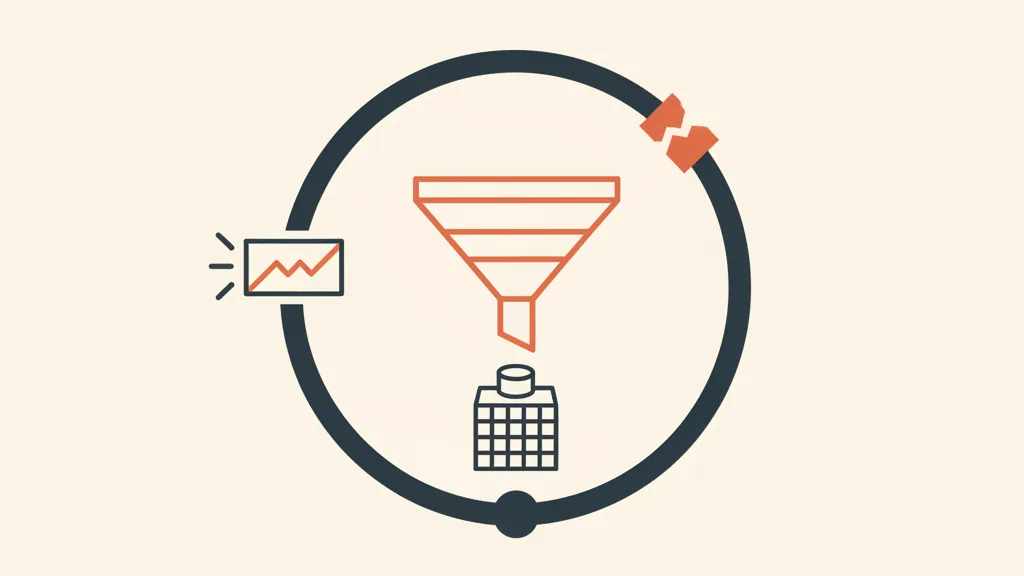
Google Ads as an acquisition engine, not a line item
Pause for a second on the word "acquisition." Google Ads isn't a goal in itself, it's one piece of a bigger machine. The full machine looks like this: ad, landing page, contact, CRM, follow-up, customer, data that flows back into Google. If you only optimize the first link, you've got a funnel you keep pouring water into from the top while it leaks out everywhere else.
That's why it makes sense to think in terms of a customer acquisition system rather than a "campaign." The Google campaign is the fuel; the system is the engine. The right questions aren't "what does the click cost," but three others.
- What does it cost me to acquire a paying customer, not a lead? (CAC, not CPL)
- What is that customer worth over time? (customer lifetime value)
- How many leads am I losing between the click and the sale, and where?
With these three metrics in hand, running Google Ads stops being a question of micro-optimization and becomes a business decision. If a customer is worth 2,000 euros over time and costs me 200 to acquire, I can afford to be aggressive. If I only see it as "80 cents a click," I'm reasoning about the wrong detail.
Search, Performance Max, or Demand Gen? The logic behind the choice
There's no such thing as "the best campaign" — there's the right one for your goal and your data maturity. In short:
- Search (with AI Max): when there's explicit demand, i.e. people are searching for exactly what you sell. High intent, more control. The starting point for almost everyone.
- Performance Max: when you already have a solid flow of conversions and want to scale reach. Great for ecommerce with a feed, but needs supervision. Full comparison in Performance Max vs. Search: which one to choose.
- Demand Gen: for generating demand where none exists yet, with visual formats on YouTube and Discover. Details in our Demand Gen guide.
A common mistake in 2026 is launching Performance Max straight away on a new account with no conversion data. Without signals, the algorithm flies blind and spends wherever it's easiest to get actions, often low-value ones. The right sequence is to build clean data with Search first, then scale.
The messy middle: why the buying journey isn't linear anymore
Google itself calls it the "messy middle": the chaotic phase between the moment someone realizes they have a need and when they actually buy. It isn't a clean funnel. It's back-and-forth made of searches, comparisons, reviews, second thoughts. AI Mode amplifies this behavior: people ask more complex questions and arrive at your site more informed, but also more demanding.
What this means in practice for your campaigns:
- You can't rely on a single click that "closes." You need to be present during exploration and evaluation, not just for people already ready to buy.
- Remarketing isn't a nice-to-have, it's how you stay on the radar while someone is having second thoughts.
- Automated follow-up is what accompanies the contact through the messy middle instead of letting them go cold. A lead who gave you their email but isn't ready today can become a customer three weeks from now, if you nurture them.
This is where the line between "advertising" and "acquisition" dissolves: the campaign generates the contact, but it's follow-up automation that turns them into a customer. Ignore this part and you're paying Google to fill a bucket with a hole in it.
Want Google Ads to bring in customers, not just clicks? Ask us for an analysis of your acquisition system: we connect campaigns, CRM, and automated follow-up into a single flow.
Lead generation with Google Ads: where ROI leaks out (and where you get it back)
For a B2B or service company, the goal of Google Ads is usually generating qualified leads, not direct sales. And here 2026 has a real problem: smart bidding, if set up badly, brings you plenty of low-quality leads. The algorithm optimizes for "conversions," and if you told it a conversion is "form submitted," it fills your inbox with submitted forms — even from people who will never buy, or from bots.
The fix isn't going back to manual. It's teaching the algorithm what a good lead looks like.
- Track quality, not just quantity: distinguish MQLs from SQLs, and report back to Google only the conversions that actually matter (a lead qualified by sales, not every form). See how to stop junk leads in Google Ads.
- Qualify fast: an AI agent that qualifies the lead on WhatsApp within the first few minutes separates the serious buyers from the curious before your sales team even spends time on them.
- Close the loop with your CRM: the real value of each lead flows back to Google and refines targeting. This is the core of a CRM integrated with your sales funnel.
The sequence that works for lead generation in 2026 isn't "more budget" — it's this: a relevant ad, a landing page that converts, fast qualification, a CRM that assigns and nurtures. Every weak link in the chain multiplies your cost per customer. Full details in our guide to lead generation with Google Ads and, more broadly, in our cornerstone resource on B2B lead generation.
Landing pages and Quality Score: the part the AI won't do for you
There's one thing no Google algorithm will ever fix for you: the page where the click lands. A landing page designed to convert raises your conversion rate and, in turn, improves your Quality Score, which lowers your cost per click. It's the one place where manual work still pays off enormously. Don't outsource it.
Account structure and hygiene: the foundation everything else stands on
Even in the AI era, a messy account burns budget. The fundamentals aren't glamorous, but they're decisive.
- Clean tracking: enhanced conversions, consent mode configured, ideally server-side tracking. If the data doesn't arrive, the AI is blind.
- Exclusions and negatives: negative keywords still matter even with AI Max, and in Performance Max you need to exclude brand traffic so you don't inflate results with conversions you'd have gotten anyway.
- The right KPIs: watch the metrics that matter (real CPA, value per conversion, lead-to-client rate), not vanity metrics like impressions.
- Regular audits: an account audit every quarter roots out the waste that automation hides.
Another 2026 theme is cross-channel integration. Google Ads doesn't live in isolation: SEO and Google Ads reinforce each other, and conversion data from one channel makes the other smarter. Thinking in silos is a luxury you can no longer afford.
Where to start: priorities for an SMB or B2B company
If you could only do one thing today, it wouldn't be "rewrite the ads." It would be fixing the link between Google and your CRM. Here's the order of priority that makes sense in 2026.
- Tracking and signals: make sure conversions are accurate and that valuable leads are distinguished from junk ones.
- CRM connection: feed offline conversions back into Google, so the algorithm optimizes for real value.
- Automated follow-up: no lead should ever go cold. Qualification and first contact within minutes, not days.
- Landing page and offer: the high-return manual work.
- Only then — fine-tuning the campaigns themselves (AI Max, PMax, bidding).
This order flips the instinct most companies have, which is to start with the campaigns and neglect the system. But it's exactly why so many companies spend on Google Ads without seeing real customers: they've got a great tap attached to a bucket with a hole in it.
Google Ads in 2026 rewards those who treat advertising as part of an acquisition machine, not a standalone activity. Google's AI does its job well — finding people — but it will never close the loop for you. That's your competitive edge, and it's exactly where we at AstraLoop work: connecting ads, data, CRM, and follow-up automation into a single system that brings in customers, not just clicks.
Frequently asked questions
What is AI Max in Google Ads?
AI Max is an AI-driven extension for Search campaigns: it automatically expands relevant keywords, assets, and landing pages beyond the ones you entered manually, increasing coverage. In exchange it reduces granular control, so it requires clean conversion tracking and well-built exclusion lists to avoid wasting budget.
In 2026, is it still worth picking keywords manually?
Control over individual keyword bids now sits with smart bidding, but keywords — and especially negatives — remain relevant as signals. The manual work that pays off most today has shifted: from bids to the quality of conversion signals, landing pages, and post-click follow-up.
Performance Max or Search campaigns: which should I choose?
It depends on how mature your data is. If you have a new account with no conversion history, start with Search to build clean signals. Performance Max performs best once you already have a solid flow of conversions and want to scale reach across all Google inventory, but it needs to be supervised by excluding brand traffic.
Why is Google Ads bringing me low-quality leads?
Usually because smart bidding is optimizing for a poorly defined conversion, such as every form submission. The algorithm gives you more of whatever you told it to target. The fix is to teach it what a good lead looks like: track quality, distinguish MQLs from SQLs, and feed offline CRM conversions back into Google.
How do I connect Google Ads to my CRM?
Through offline conversions: when a lead becomes a customer in your CRM, that data — along with its value — flows back into Google Ads. That way the algorithm stops optimizing for simple form fills and starts looking for people similar to your real, paying customers. It's the link that turns an account that spends into one that acquires.
How much budget do I need to start with Google Ads in 2026?
There's no universal number: it depends on your industry's acquisition cost and a customer's lifetime value. The right question isn't how much you spend per click, but how much it costs you to acquire a paying customer relative to what that customer is worth. If lifetime value comfortably covers acquisition cost, you can afford to be aggressive.
If you're spending on Google Ads without seeing real customers, talk to us: we'll map out where you're losing leads and build the system that closes the loop between ad and sale.