Zero-Party Data: How to Collect Customer Data in the Post-Cookie Era
8 min read · AstraLoop Studio
For years digital marketing worked like this: you rent an audience from the platforms, a pixel follows people around the web, and Meta or Google tell you who to show your ads to. That mechanism is falling apart. Third-party cookies are disappearing, mobile operating systems are restricting tracking, and privacy regulation keeps raising the wall. The signal you used to take for granted now arrives in fragments.
The answer isn't chasing the latest trick to dodge the block. It's changing where the data comes from. Instead of inferring what a customer wants by spying on their behavior, you ask them. Directly. And they tell you, because in exchange they get something useful. This is zero-party data: information a person shares voluntarily and knowingly with your brand. Preferences, goals, size, budget, the problem they're trying to solve.
The most striking number in this whole story: industry research suggests only about 16% of marketers use zero-party data systematically today. Whoever moves now gets a real competitive edge, not a theoretical one. In this article we'll look at how to collect it with quizzes and forms, and above all how to activate it (the part almost everyone gets wrong) through CRM and AI automation.

Zero-party, first-party, third-party: the distinction that actually matters
Before building anything, you need clarity on the terms, because they get mixed up constantly. If you want an extended definition with examples, we covered it separately in what zero-party data really is. Here's the operational version.
| Data type | Where it comes from | Example | Reliability |
|---|---|---|---|
| Zero-party | The customer states it explicitly | "My goal is to lower cost per lead" | Very high: they're telling you themselves |
| First-party | Behavior observed on your own channels | Pages viewed, products added to cart | High, but needs interpretation |
| Third-party | Bought or rented from outside brokers | Aggregated segments sold by platforms | Low, and going extinct |
The key difference is this: zero-party data isn't something you have to guess. A customer who completes a quiz and tells you "I'm looking for a gift, 50-euro budget, for someone into sports" has just handed you three segmentation variables that no tracking algorithm could ever give you with the same precision. It's the natural complement to first-party data collected on your own channels: the two work together, with zero-party as the declaration and first-party as confirmation in actual behavior.
Why now: post-cookie isn't a slogan
The issue isn't "cookies will disappear someday." It's that the signal your campaigns are built on is already degrading. Cross-site tracking keeps getting more restricted, attribution gets murkier, and acquisition costs climb precisely because platforms are working with less information. We covered this from the advertising side in the limits of modern attribution.
There's a second, less obvious reason. The AI systems that today optimize campaigns, personalize emails, and score leads need clean inputs. The dirtier or more inferred the data, the worse they reason. Zero-party data is the cleanest input there is, because it isn't a statistical guess: it's a statement. In an era where AI becomes the engine of activation, the quality of the data going in determines the quality of everything that comes out.
How to collect it: quizzes, forms, and a fair value exchange
The rule that holds everything together: nobody fills out a form to do you a favor. Every collection mechanism has to return immediate, visible value in exchange for the information. Ask without giving, and you get empty fields or fake data. Here are the formats that actually work.
The "find your X" quiz
The king of zero-party data formats. The customer answers 4-6 questions and in return gets a personalized recommendation: the right product, the right routine, the tailored package. The most cited example is L'Oreal's "Routine Finder," a quiz that pushed average order value up precisely because the final recommendation was relevant. It's not magic: asking "what's your skin type?" delivers value (the recommendation) and captures data (the segment) at the same time.
- E-commerce: "Which size/model is right for you?" with a final product suggestion.
- B2B services: "What's your main acquisition bottleneck?" with a report or recommended path.
- Local business: "What kind of treatment are you looking for?" with a proposal and the option to book.
Preference centers and optional fields
At newsletter sign-up or account creation, ask (with optional, not mandatory, fields) for the two or three things you actually need for segmentation. Not twenty. Two. A preference center where the customer picks interest categories and email frequency is a goldmine: you do them a favor (less irrelevant spam) and they tell you exactly what they want to receive.
Sales-stage questionnaires
In B2B, the qualification questionnaire is zero-party data in its purest form. The answers a prospect gives you about budget, timeline, and goals are declared data that goes straight into the CRM. We dedicated a guide to how to use a questionnaire to sell: the same tool qualifies and collects data in one move.
Post-purchase surveys and micro-questions
After a purchase, a single question ("What did you buy this product for?") gets high response rates because the customer is already engaged. Star ratings, sliders, and mini social polls are also lightweight zero-party data. The key is low friction: one question at a time, never the mile-long survey.
The real bottleneck: activating the data, not just collecting it
This is where 90% of projects fall apart. Companies launch a nice-looking quiz, collect thousands of responses, and then those responses sit parked in a spreadsheet or inside the quiz tool. Data collected, value zero. Zero-party data is only worth something if it flows back into the marketing and sales engine and actually changes what that customer sees and receives.
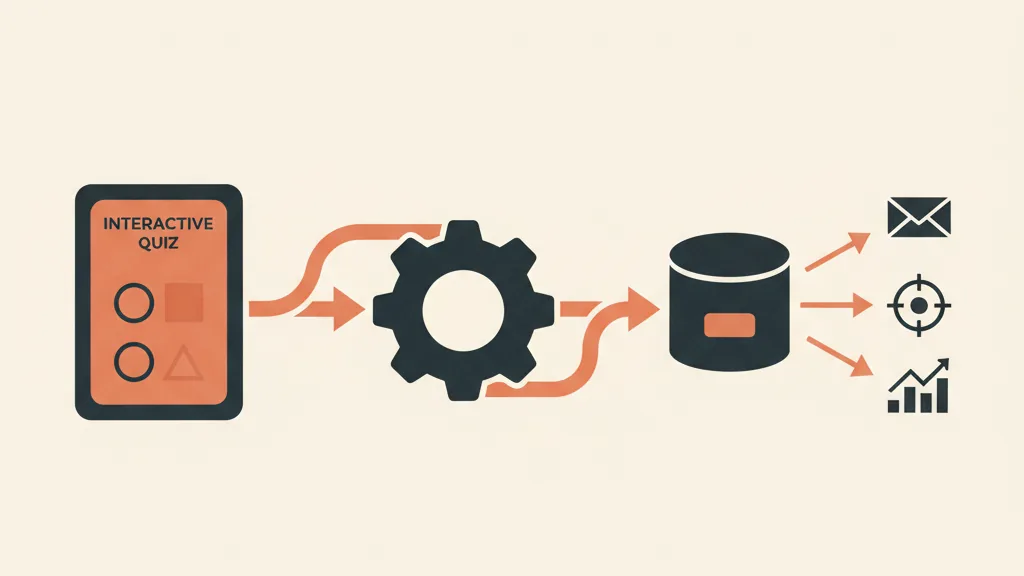
Activation means three things: getting the data where it needs to go, using it to personalize, and keeping it current. This is exactly the angle we care most about at AstraLoop: collection is the easy part, automated activation is where the return gets generated.
1. The data has to flow into the CRM in real time
When someone completes the quiz, the answers need to land automatically in the CRM as structured fields, not as free text someone has to retype by hand. "Goal = lower CPL," "Budget = mid-range," "Industry = services" become tags and properties on the contact. An automation (via n8n, Make, or a native integration) bridges the form and the CRM with no human involvement. If the data doesn't flow in automatically, it doesn't flow in at all: nobody has time to transcribe answers.
The most solid model treats zero-party data as the source of truth for who the customer says they are, and first-party behavior as confirmation. Declared data anchors database segmentation; behavior enriches and validates it.
2. Segmentation and lead scoring driven by declared data
Once the answers are in the CRM, every contact can be segmented on real variables, not proxies. A prospect who declared a high budget and an urgent goal jumps to the top of the sales list. An AI-powered lead scoring system works better when its inputs are explicit statements instead of ambiguous behavioral signals: it assigns more accurate scores, and salespeople call the right people first.
3. Personalization at scale with AI
The biggest payoff. With zero-party data, the email a customer receives can mirror exactly what they declared. Someone who said "I'm looking for e-commerce solutions" gets e-commerce case studies and offers; someone who said "local services" gets something entirely different. Done by hand, this doesn't scale. Done with AI-driven personalization connected to CRM fields, it scales to thousands of contacts while keeping one-to-one relevance. Industry numbers back this up: campaigns that leverage zero-party data report higher open rates and significantly better click and conversion rates than generic sends.
4. Advertising activation without a pixel
Emails collected through a quiz can be uploaded into Customer Match audiences on Google and Meta. The ad message mirrors what the person declared they wanted — a level of relevance old cookies could never deliver. It's the logic behind the first-party strategy on Google Ads: building your audience from your own proprietary data instead of renting it.
Want to turn the data your customers hand you into sales, not rows in a spreadsheet? Request an analysis: let's look together at how to connect collection, CRM, and AI automation for your specific case.
GDPR: why zero-party data is the most solid approach on privacy
An important note, informational only (not legal advice). EU Regulation 2016/679 (GDPR) requires consent to be freely given, specific, informed, and unambiguous. Zero-party data is born almost by definition inside these requirements: it's the customer actively completing the quiz knowing exactly what they're doing. Unlike silent cookie tracking, the act of sharing here is explicit.
The usual obligations still apply: a clear notice on how you'll use the data at the moment of collection, the correct legal basis, and the ability to update preferences or withdraw consent. The preference center isn't just a marketing tool: it's also the place where the customer exercises control over their own data, something Italy's Data Protection Authority (Garante Privacy) views favorably. In practice, the most privacy-respectful path is also the one that generates the best data. That's not a coincidence: it's the whole point of the post-cookie era.
Where to start: a four-step path
You don't need to overhaul everything. The minimum viable version is small and concrete.
- Pick a question that's worth asking. Identify the two or three pieces of information that would genuinely change how you treat a customer. Don't collect data you wouldn't actually use.
- Build one collection mechanism. A quiz or a preference center, with a clear value exchange. Start with one, do it well.
- Connect collection to the CRM automatically. The automation that pushes answers into the CRM as structured fields is the piece that makes everything operational.
- Activate on one channel. A personalized email sequence built on declared segments is the first measurable return. Scale from there.
Zero-party data isn't the latest marketing fad. It's how customer acquisition will work once cookies are gone: building direct relationships where the customer tells you what they want and you, thanks to CRM and AI automation, actually deliver it. If you're rethinking your customer acquisition system for a post-privacy world, this is the asset to start from, because it's the one thing no platform can ever take away from you.
Frequently asked questions
What's the difference between zero-party data and first-party data?
Zero-party data is declared: the customer tells you explicitly (preferences, goals, budget) through quizzes, questionnaires, or preference centers. First-party data is observed: you infer it from behavior on your own channels (pages viewed, purchases). The first is more reliable because it needs no interpretation; the second confirms it in practice. Together they form the ideal post-cookie foundation.
How do you collect zero-party data in practice?
The most effective formats are 'find your product/service' quizzes (4-6 questions with a personalized recommendation in return), sign-up preference centers, sales-stage qualification questionnaires, and post-purchase micro-surveys. The golden rule: low friction and a clear value exchange. Nobody fills out a form to do you a favor — you need to give something useful in return.
Is zero-party data GDPR-compliant?
Yes, and it's actually among the most solid approaches from a privacy standpoint. The GDPR (EU Regulation 2016/679) requires consent that is freely given, specific, informed, and unambiguous: zero-party data is born within these requirements because the customer shares it actively and knowingly. The usual obligations remain — a clear notice at the point of collection and the ability to update or withdraw preferences. This is informational content, not legal advice.
Why does zero-party data matter more in the post-cookie era?
Because third-party cookies are disappearing and behavioral tracking is degrading, making attribution and targeting increasingly opaque. Data the customer declares directly becomes the most reliable signal left. On top of that, the AI systems that personalize and optimize work better with explicit, clean inputs than with statistical guesswork.
How do you activate zero-party data once it's collected?
Activation is the part almost everyone gets wrong. The data needs to flow automatically into the CRM as structured fields (via n8n, Make, or native integrations), feed segmentation and lead scoring, drive AI-powered email personalization, and build audiences for Google/Meta Customer Match. Collecting without activating just means data parked in a spreadsheet and zero value.
How much does zero-party data actually improve performance?
Industry research reports higher email open rates and significantly better click and conversion rates than generic sends, with some cases citing meaningful lifts in average order value and audience ROAS. The numbers vary a lot by industry and should be verified against your own data, but the direction is clear: the more the message mirrors what the customer declared, the better it converts.
If you're rethinking customer acquisition for the post-cookie era, let's talk: we design the zero-party data collection and activation path tailored to your business.