AI Voice Assistant vs Chatbot: When You Need a Voice and When You Need Text
9 min read · AstraLoop Studio
The question almost always comes in the same form: "Is it better to have a voice assistant answer the phone, or a chatbot on the site?". The honest answer is that you're comparing two tools that solve different problems, at different moments, for customers who expect different things. It's not a contest. It's a choice of channel.
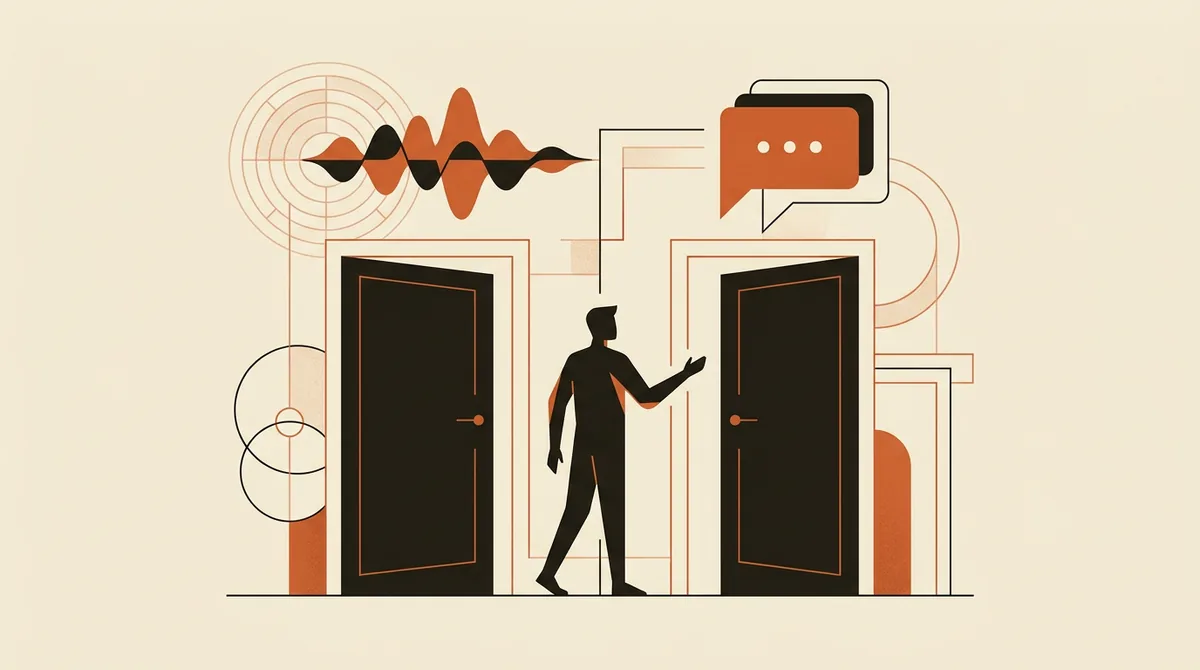
A chatbot lives in text: WhatsApp, website, forms, Messenger. An AI voice assistant lives in voice: the phone ringing while you're with a customer, at 9:30pm, on a Sunday. They're two doors into your business, and the customer picks whichever one matches how much of a hurry they're in, how complex their request is, and where they happen to be.
In this article we split the two channels properly: what each one does, when voice wins, when text wins, roughly what each costs, and how to make them work together instead of choosing between them. Because the real question isn't "voice or chat" — it's "how do I avoid losing the customer no matter which door they pick."
The real difference: it's not the technology, it's the context
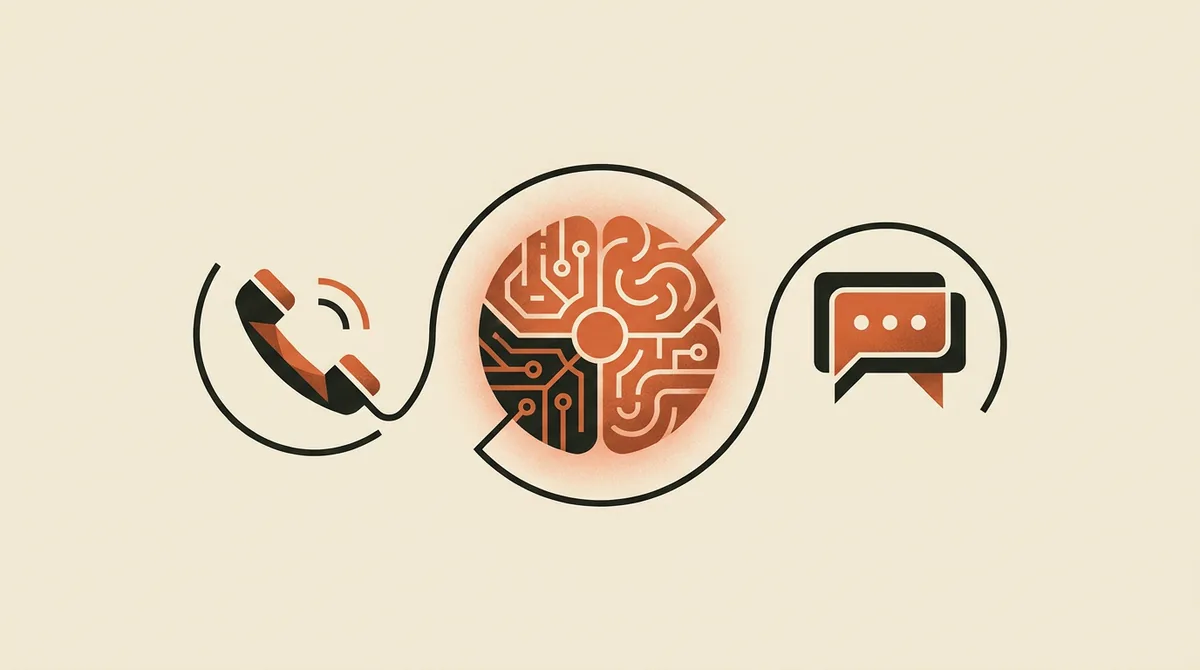
Under the hood, a modern AI chatbot and an AI voice assistant share the same brain: a language model that understands the request, checks a company knowledge base, and formulates a response. The difference sits at the edges — in how the customer enters and exits the conversation.
The chatbot receives text and returns text. The AI voice assistant has to do two extra, delicate steps: turn voice into meaning (speech-to-text) and meaning into natural-sounding voice (text-to-speech), all in real time while the person on the other end talks, interrupts themselves, changes their mind. If you want the full mechanics behind the voice, we covered it in how an AI that answers the phone actually works.
This technical difference has a huge practical consequence on customer expectations:
- On the phone, the customer doesn't wait. If the AI takes two seconds to reply, it sounds broken. Voice conversation in 2026 runs under 320 milliseconds of latency and handles interruptions (so-called barge-in: you talk over it and it stops). Below that threshold it feels human; above it, it feels like a 2000s-era IVR.
- In chat, the customer tolerates waiting. A "typing…" indicator for three seconds is normal. You can show buttons, links, images, a product carousel. Chat is a visual channel; voice is a linear one — one thing at a time, in order.
Disasters happen when someone mixes up these two worlds: chatbots that "read out" ten-item phone menus, or voicebots that try to dictate a long URL. Each channel has its own grammar.
When you need voice (and text isn't enough)
Voice wins whenever the customer already has the phone in hand and wants to solve something now. These are high-intent, low-patience situations.
1. Bookings and appointments for local businesses
Restaurants, medical practices, beauty salons, hairdressers, gyms, repair shops. Whoever calls wants a table, an appointment, a haircut, a quote. And they often call outside business hours, when the front desk is closed. An AI voice assistant answers 24/7, checks the calendar, and books the appointment without letting the phone ring out. In healthcare this cuts no-shows by up to 70%, because the AI also handles reminders and cancellations. We've written dedicated guides for medical and dental practices, restaurants, and beauty salons and hairdressers.
2. When a missed call means real money
For a small local business, every unanswered phone call is a customer calling your competitor instead. It's not an annoyance, it's revenue walking out the door. If you've never put a number on those calls, it's worth reading what a missed call actually costs and the reasons businesses lose customers on the phone. A chatbot on your website doesn't catch someone who's already calling you: that customer has chosen voice.
3. Age group and comfort with technology
There's an audience that will never open a chat window: people over 65, anyone who isn't comfortable with a smartphone, anyone who calls because it's faster than typing. For these people, voice isn't an alternative to chat — it's the only channel. The old objection "but can it understand older people and dialects?" is much less valid today than most people assume: we tackle it head-on in AI voice, dialects, and older users.
When you need text (and voice would be wasted)
The chatbot wins whenever the conversation is visual, asynchronous, or full of information that's better seen than heard.
1. Support on the website and on social media
Someone browsing your site or messaging you on Instagram is already in text mode. They want to compare two products, get a link, see a photo, have an address written out they can copy. A chatbot on WhatsApp Business handles all of this naturally, and the conversation can stay open for hours: the customer replies whenever they want.
2. Complex requests with lots of data
Order codes, IBANs, email addresses, comparison tables, forms. Trying to dictate an alphanumeric code over the phone is frustrating for everyone. In chat, you just paste it. For handling repetitive requests in a structured way, AI-powered customer care automation almost always works better on a text channel.
3. Cost and high volumes
At equal volume, text costs less than voice, because you're not paying for conversation minutes, speech synthesis, and telephony. If you handle thousands of simple, repetitive requests a month, the chatbot has a lower cost per interaction. For a sense of the numbers, we have two reference points: what an AI chatbot costs and what an AI voice assistant costs.
Voice vs text at a glance
| Criterion | AI voice assistant | AI chatbot |
|---|---|---|
| Entry channel | Phone, call | Website, WhatsApp, social, forms |
| Speed expectation | Immediate (<320ms), zero wait | Tolerant, even asynchronous |
| Type of conversation | Linear, one thing at a time | Visual (links, images, buttons) |
| Typical moment | After hours, on the go, urgent | While browsing, on social media |
| Ideal audience | People in a hurry, over 65, local | People comparing options, digital-first, complex data |
| Cost per interaction | Higher (minutes + telephony) | Lower |
| Strong use case | Bookings, appointments, missed calls | Support, FAQs, lead qualification |
The right way to read this table isn't "pick the better column." It's "my customer comes in through both columns, and I need to cover both."
Not sure whether your business needs voice, text, or both? Tell us how your customers reach you today and we'll tell you where you're losing contacts: request a free analysis.
The omnichannel approach: stop choosing
The real leap forward happens when the two channels share the same brain and the same memory. A customer calls to book, the voice AI sets the appointment, and the next day they get a confirmation on WhatsApp handled by the same system. Or they start a chat on your site, don't finish it, and get called back by the voice AI. The customer doesn't perceive two different bots: they perceive your business, consistent across every door.
Making this work takes two technical ingredients:
- A single knowledge base. Hours, price lists, services, booking rules need to live in one place, so voice and text say the same thing. This is the principle behind the company knowledge base that powers the AI.
- Integration with CRM and calendar. Whether the contact comes from voice or chat, it needs to land in the same HubSpot, Salesforce, or Google Calendar, with no duplicates. This is the real purchase driver for B2B, and we explain it in how to integrate an AI voice assistant with your CRM.
There's also a theme that applies to both channels: handing off to a human agent when the AI doesn't know the answer. A good system doesn't pretend to know everything: it recognizes its limits and passes the ball, in chat as much as in voice. That's what turns automation from a risk into a reassurance.
An obligation that applies only to voice (not to chat)
There's an important regulatory difference between the two channels. Italian Law 132/2025 introduces the obligation to disclose to the user that they're speaking with an artificial intelligence system, and the EU Regulation 2024/1689 (AI Act) introduces transparency obligations, starting August 2, 2026, for systems that interact with people. In practice: when an AI answers the phone, it has to say so. The same principle applies to chat, but voice is the more delicate case, because the person on the other end has no way to "see" that it's a bot.
This isn't a technicality — it's a requirement to design in from the start. We've dedicated two in-depth articles to it: the obligation to disclose AI on the phone under Law 132/2025 and the AI Act 2026 obligations for SMEs. This article is for informational purposes: for the legal specifics of your situation, check with a professional. The official sources remain the AI Act (EU Regulation 2024/1689), the Italian Data Protection Authority (Garante Privacy) for handling recordings, and the ACN for security matters.
How to decide for your business
Start from the right questions, not from the technology:
- Where do your customers come from today? If the phone keeps ringing and goes unanswered, start with voice. If you get messages on social media and requests from your website, start with chat.
- How much is a lost request worth? A medical appointment or a booked table is worth far more than an FAQ about a return. Where the value is high and the channel is the phone, voice pays for itself quickly.
- How complex are the requests? A lot of information to see and compare pushes you toward text. Short, repetitive requests ("are you open tonight?") work perfectly well in voice.
If you're an SME and don't know where to start, the big picture is in our AI phone system for SMEs guide, while for the broader context of AI adoption we have the guide artificial intelligence for SMEs. If instead you want the complete, technical picture of how a phone assistant is actually built, the complete guide to the AI phone system is where everything else starts.
The practical takeaway is simple: in 2026, the smart choice isn't voice versus text. It's putting a door where the customer knocks, and making sure that behind every door is the same business, with the same memory and the same answers. Voice captures the person in a hurry who calls. Text captures the person comparing options who writes. Omnichannel captures both.
Frequently asked questions
Is an AI voice assistant or a chatbot better for my business?
It depends on where your customers come from. If they call you and get no answer (typical for restaurants, medical practices, beauty salons), start with voice. If you get requests from your website and social media, start with a chatbot. Many businesses end up using both, with an omnichannel approach.
Can a chatbot also handle phone calls?
No. A chatbot works on text (website, WhatsApp, social media). To answer the phone you need an AI voice assistant, which adds real-time speech recognition and voice synthesis, staying under 320 milliseconds of latency to sound natural.
Does an AI voice assistant cost more than a chatbot?
Usually yes, at equal volume, because voice includes conversation minutes, speech synthesis, and telephony. A chatbot has a lower cost per interaction. Voice, however, pays for itself when each missed call is worth a lot (an appointment, a booking).
Can voice and chat work together?
Yes, and it's the best approach. When they share the same knowledge base and the same CRM, the customer gets consistent answers across every channel: they book by phone and get the confirmation on WhatsApp from the same system, with no duplicate data.
Do I have to disclose that an AI is answering the phone?
Yes. Italian Law 132/2025 and EU Regulation 2024/1689 (the AI Act, with obligations starting August 2, 2026) require transparency: the user needs to know they're interacting with an artificial intelligence system. For your specific situation, check with a professional.
Does an AI voice assistant understand older people and dialects?
Much better than it did a few years ago. 2026-generation systems handle regional accents and non-standard speech reliably, and know how to hand off to a human agent when they don't understand. It's still the ideal channel for people who don't use chat.
Want to cover phone and chat with a single, consistent system, integrated with your CRM? Talk to us and we'll design the right solution for your industry together.