AI Voice Assistant and AI Phone System: The Complete 2026 Guide for SMBs and Local Businesses
12 min read · AstraLoop Studio
Every call that rings out unanswered at your business is, in all likelihood, a customer who's about to call your competitor instead. That's not just a figure of speech. For a local business, a missed call after hours often means an appointment never booked, a quote that never went out, an order that ended up somewhere else. The AI phone system, or AI voice assistant, exists precisely to close this gap: it answers the phone with a natural voice, understands the request, books appointments, provides information, and transfers to a human operator when needed, 24 hours a day.
In this guide, I'll explain what an AI voice assistant really is in 2026, why the technology has stopped sounding robotic, what it costs, who it's for, and — a topic almost nobody addresses seriously in Italy — what you need to do to stay compliant with the AI Act and Italian regulations. This is a long article, meant as a reference: use the table of contents to jump straight to the section you need.
Table of Contents
- What an AI voice assistant is (and what an AI phone system is)
- How it works: speech-to-speech, latency, and barge-in
- Voice AI vs. traditional IVR: routing isn't resolving
- Who it's for: industries and local businesses
- What a missed call is worth (the ROI in euros)
- What an AI phone system costs
- Compliance: the 2026 AI Act, Law 132/2025, and GDPR
- CRM and calendar integration
- The real objections: robotic voice, dialects, older callers, human handoff

What an AI voice assistant is (and what an AI phone system is)
An AI voice assistant is software that answers the phone in place of a person, carries on a natural-language voice conversation, and completes a concrete action: booking an appointment, giving information, collecting a lead's details, or routing the call. It's not a voicemail system and it's not a touch-tone menu. It's a conversational partner that listens, understands, and acts.
The term AI phone system describes the same concept from the business side: it replaces (or works alongside) the classic phone system, the one that today sends callers to voicemail or forces them to press buttons. In marketing language you'll also see "voicebot," "AI receptionist," "AI answering service." These are all variations on the same tool.
The difference from five years ago is enormous. Older voice systems followed rigid scripts and recognized only a handful of preset phrases. 2026's AI voice assistants, by contrast, run on large language models: they understand naturally phrased requests, handle tangents, maintain conversational context, and respond with a voice that, in many cases, is hard to distinguish from a human's.
How it works: speech-to-speech, latency, and barge-in
To understand why "it actually works now," three technical concepts are enough, explained without unnecessary jargon.
Speech-to-speech (voice-to-voice)
Traditional systems worked as a chain: they transcribed your voice into text, processed the text, generated a written response, and finally converted it back into audio. Every step added delay and lost nuance, tone, hesitations, emphasis. The speech-to-speech approach (or native audio-to-audio) processes incoming audio directly and produces audio output, cutting out the intermediate steps. The result is a smoother conversation, with natural intonation and human-like response times.
Latency under 320 ms
Latency is the time that passes between the end of your sentence and the start of the response. In a conversation between people, this gap is typically around 200-300 milliseconds. When a voice system significantly exceeds this threshold, the wait becomes noticeable and unnatural — that annoying feeling of talking "to a robot." Today's AI voice assistants aim to stay under 320 ms, within the window of natural conversation. It's one of the technical reasons perception has shifted so much.
Barge-in (handling interruptions)
Barge-in is the ability to handle interruptions. If you start speaking while the assistant is talking, an advanced system stops and listens to you, exactly as a person would. Older answering systems plowed on with their script regardless — the clearest giveaway that you were talking to a machine. Natural handling of interruptions is what makes a call flow smoothly instead of feeling mechanical.
If these mechanisms interest you, we've also covered them in our article on what AI agents are: a voice assistant is, in every meaningful sense, an agent specialized in the phone channel.
Voice AI vs. traditional IVR: routing isn't resolving
The most common mistake is confusing an AI phone system with an advanced IVR. IVR (Interactive Voice Response) is the classic "press 1 for bookings, press 2 for hours." Its purpose is to route the call to the right department. The AI voice assistant has a different goal: to resolve the request right there, with no handoffs.
The difference is measured by the containment rate, i.e. the share of calls handled from start to finish without human intervention.
| Aspect | Traditional IVR | AI Voice Assistant |
|---|---|---|
| Interaction | Touch-tone menu / a few fixed phrases | Free natural language |
| Goal | Route | Resolve |
| Typical containment | about 30-40% | about 60-80% |
| 24/7 bookings | No (collection or referral only) | Yes, autonomously |
| Updates | Manual reprogramming | Edit the prompt or knowledge base |
These containment figures should be read as indicative ranges, which vary a lot depending on the industry and the complexity of the requests. But the leap is clear: you go from a tool that sorts calls to a tool that closes the loop.

Who it's for: industries and local businesses
An AI phone system delivers the most value where call volume is high, repetitive, and concentrated on bookings or standard information. Here are a few industries where it works particularly well.
- Medical and dental practices, multi-specialty clinics. 24/7 bookings, waitlist management, appointment reminders. Operators in the sector report no-show reductions of up to 70%, because the assistant calls back, confirms, and refills freed-up slots. Dedicated healthcare platforms already exist.
- Restaurants. Table bookings after hours, handling evening peaks when staff are on the floor, upselling (tasting menus, events). A phone ringing while you're serving tables is money left on the table.
- Beauty salons, hair salons, gyms, and wellness businesses. A local segment often overlooked by vendors, yet with a very high density of after-hours phone bookings. Here the voice assistant becomes a genuine competitive edge.
- Repair shops, car dealerships, and showrooms. Booking servicing appointments, handling quote requests, qualifying interest in a car. If you're in the automotive business, this connects to our work on lead generation for car dealerships.
- Professional practices (law firms, accountants, consultants). Call screening, structured collection of client needs, booking the first appointment. We go deeper on this in our guide to lead generation for professional firms.
The common thread is always the same: wherever a missed call equals a lost customer, the AI voice assistant has a concrete use case. For an overview geared toward neighborhood businesses, we've gathered these cases in a dedicated hub on systematic customer acquisition strategies.
What a missed call is worth (the ROI in euros)
Many vendors promise "24/7" but never quantify the return. Let's do it ourselves, with a calculation you can replicate on your own numbers.
Imagine a beauty salon that gets 40 calls a day. Say 25% come in after hours or when the staff member is busy: that's 10 calls a day going to voicemail. And of those, in practice, a good chunk never call back. If just 3 calls a day represented a missed booking with an average ticket of €50, that's €150 a day. That works out to roughly €3,000-4,000 a month in revenue that simply never comes in.
The math is deliberately conservative, but it makes the point: the cost of an AI phone system (we'll get to that shortly) is almost always a fraction of the value it recovers. The same reasoning about the "value of a missed call" is what we apply when calculating cost per lead in a campaign: every unhandled contact has a price, even when you don't see it on the balance sheet.
To estimate your own case, you just need three figures: average calls per day, the percentage that go unanswered, and the average value of a conversion (appointment, order, quote). Multiply them and compare against the subscription fee. For most local businesses, the math favors automation as early as the first month.
Want to know what the calls you're missing every month are really costing you? Request a free analysis: we'll start from your real numbers and tell you whether an AI phone system makes sense for your business.
What an AI phone system costs
Prices vary quite a bit depending on volume, complexity, and integrations, but we can give you realistic ranges to get your bearings. There are typically three cost items.
| Item | What it covers | Indicative range |
|---|---|---|
| Initial setup | Configuration, training on your business, integrations, testing | one-time, from a few hundred to a few thousand euros |
| Monthly fee | Platform, phone number, maintenance, updates | from a few tens to a few hundred euros a month |
| Per-minute usage | Actual conversation minutes handled | a few cents per minute |
The variable that matters most is volume: a business with 20 calls a day and a multi-specialty clinic with 400 have very different needs — and costs. Be wary of anyone quoting a single flat price without asking how many calls you get and what they need to accomplish. A serious vendor starts from your numbers, not a pre-packaged price list. We go deeper on pricing models in a dedicated article in this cluster.
Compliance: the 2026 AI Act, Law 132/2025, and GDPR
This is the point that almost no Italian competitor addresses openly, yet it's the first thing you should clarify before switching on an AI phone system. One necessary caveat: what follows is for informational purposes and doesn't replace legal advice on your specific case.
The transparency obligation
The core principle is simple: the caller has the right to know they're talking to artificial intelligence, not to a person. You can't let the caller believe they're speaking with your receptionist. The assistant must state this clearly at the start of the conversation.
This transparency obligation, for AI systems that interact directly with people, is set out in the AI Act (EU Regulation 2024/1689), Europe's regulation on artificial intelligence. Its provisions come into force in stages: transparency obligations for systems that interact with users fall among those applying in the phase culminating around August 2, 2026. On the Italian side, Law 132/2025 (the national law accompanying the AI Act's implementation in Italy) reinforces these transparency and protection principles. Always check current deadlines and texts against official sources before making decisions.
Data processing (GDPR)
Every call handled by a voice assistant processes personal data, and if the conversation is recorded or transcribed, the issue becomes more sensitive. In practice, without mincing words:
- You must inform the caller if the conversation is being recorded, and for what purpose.
- You need a legal basis for the processing and, where required, consent.
- You need an agreement with the vendor designating them as data processor, with guarantees on where the data resides.
- The principles of data minimization and limited retention apply: record only what's needed, for as long as needed.
The key references to keep in mind are the GDPR (EU Regulation 2016/679), guidance from Italy's Data Protection Authority (Garante), and, on the AI side, the broader European framework. A vendor that builds the service as "voice AI compliant by design" — meaning transparency and privacy are baked in from configuration onward — will save you plenty of headaches. We've written a deeper piece on 2026 AI Act obligations for SMBs, which I'd recommend reading if you're considering adoption.
CRM and calendar integration
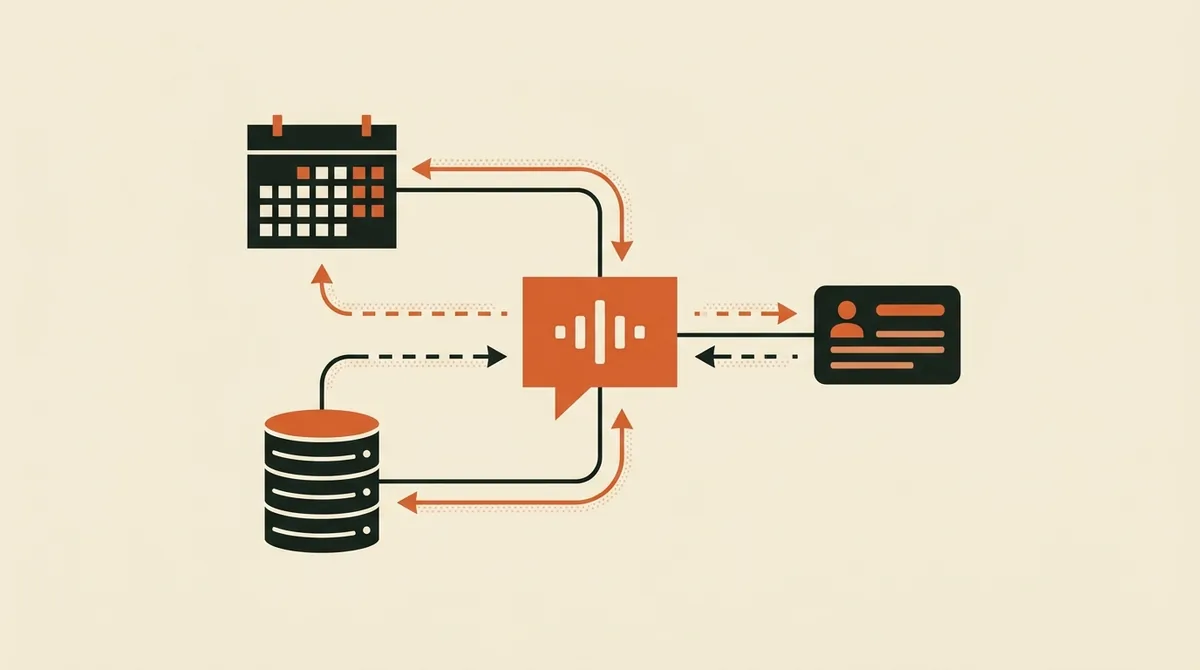
This is where the real difference between a toy and a working tool plays out. A voice assistant that answers but doesn't write anything down anywhere is worth half as much. The decisive lever is integration with the systems you already use:
- Calendar (Google Calendar, Microsoft 365 / Outlook): the assistant sees open slots and books in real time, with no double bookings.
- CRM (HubSpot, Salesforce, and industry-specific software): every call becomes a structured contact, with name, request, and outcome, ready for follow-up.
- Vertical practice-management software: booking software for medical practices, restaurants, salons. Integration with the software the customer already uses is often the factor that unlocks the purchase decision.
When the assistant writes directly into the CRM, the call stops being an isolated interaction: it becomes the first link in a sales process. It's the same principle behind business process automation with AI and solid lead qualification work: data collected on the phone needs to flow, not sit on a sticky note.
The real objections: robotic voice, dialects, older callers, human handoff
Let's tackle the questions you're already asking, without pretending they don't exist.
"It'll sound robotic"
With speech-to-speech and latency below the perceptible threshold, 2026's voice sounds natural in the vast majority of cases. Edge cases remain (heavy background noise, poor phone lines), but the gap from the answering systems of the 2000s is enormous. The honest test is to try a demo with your own real use case.
"What about dialects? What about older callers?"
Today's models handle spoken Italian with regional inflections and varying speeds well. With older or less tech-savvy callers, good practice is to design the assistant to speak slowly, confirm key steps, and transfer to a human operator at the first sign of difficulty. It's not an insurmountable technological limit — it's a configuration choice.
"What happens when the AI doesn't know how to answer?"
This is where human handoff comes in — transferring the call to a human operator. A well-designed system recognizes when it's outside its scope (a complex request, an irritated customer, an unforeseen case) and passes the call to a person, or collects the details and promises a callback. An AI phone system shouldn't replace humans 100%: it should handle the repetitive 80% and free up people for the 20% that really matters. A vendor who promises you "zero human intervention" is selling you an illusion.
In summary: where to start
The AI voice assistant in 2026 is mature: natural voice, human-like response times, interruption handling, calendar and CRM integration. It's most valuable for local businesses where every missed call is lost revenue, and it usually pays off within the first few months. The two things not to overlook are compliance (AI Act transparency, GDPR data handling) and a well-designed human handoff.
If you're considering adoption, the right first step isn't picking a platform right away — it's starting from your own numbers: how many calls you receive, how many you miss, what each one is worth. From there, it's just a matter of sizing. For a broader picture of how AI enters a business without leaps in the dark, you'll also find our guide on where to start with artificial intelligence in your business useful, along with the overview on artificial intelligence for SMBs.
Frequently asked questions
Is an AI voice assistant legal in Italy in 2026?
Yes, as long as transparency is respected. The AI Act (EU Regulation 2024/1689) requires that users know they're talking to artificial intelligence, and Italian law (Law 132/2025) reinforces these principles. GDPR obligations also apply to processing and any recording of calls. It's a fully lawful use when configured correctly.
How much does an AI phone system cost for a small business?
It depends on volume, but generally there's a one-time setup (from a few hundred to a few thousand euros), a monthly fee (from a few tens to a few hundred euros), and per-minute usage of a few cents. For most local businesses, the cost is a fraction of the revenue recovered from calls that would otherwise be missed.
Does the AI assistant's voice still sound robotic?
Much less than in the past. Thanks to the speech-to-speech approach and latency under 320 milliseconds, the conversation is smooth and naturally intonated. Edge cases like poor phone lines or heavy background noise remain, but the gap from old answering systems is enormous. The best way to judge is with a demo on your own real use case.
What's the difference between IVR and an AI voice assistant?
IVR (press 1, press 2) is used to route the call to the right department. An AI voice assistant, on the other hand, is used to resolve the request directly, in natural language. You can see it in the containment rate: an IVR handles about 30-40% of calls from start to finish, while an AI voice assistant reaches roughly 60-80%.
What happens when the AI doesn't know how to answer?
Human handoff kicks in: the assistant recognizes it's outside its scope (a complex request, an irritated customer, an unforeseen case) and transfers the call to an operator, or collects the details and arranges a callback. The goal isn't to eliminate people, but to autonomously handle the repetitive part and free them up for the cases that matter.
Does the AI voice assistant integrate with my practice-management software and calendar?
Yes, and it's the most important point. It integrates with calendars (Google Calendar, Microsoft 365), CRMs (HubSpot, Salesforce), and industry-specific practice-management software. This lets it book open slots in real time and turn every call into a structured contact ready for follow-up, with no manual data entry.
If you want to see what an AI voice assistant tailored to your business would look like — compliant and integrated with your tools — let's talk: we'll put together a custom quote, no obligation.