AI for Small Businesses: A Practical Guide with Use Cases and Costs
10 min read · AstraLoop Studio
If you run a small or medium-sized business, AI is coming at you from two directions. On one side, vendors promising to "revolutionize your business"; on the other, your own employees already using ChatGPT on the sly to write emails. Stuck in the middle is you, trying to decide where to put the budget without getting played. That's exactly what this guide is for: understanding what actually makes sense for a company with 5, 20, or 80 people, with real numbers instead of conference slides.
The difference from large enterprises isn't ideological, it's structural. You don't have a ten-person IT department, you don't have months to burn on a proof of concept, and you can't afford to pay a big consulting firm 200,000 euros for a strategy document. You need small projects that pay for themselves within a few months and that one person in the company can actually manage. If you're after the full strategic picture, from governance to ROI, you'll find it in our complete guide to AI consulting for businesses. Here, instead, we go concrete, all in on small businesses.
An honest disclaimer up front: roughly 85% of generative AI pilot projects fail when it's time to scale them. Not because the technology doesn't work, but because people start from the tool instead of the problem. The ones who win do the opposite. If you're not sure where to start, read how to get started with AI in your company first, then come back here for the use cases.
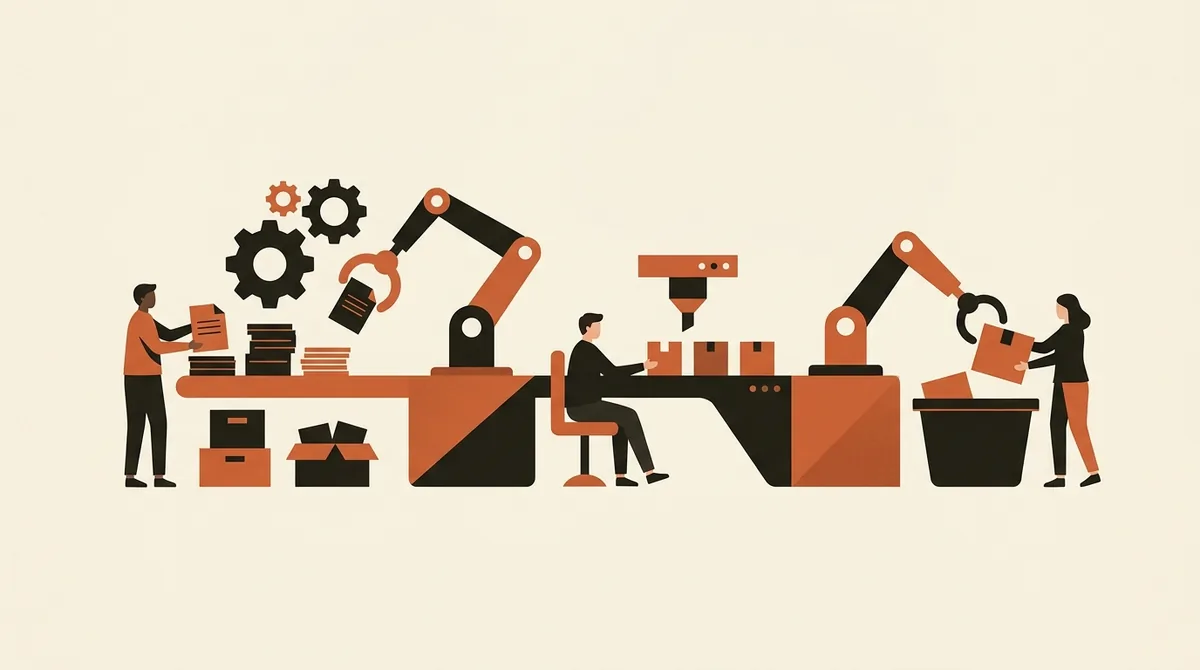
What problems AI actually solves for a small business
Forget the phrase "artificial intelligence" for a second and think about the repetitive tasks that eat up your hours today. In a small business, AI almost always serves one of three purposes: freeing up time on manual tasks, responding to customers faster, or turning the data you already have (emails, documents, chats) into action. Everything else is window dressing.
Here's where Italian SMBs are getting measurable results in 2026:
- Customer support and first-line triage: an assistant that answers frequently asked questions, routes tickets, and hands off only the complex cases to a human. Cuts the load on customer care by 30-50% for repetitive requests.
- Quotes and proposals: generating draft quotes starting from a spec sheet or a customer email. Saves the sales rep hours, since they only need to check and sign off.
- Document reading: automatic data extraction from invoices, delivery notes, contracts, and orders. Here, AI agents read a PDF and populate the management system with no manual data entry.
- Marketing and content: first drafts of posts, product descriptions, newsletters. It doesn't "write everything by itself," but it cuts the time for a first draft in half.
- Customer reactivation: pulling from the database anyone who hasn't ordered in months and building personalized messages. We have a dedicated piece on reactivating dormant customers in your database.
- Lead qualification: filtering incoming contacts and passing only the sales-ready ones to your reps, a topic we cover in depth in AI agents for lead generation.
The real leap in 2026 is the shift from chatbots to AI agents. No longer just tools that answer a question, but systems that read documents, query your CRM or management software, and complete an entire process. An agent can take an order email, check stock availability, generate the confirmation, and update the management system. This changes the rules of the game, but it also raises the bar on oversight, as we'll see.
Quick wins: where to start in the first 90 days
A quick win is a project that solves a real problem, goes live in 4-8 weeks, and pays for itself in under six months. It's not an experiment, it's the first win that tells you whether the whole thing is worth it. The practical rule is simple: pick a process that's high-frequency (happens every day or several times a day), low-risk (if it gets something wrong, no serious damage is done), and has a verifiable output.
Three concrete, realistic quick-win examples for a small business:
| Quick win | Who benefits | Time to go live | Typical payback |
|---|---|---|---|
| FAQ assistant for customer care | Retail, services, e-commerce | 3-5 weeks | 3-5 months |
| Data extraction from invoices and orders | Distribution, manufacturing | 4-6 weeks | 4-7 months |
| Draft quotes and proposals | Professional firms, B2B, systems integration | 4-8 weeks | 4-8 months |
The trap almost everyone falls into is starting from "we want to do AI" instead of "this process costs us 15 hours a week." The pilot fails in 85% of cases precisely because it's born from the technology, not the problem. If you start from the number (hours, costs, errors), you already have the yardstick in hand to measure whether it worked.
There's a second, even more underrated mistake: ignoring the people. The number one cause of pilot failure isn't technical, it's human. If your sales rep doesn't trust the assistant, they'll work around it and you're back to square one. Before you buy any tool, decide who in the company owns it and how you'll train the team. On this front, 73% of companies say AI training is a priority, but only 22% have structured programs in place. And it's exactly in that gap that projects die.

What it really costs: realistic budgets
This is where most guides go quiet, because putting numbers on the table exposes you. We put them on the table anyway, with the caveat that these are indicative ranges and depend on complexity. But they'll give you the order of magnitude so no one can quote you a random figure.
Costs break down into three line items you need to keep separate:
- Initial setup: analysis, integration with your systems, development, and go-live. This is the bulk of the spend in year one.
- Recurring operating costs: AI model usage (the API "calls"), software subscriptions, hosting. Grows with usage.
- Maintenance and monitoring: the line item almost nobody mentions. Models change, processes evolve, and quality can degrade over time (so-called model drift). It needs to be kept under control.
| Scenario | Initial setup | Recurring monthly cost |
|---|---|---|
| Custom FAQ assistant / chatbot | €3,000 - 8,000 | €100 - 400 |
| Document automation (invoice/order reading) | €6,000 - 18,000 | €200 - 700 |
| AI agent integrated with CRM/ERP | €12,000 - 35,000 | €400 - 1,500 |
Two honest points. First: "ready-to-use" tools (subscription plans from SaaS platforms with built-in AI) cost much less than custom builds, often €20-100 a month per user, but they adapt poorly to your processes. The build-vs-buy choice is critical, and we cover it separately in the best AI tools for businesses. Second: be wary of anyone who gives you a quote without having mapped your processes first. The right number comes out of an assessment, not a price list.
How to calculate ROI (without fooling yourself)
AI's ROI isn't magic, it's arithmetic. The formula we use with clients is simple:
ROI = (hours freed up × hourly cost) + extra revenue − total AI costs
Let's work through a concrete example. An FAQ assistant frees up 12 hours a week for customer care, valued at €20 an hour: that's roughly €12,480 a year in recovered time. If the project costs €6,000 to set up plus €200 a month (€2,400 a year), you spend €8,400 in year one and recover €12,480. Payback lands around 8 months, and from there on it's all upside. For well-chosen projects, typical payback runs between 4 and 12 months.
Hours freed up are the easy part to measure. Extra revenue (more quotes closed, more qualified leads, fewer lost customers) is harder to estimate but often weighs more. The point is to define your KPIs before you start, not after. If you don't know what to measure, you won't know whether it worked, and you fall straight into that 85% failure statistic.
Want to know which AI quick win pays back fastest in your business? Request a free analysis of your processes and we'll tell you where it makes sense to start, backed by real numbers.
Incentives and grants: what's available in 2026
Good news: you don't have to fund all of it out of pocket. In Italy there are instruments that cover part of the investment in AI technologies, when it falls under digitalization and innovation projects. Without getting into regulatory detail (the rules change and should be checked with your accountant), the main channels for a small business are:
- Transizione 5.0 Plan: a tax credit for investments in digital and AI-linked assets tied to efficiency projects, with rates that depend on the savings achieved.
- Training tax credit: covers part of the cost of upskilling staff on new digital skills, including AI training.
- Regional and Chamber of Commerce grants: many Italian regions and Chambers of Commerce publish vouchers for digitalization and innovation, often non-repayable for smaller amounts.
- New Skills Funds: support for employee reskilling managed through ANPAL and inter-professional funds.
The practical advice: always check the measure in force at the time of your investment on the official portals (MIMIT for Transizione 5.0, your region's website for local grants), and have your accountant guide you through the tax credit. Incentives don't justify a bad project, but they can make a good one lighter to carry.
The AI Act and the rules: what you need to know even if you're small
This isn't just a matter for law firms, it concerns you too. EU Regulation 2024/1689 (the AI Act) is in force and is being applied progressively. Two practical points for a small business.
First, AI literacy (Article 4): since February 2, 2025, anyone using AI tools must ensure their staff has an adequate level of AI competence. In practice, if your employees use AI tools, you need to make sure they know what they're doing. It's not an abstract bureaucratic requirement, it's minimum training.
Second, during 2026 the rules get stricter as further obligations come into effect, and penalties for the most serious violations run up to €35 million or 7% of global revenue. Small businesses almost always use low- or limited-risk systems, so the heavy obligations rarely apply to you, but you still need to know which risk category your tools fall into. For the full picture on deadlines and requirements, we have a dedicated guide to 2026 AI Act obligations for small businesses.
Tied to all this is the issue of Shadow AI: between 68% and 76% of employees use AI tools on the sly, without the company knowing. That means company data, and sometimes personal data, ending up in unvetted services, with real GDPR risk. The answer isn't to ban it (that doesn't work), but to provide clear policies and approved tools. Better that your people use a tool you've chosen and configured than copy-paste client contracts into some random service.
The 4-phase roadmap to avoid wasting money
Let's close with the method. Small businesses that succeed with AI don't improvise: they follow a precise sequence that keeps both risk and spend under control.
- Assessment: map your processes, identify which ones can be automated, and classify your tools by risk category (useful for the AI Act too). This is where the number comes out: how many hours, how many errors, what it costs today.
- Pilot projects / quick wins: one or two small projects, high value and low risk. The goal is a measurable win within a few months, not total transformation.
- Scale-up: put what worked into production, integrate it with company systems, and train people. This is where the 85% fail, if they skipped the previous steps.
- Ongoing monitoring: keep an eye on KPIs, output quality, and costs. With agents in production you need guardrails and a human supervising critical cases (human-in-the-loop), because when an agent gets something wrong, you need to know how to step in.
The factor that separates the ones who make it from the ones who waste money isn't the budget: it's starting small, measuring, and taking care of the people as much as the technology. A well-executed €6,000 project beats a €60,000 one that started with the wrong tool. If you want to see how all of this fits into a complete process, take a look at business process automation with AI as well.
AI for small businesses isn't about being big or tech-savvy. It's about choosing the right problem, setting realistic numbers, and starting with the quick win that pays back first. Everything else follows from that.
Frequently asked questions
How much does it cost to start using AI in a small business?
A realistic quick win like an FAQ assistant starts at €3,000-8,000 in setup plus €100-400 a month. Ready-to-use tools cost less (€20-100 a month per user) but adapt poorly to your processes. An agent integrated with your management system runs €12,000-35,000.
How long does it take for an AI investment to pay back?
For well-chosen projects, typical payback is between 4 and 12 months. The formula: hours freed up times hourly cost, plus any extra revenue, minus total costs. If the project frees up 12 hours a week, it often pays back in 6-8 months.
Which AI project should you start with?
A high-frequency process (happens every day), low-risk, with a verifiable output. The classic first steps are an FAQ assistant for customer care, automatic reading of invoices and orders, and generating draft quotes.
Does the AI Act apply to small businesses too?
Yes. EU Regulation 2024/1689 has required AI literacy since February 2, 2025 (Article 4): staff using AI tools must have adequate competence. Small businesses almost always use low-risk systems, but they still need to know which risk category their tools fall into.
Are there incentives for investing in AI in 2026?
Yes. The main channels are the Transizione 5.0 Plan (tax credit), the training tax credit, regional and Chamber of Commerce digitalization grants, and new skills funds. Always check the measure in force on the official portals and with your accountant.
Why do so many AI projects fail?
Roughly 85% of generative AI pilots fail at the scale-up stage, almost always because they start from the tool instead of the problem, and because the human factor gets overlooked. If the team doesn't trust the tool, they'll work around it. The fix is to start from a measurable problem and train your people.
If you want an AI roadmap tailored to your small business, with realistic budgets and clear priorities, let's talk: we'll analyze your processes and propose the first project that pays for itself within a few months.