How Much Does an AI Chatbot Cost for Businesses: Pricing and Hidden Costs in 2026
9 min read · AstraLoop Studio
Ask for a quote on an AI chatbot and you'll get numbers ranging from zero to 30,000 euros, with almost nobody explaining why. The real problem isn't the starting price. It's the costs nobody puts in writing: the model's API calls, hosting, and the monthly maintenance needed to stop the bot from giving worse and worse answers after three months. On top of that, there's a deeper confusion. The word "chatbot" today covers two profoundly different things, with prices that differ by an order of magnitude.
In this guide you'll find concrete, verifiable figures, the real cost structure (one-off setup plus recurring spend), and the criteria for figuring out whether you need a basic chatbot or a genuine AI agent. It's part of our series on business process automation with AI, so we'll think in terms of return, not just price lists.
Basic chatbot vs AI agent: why the price jumps 10x
Before the numbers, there's a distinction that determines everything else. It's not marketing spin: these are two different architectures.
A basic (conversational) chatbot answers questions. It takes the user's message, looks up the answer in a knowledge base or generates it with a language model, and returns it. It can tell you opening hours, explain a return policy, answer an FAQ. But that's where it stops. It doesn't touch any system, doesn't execute anything. It talks.
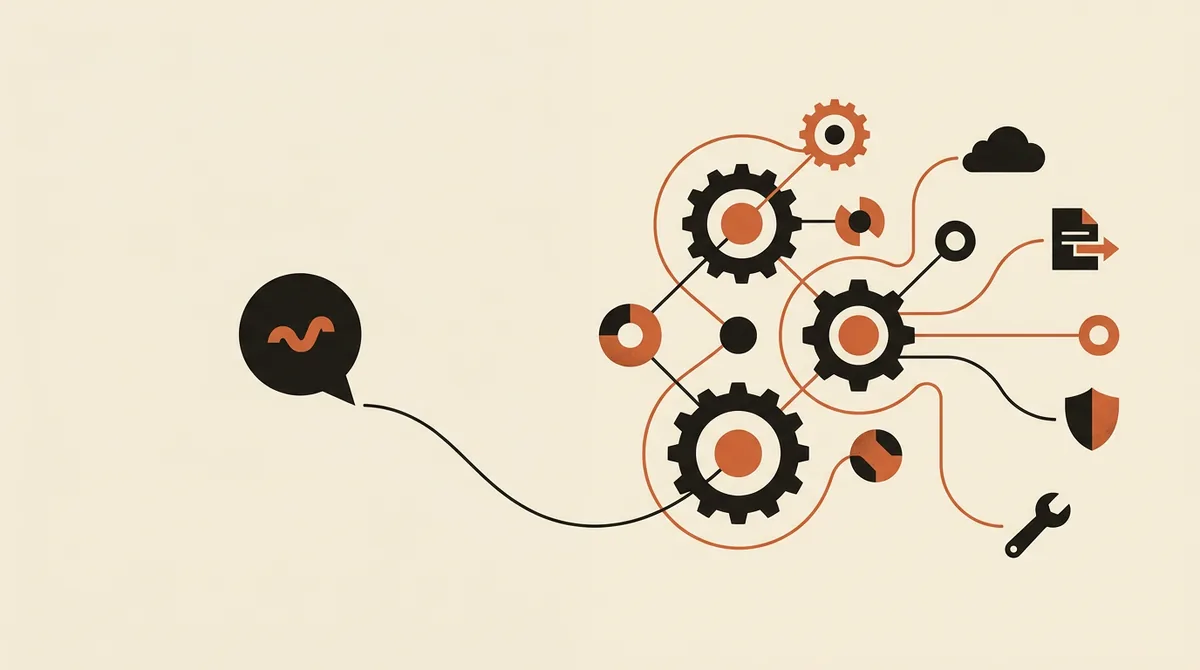
An AI agent acts. Beyond answering, it carries out concrete actions: opens a ticket in your management software, updates the CRM, books an appointment on the calendar, calls a shipping API to track an order, sends a confirmation email. This is the 2026 leap, from AI that talks to AI that does. If you want to go deeper on the architecture, we have a piece dedicated to the difference between a chatbot and an AI agent and another on what AI agents actually are.
Why does it cost ten times more? Because an agent requires integrations with your systems (each one has to be designed, tested, and maintained), serious error handling (what happens if the CRM's API goes down while the agent is mid-write?), and decision logic that goes well beyond "find the answer and return it." A basic chatbot is a content project. An agent is an integration project.
A practical rule of thumb
- You need to answer repetitive questions and cut down support emails: basic chatbot.
- You need something to get done autonomously (bookings, data updates, tickets handled start to finish): AI agent.
- Not sure: start with the basic chatbot and evaluate the upgrade once you've measured real volumes.
How much does an AI chatbot cost: the three price tiers
In the Italian market in 2026, prices cluster into three clear tiers. Here are the real ranges, then we'll break down where the money actually goes.
| Solution | One-off setup | Recurring cost | What it does |
|---|---|---|---|
| Ready-made SaaS (Tidio, Intercom Fin, no-code plugins) | 0 - 500 EUR | 29 - 300 EUR/month | Basic FAQ chatbot, a handful of standard integrations |
| Custom-built chatbot | 2,000 - 8,000 EUR | 150 - 600 EUR/month | Company knowledge base (RAG), tone of voice, 1-2 integrations |
| Operational AI agent | 8,000 - 30,000 EUR | 400 - 2,000 EUR/month | Executes actions, multiple integrations, end-to-end ticket management |
Read this table carefully, because the recurring cost isn't just the software subscription. It includes line items that whoever's quoting you tends to leave out. Let's go through them one by one, because that's where transparency is actually decided.
The hidden costs: what you're really paying every month
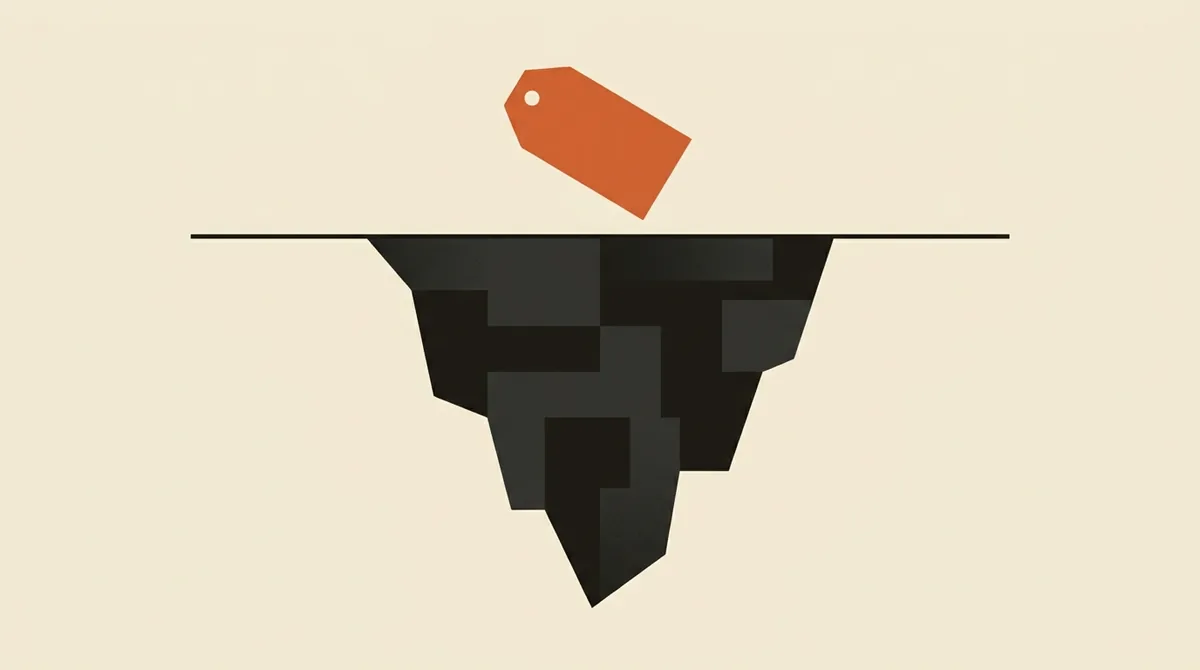
The setup price is just the tip of the iceberg. An AI chatbot has a recurring cost structure made up of four line items. Missing even one of them means blowing your budget by 30-50% by the first quarter.
1. Model API calls (pay-as-you-go spend)
Every conversation consumes "tokens" - chunks of text that the language model reads and generates. You pay per use, not a flat fee. With today's mid-tier models, a typical support conversation costs between 0.003 and 0.02 euros. Sounds like nothing, until you multiply it by volume:
- 500 conversations/month: roughly 2 - 10 EUR in API costs
- 5,000 conversations/month: roughly 20 - 100 EUR
- 50,000 conversations/month: roughly 200 - 1,000 EUR
Two factors make this line item blow up: using a premium model when a cheap one would do, and failing to "trim" the context (if every answer rereads the entire 50-page manual, you're paying for that manual every single time). A good provider uses a model sized to the task and a knowledge base with RAG that retrieves only the relevant chunks, keeping API costs low and predictable.
2. Hosting and infrastructure
The bot has to run somewhere. With a SaaS solution, it's included in the subscription. With a self-hosted custom chatbot (for example orchestrated on n8n, by now the standard for SMBs that want control and GDPR compliance) you're looking at a server running 10 to 80 euros a month, plus any supporting services like databases, queues, and logs. Self-hosting costs a bit more to manage but keeps your data in-house, which is far from a minor point under the EU AI Act and GDPR.
3. Monthly maintenance (the most underestimated line item)
This is the line item nobody puts in the initial quote, and it's the one that decides whether your chatbot will be useful six months in or an embarrassment. A chatbot isn't a website you publish and forget. It needs upkeep:
- Knowledge base updates: you change your price list, your policies, your products. If the bot doesn't know, it lies to your customers.
- Monitoring wrong answers: someone has to read the failed conversations and fix the logic.
- Versioning and model updates: providers update their models, behavior shifts, everything needs re-testing.
- Handling edge cases: off-script questions, attempts to jailbreak the bot, ambiguous requests.
In numbers: a realistic maintenance retainer runs 150 to 500 euros a month for a basic chatbot, and 500 to 2,000 for an AI agent that touches critical systems. If a vendor sells you a chatbot as "set it and forget it," be wary. The "after" is exactly the part that makes the difference, and almost nobody talks about it.
4. Updates and new integrations
Want to add WhatsApp three months in? Connect a new management system? That's extra development hours. Better to settle the hourly rate for extras upfront (in Italy typically 50 - 120 EUR/hour for this kind of work) than to find out once the project is already underway.
Not sure whether you need a basic chatbot or an AI agent that actually takes action? Get a free assessment: we'll look at your real volumes and give you a transparent quote, API and maintenance included.
A realistic total-cost example (custom chatbot, SMB)
Let's put the numbers together for an SMB that wants a custom chatbot on its website and on WhatsApp, integrated with the CRM to log leads. Estimated volume: 3,000 conversations a month.
| Line item | Year one |
|---|---|
| Setup and development (one-off) | 5,000 EUR |
| Model API (roughly 40 EUR/month) | 480 EUR |
| Self-hosted hosting on n8n | 360 EUR |
| Maintenance (300 EUR/month) | 3,600 EUR |
| Year one total | roughly 9,440 EUR |
| Following years (no setup) | roughly 4,440 EUR/year |
Notice the shape of it: the first year is weighed down by setup, and from year two the cost drops and becomes predictable. That's where you assess the return. If the chatbot handles 3,000 conversations a month and resolves 60% of them on its own, that's 1,800 requests that never land on your support team. To put real numbers behind estimates like these, we have a guide on how to measure AI ROI.
What if you need an AI agent? Costs, and when it makes sense
If your goal isn't just to answer but to do (book, update, handle tickets start to finish), you move into the agent tier. Costs rise here because every integration is a project in its own right: connecting to the system, error handling, permissions, logging, and the thorny question of who's accountable when the agent gets a real action wrong. We've dedicated a full guide to how much an enterprise AI agent costs, breaking down projects from 8K to over 30K euros.
The honest rule is this: don't buy a 25,000-euro agent if a 49-euro-a-month SaaS solves your problem. And don't kid yourself that a 49-euro basic chatbot can handle end-to-end bookings on your calendar. The build-vs-buy call has to be made on real volumes and how critical the process is, not on whoever has the nicest brochure.
Signs you need an agent, not a chatbot
- The value isn't in the answer but in the action (booking, order, data update).
- The process spans multiple systems (website, CRM, calendar, management software).
- You want to cut down human operational work, not just emails.
- You have use cases like a 24/7 AI phone receptionist that books appointments, or WhatsApp Business automation with sales logic built in.
How to avoid getting an inflated quote
Five questions to ask anyone pitching you an AI chatbot, before you sign:
- Is the API cost included or on my tab? If it's on you, ask for an estimate based on your real volumes.
- How much is monthly maintenance and what does it cover? It should include knowledge base updates and monitoring, not just "the server stays on."
- Is the data and the code mine? With closed proprietary solutions you risk lock-in: switch providers and you start from zero.
- Is this a basic chatbot or an agent? Get them to spell out exactly which actions it performs beyond answering.
- How do you handle errors, and who's accountable? A serious question, especially for agents touching real systems.
If you're weighing AI for your business more broadly and not just the chatbot, you might find our guide on where to start with AI in your business useful, along with our overview of concrete AI use cases for businesses.
The cost of doing nothing
One last point, the one missing from every quote: the cost of doing nothing. If your team spends 20 hours a week answering the same questions, that's already a cost - you just don't see it on an invoice. A well-built chatbot isn't a technology expense: it's swapping a hidden operational cost for a visible, optimizable one. The right question isn't "how much does an AI chatbot cost," but "how much does the work it could do for me cost today, and how many months until it pays for itself."
Frequently asked questions
How much does a basic AI chatbot cost for a small business?
A ready-made SaaS solution starts at 29-300 euros a month with near-zero setup. A custom chatbot on your own site, with your own knowledge base and tone of voice, costs 2,000-8,000 euros in setup plus 150-600 euros a month across API, hosting, and maintenance.
Why is the API cost billed separately?
Because it depends on your real volumes: every conversation consumes tokens from the language model and is billed per use, not as a flat fee. For 3,000-5,000 conversations a month, you're looking at roughly 20-100 euros. A serious provider gives you an estimate based on your numbers before you start.
What's the price difference between a chatbot and an AI agent?
A basic chatbot answers questions and costs anywhere from a few dozen to a few thousand euros. An AI agent carries out real actions (booking, updating the CRM, handling tickets) and requires integrations: projects run from 8,000 to over 30,000 euros because every connection has to be designed, tested, and maintained.
How much does monthly chatbot maintenance cost?
From 150 to 500 euros a month for a basic chatbot, from 500 to 2,000 for an agent touching critical systems. It covers knowledge base updates, monitoring wrong answers, and re-testing after model updates. It's the most underestimated line item, and at the same time the most important.
Is a 49-euro SaaS chatbot worth it, or should I go custom?
It depends on your volumes and how critical the process is. If standard FAQs are all you need, the low-cost SaaS is the right call. If you need your own knowledge base, integrations with your systems, or operational actions, custom pays for itself quickly because it cuts repetitive human work.
How long until an AI chatbot pays for itself?
For customer care use cases, typical payback is 6-14 months, depending on volume and the share of requests resolved autonomously. The calculation should weigh the chatbot's cost against the human hours it eliminates, not just the subscription fee.
Want a precise number for your case, with no hidden costs? Talk to us: we'll map the process, estimate the recurring costs, and tell you honestly whether a SaaS or a custom solution makes more sense.