Voice AI for Hair Salons and Beauty Spas: Automatic Bookings After Hours
10 min read · AstraLoop Studio
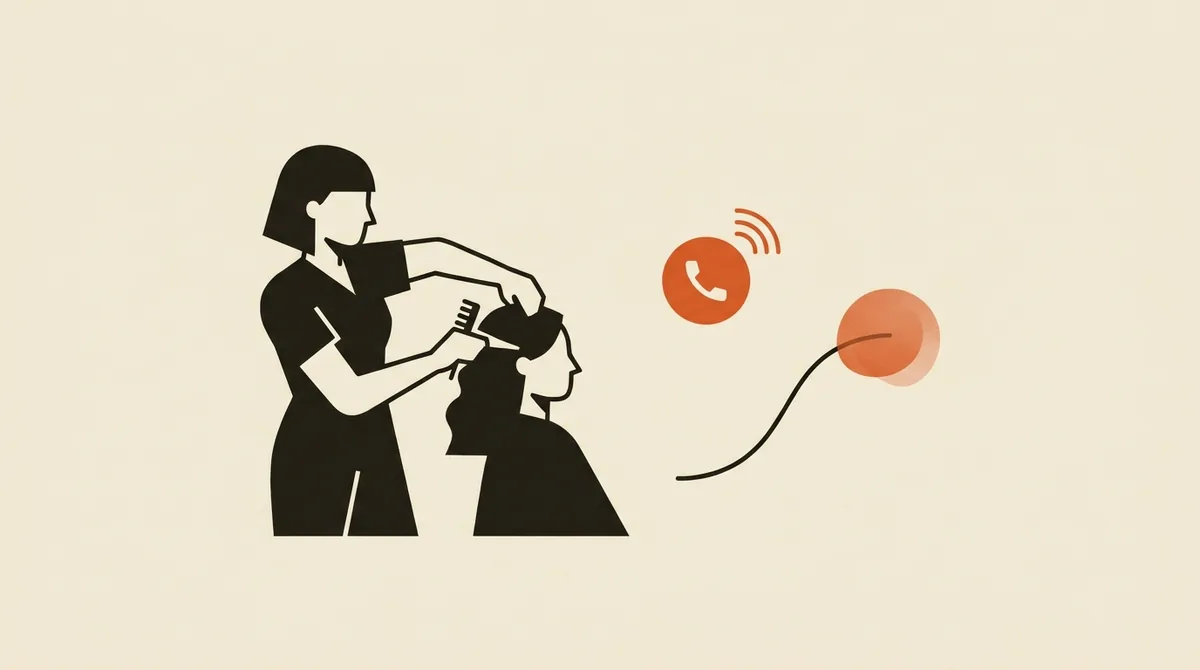
Let's set the real scene, the one you live every day. Your hands are in a client's hair dye, the perm timer starts in two minutes, and the phone at reception rings. It rings three times, four, then stops. No one could pick up. Whoever was on the other end wanted an appointment: they hung up and called the salon two streets over.
This is the reality of the underserved local business: beauty businesses lose clients not because they're bad at what they do, but because staff literally have their hands full. You can't drop a color treatment halfway through to take a booking. And calls don't come in when you're free, they come in when you're mid-treatment, in the evening after closing, on Sunday while the salon is dark.
An AI voice assistant solves exactly this: it answers the phone with a natural voice, understands what the client wants, checks the calendar and books the appointment. Without you having to interrupt anything. In this article we'll look at how this works in practice for a beauty spa or hair salon, what a missed call is really worth in your industry, and what you need to get started.
Why your industry loses more calls than most
Some businesses have someone sitting at a desk whose main job is answering the phone. Not yours. In a salon or beauty spa, whoever's working always has their hands busy: scissors, brushes, wax, equipment. Reception is often not a dedicated role at all, or only exists during certain hours.
The result is that calls pile up exactly when you can't answer:
- During long treatments: a color job or nail reconstruction keeps you occupied for 45-90 minutes during which the phone is effectively off.
- Evenings after closing: many people call on their way home from work, between 7 and 9pm, when you've already pulled down the shutters.
- Sundays and days off: here the call is 100% lost, because there's simply no one there.
- Monday mornings, the typical closing day for hair salons, when someone wanting to book for the week finds the door shut and the phone silent.
If you suspect you're losing revenue without realizing it, we've written a dedicated guide on the phenomenon: why you're losing clients on the phone and what actually causes it. Here we'll stay focused on the beauty vertical.
What a missed call is really worth for a salon or spa
This is the number that "24/7" solution vendors never tell you. They talk about round-the-clock availability but never quantify what you actually recover. Let's do it ourselves, with realistic numbers from your industry.
Take a mid-sized salon. The average ticket for a beauty service in Italy varies a lot: a simple blow-dry runs around 20-30 euros, but a color-plus-cut package reaches 60-90 euros, and a full beauty treatment can go even higher. Let's use a conservative figure of 45 euros per booking.
| Scenario | Missed calls / week | % that would have booked | Revenue lost / year |
|---|---|---|---|
| Small salon | 5 | 60% | ~€7,000 |
| Mid-size salon | 12 | 60% | ~€16,800 |
| Structured beauty spa | 20 | 60% | ~€28,000 |
The math is simple: missed calls per week × 52 weeks × percentage who wanted to book × average ticket value. And we're only counting the first appointment, not the recurring value of a client who would have come back every month for years. A loyal hair salon client is easily worth 500-800 euros a year.
The point is this: a missed call isn't "one contact fewer," it's an appointment never booked that almost always ends up with a competitor. If you want the full calculation method for your specific business, we've detailed it here: what a missed call really costs a local business.
How a voicebot works in a salon, step by step
Forget the image of an automated answering system that makes you press 1 for one service and 2 for another. That's old technology, an IVR, and it only routes calls, it doesn't resolve them. The gap between the two worlds is huge, and we've explained it in voice AI vs. traditional IVR: IVRs retain and resolve 30-40% of calls, an AI voice assistant reaches 60-80%.
A modern voicebot works in speech-to-speech: it hears the client's audio and replies with audio, no robotic intermediate steps. Latency has dropped below 320 milliseconds, meaning the client doesn't notice that unnatural silence that used to give away old synthetic voices. If the client interrupts mid-sentence, the AI stops and listens, exactly as a person would (this is called barge-in handling).
Here's a typical call, in the evening, salon closed:
- It rings and answers immediately. "Salone Chic, good evening, this is the virtual assistant. Please note you're speaking with an automated system. How can I help you?"
- The client says what she wants. "I'd like to book a cut and blow-dry for Friday afternoon."
- The AI checks the calendar in real time. "Friday I have openings at 3:30pm or 5pm. Which would you prefer?"
- It confirms and records. It takes the name, phone number, service type and writes the appointment directly into your booking software.
- It closes the call. "Perfect, we'll see you Friday at 3:30pm. You'll get a reminder by text. Have a good evening."
The next morning you open your booking software and the appointment is already there. You didn't do anything, you didn't lose that client, and you didn't have to pay someone to sit by the phone in the evening.
Want to understand the mechanics under the hood, without the jargon? You'll find it explained in how an AI answers the phone.

"What if it sounds robotic? What about older clients? What about regional accents?"
This is objection number one, and a fair one, and whoever sells you the solution tends to wave it away as "already solved." It's not that simple, so let's tackle it properly.
2026 voices are nothing like the metallic ones from a few years back. They sound natural, with human intonation and hesitations. That said, there are two concrete situations to handle in your industry:
- Older clients. A 75-year-old lady used to talking to the owner in person can feel thrown off. A good system is tuned to speak more slowly, repeat itself when needed, and hand off to a human number if the person is struggling.
- Regional accents and dialects. In many parts of Italy clients don't speak standard Italian. The best systems recognize regional Italian, but it's something to test before going live, not something to assume.
We've dedicated a whole deep dive to this issue, because it's where many solutions fall short: voice AI, dialects and older clients. The golden rule is: when the AI doesn't understand or doesn't know how to answer, it must not make things up, it must hand off to a human cleanly. That's the topic of handoff to a human operator, and it's what separates a serious system from a toy.
Want to know how many appointments you're losing and how much you'd recover with a voice assistant? Ask AstraLoop for a free analysis of your salon or spa.
There's a legal requirement you need to know: disclosing the AI
Almost every competitor skips this part, and yet it's the most important thing to know before activating a voicebot in Italy in 2026.
From August 2, 2026, the transparency provisions of the AI Act (EU Regulation 2024/1689) come into force. In parallel, Italy already has its own reference law, Law 132/2025. What this means for you is simple: when a client speaks to your AI on the phone, she must be clearly informed that she's speaking with an automated system, not a person.
This isn't a legal technicality, it's one sentence at the start of the call (as in the example above: "you're speaking with an automated system"). A serious provider sets this up by default. A sloppy one leaves it for you to sort out, with the risk on your shoulders.
We're not offering legal advice here, but the guidance is clear: before activating, check that your system is compliant by design. We've written two plain-language guides on this: the requirement to disclose AI on the phone under Law 132/2025, and a broader overview of AI Act 2026 obligations for SMEs. The official sources remain the text of EU Regulation 2024/1689 and the guidance from Italy's Data Protection Authority on the data side.
And the privacy of recorded calls?
If the system records or transcribes calls, GDPR comes into play. In plain terms: you need a legal basis for doing so, you must inform the client, and you must store the data securely and only for as long as necessary. You don't need to become a privacy expert, you need a provider who gives you a compliant system and the documentation ready to go. It's a requirement, not an option.
Integration with your booking software: the real lever
A voicebot that takes a booking but doesn't write it down anywhere is useless: you're stuck copying it out by hand, and you've just moved the problem. The real value appears when the voice assistant connects to the calendar and booking software you already use.
In your industry the most common software is a vertical booking system for salons and spas (schedule, client records, inventory), or simply Google Calendar for those running a leaner operation. A good voice assistant reads availability in real time and avoids double-booking the same slot. We explain how this connection is built in how to integrate a voice assistant with your CRM and booking software.
The features that really move the needle:
- Automatic reminders to the client the day before, to cut down on no-shows, the bane of every salon.
- Rescheduling and cancellations handled by phone, so the freed-up slot becomes bookable again right away.
- Client recognition from the phone number, for a more personal touch ("Good evening Mrs. Rossi, the usual color today?").
What it costs and when it's worth it
Let's stay concrete. Prices for an AI voice assistant for a small local business typically start at a few tens of euros and go up to a few hundred a month, depending on call volume and integrations. You'll find the full breakdown of pricing models in what an AI voice assistant costs.
The question to ask isn't "how much am I spending" but "how much am I recovering." If you were previously losing even just 8-10 appointments a week and you recover half of them, at a 45-euro average ticket that's 900-1,100 euros a month in revenue that used to vanish. At that point the assistant pays for itself with the first two recovered appointments of the month.
It's worth it if: you have a significant call volume, you're often unreachable while working, and you're closed on days or at hours when people still try to book. It's worth it less if you're a very small business with very few calls, where a simpler answering system might be enough.
Want the full picture on the topic, from the basics to choosing a provider? Start with the complete guide to the AI switchboard, our reference article on how a voice assistant works for businesses. And if you're exploring local business use cases more broadly, there's also useful reading for a nearby industry: phone bookings for restaurants, where the 24/7 and anti-no-show logic is identical to yours.
Where to start, in practice
You don't need to overhaul anything. The sensible path is:
- Measure how many calls you're really missing (many phone providers show unanswered calls in their dashboard).
- Define the scenarios the AI needs to cover: booking, rescheduling, cancellation, hours, basic price list.
- Check the integration with your booking software or calendar.
- Test the voice with your real client base, dialects and older clients included, before going live.
- Set up compliance: the AI disclosure at the start of the call and privacy handling for recordings.
Done right, the result is that in the evening, on Sundays, and while your hands are in someone's hair dye, the phone stops ringing into the void. Every client who calls gets an answer, and every appointment booked is one that doesn't end up at the salon next door.
Frequently asked questions
Does the AI voice assistant understand clients who speak in dialect?
2026 systems recognize regional Italian and local accents well, but it's not something to take for granted. It needs to be tested with your real client base before going live. When the AI doesn't understand, it should hand the call off to a human number rather than guessing.
Is it mandatory to tell the client she's speaking with an AI?
Yes. Under the AI Act (EU Regulation 2024/1689), whose transparency provisions apply from August 2, 2026, and under Italy's Law 132/2025, the client must be informed at the start of the call that she's speaking with an automated system. A serious provider configures this disclosure by default.
Does the appointment land directly on my calendar?
Yes, if the voicebot is integrated with your booking software or Google Calendar. It reads availability in real time, avoids double-booking the same slot, and writes the booking without you having to copy it out by hand. Without integration, that advantage is lost.
How much does a voicebot cost for a salon or beauty spa?
For a small local business, prices range from a few tens to a few hundred euros a month, depending on call volume and integrations. The calculation to make is how much revenue you recover: it only takes a few appointments a month, previously lost, to pay for the cost.
What happens if the AI doesn't know how to answer a question?
A well-configured system doesn't improvise: it hands the call off to a human number or takes down details so you can call back. This step is called human handoff, and it's what distinguishes a professional voicebot from a rough-and-ready answering machine.
How is this different from an old automated answering system?
A traditional answering system (IVR) makes you press keys and only routes the call, resolving 30-40% of calls. An AI voice assistant holds a natural conversation, understands the request, and actually books the appointment, reaching 60-80% of calls resolved.
Tell us how you work and when you lose the most calls: we'll show you a voicebot built for your salon, already compliant with 2026 rules. Talk to us about it.