AI Voice Assistant for Medical and Dental Practices: 24/7 Bookings and Fewer No-Shows
9 min read · AstraLoop Studio
Your practice's receptionist can't be on the phone and at the front desk at the same time. While she's checking in a patient at the counter, three other calls go unanswered. And every missed call at a medical or dental practice isn't just an annoyance: it's an appointment never booked, a prescription never issued, a patient who calls the practice across the street instead.
An AI voice assistant for medical practices solves exactly this. It answers every call, even at 9pm on a Saturday, books appointments straight into your practice management software, sends the reminders that slash no-shows, and sorts genuine requests from real emergencies. In this article we look at how it works in practice for a clinic, what it's really worth in euros, and what it takes to do it in a way that complies with Italy's 2026 rules.

Why medical practices are the ideal vertical for voice AI
An average practice gets between 40 and 120 calls a day, with brutal spikes on Monday mornings and during lunch hour — exactly when the receptionist is busiest. Most of these calls are repetitive and predictable:
- Booking, rescheduling or cancelling a visit
- Asking whether a prescription or a report is ready
- Checking hours, address, accepted insurance, directions
- Describing a symptom to figure out whether it's an emergency
These are structured conversations with few variations. And that's exactly the ground voice AI excels on today. We're not talking about the robotic auto-attendants of ten years ago: today's generation uses speech-to-speech models with latency under 320 milliseconds, that handle interruptions (so-called barge-in) and hold a natural conversation. If you want the full picture of the technology under the hood, we've written a step-by-step explanation of how an AI phone system works.
The point is that the patient doesn't have to press buttons, doesn't have to wait on hold, doesn't have to call back tomorrow. They speak, and the request gets handled. This difference between "routing" and "resolving" is what separates voice AI from old-school IVR systems, a comparison we cover in depth in voice AI vs. traditional IVR.
24/7 bookings: patients book when they can, not when you're open
The moment someone decides to book a dentist appointment rarely lines up with the practice's opening hours. They think of it in the evening on the couch, on a Sunday, on a work break. If they hit an answering machine at that moment, 60-70% of the time they won't call back — they'll call the next practice on the list instead.
An AI voice assistant covers all 24 hours. When it receives a booking request, it:
- Asks what type of appointment is needed (cleaning, check-up, follow-up, first visit)
- Checks the calendar or practice management system in real time for open slots
- Proposes a date and time, confirms it, and writes the appointment directly into the schedule
- Sends the patient a confirmation text or WhatsApp message
No double data entry, no sticky note to transcribe the next morning. This part only works if the system is connected to your tools: shared calendar, practice management software, CRM. That's the real lever of the whole project, and it's worth reading how to integrate an AI voice assistant with your CRM or practice management software without breaking your existing workflows.
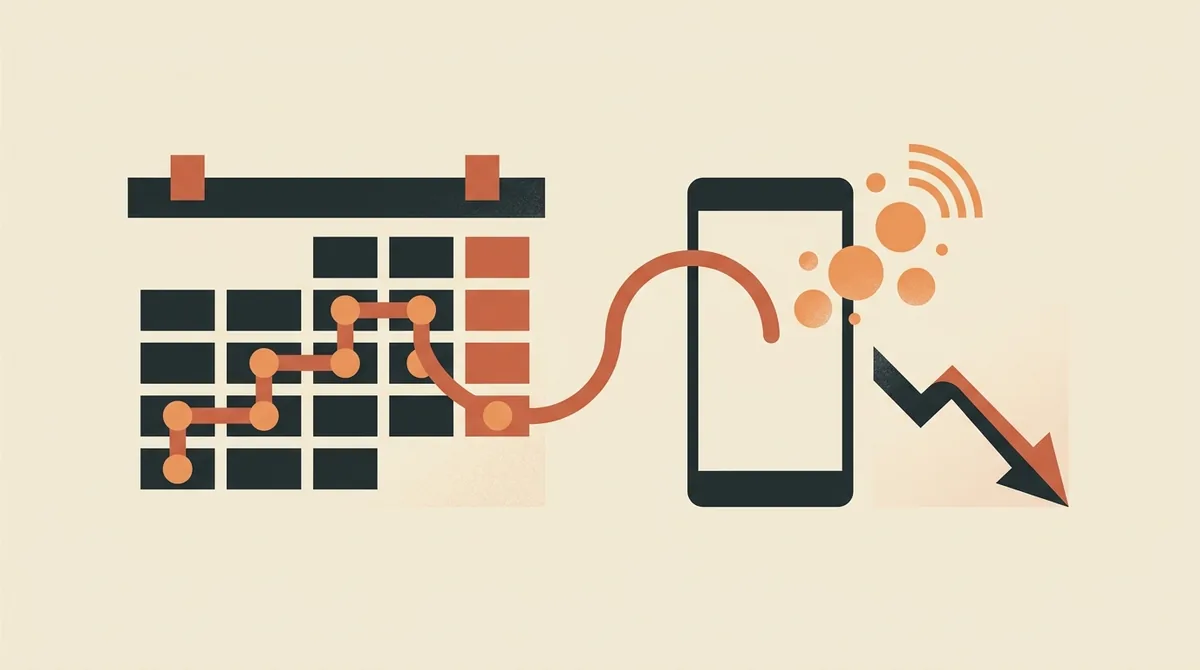
No-shows cut by up to 70%: where the real savings come from
The no-show — a patient who doesn't turn up without notice — is the economic black hole of any practice. A missed dental cleaning slot or specialist visit is time the clinician was paid to keep free, and you never get it back.
Let's run the numbers for a typical dental practice. Assume a 15% no-show rate across 40 weekly appointments, at an average value of €80 per slot.
| Scenario | No-shows / week | Value lost / week | Value lost / year (46 wks) |
|---|---|---|---|
| No reminders | 6 (15%) | €480 | ~€22,000 |
| With AI reminders (-70%) | ~2 (4.5%) | €144 | ~€6,600 |
| Recovered | +4 | +€336 | ~€15,400 |
These are indicative figures that will shift with your average ticket and starting rate, but the order of magnitude holds: cutting no-shows alone pays for the service many times over. The mechanism is simple: automated reminders 48 and 24 hours ahead, letting the patient confirm, reschedule or cancel by replying to the message or the call. A slot freed up in time can then be offered to a patient on the waiting list.
The up-to-70% figure is what vertical players in the sector report (VocalMed, MedbotVoice, CiaoDott among others), and it holds as a realistic ceiling when there was no reminder system at all beforehand. If you were already sending manual SMS reminders, the improvement will be smaller but still meaningful. To see how much a single missed call costs a local business's revenue, see what a missed call really costs a local business.
Prescription requests and triage: sorting calls without replacing the doctor
Two types of calls clog up every practice: requests for repeat prescriptions and people calling about a symptom. The AI voice assistant handles both, but with different, careful logic for each.
Prescription and report requests
A chronic patient calling for a routine prescription refill ties up the receptionist for an extremely low-value task. The AI collects the name, the medication and the tax ID, checks the practice management system, and queues the request for the doctor's approval, or notifies the patient once the document is ready for pickup. The doctor never loses clinical control: they approve, the AI communicates.
Routing triage (not diagnosis)
This is where clarity matters, because it's a sensitive YMYL topic. An AI voice assistant in healthcare does not diagnose and does not give medical advice. It performs routing triage: it works out from the request whether the case is a routine booking, an administrative matter, or a potential emergency, and when in doubt it routes the call to a human operator or gives the agreed-upon guidance (for example: "for an out-of-hours emergency, call 112 or contact the on-call medical service"). You and the doctor define the routing rules — not the software vendor.
And this is exactly where the most important step comes in: handing the call off to a human operator (human handoff). A good system knows when it's out of its depth (an agitated patient, a case it can't handle, a clinical question) and transfers the call to a person, passing along the context it has already gathered. An assistant that pretends to know everything is dangerous; one that knows when to stop is trustworthy.
Want to know how many patients you're losing outside office hours, and what recovering them would be worth? Request a free analysis of your practice: we'll give you the real numbers before you make any decision.
The robotic voice, dialects and elderly patients: the real objection
This is the objection every practice owner raises first, and it's a fair one: "my patients are elderly, a robot on the phone will scare them, and they speak in dialect." It deserves a real answer, not a dismissal.
The honest truth: 2026-generation models have made a huge leap in voice naturalness and in understanding spoken Italian, including regional accents and imperfect phrasing. They're not flawless with heavy dialects or with people who speak very slowly, but they handle the vast majority of real conversations without the patient noticing any difference. The real antidote to this objection is still the handoff to a person: if the conversation gets stuck, the call goes to the receptionist. We've dedicated an honest deep-dive to how voice AI copes with dialects and elderly patients, without selling any miracles.
Compliance: disclosing the AI and protecting health data
In healthcare, compliance isn't a detail, because you're handling special categories of data (formerly "sensitive data"). Three points you need to know, for informational purposes and not as legal advice.
1. The obligation to disclose that it's an AI
From August 2, 2026, transparency obligations under the AI Act (EU Regulation 2024/1689) take effect, alongside Italy's Law 132/2025. In practice: the caller must know they're talking to an artificial intelligence system, not a person. In practice, the assistant discloses this within the first few seconds of the call. It's simple to comply with, but it needs to be worded properly: you'll find the details in our article on the obligation to disclose AI on the phone under Law 132/2025 and a broader overview of the AI Act 2026 obligations for SMEs.
2. GDPR and health data
Recorded calls and the data collected (name, reason for the visit, symptoms) are personal data, often health-related. You need: a clear privacy notice for the patient, a proper legal basis, a vendor acting as a data processor under a GDPR Article 28 contract, and servers preferably located in the EU. The Italian Data Protection Authority (Garante Privacy) is the relevant authority. It isn't complicated, but it needs to be set up correctly from the start — one reason it pays to work with someone who knows the Italian context rather than a generic imported solution.
3. Who processes the data, and where
Check where the voice models and conversation data actually reside. For a healthcare practice, choosing a vendor whose infrastructure and data processing align with EU rules isn't a technical nicety — it's a requirement.
AI voice assistant or receptionist: the right answer is "and"
This isn't a replacement. The mistake is thinking of it as "AI instead of the receptionist." The model that works is "AI that frees up the receptionist": the voice assistant handles the repetitive volume (overnight bookings, cancellations, prescriptions, information), while the person focuses on welcoming patients at the desk, complex cases, and the in-person relationship. We've broken down the two approaches in AI receptionist vs. human receptionist, with the real pros and cons of each.
A practice set up this way stops losing patients outside office hours, cuts no-shows, and gives the receptionist back the hours she currently burns on the phone. For the full picture of the technology and the possibilities, our complete guide to AI phone systems is the place to start.
Where to start in your practice
A serious rollout in a practice isn't "plug it in and go." The sensible steps:
- Map your calls: a week-long log to understand volumes, peak hours and recurring request types.
- Define the scenarios: which requests the AI handles on its own, which it passes to a human, and what triage rules you've agreed on with the doctor.
- Connect your tools: calendar, practice management system, reminder channel.
- Set up compliance: AI disclosure, privacy notice, data processing agreement.
- Start with human oversight: the first few weeks under human supervision, then widen the AI's scope as confidence grows.
The return, between recovered calls and cut no-shows, tends to make the project comfortably pay for itself within the first few months for a medium-to-high-volume practice.
In summary
For a medical or dental practice, an AI voice assistant is one of the few automation investments with a fast, measurable return: 24/7 bookings that capture patients outside office hours, reminders that cut no-shows by up to 70%, and prescription handling plus routing triage that lighten the load on the front desk. All without replacing the human element — freeing it from repetitive work instead — and while staying compliant with Italy's rules on transparency and health data.
Frequently asked questions
Can an AI voice assistant really cut no-shows by 70%?
That's the figure reported by vertical healthcare players, and it holds as a realistic ceiling when there was no reminder system in place beforehand. The mechanism is automated reminders at 48 and 24 hours with quick confirm-or-cancel. If you were already using manual texts, the improvement will be smaller but still substantial.
Can the AI diagnose conditions or give medical advice on the phone?
No, and it shouldn't. An AI voice assistant in healthcare only performs routing triage: it works out whether a request is a booking, an administrative matter, or a potential emergency, and routes it accordingly. The doctor sets the rules. When in doubt, it hands the call off to a person.
My patients are elderly and speak in dialect: does it still work?
2026-generation voice models understand real spoken Italian well, including regional accents and imperfect phrasing. They're not perfect with heavy dialects, but the safety net is the automatic handoff to the receptionist when a conversation gets stuck. No patient is left stranded.
Do I have to tell patients they're talking to an AI?
Yes. From August 2, 2026, the AI Act (EU Regulation 2024/1689) and, in Italy, Law 132/2025 require that the caller know they're talking to an artificial intelligence system. In practice, the assistant discloses this in the first few seconds of the call. It's simple to comply with.
How is the health data collected from calls handled?
It's a special category of data under the GDPR. You need a clear privacy notice, a proper legal basis, a vendor acting as data processor (under an Article 28 contract), and infrastructure preferably based in the EU. The Italian Data Protection Authority (Garante Privacy) is the relevant authority. It needs to be set up correctly from the outset.
Does an AI voice assistant replace my receptionist?
No. It frees her up. It handles the repetitive volume (overnight bookings, cancellations, prescriptions, information) so the receptionist can focus on welcoming patients at the desk and on complex cases. The model that works is AI plus a person, not AI instead of a person.
If you run a medical or dental practice and want 24/7 bookings and fewer no-shows without the hassle, talk to us: we'll review your case together, including compliance with the 2026 rules.