Email Marketing: What It Is, How It Works, and Why It Still Works in 2026
11 min read · AstraLoop Studio
Email marketing gets declared dead at least once a year, and has been for two decades. Meanwhile it remains the digital channel with the single highest return on investment: industry estimates put it at 36-40 euros generated for every euro spent, a ratio no other paid channel comes close to. Not because email is magic, but because it's the only space where you talk to people who gave you permission to, straight from your own database, without paying a middleman for every contact.
The real problem is different. Most Italian businesses still run email marketing the way it was run in 2012: a newsletter sent "whenever there's something to say," to the whole list, identical for everyone. It's like owning a Ferrari and only using it to pick up bread. In this article I'll walk you through what email marketing actually is, how the mechanism works under the hood, and above all the gap that in 2026 separates people who send newsletters from people who've built an automated system that keeps working while they sleep.
No textbook theory here. Numbers, mechanics, and the AI-first version that's rewriting the rules today.
What email marketing actually is (the definition that matters)
Email marketing is the use of email to build a relationship with contacts who have given you permission to reach them, with the goal of turning them into customers over time, and then into customers who buy again. The two heavy words in that sentence are permission and over time.
Permission: unlike a Meta or Google ad, which interrupts someone doing something else, an email arrives because the person left you their address. In Italy and across Europe this isn't just good manners, it's a legal requirement. GDPR and the ePrivacy directive require explicit, documented consent before you send commercial communications to a contact. Emailing purchased or non-consenting lists isn't "aggressive email marketing": it's illegal, and the Italian Data Protection Authority fines for it.
Over time: email isn't a direct-response, sell-right-now channel like a paid ad. It's a relationship channel. Its value builds over weeks and months, through a sequence of messages that walks the person from "who are you?" to "take my money, gladly." Anyone judging a single email like it's a standalone ad campaign is using the wrong yardstick.
Put bluntly: email marketing isn't there to sell once to a stranger. It's there to monetize, and re-monetize, people who have already raised their hand. That's exactly why it pairs so well with a customer acquisition system upstream: the funnel brings in new people, email converts them and brings them back.
How email marketing works: the three parts of the engine
Under the hood, every email marketing program that actually works has three components. Miss one, and the engine knocks.
1. The list (the part almost everyone underrates)
The list is the set of contacts you're allowed to email, with their consent on record. It's the asset. It's not just "the customer database" — it's broader: it includes people who left their email for a lead magnet, newsletter subscribers, buyers, and people who abandoned a cart. Every consenting address is potential revenue.
Rule number one: a list is built, not bought. A list of 800 genuinely interested contacts is worth more than 50,000 purchased emails that will land you straight in spam and can get your account shut down. The right way is to offer something of value in exchange for the address — a process that deserves its own strategy, which we cover in how to build a contact list from scratch.
One thing few people factor in: a list decays. Every year you lose an average of 20-25% of contacts to unsubscribes, job changes, and abandoned addresses. If you're not constantly feeding the list, in two years you're talking to nobody.
2. The message (content and delivery)
The message is the email itself. And here there are two separate battles that get confused constantly.
The first is getting opened and read: it depends on the subject line, the sender, and the content. The average open rate in Europe today sits between 25% and 35% depending on the industry, and click-through between 1.5% and 4%. If you're below that, the problem is usually upstream — a cold list or a weak subject line — not the copy. The subject line is by far the most sensitive lever, and it's always worth testing: there's a precise method for that in our piece on A/B testing applied to email.
The second battle is landing in the right inbox, and not in spam or the Promotions tab. This is technical, not creative: it depends on your domain's reputation, on authentication protocols like SPF, DKIM and DMARC, and on how recipients behave. You can write the best email in the world; if it lands in spam, it doesn't exist. If your open rates crash with no obvious cause, deliverability is almost always the culprit, and we've listed the usual causes in why emails end up in spam.
3. Automation (where 90% of the value hides)
This is where a hobby turns into a system. A newsletter is an email you decide to send, whenever you feel like it. Automation is a sequence of emails that starts on its own when a contact takes a specific action, and runs 24/7 without you thinking about it.
Concrete example: someone signs up to your list at 3am on a Sunday. In an automated system they get the welcome email immediately, the second one the next day, and so on through a sequence designed to turn them into a customer. You were asleep. This is the core of marketing automation, and within email it's where the bulk of the revenue is generated.
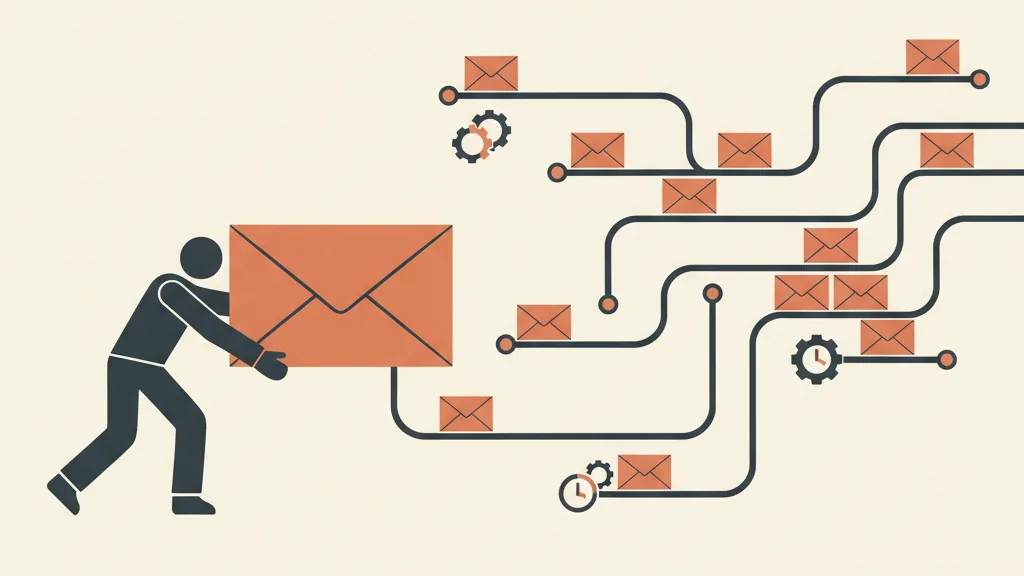
Newsletter vs automated flows: the gap that matters
If I had to point to the one thing that separates people who make money from email from people who waste time on it, it's this. The newsletter (or "broadcast campaign") is fine for announcements, seasonal promotions, and periodic content. But it's manual, one-off, and it doesn't scale. Automated flows, on the other hand, are the workhorses: few in number, always on, built once and left to run.
These are the flows every business should have in place before even thinking about a weekly newsletter:
| Flow | When it triggers | What it does |
|---|---|---|
| Welcome | List signup | Introduces the brand, builds trust, drives the first action or first purchase |
| Abandoned cart | Product left in cart (ecommerce) | Recovers near-lost sales, often the single most profitable flow of all |
| Post-purchase | After an order | Reassures, reduces returns, sets up repeat purchases and upsell |
| Nurturing | Lead not yet ready to buy | Educates over time until they're warm (essential in B2B) |
| Win-back | Customer inactive for X months | Re-activates people who've bought before but went quiet |
The logic is simple and unforgiving: these flows are usually a minority of the emails you send but the majority of the revenue email generates. That's because they reach the person at the right moment in their journey, not whenever it's convenient for you. The welcome flow in particular has the highest open rates of all (often over 50%), because the person just met you and is at peak attention — it's worth building it properly, and we have a dedicated guide on the welcome flow.
Then there's a flow almost nobody uses that's pure margin: reactivating dormant contacts. Someone who's already bought and then vanished costs a fraction of a brand-new customer to bring back on board. It's money sitting idle in your database, and we explain how to recover it in reactivating dormant customers.
Why it still works in 2026 (and works better than before)
Three concrete reasons, not fan-boy hype.
One: you own the channel. On Meta, TikTok or Google you're renting attention. Tomorrow the algorithm changes, cost per click doubles, an account gets suspended, and your audience evaporates. The email list is yours. No platform can take it away or tax it at will. In an era where paid acquisition cost climbs every year, owning an asset you don't pay for per contact is worth its weight in gold.
Two: the end of third-party cookies shifts the value onto first-party data. With advertising tracking increasingly restricted, the data people hand you directly — their email, their preferences, their behavior on your site — becomes the most valuable currency in digital marketing. Email is the native channel for zero-party and first-party data: that's where it lives and does its work.
Three: it's measurable down to the last euro. Opens, clicks, conversions, revenue per email: you know exactly what's working and what isn't. You can connect email to your CRM and see the real return, not estimates. That makes it surgically optimizable, something you can't do with brand awareness.
Want to turn your list into a system of automated flows that sells even when you're not thinking about it? Tell us where you're at and let's figure out what to build together.
AI-first email marketing: what changes in 2026
Here's the new part, and the reason email in 2026 isn't the same thing it was five years ago. Artificial intelligence doesn't bolt a gadget onto the process: it changes the scale of what one person alone can do. Three changes in particular.
Real dynamic personalization (not just "Hi {name}")
For years "personalizing" meant dropping a name into the subject line. That's 2010-era stuff. With AI, personalization becomes real: the content of the email itself changes based on what the person bought, viewed, or clicked. Two subscribers on the same sequence get different messages, with different products and different tones, generated automatically from their behavior. You don't need a copywriter per segment: AI adapts the copy while keeping your voice. This is the core of AI email personalization, and it's what lifts click-through rates without adding manual work.
Emails that sound human, produced at scale
The paradox: the more you automate email, the more it risks sounding robotic and getting ignored. AI, used well, does the opposite. Trained on your brand voice, it writes copy that sounds like you wrote it, not a template, and produces it for dozens of different segments in minutes. The key is training it on how you actually talk, not using it out of the box: the difference between an email that reads like generated spam and one that reads like a personal message shows up in the reply rate, and we cover this in more human emails with AI.
Multichannel orchestration: email stops working alone
The biggest leap. Email in 2026 doesn't operate in isolation: it becomes one piece of a broader orchestration. An AI agent can decide whether to reach that person by email, WhatsApp or SMS based on where they respond best, and switch channels if the first one doesn't work. People who open emails get emails; people who ignore them but read WhatsApp get a message there instead. The system chooses on its own. If you're weighing when it makes sense to add SMS or messaging alongside email, we've compared costs and response rates in WhatsApp vs SMS marketing and in automating WhatsApp Business with AI.
The upshot of these three shifts is that an SMB today can achieve, with a well-built system, what five years ago required an entire email marketing team. Not more emails: better emails, more relevant, at the right moment, on the right channel.
How to start: the first three concrete steps
If you're starting from zero or close to it, you don't need the most expensive platform or a 40-page strategy document. You need three moves, in this order.
- Set up contact collection. A way to get people to leave their email (a lead magnet, a discount on the first order, a newsletter signup with a genuine reason to subscribe) and consent recorded properly. No list, no email marketing, full stop.
- Build the flows first, the newsletter second. Welcome and (if you sell online) abandoned cart are the two that pay for themselves immediately. Build them once, and they run forever. The weekly newsletter can wait: it's less profitable and more work.
- Pick the tool based on where you are, not on the biggest name. Platforms change price and complexity fast; what matters is that it integrates with your site and your CRM. We've compared the options for the Italian market in the best marketing automation software.
One common mistake to avoid: starting with the newsletter because "everyone does it." The newsletter is the most visible but least profitable part of email marketing. The money is in the automated flows nobody sees. It's also the point where email connects to the rest of the system: a good nurturing flow is the bridge between a cold lead and the moment sales can close, as we show in automating sales follow-up.
The bottom line
Email marketing doesn't "still" work in 2026 despite AI. It works better because of AI. It's the only channel you truly own, the only one where you talk to people who gave you permission, the only one measurable down to the euro, and now also the only one that can personalize and orchestrate itself across channels on its own.
The real question isn't whether email marketing is worth it. It's whether you're running a manual 2012-style newsletter or an automated 2026 system. The gap between the two, in revenue terms, is enormous. And closing it no longer requires a whole department: it requires the right system, built properly, once.
Frequently asked questions
What is email marketing, in plain terms?
It's the use of email to build a relationship with people who have given you permission to contact them, so as to turn them into customers over time and bring them back to buy again. The key words are permission (consent) and relationship over time, not immediate selling to strangers.
Does email marketing still work in 2026?
Yes, and it's still the digital channel with the highest ROI: industry estimates put it at roughly 36-40 euros generated for every euro spent. With the end of third-party cookies and the arrival of AI, it works even better than before, because it shifts value onto the data people give you directly.
What's the difference between a newsletter and an automated flow?
A newsletter is something you send manually whenever you want, to the whole list. An automated flow starts on its own when a contact takes an action (signs up, abandons a cart, goes inactive) and runs 24/7 with no intervention. Automated flows usually generate the majority of revenue while being a minority of emails sent.
Can I buy an email list to get started?
No. In Italy and across Europe you need explicit, documented consent (GDPR and ePrivacy): emailing purchased lists is illegal, and the Italian Data Protection Authority fines for it. On top of that, purchased lists send you straight to spam and can get your account shut down. A list is built by offering value in exchange for the address.
How much does email marketing cost?
Platforms start with free plans or a few tens of euros a month for small volumes, and scale with contact count. The real cost isn't the software, it's building the flows and the strategy. Compared with paid channels, it remains among the cheapest, because you're not paying a middleman for every contact reached.
How does AI power email marketing today?
In three ways: real dynamic personalization (content changes based on the person's behavior, not just their name), generating copy that sounds human at scale while keeping the brand voice, and multichannel orchestration (an agent decides whether to reach someone by email, WhatsApp or SMS based on where they respond best).
If you want to move from a manual newsletter to AI-first email marketing, with automated flows and dynamic personalization built into your funnel, talk to us: we'll look at your case and tell you where to start.