Welcome Email Flow: Why You Need One and How to Build It Step by Step
10 min read · AstraLoop Studio
The window when a contact is warmest lasts minutes, not days
When someone leaves their email on your site (for a discount, a lead magnet, a newsletter) they're at the absolute peak of attention toward your brand. They've just decided to trust you. From that second on, interest decays. Every hour that passes without a message from you is a piece of that trust evaporating.
The welcome email flow (or welcome sequence) is the automation that catches exactly that moment. It's not a single "thanks for signing up" email, but a series of 3-6 scheduled messages that walk the new contact from first interaction to first conversion. It's the first automation any company should switch on, ahead of abandoned carts or win-back campaigns, because it works the single most profitable segment there is: people who just said yes to you.
The numbers back this up without much room for doubt. Welcome emails see open rates between 50% and 80% (versus 15-25% for an average newsletter) and generate on average 3-4 times more revenue per send than a standard promotional campaign. The reason is simple: you're writing to someone who's still thinking about you.
In this guide we'll look at why the welcome flow works, how to structure it email by email, what timing to use, and — above all — how AI personalization changes the game from the very first contact, turning a generic sequence into a conversation that feels hand-written for each individual subscriber.
Why the welcome flow is the first automation to switch on
If you could turn on only one automation tomorrow morning, this would be it. Here's why it beats everything else on the priority list.
It catches the attention peak
A freshly acquired contact opens your emails. Full stop. You don't have to fight the inbox, oversaturation, or newsletter fatigue. Using this window means building relationship and selling while the cost of attention is close to zero. The longer you wait, the more that window closes: after 48 hours, a new subscriber has already forgotten half the reason they signed up.
It turns an address into a customer (or qualifies it)
Collecting emails without a sequence behind them is like filling a bucket with a hole in it. The welcome flow is what converts a sign-up into a first purchase (e-commerce) or a qualified lead (B2B and services). It's the link between building your contact list and generating actual revenue. Without it, you're just piling up addresses that go cold.
You build it once, it pays off for years
Unlike a one-off campaign, the welcome flow is an asset you write once and that keeps running automatically for every new contact, whether that's one a day or a thousand. It's the essence of marketing automation applied to SMBs: build the system once, then let it work for you while you sleep. The return on the hours spent writing and setting it up is among the highest in all of digital marketing.
It improves future deliverability
There's a technical benefit few people consider. Opening a conversation right away with high open and click rates signals to providers (Gmail, Outlook) that your contacts genuinely want you in their inbox. This builds domain reputation and lowers the odds that future emails end up in spam. A good welcome flow is also an investment in the health of your channel.
The structure of a welcome flow, email by email
There's no universal magic number, but a solid sequence is built on 3-5 emails. Let's look at what each one needs to do. The order and the logic matter more than the count.
Email 1: The welcome and the promise (sent immediately)
This goes out within minutes of sign-up, while attention is at its peak. It has three jobs: confirm (deliver on the promise — the discount, the lead magnet), introduce yourself in one sentence, and say what to expect from you. No wall of text. One clear call to action. If you promised "10% off your first order," that code needs to be the absolute star of the first email, not a footnote.
Email 2: The story and the why (after 1-2 days)
This is where you build the relationship. Tell people who you are, why you do what you do, what problem you solve. In B2B this is where you demonstrate expertise; in e-commerce it's where you convey brand values. People buy from those they understand and recognize themselves in. This email works on emotion and identity, not on the direct sell. It's the bridge between "I gave you my email" and "I trust you."
Email 3: Social proof and benefits (after 2-3 days)
Now you bring the evidence. Reviews, case studies, numbers, before/afters. Answer the silent objection: "will this actually work for me?" In B2B you show concrete results from similar clients; in e-commerce you show the most-loved products and testimonials. Social proof defuses doubt better than any adjective you could use about yourself.
Email 4: The offer or the call to action (after 2-3 days)
Now you ask. A first purchase with an incentive, a consultation booking, a qualifying questionnaire. This is the moment of real conversion, and it works precisely because you've laid the groundwork with the previous emails. The CTA needs to be sharp, with a reason to act now (discount deadline, limited spots, a bonus gift).
Email 5: The soft win-back (after 3-4 days, conditional)
Anyone who hasn't acted yet gets one last message: a new angle, a direct question ("what's holding you back?"), one last chance. Anyone who has already converted skips this email and joins your list's main flow. This is the first piece of conditional logic in your system, and it introduces the branching concept that governs every advanced automation.
A reference framework
| Timing | Goal | Typical CTA | |
|---|---|---|---|
| 1. Welcome | Immediate | Deliver the promise, introduce yourself | Use the code / download the guide |
| 2. Story | +1-2 days | Build trust and identity | Learn who we are |
| 3. Social proof | +2-3 days | Defuse objections | Read the results |
| 4. Offer | +2-3 days | Convert | Buy / book now |
| 5. Win-back | +3-4 days | Last attempt on non-converters | Last chance |
Adapt the pace to your purchase cycle: an impulse-buy e-commerce brand can compress everything into 7-8 days, while a complex B2B sale can stretch the sequence over three weeks. The logic stays the same.
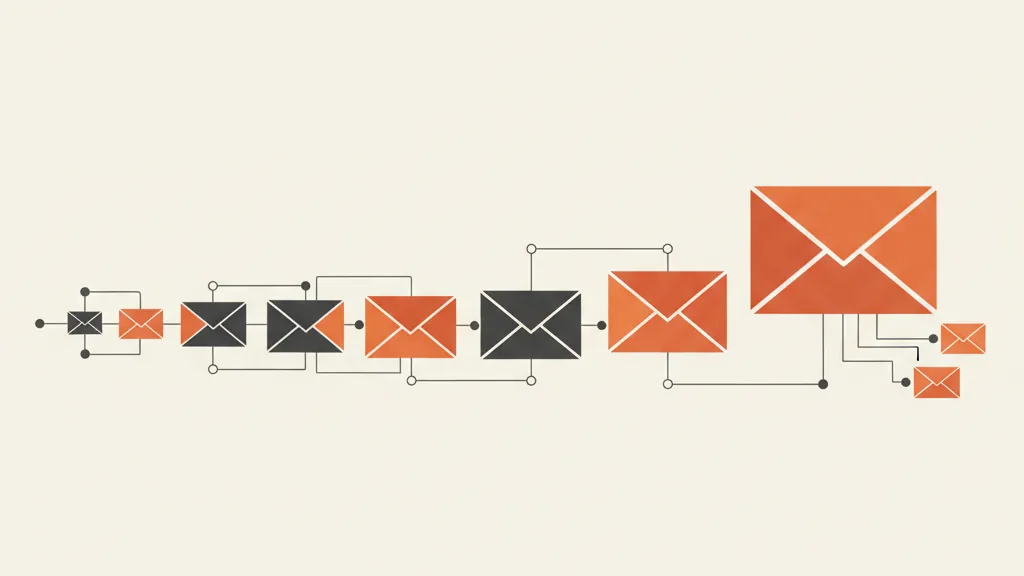
The step up: AI personalization from the first touch
So far we've described a classic welcome flow, identical for everyone. It works, and it's already much better than nothing. But the real competitive edge in 2026 lies in making this sequence dynamic and personalized from the very first message, using artificial intelligence to adapt content, tone, and offer to each individual contact.
Personalization beyond "Hi [Name]"
Dropping a name into the subject line is 2010-era personalization. Today, AI lets you go much deeper: generating the email body based on the sign-up source (someone arriving from a sportswear campaign gets examples and imagery from that world), on-site behavior, and declared data. This is the approach we dig into in our guide on making emails more human with AI: no more rigid templates, just messages assembled around the individual recipient.
Qualifying while you welcome
This is the most powerful angle for anyone selling services or operating in B2B. The welcome flow shouldn't just warm people up — it can qualify them too. An AI agent can read the contact's replies, email clicks, and browsing data, assign a score, and route the hottest leads to a call while sending colder ones more educational content. This is the logic of AI lead scoring applied to SMBs, grafted directly onto the welcome sequence. The result: sales reps only get ready-to-talk contacts, not cold names on a list.
Dynamic content that adapts in real time
With an AI layer, the same email can show different products, different arguments, and even a different tone depending on who opens it. A subscriber who's checked the pricing page three times gets a focus on ROI in email 4; one who's only read the blog gets more social proof. This kind of orchestration, which extends the reasoning behind AI-driven email personalization, is what separates a flow that merely "runs" from one that actually converts.
Multichannel orchestration: email + WhatsApp
The modern welcome flow doesn't live in the inbox alone. A contact who doesn't open the first two emails can get a WhatsApp message instead (if they've opted in), bringing the conversation onto a channel with open rates near 95%. AI-powered WhatsApp Business automation turns the sequence from single-channel into orchestration, multiplying touchpoints without adding manual work. This is where classic automation becomes a genuine acquisition system.
Want to see what an AI-personalized welcome flow could look like for your business? Request a free analysis and we'll show you where to start.
The mistakes that sink a welcome flow
Before you switch on your sequence, avoid the most common traps. We see these often, and they cost conversions.
- Selling too hard, too soon. Asking for the purchase in the first email, before you've built any trust, burns the contact. The sale comes after the value, not before.
- Not delivering on the promise. If someone signed up for "15% off" and the first email talks about something else entirely, the contact feels tricked and marks you as spam. The opt-in promise is a contract.
- Emails that run too long. Nobody reads a wall of text. One message, one CTA, white space. Emails that convert follow a precise structure, not a stream of consciousness: we cover this in the guide on how to structure emails that convert.
- Wrong timing. Five emails in two days is aggression; five emails in two months is irrelevance. The pace needs to match your purchase cycle.
- Zero segmentation. Sending the exact same sequence to a company owner and to a student is wasteful. Even minimal segmentation multiplies results, as shown by these email segments to build right away.
- Weak subject lines. If the email doesn't get opened, nothing else matters. Give subject lines that work the same care you give the content itself.
How to tell if your welcome flow is working
A welcome flow isn't something you write and abandon: it's measured and improved. The numbers to watch are few but decisive.
- Open rate per email. If it drops sharply from the first to the third, the content isn't living up to the initial promise.
- Click-through rate. Measures how convincing and well-placed your CTAs are.
- Sequence conversion rate. The headline metric: how many new subscribers become customers or qualified leads by the end of the flow.
- Drop-off point. If unsubscribes cluster around one specific email, that email has a problem (too pushy, off-topic, poorly timed).
This is where continuous optimization begins. Testing subject lines, timing, and offers one variable at a time, using a structured A/B testing method, is what turns a decent flow into an excellent one. And once the welcome flow is running, it's just the first piece of a bigger ecosystem: automated sales follow-ups, win-back campaigns to re-engage cold contacts, and long-term nurturing. The welcome sequence is only the front door.
And if the welcome flow needs to feed a sales process (bookings, quotes, appointments), the real multiplier is connecting it to a custom-built CRM: that way, every contact entering through the sequence gets tracked, enriched, and worked without anything falling through the cracks. That's when email marketing stops being an isolated channel and becomes part of an end-to-end marketing automation system.
In short
The welcome email flow is the first automation you should activate because it works the warmest contact you'll ever have: someone who just said yes to you. A 3-5 email sequence, calibrated to your purchase cycle, that delivers the promise, builds trust, brings social proof, and asks for the conversion at the right moment. The step up in 2026 is AI personalization from the very first message: dynamic content, automatic lead qualification, and multichannel orchestration that turn a generic sequence into a tailor-made conversation. Write it once, measure it, improve it. It's the asset with the best return on invested time in your entire marketing stack.
Frequently asked questions
How many emails should a welcome flow have?
Generally 3 to 5. Three emails is the functional minimum (welcome, value, offer); five lets you add brand storytelling and a final win-back for non-converters. The logic matters more than the count: deliver the promise, build trust, then ask for the conversion.
How much time should pass between one email and the next?
The first goes out immediately, within minutes of sign-up. The following ones are spaced 1-3 days apart. The pace should match your purchase cycle: an impulse-buy e-commerce brand can compress everything into a week, while a complex B2B sale can spread the sequence over two or three weeks.
Does a welcome flow matter for B2B and services too?
Yes, arguably even more. In B2B, the welcome sequence builds authority, demonstrates expertise through case studies, and qualifies the contact, routing the hottest leads toward a call. It isn't selling an impulse product — it's setting the stage for a sales conversation.
What's the difference between a welcome flow and a newsletter?
A newsletter is a periodic send that's the same for every subscriber. A welcome flow is an automated, personalized sequence that only kicks off when a new contact signs up, guiding them from the first days through to their first conversion. They're complementary: the flow warms people up, the newsletter keeps the relationship going over time.
How do you personalize a welcome flow with AI?
AI goes beyond inserting a name: it adapts content, tone, offer, and featured products based on sign-up source, on-site behavior, and contact data. It can also score leads in real time and trigger different channels, such as a WhatsApp message for people who don't open the first emails.
Which metrics show that a welcome flow is working?
The four main ones are: open rate per individual email, click-through rate on CTAs, overall sequence conversion rate (how many subscribers become customers or qualified leads), and the drop-off point — the email where unsubscribes cluster, signaling content that needs a rework.
If you want to turn your contact list into a system that converts automatically, let's talk: we'll design the sequence, the AI personalization, and the integration with your CRM.