Digital Strategy for SMEs: The Complete 2026 Guide (Metrics, Funnels & AI)
13 min read · AstraLoop Studio
Digital strategy for an SME in 2026 isn't the sum of the platforms you're present on. It's not "let's run Meta Ads, open a LinkedIn profile, send a few newsletters." That's a list of activities. A strategy is something else: it's the system that connects what you spend at the top to what you collect at the bottom, and tells you, numbers in hand, whether it's working or not.
The problem is that most Italian companies confuse the two. They invest in disconnected channels, measure vanity metrics (followers, likes, impressions), and by the end of the quarter can't answer the only question that actually matters: how much does it cost me to acquire a customer, and what is that customer worth over time? Without that answer, every euro spent on advertising is a bet in the dark.
This guide works as a hub. I'll give you the complete framework — the four levers that make up a serious digital strategy — and then, wherever it's worth going deeper, I'll point you to the right deep dive. The goal isn't to make you know more about marketing: it's to give you a way of thinking in terms of a system, oriented toward measurable customer acquisition instead of noise. Straight to the point.
The paradigm shift: from campaigns to system
Let's clear up a costly misunderstanding. For many SMEs, "doing marketing" means running campaigns: one month you push on Ads, then you let it drop, then the slow period hits and you scramble to restart. It's a start-stop model, reactive, impossible to improve because it leaves no comparable data behind.
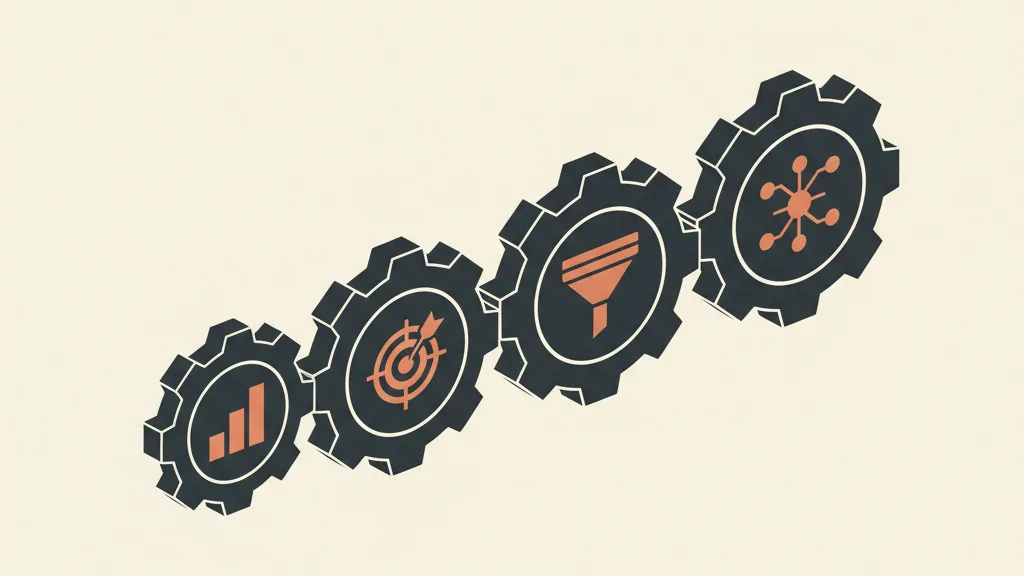
A digital strategy, instead, is a machine that always keeps running, with four gears connected to each other:
- Metrics. How you measure whether you're actually growing or just telling yourself stories.
- The offer. What you're proposing and why someone should choose you over the competitor.
- Conversion. How you turn the traffic you pay for into real leads and customers.
- AI automation. How you make the system fast, tireless, and scalable without hiring twenty people.
These four pieces aren't optional, and they're not alternatives to each other. Skip one and the others run idle. Metrics without an offer only tell you how much you're losing. A strong offer without conversion stays an idea on a slide. And automation applied to a process that doesn't exist amplifies the chaos instead of solving it. The rest of this guide breaks down the four levers one by one.
Lever 1. Metrics: stop measuring vanity
This is where the game is won or lost, even before you pick a channel. The wrong metric makes you take the wrong decisions with total confidence. And the most common wrong metric in Italy is the vanity metric: numbers that inflate the ego and never touch the bank account.
The only metrics that actually matter
A serious digital strategy revolves around three numbers, not thirty:
- CAC (Customer Acquisition Cost). How much you spend, on average, to acquire a customer. Includes advertising, tools, sales time. It's the real cost, not just the Ads budget.
- LTV (Lifetime Value). What a customer is worth across the whole relationship, not just at the first purchase. Changes the picture completely if you sell on subscription or with repeat purchases.
- LTV/CAC ratio. The summary of everything. Below a 3:1 ratio the model isn't healthy: you're spending too much relative to what you take in. Above 5:1 you might actually be under-investing and handing market share to competitors.
These three numbers, together with cost per lead and the conversion rate across the funnel, are a company's real dashboard. We've laid out how to calculate and read them in the guide on acquisition unit economics: CAC, CPL, and LTV, and it's the point everything else should start from. If you want to dig into how to calculate customer value, there's a deep dive on how to calculate customer lifetime value.
MER or ROAS? The question that separates SMEs from professionals
There's a technical mistake we see constantly: judging campaigns only on ROAS, the return for a single campaign. ROAS tells you how well an ad is performing, but with third-party cookies gone and attribution ever more uncertain, per-platform data is inflated and the platforms don't talk to each other. Meta takes credit for sales Google would have made anyway, and vice versa.
The metric that holds up in 2026 is MER (Marketing Efficiency Ratio): the ratio between total revenue and total marketing spend, viewing the company from above instead of channel by channel. It's attribution-proof, because it doesn't try to reconstruct who did what. It measures one thing only: whether marketing, overall, is generating margin. We've dedicated a full comparison to MER vs ROAS and which metric to actually use, and it's a read that changes how you look at your reports.
The underlying theme is measurement in a post-privacy world. With Consent Mode, server-side tracking, and attribution models that are less and less reliable, you can no longer blindly trust the numbers inside the platforms. You need to understand marketing attribution models to know what you're actually looking at.

Lever 2. The offer: the variable everyone skips
Here's the uncomfortable truth: most SMEs try to fix with more ad budget a problem that actually sits upstream, in the offer. You can have perfect targeting and the best creatives, but if what you're proposing doesn't stand out and doesn't convey value, you're just paying to drive traffic to a weak message.
A strong offer isn't a discount. It's the combination of what you sell, to whom, with what concrete promise, and what reason to choose you specifically, right now. It's the single highest-return lever there is, because it improves every number downstream: it lowers CAC (you convert more for the same spend), raises LTV (you attract the right customers, the ones who stick around), and makes sales more effective. We've written a hands-on guide on how to build an irresistible offer.
Performance branding: you don't have to choose between brand and sales
There's a false opposition holding SMEs back: "do I do brand or do I do performance?" In 2026 the real answer is performance branding: building brand perception and generating measurable results in the same activity, without wasting half the budget on awareness that leads nowhere. A clear offer and a sharp positioning also make direct-response advertising work better. We go deeper on this in brand vs. performance marketing, where we explain why the classic opposition no longer holds up.
Lever 3. Conversion: where traffic becomes customers
Driving traffic is the easy part: you just open your wallet. The hard part, the one that separates those who grow from those who burn budget, is converting that traffic into leads and those leads into customers. This is where most SMEs silently lose the majority of the money they spend.
The funnel: knowing where you lose people
Every customer goes through a journey, from first contact to signature. The acquisition funnel is made of steps (awareness, consideration, decision), and at every step you lose people. The point isn't to have "a funnel." It's knowing where and how many you're losing, because that's where you optimize. A well-designed funnel tells you exactly which step to fix first. We've explained how to build one step by step in how to create a customer acquisition funnel.
CRO: the optimization that multiplies what you're already spending
Conversion Rate Optimization is the most underrated lever because it doesn't require any extra budget: it works on what you already have. Taking a landing page's conversion rate from 2% to 3% means 50% more customers for the same ad spend. That's pure math. Clear landing pages, lean forms, a message consistent with the ad, visible social proof: details worth tens of thousands of euros a year. The starting point is understanding how to build a high-converting landing page.
Retention and repeat purchases: the revenue you already own
Acquiring a new customer costs 5 to 7 times more than getting an existing one to buy again. Yet SMEs pour almost their entire budget into acquisition and neglect the database they already have at home. Retention raises LTV, improves the LTV/CAC ratio, and stabilizes revenue. A satisfied customer who comes back is the highest ROAS there is, and you never pay for it twice. We go deeper on the tactics in customer retention strategies.
Connected to retention is the topic of first-party data. In a world without third-party cookies, the data you collect directly — who your customers are, what they buy, what they prefer — becomes your most defensible asset. It's the foundation for building personalization and repeat purchases. We cover it in zero-party data strategy.
Want to find out if your digital strategy is a measurable system or just a pile of disconnected campaigns? Request an analysis of your customer acquisition: we'll tell you exactly where you're leaving margin on the table, numbers in hand.
Lever 4. AI automation: from strategy to a system that runs itself
Here comes the piece that, in 2026, separates the SMEs that scale from the ones that stay stuck. And this isn't brochure marketing: it's what we do every day for our clients.
The first three levers (metrics, offer, conversion) define what to do. AI automation defines how you keep it running at a steady pace, 24 hours a day, without depending on the heroics of a team answering emails whenever it can. There's one number that changes everything: companies that follow up with a qualified lead within the first hour convert roughly three times more than those who wait a full day. And the first hour, done by hand, you never actually cover. AI does.
What AI actually automates in a digital strategy
- Real-time lead qualification. An agent analyzes every contact, cross-references data and behavior, assigns a score, and decides who goes to sales and who gets nurtured further. No more time wasted on cold contacts. We cover this in AI lead scoring for SMEs.
- Instant response. The contact gets a relevant first reply in seconds, not days. The first-hour window covers itself.
- Personalized nurturing. Sequences that adapt to each individual's behavior, instead of the usual identical drip for everyone.
- Database reactivation. AI automatically recovers dormant contacts — the revenue sitting asleep in your CRM. See how to reactivate dormant database customers.
The glue holding all this together is the CRM. Without a CRM that unifies marketing, data, and sales, automation stays fragmented. It's the central nervous system where the four gears talk to each other. For an SME, the choice between off-the-shelf software and a custom solution makes a huge difference in efficiency: we've covered it in custom CRM for SMEs. The broader theme of business process automation with AI shows how far this logic can be pushed, even beyond marketing.
Who drives all this: from marketing to growth
The way we think about the role changes too. The companies further ahead no longer think in terms of an isolated "marketing manager," but in terms of growth as a single function connecting acquisition, conversion, and retention under the same numbers. It's the shift from a siloed mindset to a systemic one, the one we've been talking about from the start. If this interests you, the comparison between CMO and CGO (Chief Growth Officer) explains this shift well.
The AstraLoop framework in one page
Let's put the pieces together. Here's how the four levers fit into a single measurable acquisition system:
| Lever | Question it answers | Control metric | Risk if you skip it |
|---|---|---|---|
| Metrics | Am I actually growing? | LTV/CAC, MER | You decide blind, you optimize for vanity |
| The offer | Why do they choose me? | Conversion rate, CAC | You pay for traffic to a weak message |
| Conversion | Does traffic become customers? | Conversion rate, retention | You lose most of what you spend |
| AI automation | Does the system run without me? | Response time, qualified leads | Slow system, doesn't scale, depends on you |
The logic is sequential but iterative: you start from the metrics to know where you stand, you fix the offer because it's the most powerful lever, you optimize conversion so you don't waste the traffic, you automate with AI to run everything at a speed you'd never reach by hand. Then you go back to the metrics and start again, improving with every cycle. That's how a strategy becomes a real customer acquisition system.

Where to actually start (without redoing everything tomorrow)
No SME builds all four levers in a week, and it doesn't need to. The right order is the one that delivers results with the least initial effort:
- Get a real snapshot of your numbers. Before touching any campaign, calculate CAC, LTV, and their ratio. If you don't know them, every other decision is a guess. This is square one.
- Fix the offer. Ask yourself honestly why a customer should choose you right now. If the answer is "because I'm cheaper," you have a positioning problem, not a budget problem.
- Fix the funnel where it leaks the most. Find the step with the worst drop-off (often the landing page or the follow-up) and optimize that first. Fixing a single point can change the entire outcome.
- Automate the bottleneck. It's usually response speed and qualification. That's where AI gives the most immediate and visible return.
This is the reverse of how most companies work, starting from the channels ("should we open TikTok?") and only arriving at the metrics once the money's already spent. The right path goes from numbers to channels, not the other way around. Anyone who wants to frame the topic within the broader context of a company's digital transformation will find the full picture there.
The mistakes we see most often in SMEs
Here's the list of mistakes that burn the most budget in a digital strategy. If you recognize even one, you've already found your first margin for improvement:
- Measuring vanity. Followers and likes don't pay salaries. If you're not looking at CAC and LTV, you're sailing without a compass.
- Treating channels as strategy. "Being on Instagram" isn't a strategy. It's a tactic inside a system that, often, doesn't exist.
- Throwing budget at the wrong offer. More ad spend doesn't fix a weak offer. It amplifies it, for the worse.
- Ignoring conversion. Obsessed with traffic, blind to the rate at which it becomes customers. This is where money quietly disappears.
- Forgetting who already bought. All the budget on acquisition, zero on retention. That way you hand revenue to your competitors.
- Responding slowly. Every hour of delay on a lead costs you conversions. And you can't cover it by hand.
- Automation without process. Automating chaos just produces faster chaos. Process first, tool second.
A digital strategy for SMEs done well, in 2026, isn't a collection of platforms or a chase after the latest trend. It's a system with four connected gears: you measure the real numbers, you build an offer that stands out, you convert traffic into customers, and you automate with AI what doesn't scale by hand. Those who think this way grow predictably. Those who switch campaigns on and off keep chasing increasingly expensive results.
The good news is that today, with AI and automation, a system like this is within reach for an SME, not just for big companies with huge teams. The difference is made by starting to think in terms of a system, not a campaign. And, if needed, getting help setting it up right from the very first round.
Frequently asked questions
What is a digital strategy for an SME?
It's not the sum of the platforms you're present on, but the system that connects four levers: metrics (how you measure real growth), the offer (why they choose you), conversion (how you turn traffic into customers), and AI automation (how you run everything at speed and scale). The goal is measurable customer acquisition, not disconnected campaigns.
Which metrics should an SME track in 2026?
The three that actually matter are CAC (customer acquisition cost), LTV (customer lifetime value), and their ratio: below an LTV/CAC of 3:1 the model isn't healthy. At the campaign level, in 2026 MER (total revenue over total marketing spend) is more reliable than per-channel ROAS, because it holds up better against attribution uncertainty after the end of cookies.
What's the difference between MER and ROAS?
ROAS measures the return of a single campaign or channel, but with third-party cookies gone, per-platform data is inflated and platforms don't talk to each other. MER (Marketing Efficiency Ratio) looks at the company from above, comparing total revenue to total marketing spend: it's attribution-proof because it measures overall efficiency instead of reconstructing who did what.
Why does the offer matter more than the ad budget?
Because it sits upstream of everything else. You can have perfect targeting and creatives, but if the offer doesn't stand out you're paying to drive traffic to a weak message. A strong offer improves every downstream number: it lowers CAC (you convert more for the same spend) and raises LTV (you attract the right customers, the ones who stick around). It's the single highest-return lever there is.
How does artificial intelligence help a digital strategy?
AI makes the system fast and tireless: it qualifies leads in real time, responds to contacts within seconds (covering the first-hour window that's decisive for conversion), personalizes nurturing, and reactivates dormant customers in the database. It keeps the strategy running 24 hours a day without needing to hire a huge team, leaving humans to handle only the complex negotiations.
Where should an SME start to build its digital strategy?
From the numbers, not the channels. First you calculate CAC, LTV, and their ratio to know where you stand. Then you fix the offer, which is the most powerful lever. Next you fix the funnel step that leaks the most (often the landing page or follow-up). Finally you automate the bottleneck, usually response speed. It's the reverse of starting from the question 'should we open TikTok?'
If you want to turn your marketing into a measurable customer acquisition system, bringing together metrics, offer, conversion, and AI automation, talk to us about it. We'll tell you how things really stand, no fluff, and where it makes sense to start.