Business Process Automation with AI: The Complete Guide for SMEs (2026)
9 min read · AstraLoop Studio
In 2026, automating business processes no longer means "writing a macro that shuffles Excel rows." With generative AI, and above all with AI agents, you can now hand off to software work that until recently required a flesh-and-blood person: reading an email and understanding its intent, qualifying a lead, replying to a customer on WhatsApp, updating the CRM, compiling a report. That's the real leap. We're moving from AI that talks to AI that does.
This is our cornerstone guide on the topic. You won't find grand predictions or recycled statistics here. You'll find what to automate first, with which tools, what it really costs, how to measure the return, and which regulatory obligations apply to you from August 2026. Each section links to a dedicated deep dive whenever more detail is needed.
What "business process automation with AI" means in 2026
Let's set things straight, because words matter and there's a lot of confusion out there. We distinguish three levels.
Classic automation (RPA and deterministic workflows). Fixed rules: "if an order comes in, send the confirmation email." Works great for repetitive, predictable processes, but it doesn't reason. If the input falls outside the pattern, it gets stuck.
Generative AI applied to the process. Here the software understands text, images, and voice. It reads a review and extracts the sentiment, summarizes a document, classifies a ticket. It doesn't just follow rules: it interprets.
AI agents (agentic AI). This is the development that defines 2026. An agent doesn't just respond, it carries out concrete actions autonomously, decides which tools to use, and sees a task through from start to finish. It calls an API, updates a record, books an appointment, opens a ticket and closes it. If you want to fully understand the difference between a chatbot and a true agent, we've dedicated a piece specifically to what AI agents are and how to tell the marketing from the substance.
In practice, a serious business process automation project with AI blends all three levels: deterministic workflows for the predictable part, generative AI for interpretation, agents for decisions and actions. Anyone selling you "just agents" or "just chatbots" is oversimplifying reality.
Chatbot, single agent, multi-agent system
One more point of clarity. A chatbot converses. A single agent runs a process. A multi-agent system coordinates several specialized agents that hand work off to one another: a sales agent that qualifies, a support agent that handles assistance, a finance agent that reconciles payments. It's not one monolithic "super-brain," but a digital team where everyone plays their part. For an SME, it makes sense to start with a single process done well and grow toward multi-agent only once the first one works and pays for itself.
What's worth automating first (and what isn't)
The most common mistake is starting with the wrong process, the flashy one you can show off in a meeting but that's ultimately marginal. The practical rule is simple: automate what is repetitive, high-volume, governed by clear rules, and has verifiable output. Here are the areas where the return comes fastest.
- Lead qualification and follow-up. The classic SME gap: contacts come in and don't get followed up on in time. An agent sorts them, enriches them, and schedules the follow-up. We dig deeper into this in our articles on how to qualify leads and on the distinction between MQL and SQL qualified leads.
- Customer care and ticketing. Immediate first response, priority-based routing, autonomous closing of simple cases, escalation to humans for complex ones.
- Data entry and system syncing. Copying data from a form to the CRM, from the management software to the spreadsheet, from email to the database. Tedious work, high error risk, immediate payback.
- Reporting. Gathering numbers scattered across multiple sources and producing a readable report every Monday morning, with no human intervention.
- Database reactivation. Re-engaging dormant contacts with personalized messages. We cover this in detail in our guide on reactivating dormant customers from the database.
What not to automate right away: strategic decisions, delicate negotiations, anything that requires human judgment or where a mistake is costly and hard to undo. Here AI supports, it doesn't replace.
The tools: no-code, AI tools, and when you need custom
You don't need an IT department to get started. The no-code ecosystem is now mature. The reference point for SMEs in 2026 is n8n, which has become the de facto standard: it has a native "AI Agent" node, it's self-hostable (crucial for GDPR compliance, since you keep the data on your own servers), and it's the true open alternative to Make and Zapier. Since April 2026 it also supports a native MCP server.
MCP explained without the jargon
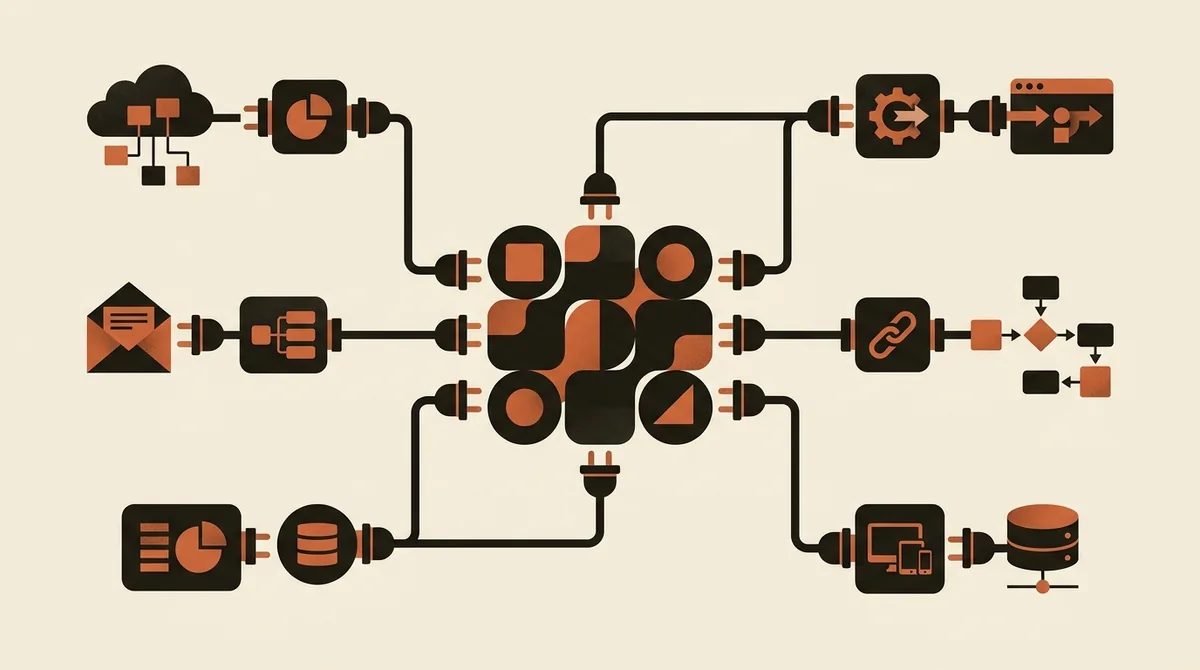
MCP (Model Context Protocol) is a standard that lets a model like Claude or ChatGPT connect cleanly to your business tools (CRM, management software, databases) and your workflows. Put simply: it's the "universal socket" that lets AI talk to your software without fragile, hand-built integrations. Most material on MCP is in English and highly technical, but the one thing that matters to you as a business owner is this. It makes agents more reliable and easier to connect to what you already use, lowering integration costs.
To help you navigate the platforms, we've gathered and compared the best AI tools for businesses using concrete criteria, not convenient rankings.
Build vs. buy: a €49 SaaS or a €25,000 custom agent?
This is where competitors tend to push you toward the expensive option only. We prefer to give you the honest criteria. There are ready-to-use vertical SaaS solutions (for example Italian-language voice AI agents like Aura, LePa, or Bookli, around €49 a month) that solve a specific problem with a quick setup. And there's the custom agent, built to measure, which can cost anywhere from a few thousand to several tens of thousands of euros.
| Criterion | Ready-made SaaS (~€49/month) | Custom agent (€5K/25K+) |
|---|---|---|
| Time to launch | Days | Weeks or months |
| Customization | Limited to the product | Total, built around your processes |
| Integration with your systems | Standard, not always deep | Tailor-made |
| Data control and GDPR | Depends on the vendor | Full (self-hosting possible) |
| Ideal for | A single, common problem | Core processes, high volumes, competitive edge |
The rule is clear-cut: if the process is standard and common, buy. If it's your competitive edge or touches sensitive data, build. Often the right choice is mixed: SaaS for the periphery, custom for the core. If you want a big-picture view of how to set everything up, check out our complete guide to AI consulting for businesses and the piece on where to start with artificial intelligence in your company.
Operating channels: WhatsApp, voice, and messaging
Automation doesn't live only in the back office. The channels where Italian customers actually talk to you are voice and WhatsApp.
WhatsApp Business. With the Meta Business Agent, rolled out globally in 2026, conversational support and sales are natively automated on the most-used channel in Italy. Reported figures point to conversion increases of around +34% when the conversation is handled well and in real time.
Voice AI agent. An AI switchboard active 24 hours a day that answers in Italian, books appointments, qualifies contacts, and cuts down on no-shows. The market is crowded with product landing pages but short on neutral content about how to choose one, how it sounds, and above all when it fails. We've written a dedicated guide to AI voice assistants and AI switchboards specifically to help you evaluate it without falling for vendor hype.
These channels are also the engine of your acquisition. If the goal is generating contacts, connect automation to your customer acquisition system and to AI agents for lead generation.
What it costs and what it returns: real ROI, not promises
Let's talk numbers, because that's where you decide whether a project makes sense. The return ranges most commonly observed, per automated process, are these. Take them as orders of magnitude, not guarantees, since they depend on your volumes and the quality of the implementation.
| Automated process | Typical efficiency gain | Indicative payback |
|---|---|---|
| Lead qualification | +200/400% | 6/14 months |
| Reporting | +300/500% | 6/14 months |
| Data entry | +400/700% | 6/14 months |
How do you build an honest calculation? Three cost items (licenses and APIs, development or consulting, maintenance) against three benefit items (hours freed up, errors avoided, extra revenue from faster responses). One concrete piece of advice: measure the "before" — how many hours, how many errors, how many leads lost today — before you start, or you won't be able to prove the "after." If you work on acquisition, also keep an eye on cost per lead, often the metric that moves first.
Want to know which process is worth automating first in your company, backed by real numbers? Request a tailored analysis and we'll show you where the fastest return lies.
The AI Act and regulation: what actually applies to you from August 2026
A sensitive topic, often handled in either alarmist or overly generic ways. Let's get concrete, with an informational angle (this isn't legal advice: for the specific obligations of your case, consult a professional).
The reference is the AI Act (EU Regulation 2024/1689). Several provisions become fully applicable during 2026, with a key deadline of August 2, 2026 for obligations tied to models and governance. Italy adds its own Law 132/2025, which sets out the national framework on artificial intelligence. The authorities to know are the Garante for the protection of personal data (for privacy and GDPR matters) and the ACN, the National Cybersecurity Agency.
For an SME using AI (so as a deployer, not a provider that develops models), the main practical obligations are these.
- Disclosure of AI content. If you generate text, images, or interactions with AI, in many cases this must be clearly disclosed. A chatbot must make it clear that it's an AI.
- AI literacy. Whoever in the company uses these tools needs training appropriate to their role.
- DPA with the LLM provider. If your data passes through an external model, you need a data processing agreement and clarity on where it's processed.
- Usage log. Keeping track of where and how you use AI protects you and saves time in case of audits.
The key point: whether you're a deployer or a provider changes the obligations significantly. The vast majority of SMEs are deployers, with much lighter burdens than alarmist narratives suggest. We've put together an operational checklist in our guide to 2026 AI Act obligations for SMEs. And if automation touches sensitive data, it's worth running a cybersecurity audit before going live.
What comes after: maintaining and governing agents
Almost everyone talks about how to build an agent. Almost no one talks about what happens next. And that's where projects fail. An AI agent isn't an appliance you switch on and forget: it needs to be monitored, corrected, and versioned.
- Monitoring. You need visibility into what the agent is doing: how many actions it takes, how many succeed, where it asks a human for help.
- Error handling. When the agent gets it wrong (and it will), there needs to be an escalation path and a person responsible for the fix.
- Versioning. Every change to behavior needs to be tracked, so you can roll back if a change makes results worse.
- Accountability. Who's responsible if the agent makes a wrong decision? This needs to be decided beforehand, not after the incident.
A well-governed project includes an initial phase of human oversight (the agent proposes, the human approves), which loosens as trust in the results grows. Skipping this phase is the perfect recipe for losing control.
Where to actually start
To sum up the practical path for an SME:
- Choose a single process that's high-volume, repetitive, and measurable (often lead follow-up or data entry).
- Measure the "before": hours, errors, lost contacts.
- Decide build vs. buy using the standard-vs-differentiator criterion.
- Start small with human oversight and a no-code tool like n8n.
- Get the regulatory side in order (disclosure, DPA, log) right from the start.
- Measure the "after," and only if it pays off, extend to other processes toward a multi-agent system.
Business process automation with AI in 2026 is no longer a first-mover's gamble, it's a concrete, measurable lever. The real risk isn't picking the wrong technology, it's standing still while competitors free up hours and respond to customers in real time. The right way to start is small, measured, and with a clear goal. If you want to figure out which process is worth automating first in your company, the next step is a tailored analysis.
Frequently asked questions
What's the difference between a chatbot and an AI agent?
A chatbot converses and answers questions. An AI agent carries out concrete actions autonomously: it updates the CRM, calls APIs, books appointments, handles a ticket from start to finish. The 2026 leap is precisely from 'talking' to 'doing'.
How much does it cost to automate a business process with AI?
It depends on the build-vs-buy choice. A ready-made SaaS solution (like an Italian-language voice agent) starts at around €49 a month. A custom-built agent runs from a few thousand to over €25,000. Typical payback is between 6 and 14 months.
Do I need an IT department to get started?
No. With no-code tools like n8n (self-hostable for GDPR compliance) you can automate processes without writing code. For complex projects or those touching sensitive data it's worth getting support, but the first process can be launched with a visual tool.
What do I need to do to comply with the AI Act in 2026?
As a deployer (not a provider), the practical obligations are: disclosing AI-generated content, training the people who use the tools, having a DPA with the LLM provider, and keeping a usage log. The key deadline is August 2, 2026 (EU Regulation 2024/1689). In Italy, Law 132/2025 adds further requirements.
Which process is worth automating first?
The one that's repetitive, high-volume, governed by clear rules, and has verifiable output. In practice: lead qualification and follow-up, data entry, customer care, and reporting. Avoid starting with strategic decisions or delicate negotiations.
What is MCP and why should I care?
MCP (Model Context Protocol) is a standard that connects models like Claude or ChatGPT to your business software cleanly. It's the 'universal socket' that lets AI talk to CRMs and management systems without fragile integrations, making agents more reliable and cheaper to integrate.
Talk to us: we'll analyze your processes together and propose a realistic, measurable automation path that's compliant with the AI Act.