Brand Marketing vs Performance Marketing: Why You Need Both
10 min read · AstraLoop Studio
There's a question that, sooner or later, lands on the desk of every business owner who invests in marketing: "should I focus on brand or on sales?" The honest answer is that the question itself is wrong. It's like asking whether a company needs sales more than production. You need both, they do different jobs, and if you remove one, the other stops working.
Brand marketing and performance marketing aren't two philosophies at war. They're two levers with different time horizons. Performance brings you a customer today. Brand makes sure that tomorrow, that customer costs you less and comes back more often. The problem is that almost nobody measures the second one, so in every budget-cutting meeting, brand is the first thing to go.
Here we put the two levers side by side: channels, metrics, timeframes. Then I'll walk you through the only practical way we know to tell whether your brand investment is actually working, without relying on faith: reading the trend of your MER.
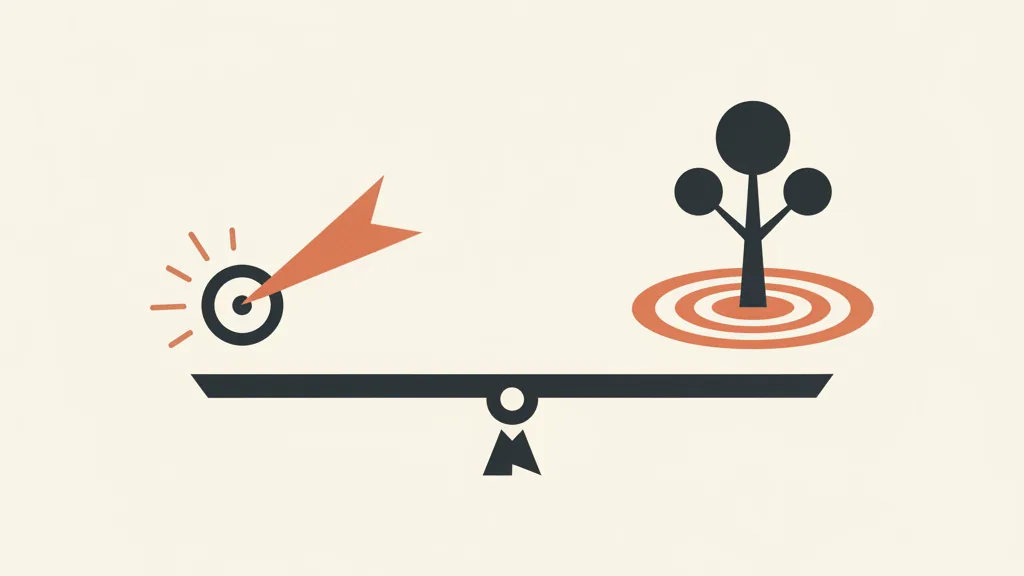
What performance does and what brand does
Let's start with definitions, because there's a lot of confusion around this topic.
Performance marketing is everything you spend to generate a measurable, attributable action here and now: a click, a lead, a sale. You pay for a result you see within days. Conversion-focused Facebook Ads, Google Search Ads, retargeting, lead generation campaigns. The logic is: put in a euro, measure how many euros come back, and optimize. It's the engine that powers your customer acquisition system in the short term.
Brand marketing is everything that gets built in the customer's head before they even think about buying: awareness, recognizability, trust, mental associations. It doesn't generate a traceable sale by tomorrow morning. It reduces friction on every future sale. Once a potential customer has already heard your name three times, your ad costs less to convince them. That's the point that gets missed by anyone looking only at campaign ROAS.
In one line: performance harvests demand, brand creates it. If you harvest without creating, sooner or later the pool dries up and costs rise. If you create without harvesting, you generate interest that someone else converts instead of you.
Side-by-side comparison: the three differences that matter
The fastest way to avoid confusion is to compare the two levers across three concrete axes: where you act, what you measure, and when you see the result.
| Axis | Performance marketing | Brand marketing |
|---|---|---|
| Typical channels | Search ads, conversion-focused social ads, retargeting, lead ads, affiliate marketing, sales email | Reach-focused video and social, PR and press relations, sponsorships, content, influencers, OOH, podcasts |
| Primary metrics | ROAS, CPL, CPA, conversion rate, CTR, attributed revenue | Aided and unaided awareness, share of voice, direct traffic, branded search, NPS |
| Horizon | Days / weeks. Effect fades as soon as you stop spending | Months / years. Effect compounds and lingers afterward |
| Goal | Convert people who are already ready to buy | Bring more people into the pool and make them predisposed to buy |
| Risk if you do it alone | Rising costs, a shrinking pool, dependence on platforms | Awareness that doesn't translate into measurable revenue |
Notice the time-horizon row, because it's the source of almost every budget mistake. Performance delivers instant gratification: you spend on Monday, you see leads by Wednesday. Brand doesn't. And since the human brain prefers immediate reward, brand is systematically underfunded. Not because it delivers less, but because it delivers later.
Why one alone isn't enough: the rising-cost trap
Imagine a company that only does performance. It optimizes campaigns, squeezes ROAS, cuts waste. At first it goes great. Then something predictable happens: the warm audience, the one already ready to buy, runs out. To keep growing, it has to fish in colder waters, and there the cost of acquiring a customer rises. And rises. Since 2023, the average acquisition cost has grown by 40-60% amid competition, rising platform costs, and increasingly murky post-privacy attribution.
A company with only performance now has a structural problem: its only lever for growth is paying more. It hasn't built anything that makes future sales easier. Every customer costs as much as the first one — actually, more.
This is where brand makes an economic difference, not an "image" one. Solid awareness lowers the acquisition cost within the same channel and raises customer value over time, because people who know you and trust you buy more often and stay longer. Advertising effectiveness research shows that brands with high equity reach a customer lifetime value (LTV) 40-60% above the category average. This isn't esoteric marketing: it's math on your P&L. If you want to see how to read this ratio, we explained it in detail in how to reduce customer acquisition cost and in how to calculate customer lifetime value.

The famous 60/40: how much brand and how much performance
The practical question becomes: how do I split the budget? The most solid reference on this topic is the work of Les Binet and Peter Field, The Long and the Short of It, built on hundreds of IPA case studies. Their conclusion, which has become almost a rule: roughly 60% of the budget to brand building and 40% to sales activation to maximize long-term growth.
Don't take it as law. It's an average, and it needs to be adapted:
- You're young or not well known: tilt toward performance (even 70% performance). First you need to generate cash and find product-market fit; pure brand comes later.
- You're in B2B: the same Binet and Field research, in the study with the LinkedIn B2B Institute, shifts the optimum to around 46% brand and 54% activation, because buying cycles are long and involve multiple decision-makers.
- You're an established brand looking to defend your position: the 60/40 toward brand is the configuration that holds up best over time — and it's also the one everyone's tempted to abandon in tough quarters.
The most important lesson from that dataset isn't the number. It's this: brands that win over multi-year horizons are the ones that kept investing in brand precisely in the quarters when short-term numbers suggested cutting it. Anyone who cuts brand the moment ROAS wobbles is condemning themselves to rising costs the following year.
Then there's a third way the market calls performance branding: content and creative that build brand perception and drive action in the same asset. A good video ad that makes you remember the brand while pushing you toward checkout works on both fronts. It doesn't solve everything, but it breaks down the false "either/or" dilemma at the level of a single campaign.
The real problem: how to measure brand without fooling yourself
This is where almost every company trips up. Performance measures itself: the platform hands you campaign ROAS. Brand, on the other hand, "can't be measured," so it always loses in meetings. But it's not true that it can't be measured. You measure it badly if you look for it in the wrong place.
Looking for brand's effect in a single campaign's ROAS is like looking for your keys under the streetlight because that's where the light is. Brand doesn't produce a conversion attributable to a click. It produces a diffuse effect across all sales. So it needs to be measured with a metric that looks at the total, not the single channel.
That metric is the MER (Marketing Efficiency Ratio), sometimes called blended ROAS. The formula is brutally simple:
MER = total revenue ÷ total marketing spend
ROAS tells you how well that campaign performs. MER tells you how well your entire marketing effort performs, brand included, above the noise of attribution. And this is exactly where brand's effect becomes visible. We wrote a dedicated guide on MER vs ROAS and which metric to use because this is the point that separates those flying blind from those who actually understand their numbers.
The AstraLoop angle: reading brand's contribution in the MER trend
Here's the practical method we use with clients, and one you can replicate without exotic tools.
- Set the baseline. Before increasing your brand investment, record your average MER over a few stable weeks. That's your zero point.
- Increase brand spend, keep everything else fixed. Don't change everything at once, or you won't know what moved what.
- Watch where the MER goes over time. If brand is working, in the following weeks you'll see the overall MER rise even if the ROAS of individual performance campaigns stays the same or dips slightly. Translation: you're generating the same revenue (or more) with less paid pressure. Brand is bringing in more predisposed people who convert with less paid push.
- Cross-check with brand signals. A rising MER that coincides with more direct traffic, more searches for your name on Google, and more conversions with "no clear source" is the signature of a brand that's working. It's not a lab-grade proof, but it's the most reliable signal you can get in a world of broken attribution.
The reverse reasoning is just as useful: if you cut brand and, in the following months, MER declines while campaign ROAS stays good, you have confirmation that brand was propping up your overall efficiency. It's the way to make visible in a meeting something that used to be "invisible."
This approach goes hand in hand with data automation: pulling total revenue, spend by channel, and brand signals into a single, updated dashboard, so you read the MER every week instead of once a year. It's the same principle we use to set up monitoring for the marketing KPIs worth tracking: a few right numbers, read often, beat a hundred dashboards nobody opens.
Want to understand how much your brand is really lowering your acquisition cost? Request a MER analysis from us: we'll show you where brand and performance are helping each other (or where you're leaving money on the table).
How to set this up in practice in your company
If you're starting out, you don't need a multinational-scale marketing division. You need a sensible sequence.
- Secure performance first. If you don't yet have a predictable acquisition flow, that's the priority. Brand built on sand foundations is a luxury. First build the engine that brings you customers, as described in how to get a steady flow of customers.
- Carve out a fixed share for brand. Even 20-30% at the start, protected and untouchable, beats zero. The rule: it's not the first line item you cut when the month goes badly.
- Choose metrics that match the lever. Don't judge an awareness campaign by click-based ROAS, and don't judge a conversion campaign by aided awareness. Each lever gets its own yardstick. This mistake is so common that we address it separately for Meta Ads campaigns between branding and sales.
- Read the MER, not just the ROAS figures. It's your control-room dashboard. You use ROAS to decide within channels, and MER to decide between levers.
All of this fits into a broader overall digital strategy and, for those working in B2B with long cycles, needs to be calibrated to the real decision timelines described in the guide to B2B lead generation. The principle doesn't change: two levers, different horizons, one control metric.
In short
Brand vs performance isn't a choice, it's a dosage. Performance gives you customers today. Brand makes sure those customers, and the next ones, cost you less and are worth more. Companies that do only performance end up hostage to rising costs. Companies that do only brand fill the pool but let others fish in it.
The point that changes the game isn't the 60/40 theory. It's giving up on demanding that brand justify every euro with an attributable conversion, and starting to measure it where its effect is real: in the MER trend. When you see MER rise while performance pressure stays flat, you're watching your brand at work. And that's the only proof that actually matters in a business.
Frequently asked questions
What's the difference between brand marketing and performance marketing?
Performance marketing generates measurable, attributable actions in the short term (clicks, leads, sales), and you pay for an immediate result. Brand marketing builds awareness, trust, and recognizability that reduce friction on all future sales. Performance harvests demand, brand creates it. They have different channels, metrics, and time horizons, but they're complementary.
Is it better to invest in brand or in performance?
It's not an either/or choice. If you're young or not well known, tilt toward performance to generate cash. Once your acquisition flow is stable, the Binet and Field benchmark points to roughly 60% on brand and 40% on activation for long-term growth (in B2B, the optimum shifts to around 46/54). Brand should still be protected and not cut at the first tough month.
How do you measure the effectiveness of brand marketing?
Not in the ROAS of a single campaign, because brand doesn't produce a conversion attributable to a click but a diffuse effect across all sales. It's measured with the MER (total revenue divided by total marketing spend) by watching its trend, cross-checked against signals like direct traffic, branded search, and aided awareness. A rising MER at the same performance pressure is the signature of a brand that's working.
What is MER and why is it useful for measuring brand?
The MER (Marketing Efficiency Ratio), or blended ROAS, is total revenue divided by total marketing spend. Unlike campaign ROAS, it looks at the total above the noise of attribution. It's the only metric that makes brand's contribution visible: if you increase brand investment and the overall MER rises while campaign ROAS stays flat, brand is bringing you more predisposed customers.
How much budget should you dedicate to brand marketing?
It depends on the company's maturity. Companies starting out can carve out a protected, untouchable 20-30%, while established ones can lean toward the 60% from Binet and Field's work. The most important practical rule isn't the exact percentage: it's not making brand the first line item you cut when the month goes badly, because doing so leads to higher acquisition costs the following year.
What is performance branding?
It's the approach that combines both levers in the same campaign: content and creative that build brand perception and drive action at the same time. A video that makes you remember the brand while pushing you toward checkout works on both fronts. It doesn't eliminate the distinction between brand and performance, but it breaks down the false dilemma at the level of a single asset.
If you want to set up a dashboard that reads MER every week and cuts budgets based on data, not gut feeling, talk to us: we'll build the measurement system tailored to your company.