AI in Business: Where to Start (2026 Practical Guide)
9 min read · AstraLoop Studio
If you're reading this guide, you've probably already heard dozens of times that you need to "bring artificial intelligence into your business," but nobody has actually explained where to start. The truth is simple: most companies start off on the wrong foot and pay for it. They buy a tool because it's trendy, slap it onto some random process, and six months later it's gathering dust in a corner. A few thousand euros burned, and the feeling that "AI just isn't for us."
The problem isn't AI. It's the approach. This guide walks you through a method that starts from the business problem, not the tool, and takes you from the first steps to a system that generates measurable value. If you want the full picture of the journey, from strategy to implementation, you'll find it in our complete guide to AI consulting for businesses. Here, we focus on just one thing: how to start well.
Mistake number one: starting from the tool instead of the problem
There's a script that plays out in almost every company that calls us after a failure. It goes something like this: "We bought tool X because everyone was talking about it, but we don't really know what to do with it." This is called a technology-first approach, and it's the number one cause of wasted money.
The correct logic is reversed. You don't start with "what can this AI do?" — you start with "which problem is costing me the most every month?" The tool comes at the end, not the beginning. Here's a concrete example. If your admin office spends 30 hours a month manually entering data from incoming invoices, the problem is clear and quantified. Only then does it make sense to ask which tool solves that specific problem.
The difference between the two approaches isn't philosophical — it's economic.
| Aspect | Technology-first approach (wrong) | Problem-first approach (correct) |
|---|---|---|
| Starting point | "Let's buy the trendy AI" | "What's the most expensive bottleneck?" |
| Success metric | None, or "we use AI" | Hours freed up, errors reduced, extra revenue |
| Risk of abandonment | High (a solution looking for a problem) | Low (solves a real pain point) |
| Time to first ROI | Often never | 4-12 months typical |
This isn't theory. Industry data points to roughly 85% of generative AI pilot projects failing to make it into production. And the dominant reason isn't technical: those projects weren't anchored to a measurable business problem from the start.

The three-question method, before you spend a euro
Before evaluating any software, sit down and answer three questions. If you don't have solid answers, you're not ready to buy anything.
1. Which repetitive task steals the most time?
Look for high-volume, low-variety processes: handling first-contact emails, data entry, answering customers' frequently asked questions, standard quotes, reconciliations. These are the natural candidates for automation. A task you do 200 times a month, always the same way, is worth more than one you do differently every time.
2. Where are we losing money to errors or slowness?
A lead who waits two days for a reply is often a lost lead. A wrong invoice costs you in corrections and in your relationship with the supplier. Quantify it: how much does that delay or error really cost you, in euros, every month? Plenty of business process automation with AI projects start exactly here, where slowness and errors translate into lost margin.
3. What would we like to do but don't have the people to do it?
Not all AI is about cutting costs. Sometimes it unlocks capacity: reactivating a database of dormant customers that no one ever has time to call back, qualifying hundreds of leads that today go ignored, staffing the switchboard outside business hours. Here, AI isn't replacing a person — it's doing something you simply don't do today.
The first use cases that deliver fast results
You don't need to revolutionize the company on the first try. You need a quick win: a small, contained project that proves value within a few weeks and builds internal trust. Here are the most reliable entry points for an Italian SME.
- Customer operations and support: an assistant that answers frequently asked questions, routes requests, and handles first contact even outside business hours. An AI voice assistant for the switchboard catches calls that today go unanswered.
- Sales and lead generation: systems that qualify incoming leads and pass only the ready ones to sales. If this is your pain point, dig into how AI lead generation works and how to qualify leads without wasting your team's time.
- Administration and back office: data extraction from documents, reconciliations, automatic filling of repetitive forms.
- Marketing: producing content drafts, analyzing campaign data, segmentation. Useful, but rarely the first project: the ROI is harder to isolate.
The practical rule is this: pick a use case where you have a clear starting figure ("today we spend X hours" or "we're losing Y leads") and where the result is visible to everyone. Internal visibility is worth as much as the savings, because it builds consensus for the next phases.
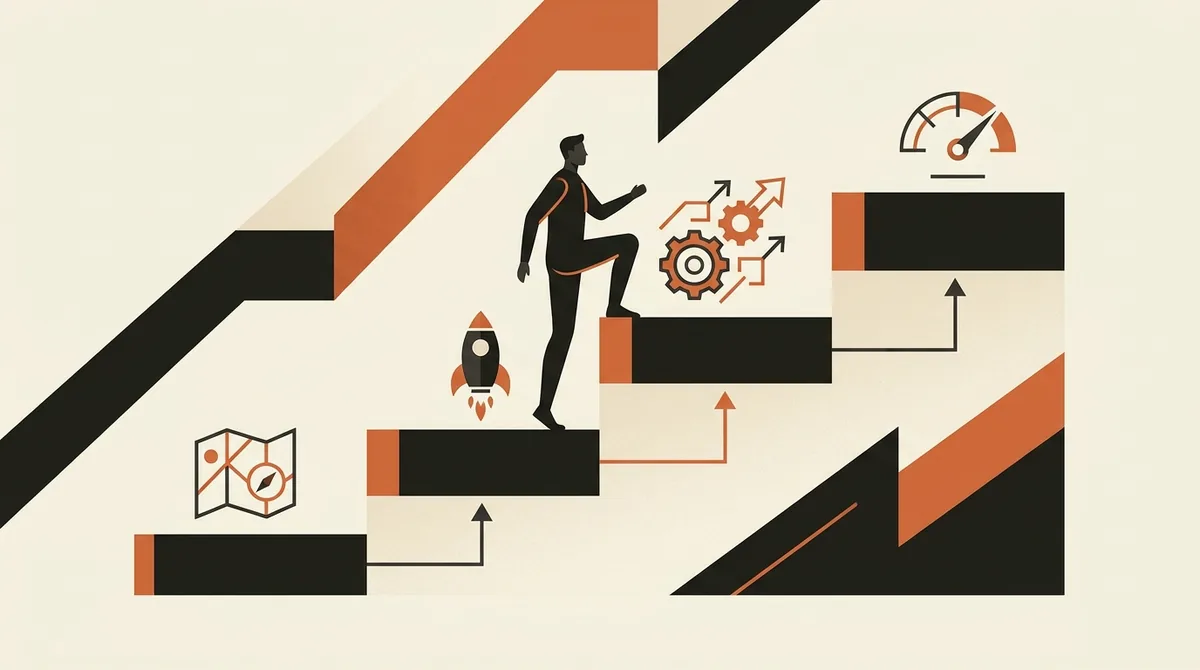
The 4-phase adoption roadmap
A serious adoption process isn't a purchase, it's a process. It breaks down into four phases, and skipping one is the most common way to end up among the 85% of projects that fail.
Phase 1. Assessment (mapping)
Before you act, you map. An assessment of your processes identifies where AI can really make a difference, estimates the effort, and classifies the systems you'll use by risk category (needed for the AI Act, more on that shortly). The output is a prioritized list of opportunities, with an estimated impact in euros and hours. Typical duration: 2-4 weeks.
Phase 2. Pilot projects (quick win)
You take one or two high-impact, low-risk opportunities from the list and turn them into a pilot. The goal is to demonstrate measurable value in 4-8 weeks, not to build the final system. This is where you define the KPIs (hours freed up, error rate, response time) and measure them before and after.
Phase 3. Scale-up (scaling)
The pilot worked. Now you extend it: more volume, more connected processes, integration with the systems you already use (CRM, ERP, management software). This is where AI agents become concrete: systems that don't just respond but read documents, query your data, and act on processes. And it's also here that 85% of pilots collapse, because scaling requires governance, data integration, and change management that the pilot never had.
Phase 4. Continuous monitoring
An AI system isn't an appliance you switch on and forget. Models "drift" (model drift), data changes, agents sometimes get it wrong. You need guardrails, a human-in-the-loop for critical cases, and constant monitoring of metrics. What do you do when the agent gets it wrong? You need to have decided that beforehand, not after.
Want to figure out which process is worth automating first in your business, backed by real numbers instead of promises? Request a free analysis: we start from your problem, not the tool.
How to measure ROI (with real numbers)
If you're not measuring, you're not running an AI project — you're running an experiment at your own expense. The basic formula is simple, and you can apply it today.
ROI = (hours freed up x hourly cost + extra revenue) minus total costs
Total costs include three items many people forget: initial setup, ongoing maintenance, and management cost (who oversees the system, handles errors, updates it). Here's a realistic numerical example for an SME.
| Item | Estimated value (annual) |
|---|---|
| Hours freed up (30 h/month x 12) | 360 hours |
| Internal hourly cost | 25 euros/h |
| Value of hours freed up | 9,000 euros |
| Extra revenue (recovered leads, upsell) | 6,000 euros |
| Total costs (setup + maintenance) | 7,000 euros |
| Net gain, year 1 | +8,000 euros |
The typical payback for a well-structured project is between 4 and 12 months. If a vendor can't tell you how long it takes to break even, that's a red flag. Transparency about costs (setup, maintenance, model drift) is one of the criteria that separates a serious partner from someone selling smoke.
The AI Act: what you need to know before you start
You can't talk about artificial intelligence in business in 2026 while ignoring the regulatory framework. The AI Act (EU Regulation 2024/1689) came into force in 2024 with a staggered rollout. One key deadline is August 2, 2026, when the obligations for high-risk systems and most of the penalty regime become applicable. Fines can reach up to 35 million euros, or 7% of worldwide annual turnover, for the most serious violations.
There are two practical points that concern almost every company.
- AI literacy (Art. 4): since February 2, 2025, anyone using AI systems must ensure an adequate level of competence among the staff who use them. It's not optional, and it applies even if you only use third-party tools.
- Risk-based classification: systems are divided into categories (unacceptable risk, high, limited, minimal) with different obligations. Knowing which category your use case falls into is part of the initial assessment.
This is informational content, not legal advice: for the specific requirements of your situation, refer to the text of the AI Act and the guidance of the competent authorities (nationally, the ACN and the Garante Privacy for GDPR matters). If you want the operational detail on deadlines and obligations, we have a dedicated article on AI Act 2026 obligations for SMEs.
The silent risk: Shadow AI
While you're weighing whether and how to start, there's a good chance AI has already snuck into your company through the back door. An estimated 68% to 76% of employees use AI tools on the sly, pasting company data (sometimes sensitive) into public chatbots, with no policy in place. It's called Shadow AI, and it's a double risk: GDPR (data leaving without control) and the AI Act (ungoverned use).
The answer isn't to ban it — it's to govern it. You need a clear internal policy: which tools are allowed, which data never leaves, who's in charge of oversight. This is another reason why starting in a structured way pays off: when you give your team approved, secure tools, Shadow AI loses its appeal.
Build in-house or rely on a partner?
The "build vs. buy" question comes up early. Building everything internally requires specialized skills (data, models, security, MLOps) that few SMEs have in-house and that are expensive to hire. Relying on ready-made solutions or a partner speeds things up and reduces risk, but you need to choose carefully to avoid ending up with the wrong vendor.
The pragmatic rule: build in-house whatever represents a unique, business-specific competitive advantage; buy or outsource everything else (infrastructure, standard components, integrations). The most underrated factor in this decision isn't technology — it's change management. 73% of companies name training and upskilling as a priority, but only 22% have structured programs in place. Your AI project lives or dies on how genuinely people adopt it.
In summary: your first steps
- Start from the most costly problem, not the trendy tool.
- Answer the three questions and quantify in euros and hours.
- Choose a visible, measurable quick win.
- Follow the 4-phase roadmap without skipping the assessment.
- Define the KPIs and measure ROI before and after.
- Get your AI use in order (literacy, anti-Shadow-AI policy, risk classification).
Starting well doesn't require a huge budget. It requires method. And unlike budget, method costs nothing to start applying.
Frequently asked questions
Where should an SME start with artificial intelligence?
Not with a tool, but with a problem. Identify the repetitive task that steals the most time, or where you're losing money to slowness and errors, quantify it in hours and euros, and only then look for the solution that solves it. The ideal first project is a quick win: small, measurable, and visible to everyone.
How much does it cost to bring AI into a business?
It depends on the use case, but for a targeted pilot project in an SME, you're often looking at a few thousand euros between setup and the first months of operation. The key figure isn't the absolute cost but the payback: a well-structured project typically breaks even in 4-12 months. Be wary of anyone who can't estimate the payback period for you.
Why do so many AI projects fail?
About 85% of generative AI pilots fail to make it into production. The main causes aren't technical: starting from the tool instead of the problem, lack of measurable KPIs, and above all, poor change management. People don't adopt what they don't understand or don't see a benefit in.
Does the AI Act require me to do anything if I only use third-party tools?
Yes. The AI literacy obligation (Art. 4 of EU Regulation 2024/1689) also applies to those who use AI tools provided by others: you must ensure adequate skills among the staff who use them. From August 2, 2026, further obligations and the penalty regime become applicable. For your specific requirements, refer to the text of the AI Act and the competent authorities.
What is Shadow AI, and should I worry about it?
It's the use of AI tools by employees without authorization or oversight, often by pasting company data into public chatbots. It affects 68-76% of employees and creates GDPR and AI Act risks. The solution isn't to ban it but to govern it: a clear policy on approved tools, data that never leaves, and oversight responsibility.
Is it better to build an AI solution in-house or rely on a partner?
Build in-house only what represents a unique competitive advantage for your business; for infrastructure, standard components, and integrations, it's better to rely on ready-made solutions or a partner, which reduce time and risk. The decisive factor remains internal adoption: without training and change management, even the best technical solution fails.
If you'd rather skip the trial-and-error phase, talk to us: we'll map your processes, identify the highest-ROI quick wins, and build you a clear roadmap, AI Act included.