Scroll-Stopping Meta Ads Creative: A Framework and Checklist
10 min read · AstraLoop Studio
Ever since Meta moved almost all optimization inside the algorithm (Advantage+, automatic targeting, automatic placements), there's really only one lever left where you can still make a difference: creative. Not the audience, not manual bidding, not placements. Creative. That's what decides whether your ad gets watched or skipped in half a second.
The problem is that "making a nice-looking ad" isn't enough. A visually polished ad without a hook that stops the thumb is money wasted. In this article you'll find an operational framework for producing Facebook and Instagram creative that captures attention in the first 3 seconds, with concrete hooks, tested angles, and a checklist to run before you publish. If you want the full picture on the topic, start with our complete guide to ad creative. Here we go deep on the scroll-stop moment specifically.
Why creative is the new optimization lever in the Advantage+ era
Until a few years ago, competitive advantage on Meta was built on targeting: detailed audiences, layered lookalikes, surgical exclusions. Today that margin has narrowed. With Advantage+ handling audience and budget automatically, the algorithm finds the right people on its own, but it needs strong signals to know who to engage. And the strongest signal you can give it is the creative itself: the ad is what "describes" who it should be shown to.
With the arrival of Andromeda, Meta's new retrieval engine, this logic has been pushed even further. The system analyzes an ad's visual and text content to make predictive matches between creative and user. In practice, the more clearly your creative communicates the offer, angle, and benefit, the better the algorithm works. An ambiguous creative confuses the machine before it even reaches the audience.
Translated into day-to-day work: your job is no longer to spend hours building audiences, but to produce many quality creative variants and test them systematically. Volume matters (more on that later), but without a structure that stops the scroll, every variant is just noise.
The 3-second rule: what actually happens in the feed
The feed is not a neutral context. The user is scrolling with a goal in mind (being entertained, looking for something, killing time), and your ad is an interruption. You have an extremely narrow window, on average around 1.7 seconds on mobile, to convince them to slow down. If you don't give them a reason to stop in that window, the ad has already disappeared from view.
This changes how you need to think about creative. The first frame of a video, or a static image, shouldn't "introduce the product." It needs to create a moment of visual or cognitive friction: an unexpected movement, a face talking straight into the camera, text that contradicts an expectation, a detail that sparks curiosity. Everything else (explanation, proof, offer, call to action) comes after, but only if you've bought yourself that first second and a half.
A common mistake is putting the brand logo or a "cinematic" intro in the first frames. Nobody stops scrolling for a logo. Branding can still be there, but it shouldn't occupy the scroll-stop window.
The Hook, Angle, Structure framework
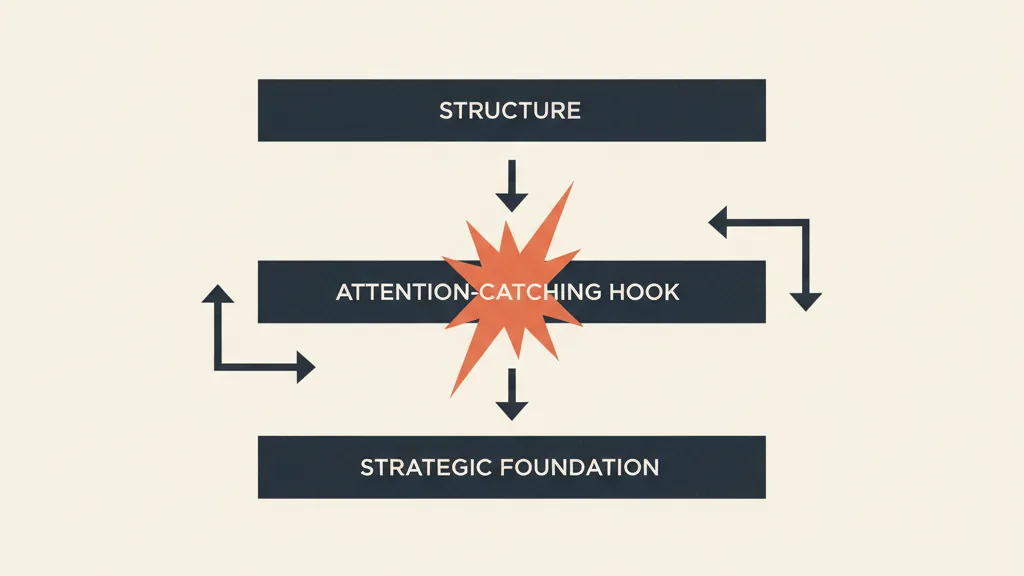
Every scroll-stopping creative rests on three distinct layers. Confusing them is the number-one cause of mediocre ads.
1. The angle: the strategic promise
The angle is the "why you should care," framed around a specific need. The same product can be sold with different angles: time savings, status, fear of making a mistake, desire for a fast result. The angle is chosen upstream and depends on the audience's awareness level. To get this right, it's worth revisiting the five levels of customer awareness: a cold audience needs angles built around the problem, an aware audience needs angles built around the solution and comparison.
2. The hook: how you capture attention in the first 3 seconds
The hook is the visual and verbal translation of the angle into the first frame. It's the most tactical piece, and the one that decides the scroll-stop. A good hook does one of these things: sparks curiosity, promises an immediate benefit, shows a recognizable problem, breaks a visual pattern, or leans on strong social proof. Below you'll find a library of ready-to-adapt hooks.
3. The structure: how you hold attention after the hook
Once you've stopped the scroll, you need to guide the eye toward conversion. This is where pacing, subtitles, message sequencing, and the call to action come in. Visual and narrative structure is what turns attention into a click. If you work with video, our guide to the structure of video ads that convert goes into detail on this phase.
Practical rule: never test everything at once. First validate the angle, then iterate on hooks within the winning angle, and only then refine the structure. Change three things at once and you'll never know what actually worked.
A library of scroll-stopping hooks
Hooks aren't magic formulas, they're proven patterns. Here are the most reliable ones, with examples adapted for an Italian-speaking market. You'll find more inspiration in our collection of creative ad hook examples.
| Hook type | How it works | Verbal or visual example |
|---|---|---|
| Recognizable problem | Show a frustration the audience deals with every day | "If this happens to you every morning too..." with a shot of the problem |
| Curiosity or information gap | Open a question without giving the answer right away | "Nobody tells you this before buying X" |
| Immediate benefit | Promise a concrete result within the first seconds | "Done in 30 seconds, no tools needed" |
| Pattern interrupt | An unexpected movement or image that breaks the feed | An object falling, a quick gesture, a sudden zoom |
| Social proof | Numbers, reviews, real "before and after" | "Over 2,000 customers have already chosen it" |
| Counterintuitive claim | A statement that contradicts common sense | "Stop doing X if you want to get Y" |
| Direct question | Address the viewer directly, in the first person | "How many times has this happened to you?" |
The practical takeaway: for every winning angle, produce at least 4-5 different hooks while keeping the rest of the creative identical. It's the cheapest way to multiply your tests without rebuilding everything from scratch. If you're short on ideas, our method for finding creative ad ideas helps you systematize the search.
Visual structure: the details that make the difference
Even the best hook is wasted if the creative is put together poorly on a technical level. Some points are non-negotiable:
- Vertical 9:16 format for Reels and Stories: it fills the whole screen and maximizes impact. Square formats work fine in the feed but lose out in full-screen placements. If you're unsure what to use, check the guide on which Meta ad format to choose.
- Always use subtitles: most people watch without sound. A spoken video without subtitles loses the message. We go deeper on why in our piece on subtitles in video ads.
- Respect the safe zones: keep text and key elements away from the edges, where interface icons cover them. The guide to Meta's safe zones shows the exact margins.
- Large, readable text in the first frames: it needs to be absorbed at a glance, not read carefully.
- Contrast and motion: bold colors and a moving element in the first second. The feed is full of grey, standing out helps.
One format that deserves special attention is UGC (user-generated-style content): it works because it doesn't "look" like advertising and gets past the audience's skepticism. If you're not familiar with it, start with what UGC ads are and why they work.
Want a system that produces and tests high-tempo creative, with AI multiplying the variants and a funnel that turns clicks into customers? Request a free audit of your Meta account.
How many creatives you need and how to test them
In the Advantage+ era, the real bottleneck is no longer targeting but the pace of creative production. The algorithm consumes creative: once one stops performing (creative fatigue), you need a new one. There's no universal number, but there is a practical benchmark: many effective advertisers work through several new creatives every week, mixing new concepts with iterations on winners. We break down the numbers in our article on how many creatives per month you need on Meta.
On method, discipline beats gut feeling. Here's a solid testing flow:
- Validate the angle: a few very different concepts, with enough budget to get past the learning phase.
- Iterate on hooks within the winning angle: same body, different hooks.
- Refine the structure: pacing, length, call to action, static versus video.
- Document everything: what you changed and what happened. Without a log, you repeat the same mistakes.
To build a repeatable process instead of one-off tests, the guide to a creative testing method for ads is the right reference, along with the deeper dive on how to test creative on Meta. And to judge results without fooling yourself, read how to tell if a creative is really performing.
How AI speeds up creative production (without flattening it)
The bottleneck for almost every team is production speed. This is where AI changes the rules, not by replacing the creative idea but by multiplying the variants of a winning concept. With AI image and video generation, you can produce dozens of variations on the same hook in a few hours instead of days. We cover this in how to produce ad creative with AI and in the 2026 outlook on AI-generated UGC creative.
The risk to avoid is flattening: if you generate everything with the same prompt and the same style, the algorithm sees variants that are too similar and learns nothing new. AI should be used to widen the testing space (different angles, different hooks, different settings), not to clone the same idea. Strategic creative decisions (which angle, which hook) stay human, AI accelerates execution. At AstraLoop, this exact intersection between creative strategy and production automation is what we work on.
Pre-publish checklist
Before sending a creative into a campaign, run it through this list. If even one point is a "no," go back to the drawing board.
- Does the first frame stop the scroll on its own, with no sound? (Test it muted.)
- Is the angle clear within the first 3 seconds?
- Is there one dominant message, not five?
- Are subtitles present and readable?
- Is the format vertical 9:16 for full-screen placements?
- Do text and key elements stay inside the safe zones?
- Is the call to action explicit and consistent with the angle?
- Do you have at least 3-4 hook variants of the same concept to test?
- Is the creative different from the others already running (to give the algorithm a fresh signal)?
- Do you have a way to measure which variant wins?
If your creative performs but the leads coming in are low quality, the problem is often not the creative but what happens next: qualification, follow-up, contact management. That's where the value generated by ads gets closed, or lost, and where a well-built acquisition funnel and a CRM that captures the signals make the difference between spend and return.
In summary
In the Advantage+ and Andromeda era, creative is the primary optimization lever, not a secondary aesthetic detail. The winners are the ones who separate angle, hook, and structure, who capture attention in the first 3 seconds with a proven pattern, and who produce many quality variants and test them methodically. AI accelerates production, but creative strategy remains the core. Run the checklist before every publish and turn the scroll-stop from luck into a repeatable process.
Frequently asked questions
Why has creative become so much more important on Meta than targeting?
With Advantage+ and Andromeda, Meta automatically handles audience, budget, and placements. The one lever advertisers still truly control is creative: it's the ad itself that gives the algorithm the signals it needs to know who to show it to. Manual targeting and bid optimization matter far less than they used to.
How many seconds do I have to stop the scroll with a Meta creative?
Very few: on mobile, the useful window averages around 1.5-2 seconds. The first frame of a video or a static image needs to create visual friction or curiosity immediately. The rest of the message can come after, but only if you've already bought that first second and a half of attention.
What's the difference between angle and hook in a creative?
The angle is the strategic promise, the reason the audience should care (savings, status, fear of getting it wrong, a fast result), and it depends on the audience's awareness level. The hook is the visual and verbal translation of that angle into the first frame, the tactical piece that decides the scroll-stop. You validate the angle first, then iterate on hooks.
How many new creatives do I need every week on Meta?
There's no universal number, but creative fatigue timelines demand a steady flow: many effective advertisers work through several new creatives a week, mixing new concepts with iterations on winners. Today's real bottleneck is production pace, not audience count.
Can AI replace human creativity in ads?
No, it multiplies it. AI is great at quickly generating many variants of a winning concept and widening the testing space, but the strategic choices (which angle, which hook) stay human. Using AI to clone the same idea flattens your tests and gives the algorithm no new signal.
How do I know if a creative is really working?
Look past surface metrics like likes. What matters is the scroll-stop rate (hook rate), click-through rate to the landing page, and above all the real cost per result and the quality of leads generated. A creative with lots of engagement but few concrete results isn't working, judge it against the business goal, not the vanity metric.
If your creative stops the scroll but the results aren't showing up, the problem is often further downstream. Talk to us and let's build the full path together, from the ad to the conversion.