Custom CRM for Real Estate Agencies: Leads, Properties, and Follow-Up Under Control
10 min read · AstraLoop Studio
If you run a real estate agency, the problem isn't a lack of leads. It's that they arrive from eight different places and nobody keeps them together. An inquiry on a listing portal, another on a different one, a WhatsApp message, a call to an agent's mobile, a form on your own site, a Facebook contact. Who was interested in that three-room flat downtown? Did you call them back, or did you lose them? And that client looking for a two-room flat with a terrace: did the right listing ever reach them, or did it end up with a colleague instead?
Most agencies patch over this chaos with off-the-shelf property management software or a spreadsheet and the memory of their best agent. Both approaches share the same limit: you adapt to the software, not the other way around. A custom CRM for real estate agencies flips that setup. It starts from the three real pain points of the job (portal leads, property-client matching, follow-up) and automates them around the workflow you actually use.
In this article we'll look at what that means in practice, how it differs from standard property management software, what it costs, and when the investment is worth it. No inflated promises.

The three problems no standard system solves well
Before talking about software, let's pin down what an agency actually loses every week. That's where a CRM earns its cost, not in the features that look good in a demo.
1. Portal leads land everywhere except in one place
Listing portals, your site's form, direct messages on social media — each channel has its own inbox, its own format, its own alert. The agent gets a notification on their phone, maybe answers, maybe forgets because they're in the middle of a viewing. The lead never enters any structured system. The result: you don't know how many contacts you generate a month, how many get worked, how many get lost. And above all, you don't know which portal actually brings you clients who buy, so you keep paying for subscriptions blind.
A well-built CRM pulls leads from every source into a single queue, assigns them automatically to the right agent (by area, by property type, on rotation), and tells you in real time who's responded and who hasn't. In residential real estate, the difference between a lead worked within five minutes and one picked up three hours later shows up directly in booked viewings.
2. Property-client matching lives in the agent's head
This is the heart of the job and its most fragile point. A new listing comes in: who, among the 400 contacts in your database, was looking for exactly this? In most agencies the answer is "whoever the agent happens to remember." If that agent is on holiday, or only has the last twenty clients in mind, the right property never meets the right client.
With a custom CRM, every client has a structured search profile: area, budget, size, number of rooms, specific needs like a terrace or a garage. When you register a new property, the system automatically cross-references its features against the profiles in your database and returns a list of matching clients, ranked by relevance. In thirty seconds you send the listing to whoever was waiting for it, instead of hoping someone remembers.
3. Follow-up is where the real money gets lost
A property buyer decides over weeks or months, not in one afternoon. Someone who viewed a home in March and didn't buy isn't a dead lead — they're a lead to nurture. But without a system, follow-up depends on individual goodwill. And goodwill, under pressure, always slips.
This is where sales follow-up automation makes the sharpest difference. Automatic reminders after a viewing, re-contact sequences for people who haven't responded, alerts when a client has gone quiet for too long. It doesn't replace the human relationship — it makes it consistent. And that's exactly what a generic system won't let you set up your own way.
Custom CRM or off-the-shelf property management software
To be clear: standard software isn't "bad." For a small agency with linear workflows and a tight budget, off-the-shelf property management tools do their job. The point is to understand where the packaged model stops holding up, and where a system built around you pays for itself instead. If you're still weighing the basic choice, the comparison between custom vs. standard CRM goes into it without taking sides.
| Aspect | Off-the-shelf software | Custom CRM |
|---|---|---|
| Workflow | You adapt to theirs | Built around yours |
| Portal integration | Standard, limited to the software's partners | Every source you use, including WhatsApp and your site |
| Property-client matching | Basic, often just area or price | On the criteria you choose, with automatic alerts |
| Follow-up automation | Rigid or absent | Custom sequences by stage and channel |
| Upfront cost | Low (monthly fee) | Higher (one-off development) |
| Cost over time | Grows with users and modules | Stable, yours to own |
| Data | On their servers, with lock-in | Yours, exportable |
The right question isn't "which is better overall," but "where am I right now." It's the same logic as make-or-buy applied to CRM: below a certain threshold of volume and complexity, buying makes sense; above it, building does. An agency with two agents and simple workflows probably doesn't need custom software. An agency with multiple branches, a growing team, and a database of thousands of contacts is already paying (in lost leads) more than the right system would cost.
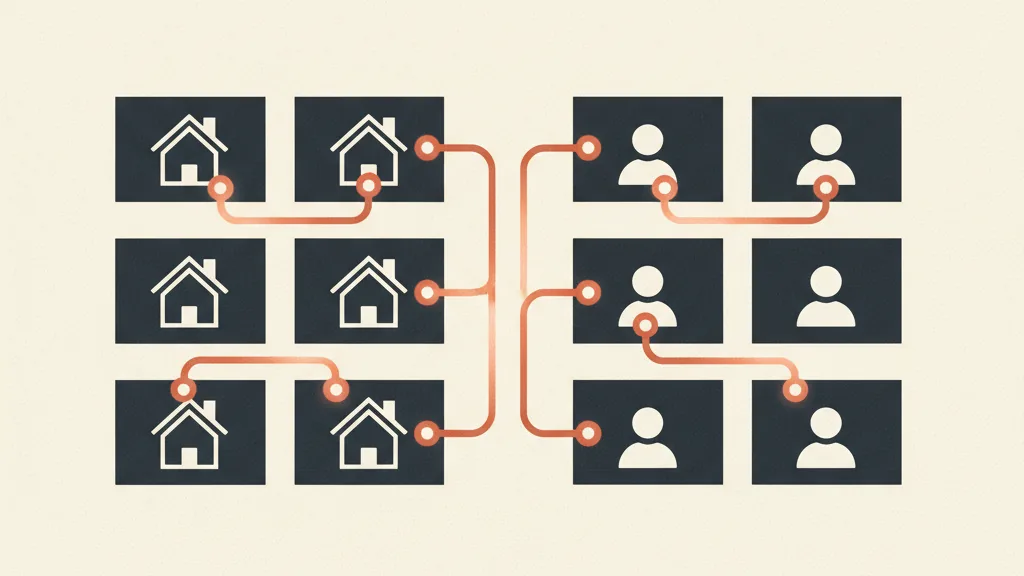
What a custom CRM for your business actually looks like
Let's look at the concrete modules, not buzzwords. A well-built system for a real estate agency generally has these building blocks:
- Multichannel lead capture. A single entry point for every listing portal, your site, social media, and WhatsApp. Every lead comes in with its source tracked, so at the end of the month you actually know which portal earns back its subscription. If you rely heavily on portals, a key piece is WhatsApp-CRM integration, since that's where half the inquiries land today.
- Linked property and client database. Not two separate archives, but two sides of the same coin. Every property has a status (acquiring, for sale, under negotiation, sold), and every client has a live search profile that keeps updating.
- Matching engine. When a property comes in, the system suggests matching clients. When a client comes in, it suggests matching properties. Matches become one-click actions.
- Follow-up automation. Post-viewing reminders, re-contact sequences, alerts on stalled leads. You decide the rules by stage and by channel (email, SMS, WhatsApp).
- Pipeline and reporting. Where your deals sit along the funnel, how many viewings turn into offers, how many offers turn into closings. Finally, you have the numbers to decide.
The point isn't to have every module on day one. You start from the most expensive bottleneck (usually lead management or follow-up) and add the rest in phases. A custom CRM shouldn't be an endless build — it should deliver results on the first block before you build the second.
The CRM alone isn't enough: you need the funnel that feeds it
A common mistake is thinking of the CRM as the finish line. In reality, it's the engine that processes what reaches it. If there's no steady, qualified flow of contacts upstream, you've automated emptiness. That's why a real estate CRM needs to be designed alongside the acquisition funnel for real estate agencies: the funnel brings in the leads, the CRM works them and loses none.
It's the logic behind the funnel that feeds the CRM: two pieces of the same system, not two disconnected tools. If you want to understand how the whole acquisition process fits together, from generating a contact to closing the deal, the full picture is in our deep dive on the customer acquisition system. And if your specific need is bringing in more real estate contacts, there's a dedicated guide to real estate lead generation.
Want to know if a custom CRM makes sense for your agency, or if standard software is enough? Request a free analysis: we'll look at your workflows together and tell you, numbers in hand, where you're losing leads and what's actually worth building.
How much does a custom CRM cost for a real estate agency
Fair question, and the honest answer is: it depends on scope. But to give you more than an unhelpful "it depends," here are realistic ranges from the Italian market.
| Setup | What's included | Indicative range |
|---|---|---|
| Focused MVP | Multichannel lead capture, agent assignment, basic follow-up | €6,000 - €12,000 |
| Full system | MVP plus linked property database, matching engine, pipeline and reporting | €12,000 - €25,000 |
| Multi-branch / advanced | Full system plus multiple branches, roles, AI automations, custom integrations | €25,000 and up |
On top of this comes an annual maintenance and evolution fee, generally 15-25% of the development cost. These are orientation figures: the actual quote depends on which portals you need to integrate with and how much automation you want. For the general picture of how the cost breaks down, there's an article on how much a custom CRM costs, and a more technical one on the cost of developing a custom CRM.
The right comparison isn't "off-the-shelf subscription vs. custom build cost." It's "custom build cost vs. the value of the leads you're losing right now." If an agency loses even two deals a year to missed follow-ups or bad matching, in many markets that alone covers a significant share of the investment, just from the recovered commissions.
How long it takes and how not to get the rollout wrong
A focused MVP typically goes live in 6-10 weeks; a full system takes 3-5 months, built in phases. The golden rule is not wanting everything at once. Start with the block that's bleeding the most, put it into production, measure it, then add the rest. For a more precise sense of timelines, there's a guide on how long it takes to implement a CRM.
The mistakes we see most often:
- Wanting to replicate the old system identically. If you're building custom, it's to fix broken workflows, not to set them in stone inside new software.
- Ignoring agent adoption. The best CRM in the world is money wasted if the agents don't use it. The interface has to be faster than their spreadsheet, not slower.
- Neglecting privacy. You handle personal data belonging to real people, potential buyers and sellers. Compliance needs to be built in from day one: consent, legal basis, retention periods. Italy's Data Protection Authority has been clear on contacts collected via portals and on subsequent marketing use. Our piece on GDPR for real estate agencies is worth a read on this.
- Building without the funnel upstream. As above: a CRM starved of leads is a half-finished investment.
Does AI change anything? Yes, but in the right places
The risk is getting sold "AI" as a magic feature. The practical truth is more concrete: in a real estate CRM, artificial intelligence helps in three measurable spots. First, lead qualification: an AI agent on WhatsApp can respond instantly to a portal inquiry, ask the first few questions (budget, area, timeline), and hand off to a human agent only the contacts who are ready. Second, smart matching, which goes beyond rigid filters and catches less obvious affinities. Third, follow-up prioritization: figuring out which client is most likely to close and putting the agent's energy there.
If this interests you, the evolution of CRM toward intelligent automation is covered in our article on agentic CRM with artificial intelligence, and on the more specific side there's a deep dive on the AI agent for qualifying leads on WhatsApp. AI isn't the starting point — it's a multiplier that makes sense once the foundations (clean database, clear workflows) are in place.
In summary
A custom CRM for real estate agencies makes sense when standard software forces you into workflows that aren't yours, and when leads lost across portals, memory-based matching, and missed follow-ups cost you more than the system that would fix them. It's not for everyone: below a certain threshold, off-the-shelf software is enough. But if your best work happens from memory and every extra contact adds to the chaos, then building around yourself pays off.
The final rule: first the funnel that brings in contacts, then the CRM that loses none of them, then — and only then — the AI that works them better. In that order.
Frequently asked questions
Does a custom CRM make more sense than off-the-shelf real estate software?
It depends on your volumes. For a small agency with linear workflows, off-the-shelf software is enough and costs less. Custom pays off when you have multiple branches, a growing team, a database of thousands of contacts, and you're losing leads because the standard software forces workflows that aren't yours. The right comparison is between the cost of building custom and the value of the deals you're currently losing.
How much does it cost to build a custom CRM for a real estate agency?
A focused MVP (multichannel leads, agent assignment, basic follow-up) typically starts at €6,000-€12,000. A full system with a linked property database, matching engine, and reporting runs €12,000-€25,000. Multi-branch setups or AI automations exceed €25,000. On top of this comes annual maintenance of 15-25% of the development cost. The actual quote depends on the portal integrations involved.
How does the CRM handle leads coming from different portals?
A custom CRM pulls contacts from every listing portal, your site, social media, and WhatsApp into a single queue, with the source always tracked. It automatically assigns each lead to the right agent by area or property type, and tells you who's responded and who hasn't. That way you know which portal actually brings you clients who buy, and stop paying for subscriptions blind.
What is property-client matching and why does it matter?
It's the automatic cross-reference between a property's features and the search profiles of clients in your database. When you register a new property, the system returns, within seconds, a list of matching clients ranked by relevance. It removes the dependency on a single agent's memory, which is the most fragile point of the job: without a system, the right property often never meets the right client.
How long does it take to implement a custom real estate CRM?
A focused MVP generally takes 6-10 weeks. A full system is built in 3-5 months, in phases. The rule is not to want everything at once: you start with the most expensive bottleneck (usually lead management or follow-up), put it into production, measure the result, and then add the rest.
Do I need an acquisition funnel on top of the CRM?
Yes. The CRM is the engine that processes contacts, but if there's no steady flow of qualified leads upstream, you've automated emptiness. The funnel and the CRM are two pieces of the same system: the funnel brings in the contacts, the CRM works them and loses none. They need to be designed together, not as disconnected tools.
Tell us how you currently handle leads, properties, and follow-up: we'll put together a concrete proposal for a CRM built around the way you work, no strings attached. Talk to us.