Custom CRM or Off-the-Shelf Software? The Build-or-Buy Call for SMBs
11 min read · AstraLoop Studio
"Should we buy an off-the-shelf CRM or have one built to measure?" It's one of the most common questions we hear from SMB owners and sales managers. And it's almost always framed the wrong way — as a matter of taste ("I'd rather have something of my own") or fear ("I don't want to depend on anyone"). In reality it's an economic decision, the classic build-or-buy call, and it deserves to be treated with numbers, not gut feelings.
In this article I'll give you the criterion we use with clients to decide: when it pays to buy an off-the-shelf tool, when it pays to build a custom one, and how to calculate the point where one option beats the other. No ideology of "custom is always better" or "SaaS is a rip-off." It depends on your numbers and your situation, and by the end you'll have a grid to see which side you're on.
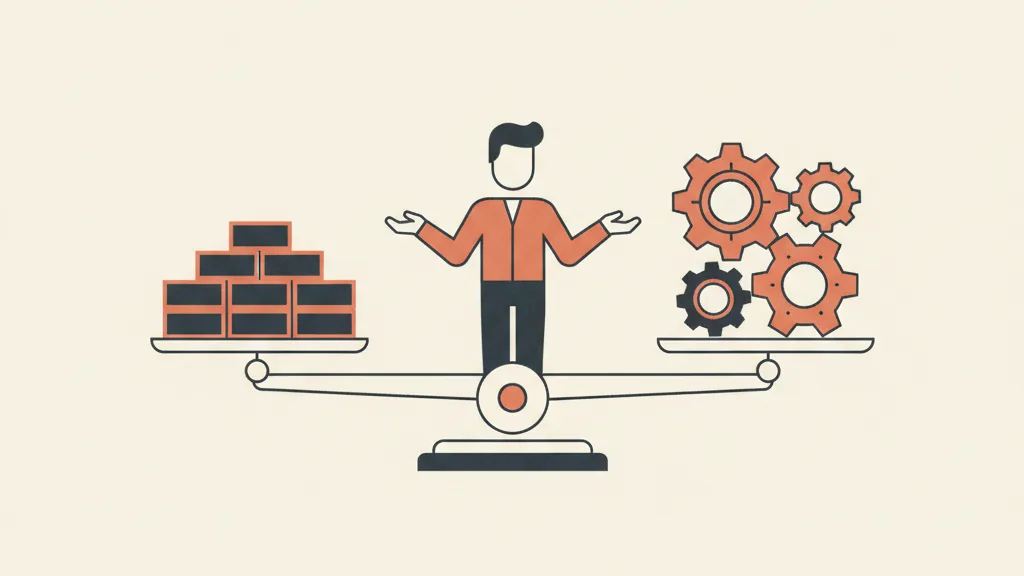
What "build" and "buy" Actually Mean
Let's clear up a mix-up right away. "Off-the-shelf management software" and "CRM" are not the same thing, and that confusion leads to bad decisions.
A traditional ERP-style management system (or the various invoicing and inventory tools) exists to run the admin side of the business: invoices, stock, accounting, orders. A CRM exists to manage commercial relationships: leads, deals, follow-ups, the sales pipeline. Many Italian management platforms have "bolted on" a CRM module over the years, but it remains an accessory, not the core of the product. If your problem is selling more and not losing track of contacts, a CRM module glued onto an accounting system often isn't enough.
That said, the real options on the table are three, not two:
- Pure buy (off-the-shelf SaaS): HubSpot, Salesforce, Pipedrive, Zoho and the like. You subscribe, configure whatever the software allows, and use it. Zero development.
- Pure build (custom CRM): software built around your specific sales process, with the fields, automations and integrations you actually need.
- Hybrid: a custom layer (usually automations, integrations, a piece of the interface) built on top of or alongside a standard engine. In practice it's the most common choice, even if it's rarely described that way.
If you want to understand what sets the first two options apart before reading on, we have a piece comparing custom CRM and SaaS and when each one makes sense. Here, though, we'll focus on the method for deciding.
The Real Cost of "Buy": It's Not Just the Subscription
The appeal of ready-made software is obvious: you start fast, the upfront cost is low, someone else handles maintenance. All true. But the price you see on the homepage isn't the price you pay.
The real cost of buying breaks down into four items:
- Per-user/month licenses: looks small with 1-2 users, explodes as the team grows. A plan costing 90 euros/month for 3 people becomes 400-600 euros/month for 12, and the "serious" tiers (automations, advanced reporting) only kick in at the higher levels.
- Add-ons and modules: the feature you need is almost always in the plan above yours, or sold as a separate package.
- Onboarding and setup: rarely included, often thousands of euros as a one-off or handled by a certified partner.
- Integrations and workarounds: when the software doesn't do something you need, you patch it with Zapier, Make or other external tools. Hidden recurring costs that pile up.
On HubSpot specifically, we've gathered the less visible line items in an analysis of the hidden costs of HubSpot for SMBs: it's the textbook case of the list price telling only half the story. The point isn't that these tools are expensive in absolute terms — they're excellent products. The point is that the cost grows with usage and with the team, and it never stops growing.
The Real Cost of "Build": High Upfront, Then Flat
A custom CRM has the opposite cost profile: a significant upfront investment, then a contained, predictable maintenance cost that doesn't scale with the number of users.
For a custom project built for an SMB, the ranges we see on the Italian market are roughly these:
| Complexity | Initial development | Maintenance/year | Typical for |
|---|---|---|---|
| Basic (pipeline + contacts + a few automations) | 6,000 - 15,000 € | 1,000 - 3,000 € | Micro-business, simple process |
| Mid-tier (integrations, roles, reporting, connected funnel) | 15,000 - 35,000 € | 3,000 - 6,000 € | SMB with a structured sales team |
| Advanced (multi-department, AI, complex vertical logic) | 35,000 € and up | 6,000 € and up | Companies with intricate processes |
These are indicative estimates: the real figure depends on the integrations, the number of workflows, and how "messy" your current process is. If you want to dig into the line items, you'll find a more granular breakdown in the piece on the cost of developing a custom CRM and an overview of custom CRM pricing.
The structural difference compared to buying is this: with build you pay a lot once and little forever, and the spend doesn't increase if you hire five more salespeople. With buy you pay little upfront and the spend grows with you. That's where the concept of break-even comes from.

Break-Even: the Number That Decides for You
Here's the calculation that shifts the decision from "I like it better" to "it pays off." Compare the total cost of both options over a realistic horizon (3-5 years), because software gets used for years, not months.
Let's run a concrete example. An SMB with a 10-person sales team.
| Item | Buy (mid-tier SaaS) | Build (custom CRM, mid complexity) |
|---|---|---|
| Year 1 | ~7,200 € (licenses) + 4,000 € onboarding = 11,200 € | 22,000 € development + 4,000 € maintenance = 26,000 € |
| Year 2 | ~7,200 € | 4,000 € |
| Year 3 | ~7,200 € | 4,000 € |
| Year 4 | ~7,200 € | 4,000 € |
| Total over 4 years | ~32,800 € | ~38,000 € |
In this scenario, buying stays cheaper even at 4 years. But change two variables and the picture flips:
- The team grows to 20 people: SaaS licenses nearly double (14,000 €/year), while custom maintenance stays at 4,000 €. Break-even arrives as early as year three.
- You need integrations and automations the SaaS doesn't handle: you add external tools, a partner, hours of configuration. The "real" cost of buying rises 30-50% and custom closes the gap.
The lesson: the smaller you are, the more stable your team, and the more standard your process, the more buying pays off. The more you grow, the more distinctive your process is, and the more contacts you handle, the sooner the moment arrives when custom costs you less AND does what you need. Break-even isn't an accounting footnote: it's the moment you stop paying to adapt to a piece of software and start making the software adapt to you.
Want to know which way your numbers fall before you sign any contract? Request a free analysis: we'll work out the break-even on your actual case and tell you, with no hidden agenda, whether it pays off to buy or to build.
Beyond Cost: Three Questions Break-Even Doesn't Answer
Money is the main criterion, but not the only one. There are three factors that can justify building even when the numbers say buy.
1. Is Your Process Your Competitive Edge?
If you sell the way everyone else sells, adapt to a standard piece of software: you save money, end of story. But if the way you qualify, nurture and close customers is part of how you beat the competition, squeezing it into a generic CRM flattens it. In that case custom protects an asset, it isn't a whim. This matters most if you have a funnel connected to the CRM: if your acquisition system is integrated with contact management, custom lets you build a custom CRM with an integrated funnel that off-the-shelf tools can't replicate.
2. What Does It Cost You NOT to Have Clean Data?
With a SaaS you adapt to its data model. If your process doesn't fit, people start putting information "wherever it fits," free-text fields fill up with notes, and after a year you have an unreliable database. A custom CRM shapes the data around your process, so the data comes in clean. This isn't cosmetic: on dirty data you can't do lead scoring, you can't automate follow-ups, you can't measure anything. If this hits close to home, it's worth understanding how to build a company-wide single source of truth.
3. How Much of a Hostage to Your Vendor Are You?
With buy, the vendor sets the price. A 20% hike at renewal, a feature moved to a pricier tier, changed terms: you have no say. With custom you own the software, but you depend on whoever maintains it for you. There's no such thing as "zero dependency": there's only a choice of which dependency you'd rather have. The right question is: would you rather depend on a price list you don't control, or on a relationship with a developer you can change?
The Third Way: the Hybrid, Often the Right Answer for SMBs
In practice, pure build-or-buy is a false dichotomy. The solution that works for most Italian SMBs is the hybrid: you use a standard engine for the commodity functions (contact list, calendar, email) and build custom only the pieces that give you an edge, typically automations, integrations with your other systems, and the connection to the acquisition funnel.
That way you get the best of both: you don't reinvent the wheel for things everyone does the same way, and you invest the budget only where differentiation matters. It's also why talking about a standalone "CRM" makes little sense: a CRM has value when it's integrated with the sales funnel and fed by a steady flow of qualified contacts. A CRM without a funnel is an address book; a funnel without a CRM is a sieve. If you want the full picture of how the two pieces fit together, start with the guide to the customer acquisition system and the difference between funnel and CRM.
The 10-Minute Decision Grid
Here's a practical way to position yourself. For each row, mark whether you lean more to the left (buy) or more to the right (build). You don't need a numeric score: if most of your answers fall on one side, that's your direction.
| Factor | Points toward BUY | Points toward BUILD |
|---|---|---|
| Team size | Small and stable (up to 5-8) | Large or growing fast |
| Sales process | Standard, "like everyone else" | Distinctive, it's an advantage |
| Usage horizon | Uncertain, short term | Multi-year, strategic |
| Integrations needed | Few or standard | Many, with your own systems |
| Upfront budget | Limited, want to start now | Available to invest |
| Connected funnel | Not a priority | Central to acquisition |
| Sensitivity to clean data | Low | High (scoring, automations) |
If you're a micro-business with one salesperson, a linear process and a budget to keep under control: buy, without overthinking it. If you have a growing team, a way of selling that's part of your strength, and an acquisition funnel to connect: you're probably in hybrid-or-build territory. The vast majority of growing Italian SMBs sit exactly in that grey zone, and that's where a serious look at the numbers is needed before signing any multi-year contract.
The Mistakes We See Most Often
- Buying with today's team in mind, not the one two years from now. The SaaS that's affordable at 3 users can become unsustainable at 15. Do the math on the foreseeable future.
- Building custom "because it's cooler". If your process is unremarkable, custom is money down the drain. Customization should only be paid for where it delivers an advantage.
- Ignoring exit costs. Migrating from one CRM to another (in either direction) costs time and data. Choose expecting to stick with it for a few years.
- Confusing "management software" with "sales CRM". The CRM module of an accounting system often doesn't help you sell more. If the problem is the sales pipeline, evaluate a tool built for exactly that.
- Deciding without calculating break-even. This is the root mistake: choosing based on year-one cost, not on total cost over the real usage horizon.
In Short
The build-or-buy call between a custom CRM and off-the-shelf software isn't a matter of taste, it's arithmetic. Buy wins when you're small, stable and standard: low upfront cost, zero maintenance on your end, you get started right away. Build wins when you're growing, when your process is an advantage, and when you work out the total cost over several years: the spend doesn't scale with the team and the tool adapts to you, not the other way around. And for most growing SMBs the real answer is the hybrid: standard where it doesn't matter, custom where it makes the difference, all connected to the funnel that fills the pipeline.
The practical advice: before signing a multi-year subscription or commissioning a build, work out the total 4-year cost for both paths, using the team you expect to have, not the one you have today. Nine times out of ten, break-even alone will tell you what to do.
Frequently asked questions
Custom CRM or off-the-shelf software: what's right for an SMB?
It depends on your numbers. Off-the-shelf software pays off if you have a small, stable team, a standard sales process, and a budget to keep low at the start. A custom CRM pays off when you're growing, when your way of selling is a competitive advantage, and when you work out the total cost over 3-5 years: maintenance doesn't scale with the number of users. Most growing SMBs do well with a hybrid solution.
How much does a custom CRM cost for an SMB?
For an SMB, the indicative ranges on the Italian market run from 6,000-15,000 euros for a basic project to 15,000-35,000 euros for a mid-complexity one with integrations and reporting, plus annual maintenance of roughly 1,000-6,000 euros. The real figure depends on the integrations and how structured the process is. The advantage is that the spend doesn't rise as you hire more salespeople.
What's the difference between management software and a CRM?
Management software (or ERP) exists to run the business: invoices, inventory, accounting, orders. A CRM exists to manage commercial relationships: leads, deals, follow-ups, the sales pipeline. Many management platforms have a CRM module bolted on, but it remains an add-on. If your problem is selling more and not losing track of contacts, a CRM module glued onto an accounting tool often isn't enough.
What is break-even in the build-or-buy choice for a CRM?
It's the number of years after which a custom CRM costs less overall than a SaaS subscription. Buying has a low upfront cost but grows with the team; building has a high investment but flat maintenance. Comparing total cost over 3-5 years shows the point where one option beats the other. It's the calculation that should decide instead of personal preference.
Is there a middle ground between a custom CRM and off-the-shelf software?
Yes, and it's the option that works best for most SMBs: the hybrid. You use a standard engine for the commodity functions (contact list, calendar, email) and build custom only the pieces that give you an edge, typically automations, integrations with your systems, and the connection to the acquisition funnel. That way you invest the budget only where differentiation matters.
Am I hostage to the developer with a custom CRM?
Zero dependency doesn't exist: with SaaS you depend on a price list you don't control that can rise at renewal, with custom you depend on whoever maintains it for you. The difference is that you own the custom software and can change the developer, while a SaaS vendor sets its own terms. The right question is which dependency you'd rather manage.
If you're in the grey zone between buy and build, talk to us about it: a free analysis of your process and your total 4-year cost keeps you from choosing on a hunch and regretting it a year from now.