How Much Does It Cost to Automate Business Processes with AI in 2026
9 min read · AstraLoop Studio
The question almost always comes up the same way: "So how much will it cost me to automate this?". And the honest answer, the one nobody wants to hear, is that it depends on what you want to automate and how reliable you need it to be. A flow that pushes emails into a CRM might cost you 49 euros a month in subscription fees. An agent that qualifies leads, calls APIs, updates systems and handles edge cases can cost 15,000 or 25,000 euros to build. These are two different worlds, and the hard part isn't paying. It's figuring out which one you're actually in.
This article lays out the real price tiers of AI business process automation in 2026, including the recurring costs almost nobody mentions and the typical payback for each type of project. The goal is to give you the numbers to decide with, not to sell you the most expensive option. Because the real mistake in this market isn't spending too much. It's spending on the wrong thing.
The four price tiers of AI automation
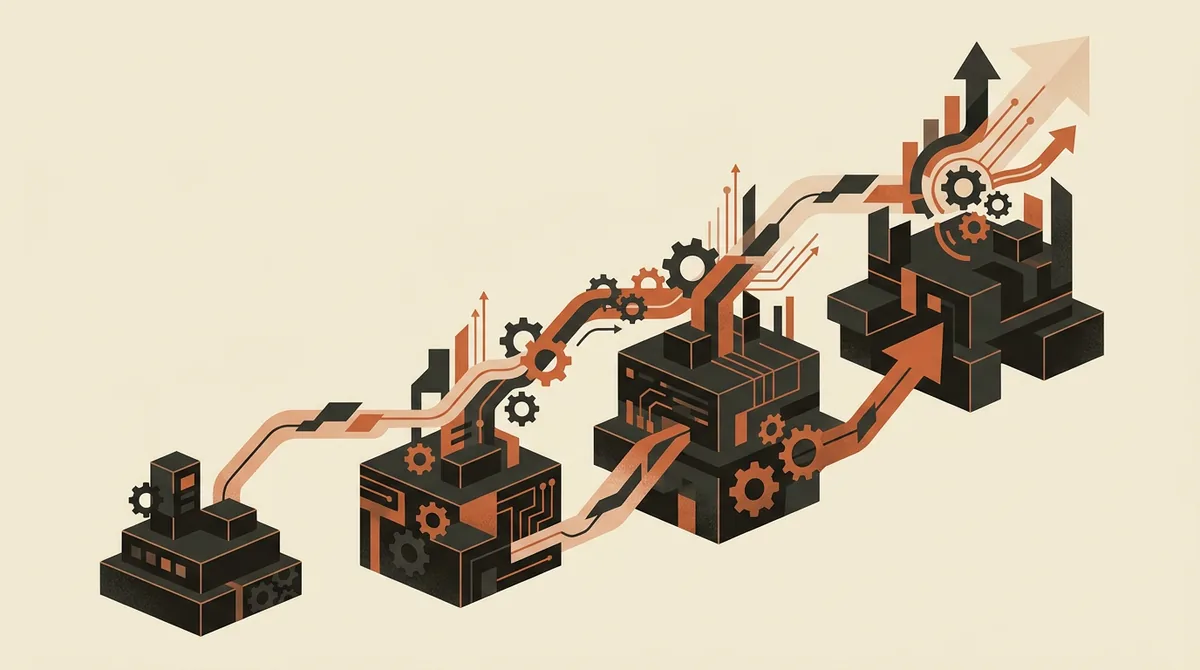
Before we get to the numbers, there's a premise that changes everything. Price depends on the combination of three variables: how many integrations are needed (one tool, or ten systems to connect), how tolerant the process is of errors (an internal report versus a reply that goes straight to a customer), and who maintains it over time. The same "customer care automation" can cost 60 euros a month or 20,000 euros as a one-off, depending on how you answer these three questions.
That said, the Italian market in 2026 splits into four fairly distinct tiers.
Tier 1: ready-made SaaS (20-200 euros/month)
These are products you buy and use as-is. A chatbot for your website, an Italian-language AI receptionist that books appointments (solutions like Aura, LePa or Bookli run around 49 euros a month), an automatic sales follow-up tool. Zero development, set up in hours or days, monthly fee.
The upside is obvious: you're up and running fast, with low risk. The limit is just as clear: you get whatever the product lets you do, and nothing more. If your process has some quirk of its own, the SaaS won't handle it. It's a great fit for standard, common processes (bookings, FAQs, first contact), and a much weaker fit for flows that reflect the specific way you work.
Tier 2: custom no-code automation (1,500-6,000 euros setup)
This is where n8n comes in, now the de-facto standard for Italian SMEs thanks to its native AI Agent node and self-hosting option (useful for GDPR compliance, since the data stays on your own servers). With n8n, or alternatives like Make and Zapier, you build workflows that connect your actual tools: your management software, your CRM, WhatsApp, email, spreadsheets.
Cost depends on how many integrations and how much logic are involved. A simple flow (a new lead from the website, enriched and added to the CRM with a notification to sales) runs 1,500-2,500 euros. A flow with more branches, error handling and a piece of AI reasoning (say, sorting incoming tickets by category and urgency) climbs to 4,000-6,000 euros. On top of that comes a modest recurring cost: hosting n8n (20-50 euros/month) plus the cost of AI model calls, which we'll get to shortly. If you want to figure out which platform fits your case, we've compared the options in n8n vs Make vs Zapier.
Tier 3: custom AI agent (8,000-30,000 euros)
This is the 2026 leap: from assistants that "talk" to agents that "act". An AI agent doesn't just reply, it executes actions. It updates the CRM, calls external APIs, makes decisions within defined rules, and handles a ticket from start to finish. The difference between a chatbot and an agent comes down to exactly this, and it shows up in the price.
A single agent, well-scoped and covering a narrow domain, starts at 8,000-12,000 euros. When you need a company knowledge base with RAG because the agent has to answer using your own documents, or when integrations start piling up, it climbs to 15,000-25,000 euros. We go into more detail in how much a business AI agent costs. The recurring cost really matters here: maintenance, monitoring and model costs can run 200-600 euros a month, and it's the line item almost everyone forgets in the quote.
Tier 4: multi-agent systems (25,000 euros and up)
Not one monolithic agent, but several specialized agents coordinating on a single process: one for sales, one for support, one for finance, handing work off to each other. This is the 2026 frontier, and it only makes sense when the process is complex, high-volume, and has a clear return. Below a certain scale, a multi-agent setup is engineering you don't need. Above it, it's the only way to avoid ending up with an unmanageable beast.
The recurring costs nobody puts in the quote
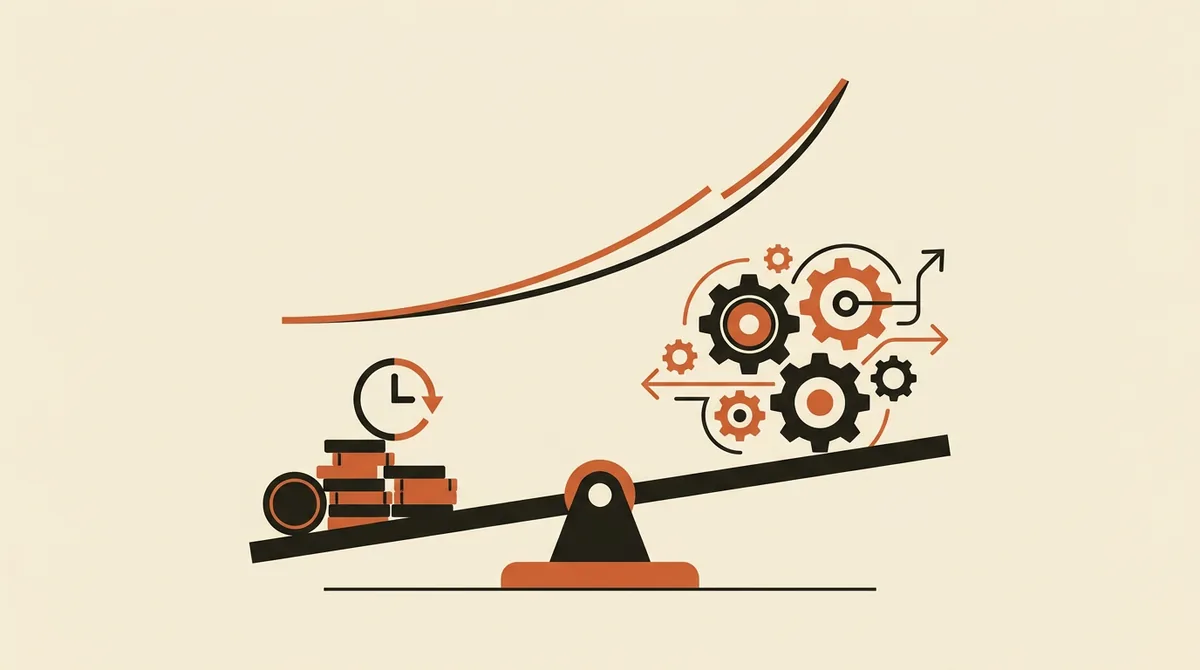
The setup price is the visible part. What blows up your year-end numbers is the recurring cost, which breaks down into three items.
- AI model cost (tokens). Every time the automation calls a model, you pay. For a low-volume flow, we're talking a few euros a month; for an agent handling hundreds of conversations a day, it can reach tens or hundreds of euros. It's variable and needs to be estimated against real volume, not a theoretical quote.
- Infrastructure. Hosting for n8n, databases, any third-party services. 20 to 100 euros a month for a typical SME.
- Maintenance and governance. The line item everyone forgets. An automation isn't an appliance: APIs change, models get updated, edge cases surface over time. You need someone monitoring it, fixing it when the agent gets something wrong, and managing versioning. Budget 150-500 euros a month for a system of medium complexity.
Anyone who sells you only the setup and never mentions maintenance is setting you up for a surprise. The right question to ask any vendor is: "When the agent gets it wrong, who notices, and who's responsible?" If they don't have a precise answer, the quote is incomplete.
How to calculate payback (with a concrete example)
Cost alone tells you nothing. What matters is the return, and in automation it's easy to measure because you're replacing hours of repetitive work with automatic execution. The formula is simple: hours saved per month, times hourly cost, times 12, against the total cost of the first year (setup plus recurring costs).
Take the most-cited case: the 5,000-euro agent that pays for itself in 6 months. Picture a company receiving 60 leads a week and qualifying them by hand. A salesperson spends an average of 10 minutes per lead on research, enrichment and initial routing: that's 10 hours a week, roughly 40 a month. At a fully-loaded cost of 25 euros an hour, that's 1,000 euros a month of labor. A lead generation agent with a 5,000-euro setup and 150 euros a month recurring costs 6,800 euros in the first year, against 12,000 euros a year in freed-up labor. Payback: just under 7 months, after which the system runs at a profit. And the freed-up time doesn't vanish, the salesperson uses it to close deals instead of sorting leads.
That's the logic. The return ranges we see most often, in line with industry benchmarks, are these.
| Automated process | ROI range | Typical payback |
|---|---|---|
| Lead qualification | 200-400% | 6-9 months |
| Automated reporting | 300-500% | 4-8 months |
| Data entry | 400-700% | 3-6 months |
| Customer care (tier 1) | 150-350% | 6-12 months |
These are estimates, not promises. Actual payback depends on your volume and the hourly cost of the labor you're replacing. A low-volume process never pays for itself, no matter how elegant the automation. To set up serious measurement, you need a method, and you'll find one in how to measure AI ROI.
Want to know how much it would cost to automate a specific process in your business, and how long it would take to pay for itself? Request a free analysis: we'll put the numbers on the table before we talk about solutions.
Build vs. buy: when the 49-euro SaaS wins and when the custom agent does
The honest choice isn't "which is better", it's "which is right for your case". Here's the practical rule we use.
Go with ready-made SaaS when the process is standard and common (bookings, FAQs, first contact), when volume is low or uncertain and you want to test the waters, when you don't have quirks that set you apart from competitors. Paying 49 euros a month to validate an idea is infinitely smarter than spending 15,000 euros to discover the process wasn't needed after all.
Go custom when the process reflects your competitive edge, when you need to integrate more systems than any off-the-shelf product connects, when volume is high and every percentage point of efficiency is worth real money, when the logic has exceptions a SaaS can't handle. Custom costs more up front, but it adapts to you, instead of forcing you to adapt to the software.
A sensible path is almost always a staged one: start with a SaaS or a simple no-code setup, measure, and move to custom only where the numbers justify it. Jumping straight to a 30,000-euro multi-agent system without validating anything first is one of the top reasons AI projects fail. If you're not sure where to start, the 4-phase AI adoption roadmap gives you the right order of moves.
The regulatory factor: what changes the cost in 2026
One piece of the budget that's no longer optional in 2026 is compliance. The AI Act (EU Regulation 2024/1689) becomes fully applicable in stages, and starting August 2, 2026, practical obligations kick in even for those who use AI, not just those who build it. In Italy, Law 132/2025 adds further requirements. For an SME, in concrete terms, this means: disclosing when content is AI-generated, keeping a minimum level of tracking, having a proper DPA in place with your model provider, and training the people who use these tools (AI literacy).
It's not a huge cost in itself, but it needs to be budgeted for: a few hours of consulting and bringing the flows that touch personal data up to code. Ignoring it is the dumbest way to save money. We've put together an operational checklist in the AI Act 2026 and SME obligations. This is informational content, not legal advice: for sensitive cases, check with official sources (the AI Act, the Italian Data Protection Authority, ACN) and a qualified consultant.
Bottom line: what to actually budget
If you had to pin down three reference numbers for an Italian SME in 2026: to start testing, 50-200 euros a month in SaaS. For a custom automation solving a real process, 2,000-6,000 euros setup plus a modest recurring cost. For an operational agent executing high-value actions, 8,000-25,000 euros with a serious recurring maintenance cost. And in all three cases, before you sign anything, calculate the payback: if it doesn't come in under 12-14 months, you've either picked the wrong process or oversized the solution.
The number that matters isn't how much you spend. It's how much comes back, and how fast. Everything else is noise.
Frequently asked questions
How much does it cost to automate business processes with AI in 2026?
It depends on the type of project. A ready-made SaaS tool costs 20-200 euros a month, a custom no-code automation with n8n runs 1,500 to 6,000 euros in setup, and a custom AI agent runs 8,000 to 25,000 euros. On top of these come recurring costs for models, hosting and maintenance.
Is it true that an AI agent pays for itself in 6 months?
It can happen when the automation replaces many hours of repetitive work. Example: a 5,000-euro agent that frees up 40 hours a month at 25 euros an hour saves 12,000 euros a year and pays for itself in about 7 months. But on low-volume processes, the payback never arrives: the return always depends on real volume.
Is a 49-euro SaaS tool better, or a custom agent?
SaaS is the right call for standard processes, low or uncertain volume, and low-risk testing. Custom makes sense when the process reflects your competitive edge, requires integrating multiple systems, or volume is high. The smartest move is usually to start with SaaS, measure, and move to custom only where the numbers justify it.
What are the hidden costs of AI automation?
Three recurring items almost nobody budgets for: pay-as-you-go AI model costs (tokens), infrastructure (n8n hosting, databases, 20-100 euros a month), and above all maintenance and governance (150-500 euros a month) to monitor the system, fix errors and manage updates over time.
How much does the AI Act affect automation costs in 2026?
Not enormously, but it needs to be budgeted for. Starting August 2, 2026, the AI Act (EU Regulation 2024/1689) and Italy's Law 132/2025 impose practical obligations even on those who merely use AI: disclosure of AI-generated content, minimum tracking, a DPA with the provider, and staff training. In practice, that means a few hours of consulting and bringing data-handling flows up to code.
How do I calculate the ROI of an automation before investing?
Use this formula: hours saved per month, times hourly cost, times 12, compared against the total first-year cost (setup plus recurring). If the resulting payback exceeds 12-14 months, you've probably picked the wrong process or oversized the solution.
Before signing any quote, talk to us: we'll help you figure out which price tier your project falls into, and whether the payback actually holds up.