AI Adoption Roadmap for Business: The 4 Phases (From Assessment to Monitoring)
10 min read · AstraLoop Studio
Most Italian companies approach artificial intelligence in the wrong order. They start with the tool ("let's buy a chatbot," "let's try an AI agent") and only afterward ask what problem it's supposed to solve. The result is predictable. Roughly 85% of generative AI pilot projects fail when they try to move into production, and in most cases it's not because of the technology's limits but because of a missing method: no initial assessment, no KPIs, no oversight after go-live.
An AI adoption roadmap exists precisely to reverse that order. It isn't a marketing document, it's a sequence of four phases, each with verifiable deliverables and measurable indicators, that takes a company from "we don't know where to start" to an AI system in production, monitored and continuously improved. This article is the methodological core of our AI consulting for businesses approach: if you're figuring out how to structure your AI rollout without burning through budget, here is the framework we use with clients.
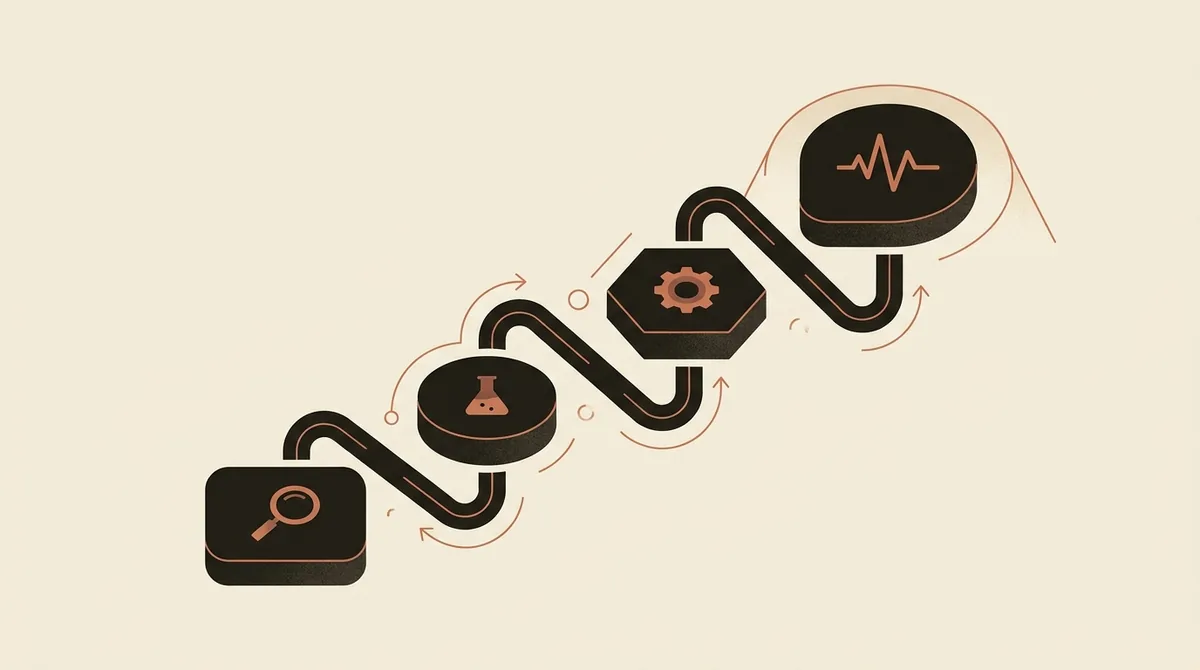
The four phases are Assessment (understanding what to automate and at what risk), Pilot projects (validating quick wins on a controlled scale), Scale-up (bringing what works into production) and Continuous monitoring (preventing value from degrading over time). Let's go through them one by one.
Why you need a roadmap (not a tool)
Failed POCs almost always share the same root cause. A pilot project starts as an isolated experiment, often pushed by a single enthusiast, with no link to a measurable business process and no plan for going into production. It works in the demo, then collides with messy real-world data, missing integrations, users who don't adopt it, and an ROI nobody bothered to calculate. If you want to dig into the specific causes, we've dedicated a whole article to why AI projects fail.
A roadmap fixes this by putting gates between one phase and the next. You don't move from pilot to scale-up out of enthusiasm, but because the pilot hit KPI thresholds set before it started. You don't scale everything, you scale only what has proven its value. And crucially, the human factor (change management, training, real adoption) enters from phase 1, not tacked on at the end. It's the number-one cause of failure and needs attention from day one.
Phase 1. Assessment: mapping processes and risks
Assessment is the phase where you stop talking about "AI" in the abstract and look at the actual company. The goal is twofold: identify where AI can generate value and with what risk profile, both operational and regulatory. It's an analysis phase, not an implementation phase, and typically takes 2 to 4 weeks for an SME.
What actually happens
- Process mapping: you list the company's processes (customer care, sales follow-up, admin, document production, reporting) and for each one you estimate volumes, person-hours, repetitiveness and error rate. The guiding question is the one we develop in what to automate in a business with AI: which activities are high-volume, rule-based and low-risk if something goes wrong.
- Use-case prioritization: every candidate is placed on an impact/feasibility matrix. The "quick wins" (high impact, low complexity) become the candidates for the pilot phase.
- AI Act risk classification: for every AI system you intend to use, you must determine its risk category under EU Regulation 2024/1689 (the AI Act) — unacceptable risk (banned), high, limited, or minimal. This classification is not a minor detail. From August 2, 2026, the obligations for high-risk systems become fully enforceable, with fines of up to €35 million or 7% of global turnover. We cover this in detail in our guide to 2026 AI Act obligations for SMEs.
- Data foundation check: without clean, accessible data, any AI project starts on the back foot. The assessment checks where the data lives (CRM, ERP, documents, management software) and what condition it's in.
Phase 1 deliverables
- Assessment report with a prioritized list of use cases
- AI systems register with risk classification (AI Act)
- Business case for the 2-3 selected quick wins, with expected ROI and payback
- Gap analysis on data, skills and infrastructure
Phase 1 KPIs
| Indicator | What it measures |
|---|---|
| No. of processes mapped | Breadth of the analysis |
| No. of prioritized use cases | Valid candidates for the pilot |
| % of AI systems classified by risk | Compliance coverage (target: 100%) |
| Estimated ROI per quick win | Hours freed up times hourly cost, plus extra revenue, minus costs |
If you want to understand how to set up this phase from scratch, our piece on AI in business: where to start goes into the operational detail of the first steps.
Phase 2. Pilot projects: validating the quick wins
The pilot answers one question only: does this use case generate real value on real data? It's not yet production, but it's no longer a demo. You pick a narrow use case, set success thresholds before starting, and work within a limited scope (one department, one type of ticket, one customer segment). Typical duration: 4-8 weeks.
The rules that separate a useful pilot from a wasted one
- Success criteria written up front: if the pilot has to cut ticket response time by 30%, that number gets decided on day zero, not justified after the fact.
- Human-in-the-loop from the start: during the pilot a human supervises the AI's output. This is how you gather error data and tune guardrails before scaling back supervision.
- One process at a time: the temptation to automate five things at once is the fastest way to never understand what actually works.
- Change management from week one: the people who will use the tool need to be involved, trained and listened to. A technically perfect pilot nobody uses is a failed pilot.
A typical concrete quick win is automating inbound lead qualification or sales follow-up with AI, where volumes are high, rules are repeatable and the revenue impact shows up quickly. Other classics are customer care automation and document management.
Phase 2 deliverables
- Working prototype integrated with real data from the chosen scope
- Validation report comparing results against the preset thresholds
- Log of errors and edge cases encountered
- Documented go / no-go decision on scaling up
Phase 2 KPIs
| Indicator | Example target |
|---|---|
| Output accuracy | ≥ 90% correct outputs without human correction |
| Time reduction per task | 30-50% less than the manual process |
| Pilot-user adoption rate | ≥ 70% of involved users actively use it |
| Measured ROI (not estimated) | Payback projected within 4-12 months |
On how to actually calculate the return, we have a dedicated guide to how to measure AI ROI, with the full formula and realistic payback times by scenario.
Phase 3. Scale-up: from pilot to production
This is the phase where 85% of projects die. A pilot running on 100 tickets a month behaves very differently from a system handling 10,000. Edge cases, real infrastructure costs, integration and governance problems that never showed up in the narrow pilot scope all surface here. Scaling up isn't "turning on the same pilot for everyone," it's re-engineering the system for production.
What changes compared to the pilot
- Stable integration: permanent, monitored connections with CRM, ERP and management systems. This is where, if you move from a chatbot to more autonomous logic, you enter the territory of AI agents, which read documents, query systems and act on processes. It's the moment to properly understand the difference between a chatbot and an AI agent so you pick the right architecture.
- Guardrails and failure management: in production an agent will eventually get something wrong. You need explicit rules on what it can and can't do, automatic escalation to a human in uncertain cases, and full logs of every action. The point isn't to prevent every error (impossible), but to contain it and recover without damage.
- Real costs on the table: setup, maintenance, model consumption, model drift. These need to be made explicit, not hidden. For a sense of scale see how much it costs to automate business processes and how much a business AI agent costs.
- Governance and broader training: scale-up involves more people. This is where the AI literacy obligation (Article 4 of the AI Act, in force since February 2, 2025) becomes concrete: anyone using these systems must have adequate skills. Employee AI training isn't a nice-to-have, it's a requirement.
Watch out for a phenomenon that scale-up needs to stop: Shadow AI. Between 68% and 76% of employees use AI tools on the sly, with no governance, creating serious GDPR and AI Act risks. Bringing AI into production in a structured way is also how you surface and regulate this hidden usage with clear internal policies.
Phase 3 deliverables
- Production system with stable, documented integrations
- Set of guardrails, escalation rules and a human-in-the-loop plan
- Internal AI usage policy and extended training plan
- Steady-state operating cost model (setup plus maintenance)
Phase 3 KPIs
| Indicator | What it tracks |
|---|---|
| Uptime and reliability | Service continuity in production |
| % of cases handled autonomously | Actual degree of automation |
| Escalation-to-human rate | How often manual intervention is needed |
| Cost per operation | Economic sustainability at real volume |
| % of staff trained | Coverage of the literacy obligation (AI Act Art. 4) |
Want to know which processes to automate first and what return to expect? Request an AI assessment: we'll map your use cases and risk profile before you spend a single euro on tools.
Phase 4. Continuous monitoring: protecting value over time
An AI system isn't traditional software that stays stable once installed. Performance can degrade: data changes, customers change, products change, and the model that worked yesterday gets it wrong today. This is model drift. Phase 4 exists to catch it before it becomes a business problem, and it has no end date because it's ongoing.
What gets monitored in this phase
- Performance monitoring: dashboards tracking accuracy, response times, error rates and escalations over time. A decline should be noticed in days, not quarters.
- Drift detection: when output quality drops below a threshold, an alert triggers and you step in with recalibration, a knowledge-base update, or tweaks to prompts or reference data. If the system relies on a RAG-based company knowledge base, keeping those documents current is part of the monitoring.
- Recurring compliance audits: AI Act registers need to stay up to date, as does the technical documentation for high-risk systems. Compliance isn't a one-time stamp.
- Improvement loop: data collected in production feeds new use cases and loops back to point 1. The roadmap is a cycle, not a straight line: new processes enter assessment while mature ones run in monitoring.
Phase 4 deliverables
- Monitoring dashboard with automatic alerts
- Documented drift-management and recovery process
- Compliance audit calendar and register update schedule
- Backlog of new use cases fed by production data
Phase 4 KPIs
| Indicator | What it signals |
|---|---|
| Accuracy stability over time | Absence of unmanaged drift |
| Average anomaly detection time | Responsiveness of monitoring |
| Cumulative ROI | Real value generated at steady state |
| No. of audits passed / registers updated | Compliance health |
How long does the whole roadmap take
For an SME with a well-chosen use case, here are indicative timeframes. These are ranges, not promises: the main variable remains the state of the data and the availability of internal people.
| Phase | Typical duration | Outcome |
|---|---|---|
| 1. Assessment | 2-4 weeks | Prioritized use cases and risk register |
| 2. Pilot | 4-8 weeks | Go/no-go validation on real data |
| 3. Scale-up | 6-12 weeks | System in production |
| 4. Monitoring | Ongoing | Value protected and new cases identified |
A common mistake is compressing or skipping phase 1 to "move fast." That's the exact opposite of moving fast: without assessment you scale the wrong use case and end up in the 85% failure statistic. The fastest way to reach production is to spend time on the right questions at the start. If you want to see how this translates into a structured path, our page on how to integrate AI into business processes connects the roadmap to concrete processes.
The human factor runs through all four phases
It's worth repeating, because it's the point almost every technical piece skips: the number-one cause of AI project failure isn't technological, it's human. People who don't understand the tool, who see it as a threat to their role, or who simply haven't been trained. A roadmap that works treats training and change management as a thread running through all four phases, not a box to tick at the end. Skills assessment in phase 1, user involvement in phase 2, extended training in phase 3, a culture of continuous improvement in phase 4.
This, incidentally, is also what keeps you compliant with the AI literacy obligation under Article 4 of the AI Act, already in force. Compliance and adoption, when designed together, reinforce each other instead of remaining two separate costs.
Frequently asked questions
What are the 4 phases of the AI adoption roadmap?
Assessment (mapping processes and risks), Pilot projects (validating quick wins on a limited scope), Scale-up (moving into production with integrations and guardrails), and Continuous monitoring (tracking performance and model drift). Each phase has its own deliverables and KPIs, with verification gates between one and the next.
How long does it take to adopt AI in an SME?
For a well-chosen use case: about 2-4 weeks for assessment, 4-8 for the pilot, 6-12 for scale-up, then continuous monitoring. Overall, 3 to 6 months to reach stable production. The main variable is the state of the company's data.
Why do so many AI projects fail at the scale-up stage?
Because the pilot starts as an isolated experiment with no KPIs, no production plan and no change management. In production, messy data, real costs, edge cases and non-adopting users all surface. A roadmap with gates between phases prevents exactly this.
Does the AI Act change anything in the adoption roadmap?
Yes. Starting from the assessment phase, every AI system must be classified by risk category under EU Regulation 2024/1689. From August 2, 2026, full obligations kick in for high-risk systems, with fines of up to €35 million or 7% of turnover. AI literacy (Article 4) is already mandatory.
Which KPIs should be used to measure AI adoption?
It depends on the phase: in assessment, estimated ROI and risk-classification coverage; in the pilot, accuracy, time reduction and adoption rate; in scale-up, uptime, percentage of cases handled autonomously and cost per operation; in monitoring, accuracy stability and cumulative ROI.
Where should we start if we've never used AI before?
With phase 1, the assessment. Before choosing any tool you need to map your processes, identify high-impact, low-complexity quick wins, and check the state of your data. Starting from the tool instead of the problem is the first step toward project failure.
If you're considering introducing AI but don't want to end up among the 85% of projects that fail, let's talk: we'll build your 4-phase roadmap together, with concrete deliverables and KPIs.