Why 85% of AI Projects Fail (and How to Avoid It at Your Company)
7 min read · AstraLoop Studio
The number gets thrown around everywhere: roughly 85% of generative AI pilot projects never reach production. It's cited by reports like the MIT Media Lab study (2025) and several Gartner analyses on POC abandonment rates. The exact figure varies from study to study, but the message stays the same: most AI projects die somewhere between the impressive demo and real, everyday use inside the company.
The uncomfortable part is that the reason is almost never technical. The model works, the demo convinces everyone, the first results look good. Then the project quietly dies, and it dies for human and organizational reasons, not because of the limits of artificial intelligence. If you're deciding where to invest, it pays to understand this mechanism before signing any contract. It's the central theme of any serious AI consulting engagement for companies, and here we tackle it head-on.
Let's look at why AI projects really fail, with concrete examples, and how to avoid ending up in that 85%.
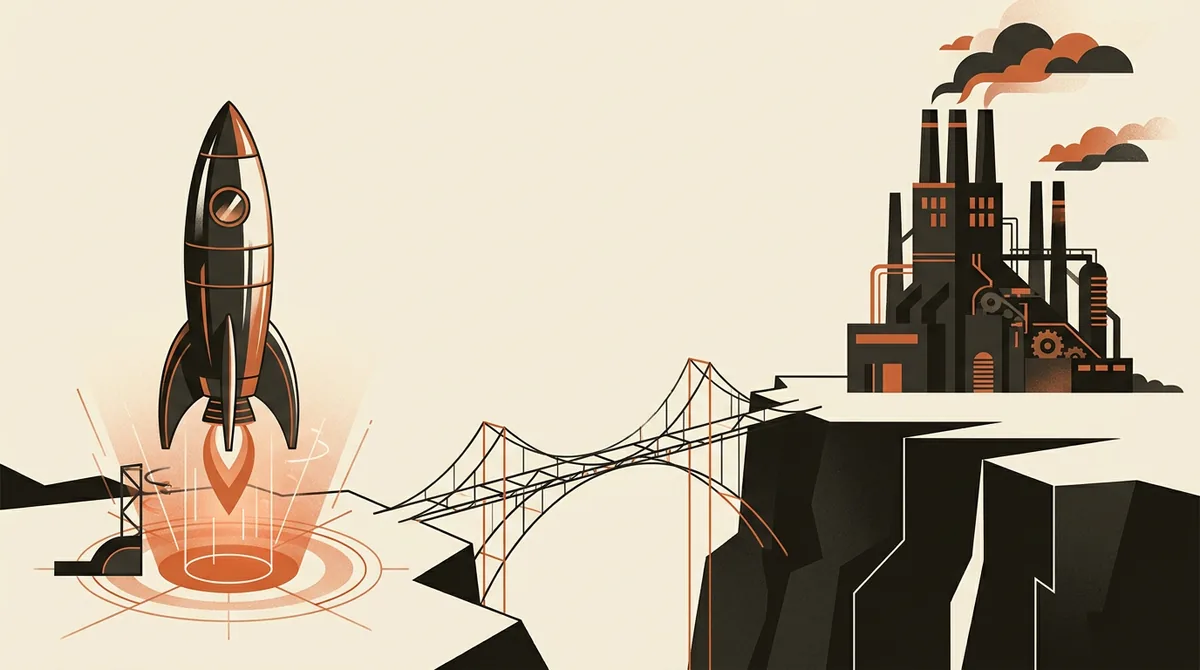
The demo works, production doesn't: the gap that kills POCs
There's a huge difference between "the AI answered 20 questions well in a meeting" and "the AI handles 400 requests a day with real data, real users, and edge cases nobody had anticipated." The POC (proof of concept) lives in the first world. Production lives in the second.
When we talk about AI project failure, the gap shows up on three levels.
- Technical and data level. The pilot runs on clean, curated data. In production the data is messy, fragmented, scattered across different silos (CRM, ERP, back-office systems, email). And the model that looked brilliant starts getting things wrong.
- Process level. Nobody redesigned the workflow around the tool. The AI gets bolted onto a process built for people, and it creates friction instead of removing it.
- Human level. The people who are supposed to use it every day never wanted it, don't understand it, don't trust it, or fear for their own role. So they sabotage it, often without ever saying so out loud.
The first two levels get solved with technical skill. The third, the human one, is the real killer. And it's also the one vendors talk about least, because it's the hardest to sell.
The human factor: cause number one of failure
Picture the typical scenario at an Italian scale-up. Leadership decides to roll out an AI assistant in customer service. A vendor builds a pilot in six weeks, the demo is excellent, management is thrilled. Then they try to move it into production, and this happens.
- Customer care agents see it as a threat to their jobs and look for every excuse to work around it.
- Nobody explained to them when to trust the AI and when to step in, so they use it badly and results get worse.
- The department head was never involved in the decision and experiences the project as something imposed from above.
- There's no internal owner who champions the tool, improves it, and collects feedback on problems. The project is left orphaned.
None of these problems get solved with a more powerful model. They get solved with change management: involvement, training, communication, redesigning roles. It's the discipline that manages the human side of a technological change, and in AI adoption it is almost always underestimated.
Why resistance is rational (and deserves respect)
A common mistake is dismissing employee resistance as "fear of the new" or laziness. That's not what it is. When someone sees a tool arrive that automates part of their job, and nobody has explained what will happen to their role, distrust is a perfectly logical reaction.
Companies that scale AI successfully do the opposite: they make clear from the start that the goal is to free people from repetitive work so they can spend time on higher-value tasks, not to replace them. And they back it up with actions, involving the future users in the design process. Employee AI training isn't an add-on to bolt on at the end: it's part of the adoption strategy from day one. It's no coincidence that 73% of companies name it as a training priority, yet only 22% have structured programs in place. That's exactly where the gap opens up.
The 6 real causes of AI project failure
Putting together what we see in the field and industry data, here are the recurring causes, ranked by how often they sink a project.
| Cause | What happens | Nature |
|---|---|---|
| No clear business problem | The project starts from the tool ("let's use AI") instead of the problem. There's no KPI to move. | Strategic |
| Resistance and lack of involvement | The people who are supposed to use it never wanted it, and they sabotage it, openly or not. | Human |
| No internal owner | Nobody at the company "owns" the project after the pilot. It's left orphaned. | Organizational |
| Data isn't ready | Silos, dirty data, unclear permissions. The model degrades in production. | Technical |
| Process wasn't redesigned | AI gets bolted onto an old workflow, creating friction instead of removing it. | Process |
| ROI never measured | Without before-and-after numbers, the project can't justify the investment and gets cut at the first budget review. | Financial |
Notice something: of these six causes, only one is purely technical. The other five are about strategy, people, organization, and economics. That's why buying "the best model" doesn't protect you from failure.
The case of the phantom ROI
One of the quietest deaths an AI project can suffer is this: nobody ever measured what it actually produced. The pilot "seems to be going well," but when the budget meeting arrives and the CFO asks "how much is this saving or earning us?" there's no answer backed by numbers. And what doesn't get measured, gets cut.
The basic formula is simple: (hours freed up multiplied by hourly cost) plus any extra revenue generated, minus setup, licensing, and maintenance costs. A reasonable payback period for a good AI project falls between 4 and 12 months. If you haven't defined these numbers before starting, you'll never know whether you won or lost. We went into the method in detail in the article on how to measure AI ROI.
How to avoid ending up in the 85%: a 4-step method
There's no magic formula, but there is a way of working that drastically cuts the risk of failure. It rests on one principle: treat AI adoption as an organizational change project, not a software purchase.
1. Start from the problem, not the tool
Before choosing any technology, identify a concrete, measurable business problem that the people working every day actually feel. "Cut response time on sales emails by 30%" is a goal. "Do something with AI" is not. A good assessment of what to automate in your company exists for exactly this: mapping processes and picking the few where AI delivers real, fast value, the quick wins.
2. Involve the people who'll use the tool, from day one
The people who will use the AI every day need to be involved right from the design stage, not presented with a done deal. Ask them where they lose time, what frustrates them, what they're afraid of. A project designed with them has a far higher chance of success than one handed down from above. This is the change management piece that no purely technical vendor will tell you about.
Have a stalled AI pilot, or want to get started without ending up in the 85% that fail? Talk to us: we'll look at your case and tell you where the real risk is hiding.
3. Appoint an internal owner and define guardrails
Every AI project in production needs a responsible person inside the company: someone who collects issues, decides on improvements, and keeps the tool alive. Without an owner, the project dies of neglect. Alongside that, you need guardrails: what happens when the AI gets something wrong? Where does a human step in (human-in-the-loop)? How do we monitor errors? This matters especially for AI agents that act autonomously on processes, where an unmanaged error can cause real damage.
4. Measure, before and after
Set the KPIs before you start, record the starting point (the baseline), and measure again after the pilot. Only this way can you prove the value and defend the project when budget tightens. A pilot without measurement is a pilot you're already setting up to fail.
The roadmap that ties it all together
The four steps above fit into a broader path. A mature AI adoption follows four ordered phases: Assessment, Pilot Projects (quick wins), Scale-up, Ongoing Monitoring. POC failure almost always happens in the jump between the second and third phase, and that's where the human factor becomes decisive. If you want to see the full path with criteria and checklists, we mapped it out in the article on the 4-phase AI adoption roadmap.
There's also a less visible risk fueling failures: while official projects stall, 68-76% of employees are already using AI tools on the side, with zero governance. This is so-called Shadow AI, which creates GDPR and AI Act risks and fragments effort. An AI project that ignores what's already happening under the radar starts at a disadvantage.
The link with regulation
From August 2, 2026, the AI Act (EU Regulation 2024/1689) enters its full operational phase, with growing obligations for companies using AI systems. Among them is the AI literacy requirement for staff under Article 4, already applicable since February 2025. Penalties can reach up to €35 million or 7% of global annual turnover for the most serious violations. This isn't just a legal matter: mandatory staff training overlaps almost exactly with the change management we've been discussing. Companies that structure AI adoption well solve two problems at once. For the full picture of the obligations, see the guide on the AI Act 2026 and SME obligations. One caveat: for the specific legal aspects of your company, you'll still need dedicated legal advice.
Bottom line: AI doesn't fail, poorly set-up projects do
If you take away just one idea from this article, make it this: AI projects rarely fail because of the technology. They fail because nobody started from a clear problem, because people weren't involved, because there was no owner, because nobody measured the ROI. These are human and organizational problems, and as such they get solved with method, not with more budget spent on models.
The good news is that success is within reach. You don't need the most expensive technology. You need to set the path up the right way from day one, giving equal weight to the human side and the technical side. That's exactly where the line falls between a pilot that becomes an asset and one that ends up in a drawer.
Frequently asked questions
Why do most AI projects fail?
Roughly 85% of generative AI pilot projects never reach production, but almost never for technical reasons. The main causes are human and organizational: no clear business problem, employee resistance, no internal owner, data that isn't ready, and ROI that's never measured.
What does it mean that the human factor is the real cause of failure?
It means the AI model often works fine on a technical level, but the people who are supposed to use it every day weren't involved, don't trust it, or fear for their role, and end up sabotaging it. Without change management work (involvement, training, redesigning roles), even the best AI sits unused.
What's the difference between a POC that works and production?
A POC runs on clean data and selected cases, in a controlled setting. In production the data is messy and fragmented across different silos, users are real, edge cases are unpredictable, and volumes are much higher. The gap between these two worlds is where most projects die.
How do you measure whether an AI project is working?
With a basic formula: hours freed up multiplied by hourly cost, plus any extra revenue generated, minus setup, licensing, and maintenance costs. KPIs need to be set before starting, a baseline recorded, and results measured after the pilot. A reasonable payback period runs from 4 to 12 months. Without numbers, the project gets cut at the first budget review.
What does it take to bring an AI pilot into production successfully?
Four things: start from a concrete, measurable business problem, involve the people who'll use the tool from the very start, appoint an internal owner with clear guardrails (human-in-the-loop, error monitoring), and measure ROI before and after. It's the approach that treats AI as an organizational change project, not a software purchase.
Does the AI Act have anything to do with AI project failure?
Indirectly, yes. The AI Act (EU Regulation 2024/1689) has required AI literacy training for staff since 2025 (Article 4), which overlaps with the change management needed for successful adoption. Companies that structure training well reduce both the risk of failure and the risk of penalties, which can reach €35 million or 7% of turnover.
Want to know if your AI project is set up to scale, or to die at the POC stage? Request a free analysis: we'll look together at your processes, data, and human factor.