n8n vs Make vs Zapier: Which One to Choose in 2026 (A Real Comparison)
8 min read · AstraLoop Studio
If you're figuring out how to automate business processes with AI, sooner or later you hit the fork in the road: n8n, Make, or Zapier. These are the three names that come up in every search, and the web is full of articles that always land on the same conclusion, "n8n wins." That's not true. Or rather, it's not always true.
The truth is that these three tools solve the same problem in different ways, and the right choice depends on who you are, how much you know (or want to know) about the technical side, and how much you care about data control and running costs. In this article we compare them properly, with pricing updated for 2026, tables, and concrete use cases. No fanboyism.
The three approaches in one sentence
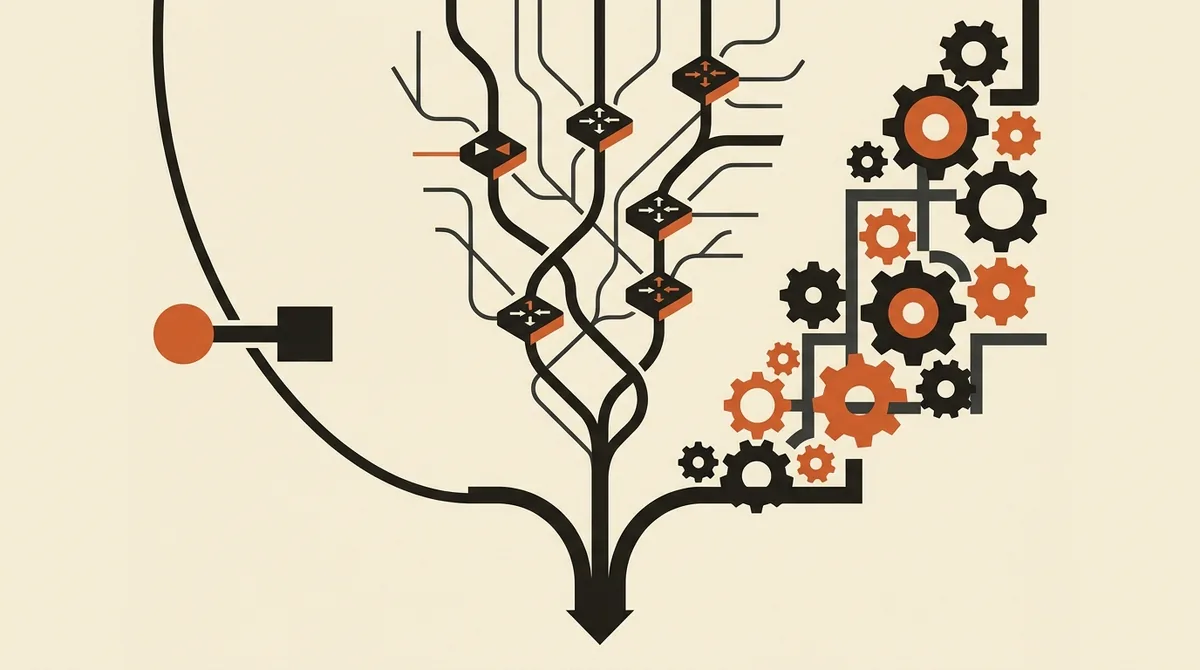
Before the details, here's the underlying difference. These are three different philosophies, not just three different price tags.
- Zapier: the simplest. You connect two apps in five minutes without overthinking it. You pay for that simplicity with costs that climb fast and little flexibility once the flow gets complicated.
- Make (formerly Integromat): the middle ground. A visual interface built around "scenarios" with logic, loops, and branching. More powerful than Zapier, cheaper at volume, with a slightly steeper learning curve.
- n8n: the most powerful and the most technical. Open source, you can install it on your own server (self-hosting), keep your data in-house, and pay per workflow execution, not per single operation. In exchange, you have to accept that someone needs to handle the setup.
If you want a deep dive dedicated just to the most talked-about platform right now, we've written a guide on what n8n is and how it works. Here, though, we're focused on the comparison.
The pricing model: this is where almost everything gets decided
The most practical difference between the three isn't the interface, it's how they count what you use. Understanding this can save you hundreds of euros a year.
- Zapier counts tasks: every single successful action (a row written, an email sent) is one task. A flow with 5 steps burns 5 tasks on every run. At high volume it gets expensive fast.
- Make counts operations: similar to tasks, but much cheaper at equivalent volume. The base plan includes tens of thousands of operations for a few euros.
- n8n Cloud counts workflow executions: an entire 20-step flow counts as 1. It's the most cost-effective model at volume. Self-hosted, the software is free and you only pay for the server (a VPS costing 5 to 10 euros a month handles a lot of work).
Real pricing table (entry-level paid plans, 2026)
| Tool | Entry plan | Price/month (annual) | Included unit | What counts |
|---|---|---|---|---|
| Zapier | Professional | ~€20 (climbs fast from here) | ~750-2,000 tasks | Every action |
| Make | Core | ~€9 | ~10,000 operations | Every operation |
| n8n Cloud | Starter | ~€20-24 | ~2,500 executions | Entire workflow (1 = 1) |
| n8n self-hosted | Community | VPS cost only (€5-15) | Effectively unlimited | Nothing (limit = server) |
Prices vary by tier and promotions, so always check the official sites before deciding. What holds up over time is the model: a complex flow run thousands of times costs a multiple on Zapier compared to n8n. If you're running just a few simple automations, the difference is negligible and Zapier saves you setup time.
How hard they really are to use
The hidden cost isn't the subscription, it's the time. Here's the honesty you won't find on the sales pages.
Zapier: anyone, right away
If you've never automated anything and want to, say, connect your site's forms to a Google Sheet and a notification email, Zapier gets you live in an afternoon. Zero servers, zero maintenance, thousands of supported apps. It's the right place to start understanding what automation even means.
Make: visual, but with logic
Make asks for a bit more reasoning, because you see the flow as a map of connected modules, with routers, filters, and iterators. After a week of practice you can handle scenarios that would be expensive or impossible on Zapier. It's the best power-to-accessibility ratio for teams without an in-house engineer who aren't afraid to get their hands dirty.
n8n: powerful, but someone has to know how to run it
n8n is a different level of control. You can write JavaScript inside nodes, call any API, handle complex conditional logic. But self-hosting has to be installed, updated, and secured. If nobody at your company can manage a server (or you don't have a partner who does it for you), n8n's "free" turns into a competence cost. To be fair, n8n Cloud exists precisely to remove that burden, at a price that's still competitive.
The 2026 factor: native AI agents and MCP
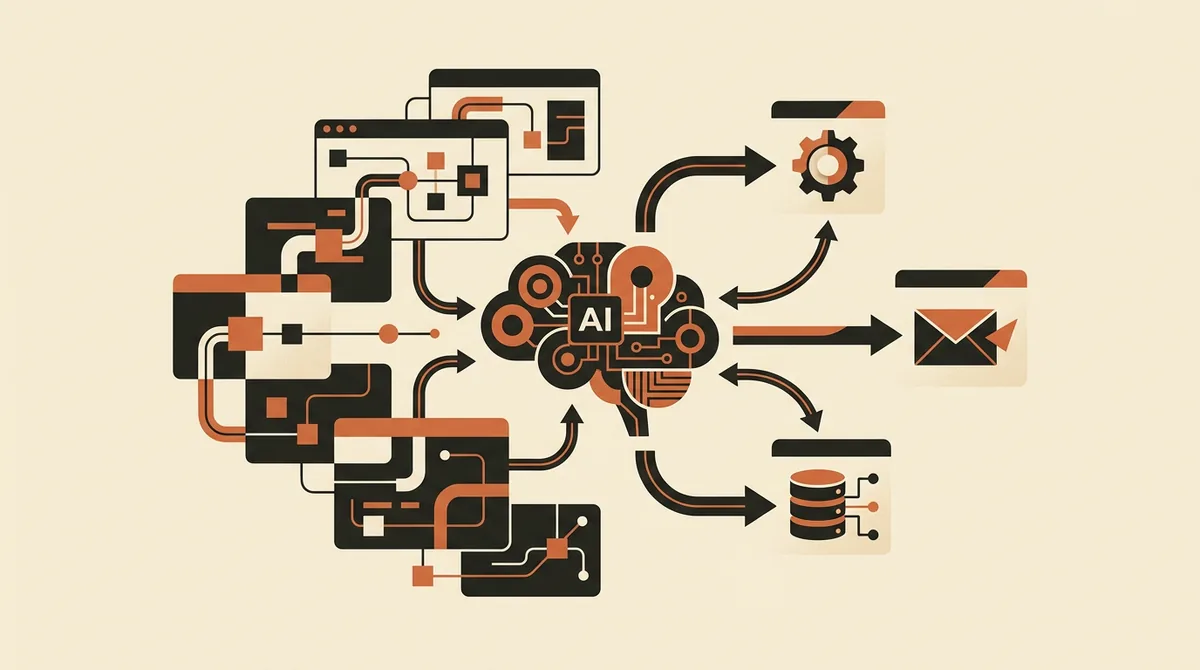
This is where things have shifted fast, and it's the real reason n8n has become the de-facto standard for anyone building operational AI agents rather than plain automations.
- n8n has a native AI Agent node and, since April 2026, support for the Model Context Protocol (MCP): meaning you can connect Claude or ChatGPT directly to your business workflows, with the AI deciding which tool to use. For anyone building systems that take action (updating the CRM, calling APIs, handling tickets end to end), it's currently the most advanced platform available.
- Make has solid AI integrations and ready-made modules for OpenAI, Anthropic, and others: enough for most SMB use cases, with a more guided approach.
- Zapier has added AI features and "agents," but it remains the least suited environment for elaborate agentic logic: it excels at simple connections, not complex orchestration.
If your goal is a linear flow (a lead comes in, you qualify it, you route it to sales), all three work fine. If you're aiming for more ambitious AI use cases with multiple coordinating agents, n8n gives you room the other two don't currently have.
GDPR and data: the factor that weighs heavily for Italian SMBs
This is often the deciding factor, and it's ignored by generic comparisons. Zapier and Make are American and European cloud services: your data passes through their servers. For most flows that's perfectly fine, but if you handle sensitive data (health, financial, extended personal records) you need to evaluate where the information ends up and sign the relevant data processing agreements (DPAs).
Self-hosted n8n solves the problem at the root: your data never leaves your own infrastructure. For a company that cares deeply about data sovereignty, or that operates in a regulated sector, that's a concrete advantage. With the AI Act fully applicable from August 2, 2026 (EU Regulation 2024/1689) and Italy's law 132/2025, data governance and tracing what the AI does are issues worth addressing before, not after. One caveat: self-hosting doesn't automatically put you in compliance, but it gives you the control to get there.
Not sure whether your case calls for Zapier, Make, n8n, or a custom agent? Tell us about the process you want to automate and we'll tell you, numbers in hand, what actually makes sense.
When each one makes sense: the honest guide
Here's the practical rundown, with no bias toward any of them.
| Choose... | If... |
|---|---|
| Zapier | You're just starting out, want 2-3 simple automations right away, have no in-house engineers, and volume is low. The time saved is worth the cost. |
| Make | You want flows with logic and branching, a good price-to-power ratio, and you're willing to learn a visual interface in a week. A great default for the average SMB. |
| n8n Cloud | You want n8n's power (AI Agent, MCP, unlimited APIs) without managing a server. Competitive price, fewer technical headaches. |
| n8n self-hosted | You have (or have access to) technical expertise, handle sensitive data, run high volumes, and want full control with low running costs. |
A common mistake: starting from the tool
The right question isn't "which tool," it's "which process am I automating and what's it worth." Many people pick n8n because it's trendy and then have nobody to maintain it; others stay on Zapier and pay 300 euros a month for flows that would cost 15 on Make. Before picking a tool, ask yourself what's actually worth automating in your business with AI and what return you can expect. The tool is the last decision, not the first.
Build vs buy: what if the real problem is something else?
One last dose of honesty. Sometimes the choice between n8n, Make, and Zapier is premature. If you need, for example, a 24/7 AI phone receptionist in Italian that books appointments, ready-made vertical solutions already exist for around €49 a month: building that from scratch on n8n would make little sense. Other times the flow is so specific that no SaaS covers it, and a custom AI agent is the only path.
The practical rule: if an off-the-shelf product covers 80% of your need, buying it almost always beats building it. If you're below that threshold, or if the automation is a competitive advantage, then it's worth investing in a custom solution on Make or n8n. Don't let the tool trend drive the decision, let the real cost of automating that process guide you, weighed against how much it saves or earns you.
In summary
There's no absolute winner. Zapier wins on simplicity, Make on price-to-power ratio, n8n on control, cost-effectiveness at volume, and 2026-era AI capabilities. The right choice depends on your case: in-house skills, volumes, data sensitivity, how ambitious your flows are. Start from the process and the ROI, then pick the tool. And if you're unsure which case is yours, it's worth getting help from people who build these flows every day.
Frequently asked questions
Is n8n really free?
The self-hosted version of n8n is open source and free: you only pay for the server you install it on (a VPS costing 5 to 15 euros a month). The hidden cost is the technical skill needed to install, update, and secure it. There's also n8n Cloud (paid, starting around €20/month) which removes the management burden.
Why does Zapier cost so much more than the others?
Zapier counts every single action (a task): a 5-step flow burns 5 tasks on every run. Make counts operations, which are far cheaper, and n8n counts the entire workflow as 1. At high volume the difference becomes huge. Zapier only stays cost-effective for a handful of simple automations, where you're paying for immediate setup convenience.
Make or n8n, for an SMB with no in-house engineers?
If you don't have technical expertise in-house, Make is often the better choice: visual interface, good pricing, a learning curve you can manage in a week. n8n makes sense if you have (or can rely on) someone who can manage a server, if you handle sensitive data, or if you're aiming to build complex AI agents. Alternatively, there's n8n Cloud, which combines n8n's power with simplified management.
Which one should I pick to build AI agents in 2026?
n8n is currently the most advanced: it has a native AI Agent node and, since April 2026, support for the Model Context Protocol (MCP) to connect Claude or ChatGPT to workflows. Make has solid AI integrations suited to many SMB cases. Zapier has AI features, but remains less suited to elaborate agentic logic.
Does self-hosted n8n make me compliant with GDPR and the AI Act?
Self-hosting keeps your data on your own infrastructure, which helps a lot with GDPR and data sovereignty, but it doesn't automatically make you compliant. You still carry obligations: legal basis, security, and with the AI Act (EU Regulation 2024/1689, fully applicable from August 2, 2026) transparency and governance. This article is informational: for legal aspects, consult a dedicated advisor.
Can I switch from Zapier to Make or n8n later on?
Yes, and it happens often: many companies start on Zapier for the simplicity, then migrate to Make or n8n as volumes grow and costs climb. Migration means rebuilding the flows (there's no automatic export between platforms), so it's worth rethinking and optimizing them during the switch instead of copying them one to one.
If you want to avoid paying for the wrong subscription or building on a platform that won't hold up, request a free analysis of your process: we start from ROI, not from the tool.