7 types of video creatives that work (and why)
11 min read · AstraLoop Studio
When a campaign stalls, the instinct is to tweak targeting, raise the budget, or fiddle with settings. Nine times out of ten, that's not the real problem: the video isn't landing. Not because it's badly shot, but because it's using the wrong archetype for that product and that audience.
A video creative isn't just "a video." It's a narrative structure that triggers a specific psychological lever. Social proof works differently from a demonstration, which works differently from a before/after contrast. Knowing which lever you're pulling — and when it's worth pulling — is the difference between a creative that scales and one that burns budget.
This guide covers the 7 video creative archetypes that keep performing in 2026, the psychological mechanism behind each one, when to use them, and how to produce them at volume without bleeding your budget dry. No textbook theory: concrete formats you can shoot next week.
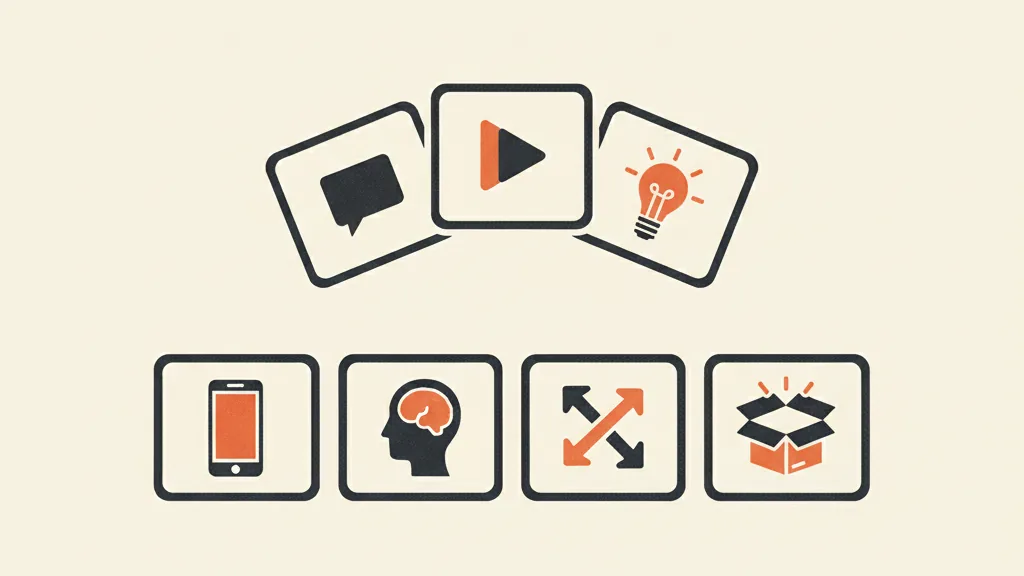
Why the archetype matters more than production quality
There's a stubborn myth: that an expensive video, shot in 4K under studio lights, converts better than one filmed on a phone. False, and Meta's data has confirmed it for years. On Feed and Reels, the video that looks like content wins over the one that looks like an ad. The winner is whoever stops the thumb in the first three seconds and holds attention with a clear promise.
The archetype is the upstream strategic choice. It defines what the video needs to make the viewer feel: trust (testimonial), desire (demo), recognition (problem-solution), belonging (UGC). Production is downstream — it matters, but it can't rescue a video built on the wrong foundation. For the full picture on building a creative that sells, start with our complete guide to ad creativity.
One practical rule before we get into the seven formats: every video has exactly one job. A testimonial that also tries to demo the product and push the offer ends up doing none of the three well. One archetype, one message, one expected conversion.
1. Testimonial: the social proof that disarms skepticism
A real person, on camera, describing how the product solved a problem for them. No actors, no rehearsed script: a genuine customer, imperfections and all, talking the way they'd talk to a friend.
Why it works. This is social proof in its purest form. The buyer's brain is wired to trust other people's experiences more than the seller's claims. When the company says "our product is great," the guard goes up. When someone who looks like you says it, the guard comes down. It's the same mechanism behind customer reviews as a strategic lever, just warmer and more credible on video.
When to use it. Products where trust is the main obstacle: services, high price points, crowded categories where the customer fears getting ripped off. Works best mid-to-bottom funnel, on people who already know you.
2026. The "hyper-native" testimonial dominates: shot vertically, natural light, imperfect audio. The more it looks like a voice memo from a friend, the better it converts. The trick is the first second: open with the customer's strongest line ("I thought it was just another scam, then..."), not "Hi, my name is Mark."
2. Demo: showing instead of telling
The product in action. How it's used, what it does, the result in real time. Zero talk about features — just the motion and the effect.
Why it works. It removes uncertainty. The buying friction usually isn't the price — it's "I don't get how this works" or "I bet it's complicated." A demo kills that doubt by showing it. It also triggers mental simulation: the viewer pictures themselves already using it, which pulls them closer to a decision.
When to use it. Products with a visible, immediate benefit: kitchen gadgets, beauty tools, gizmos, digital tools — anything with a demonstrable "wow" in a few seconds. Perfect for top-of-funnel, to build cold desire.
2026. The "no voiceover" demo, with on-screen text and heavy captions, is winning, because most people watch on mute. It's no coincidence that captions in video ads are now a requirement, not an extra. Fast pace, hard cuts every 1-2 seconds, the final result revealed by second five.
3. Problem-solution: the mirror that makes people say "that's me"
Show the problem first, through a scene the viewer recognizes and finds frustrating. Then the product as the natural solution. It's the oldest narrative structure in marketing, and it still holds because it hits a nerve.
Why it works. A well-portrayed problem creates instant identification: the viewer thinks "that's exactly my problem." From there, the product stops being an ad and becomes relief. The lever is emotional contrast: from irritation to release. The more vivid and specific the "before," the stronger the "after."
When to use it. Pretty much anywhere, but especially for problem-solver products, where there's a concrete frustration to dramatize. It's the archetype best suited to a strong hook in the first few seconds: open directly on the moment of peak annoyance.
2026. The 8-12 second "micro-story" version wins: a hyper-specific problem (not "you have dry skin" but "your foundation cracks by midday"), solution, result. Specificity beats generality every time. A problem that speaks to 10% of your audience converts better than one that speaks vaguely to 100%.
4. UGC: the content that doesn't feel like an ad
User Generated Content: videos that imitate (or actually are) content created by everyday users. Spontaneous, first-person, more like an organic post than a campaign.
Why it works. It bypasses the ad shield. We're trained to ignore ads, but we lower our guard in front of anything that looks like genuine content from a peer. UGC combines perceived authenticity with social proof: not only does someone use it, a "normal" person like you uses it. To dig into the mechanics and formats, see our dedicated piece on what UGC ads are and why they work.
When to use it. Consumer goods, e-commerce, young and social-native audiences. It's the most versatile and scalable archetype — it combines with testimonial, demo, and unboxing within the same style.
2026. This is where the biggest shift happened. AI-generated UGC lets you produce dozens of variants (different faces, voices, settings) without physically shooting every single video. Cost per variant drops and testing speeds up. The risk is repetitiveness: AI tends to flatten everything into the same register, so you still need a human hand on hooks and scripts. If you need a real creator, we've rounded up where to find reliable UGC creators.
5. Founder / behind-the-scenes: the face that humanizes the brand
Whoever founded or runs the company talks on camera. They explain the why behind the product, show the work behind it, take a stance. Not selling — explaining who's on the other side.
Why it works. People buy from people. A recognizable face turns an anonymous brand into a relationship. It triggers trust (a real human is putting their face and their reputation on the line) and differentiation (nobody can copy your story). In markets where products all look alike, the founder is often the only genuinely distinctive element.
When to use it. Brands with a story or a mission, high-value services, categories where trust outweighs price. Great for building long-term recognizability and for a warm audience still weighing the purchase.
2026. The founder "hot take" format is pulling hard: a sharp, slightly uncomfortable stance on the industry ("Why most [products like mine] are badly designed"). It grabs attention because it breaks the reassuring, uniform tone everyone else uses. Boldness and clarity beat caution.
6. Before-after: the contrast worth a thousand words
Starting state against end state, side by side or in sequence. The transformation is the message: you don't explain the benefit, you show it as a visible leap.
Why it works. The brain reasons in contrasts, not absolute values. An "after" on its own says nothing; next to the "before," it becomes a concrete, measurable promise. It's also the format that looks the most honest: the numbers seem to speak for themselves, even when there's staging behind the scenes. The lever is visual proof of the result — the hardest kind to argue with.
When to use it. Anywhere there's a showable transformation: beauty, fitness, home, organization, any kind of "aesthetic" result. Even in B2B, where "before/after" can be a chaotic dashboard versus a clean, ordered one.
2026. The synchronized split-screen version works well on Reels: chaos on the left, order on the right, in parallel. Watch the line with misleading advertising: if the "before" is manipulated or unrealistic, the platform penalizes it and the audience feels it. Credible beats spectacular.
7. Unboxing: the anticipation that builds desire
Opening the product, from package to reveal. The hands, the details, the gradual discovery. A ritual everyone recognizes and, for whatever reason, finds mesmerizing.
Why it works. It taps into anticipation, one of the most powerful emotional levers. The brain releases dopamine less on the reward itself and more on the wait for it. Unboxing builds that tension in small steps. It also shows tangibility and care: the packaging, the details, the perceived quality that a flat photo can't convey.
When to use it. Physical products where packaging and aesthetics matter, gifts, limited editions, anything with a "wow moment" in the opening. Strong at top-of-funnel to build desire, and during peak periods like creatives for sales and holidays.
2026. ASMR-style unboxing (amplified opening sounds, minimal talking, slow pace) is converting well with audiences looking for relaxing content. It's the opposite of the fast-paced demo, and that's exactly why it stands out in the feed.
Want to produce creative volume without losing quality? We help you build a system that combines winning archetypes with AI-assisted production. Request an analysis of your case.
How to choose the right archetype (decision table)
There's no single best format: there's the right one for your goal, your product, and your funnel stage. Here's a quick guide to help you decide.
| Archetype | Psychological lever | Ideal funnel stage | Best for |
|---|---|---|---|
| Testimonial | Social proof / trust | Mid-to-bottom | Services, high price points, skeptical categories |
| Demo | Uncertainty reduction | Top | Products with a visible "wow" |
| Problem-solution | Identification / contrast | Top-mid | Problem-solvers, gadgets, beauty |
| UGC | Perceived authenticity | Top-mid | E-commerce, consumer goods, young audience |
| Founder | Relationship / differentiation | Mid-to-bottom | Story-driven brands, high value |
| Before-after | Visual proof | Top-mid | Showable transformations |
| Unboxing | Anticipation / desire | Top | Physical products, curated packaging |
The operating rule: don't choose by taste, choose by testing. Start with 2-3 different archetypes on the same product, measure, keep the winner, and iterate. Plenty of companies in love with the founder format discover their audience actually converts on before-after, and vice versa. The data has no preferences. For setting up clean comparisons, our guide to creative testing methodology will save you the common mistakes.
Volume: the real problem in 2026
One fact changes the priorities: with the shift to the Andromeda era, Meta needs far more creatives to test, because it's the algorithm — not manual targeting — deciding who sees them. In practice, the creative has become the new audience. If you're not sure what's changing, read what Andromeda means for creative.
The practical consequence: the perfect video isn't enough anymore, you need dozens of variants to feed the algorithm. Shooting them one by one by hand doesn't hold up, not on time and not on cost. This is where AI-assisted production comes in: start from an archetype that works and semi-automatically generate variants (different hooks, angles, backgrounds). We cover this in detail in how to produce ad creatives with AI.
The approach we recommend to our clients is hybrid: strategy and hooks decided by humans, variant production automated, selection guided by data. That way you get volume without losing the creative spark that AI alone doesn't have. It's the same principle behind automating business processes with AI: the machine scales the repetitive work, the human keeps the strategic lead.
How to tell if it's working
An archetype that looks right on paper still needs to be validated against real numbers. The metrics that actually matter for video: hook rate (how many make it past the first 3 seconds), hold rate (how many make it to the midpoint), CTR, and of course cost per acquisition. A low hook rate tells you the problem is the opening, not the product; a hold rate that drops at the midpoint tells you where the story loses people. To read these signals without fooling yourself, see how to tell if a creative is actually performing.
One last piece of advice, maybe the most important one: document what you tested and why. Most companies repeat the same tests every three months because nobody wrote down the results. An organized record of which archetypes, hooks, and angles worked for your audience is worth more than any trending format. That's the creative asset that lets you scale.
Frequently asked questions
Which type of video creative converts best?
There's no absolute winner: it depends on the product, the audience, and the funnel stage. Testimonials and UGC work when trust is the obstacle; demos and before-after work when you need to show a concrete benefit. The choice should be validated with A/B testing, not gut feeling.
How many different video creatives do you need for a Meta campaign?
With the current algorithm (the Andromeda era), you need far more variants, because the creative itself acts as the targeting. A reasonable starting point is 5-10 variants per product, rotating 2-3 different archetypes, so the algorithm has material to optimize against.
Do videos shot on a smartphone convert better than professional ones?
Often yes, on Feed and Reels. Audiences skip anything that looks like an ad and stop on anything that looks like authentic content. A native, vertical video almost always beats an overly polished one: what matters is the archetype and the hook in the first three seconds, not the production value.
What is AI-generated UGC, and is it worth using?
It's the creation of user-generated-style videos through artificial intelligence, without physically shooting every clip. It's worth it for producing many variants at low cost and speeding up testing, but it needs a human hand guiding hooks and scripts — otherwise every video ends up sounding the same and performance drops.
What's the most important part of a video creative?
The first three seconds. That's where it's decided whether someone keeps watching or scrolls away. A strong hook — a punchy line, a recognizable problem shown right away — matters more than everything else: a great product with a weak opening never even gets seen.
How do I know which archetype works best for my product?
Test 2-3 of them in parallel on the same product and audience, then look at hook rate, hold rate, CTR, and cost per acquisition. Keep the winner, iterate on it with new variants, and keep a record of the results: what matters is your specific audience's data, not intuition.
If you're wasting budget on videos that don't convert, let's talk: we'll analyze your archetypes and show you how to scale production with AI while keeping the strategic control.