Customer Reviews: The Strategy to Collect Them and Turn Them Into Sales
10 min read · AstraLoop Studio
Most companies treat reviews as a byproduct: they show up if they show up, they end up on Google or Trustpilot, and every so often someone looks at them with either pride or irritation. That's a waste. Social proof is one of the cheapest, most reliable conversion accelerators you have access to, and in most cases it works far below its potential simply because nobody manages it as a process.
In this article we get practical: why reviews genuinely move revenue, how to build a system that collects them on its own instead of hoping for customer goodwill, how to use AI to read their sentiment at scale, and above all where to place them so they influence the purchase decision. The goal isn't "lots of stars" — it's turning your customers' voice into a repeatable sales lever.

Why reviews genuinely move revenue
Anyone about to buy from you is in a moment of uncertainty. They don't know the product as well as you do, they don't know if you'll keep your promises, and they're weighing a risk. The review solves exactly that problem: it shifts the source of reassurance from you (an interested party) to someone like them who has already taken the leap. That's the mechanism of social proof, and it's powerful because it bypasses the natural distrust toward marketing messages.
You don't need textbook American numbers to grasp the order of magnitude. Adding credible reviews to a product page or landing page shifts the conversion rate tangibly, typically in a double-digit percentage range when there was nothing there before. On expensive purchases or high-involvement services the effect is even more pronounced, because the perceived risk is higher and reassurance is worth more. If you're working on your e-commerce conversion rate, reviews are often the lowest-cost, highest-impact lever available.
There's also a less obvious secondary effect: reviews reduce the load on pre-sale customer care. Many of the questions customers would ask before buying (sizing, returns, timing, support) get answered in other customers' own words. Less friction, fewer abandonments, fewer tickets. Social proof works on conversion and operating costs at the same time.
Stars aren't enough: text quality is what counts
A common mistake is focusing on the average rating. The score alone communicates little: "4.7 stars" is reassuring but abstract. What converts is specific content: "I used it for three months and it held up," "support replied within half a day," "the sizing is spot on." These are concrete details the prospective customer recognizes as their own. A well-built review strategy doesn't just aim to raise the average — it aims to collect useful phrases tied to real objections and specific benefits.
The real problem: collection is almost always broken
Almost everyone has the same bottleneck. It's not that customers are unhappy: it's that nobody asks for the review, or asks badly, or asks too late. A happy customer has no spontaneous incentive to write to you. Whoever leaves a review without being asked is often someone who had a negative experience and wants to vent. Result: without a system, the sample you collect skews toward discontent.
The difference between companies with lots of good reviews and those with almost none is rarely product quality. It's that the former ask systematically and the latter don't. Some principles that work:
- Timing. Ask at the moment of peak satisfaction, not whenever it happens. For a physical product that's a few days after delivery (enough time to try it, not so long they forget). For a service it's right after a result or milestone is reached.
- Right channel. Email for detailed messages, WhatsApp or SMS when you want higher response rates on short requests. The channel should be wherever your customer already responds to you.
- Minimal friction. A direct link, a single question, zero login. Every extra step halves responses.
- Guided question. "How did it go?" produces vague answers. "What convinced you, and what would you use it for?" produces useful, sellable text.
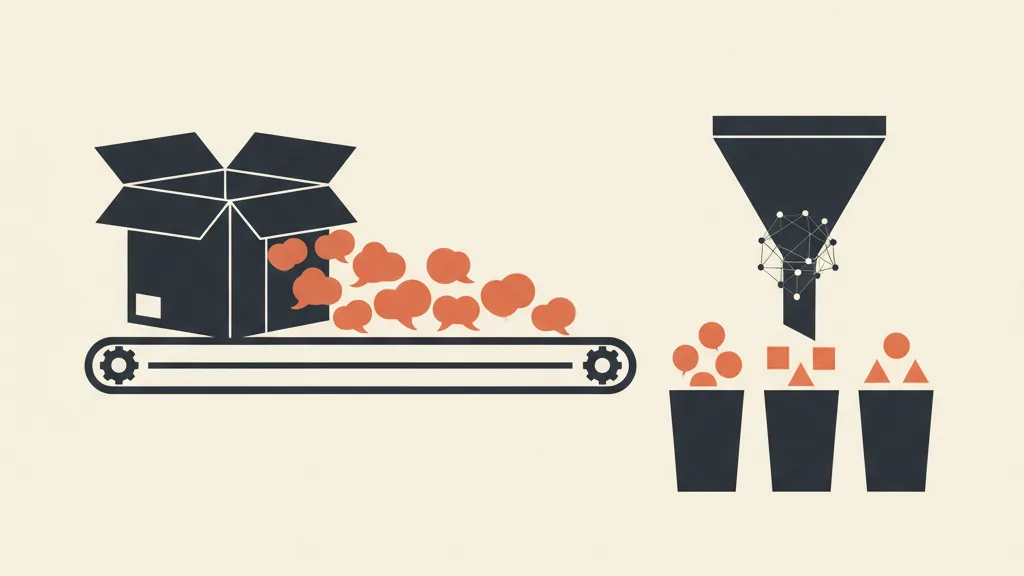
The point is that all of this, done by hand, doesn't scale. Remembering every order, sending the email at the right moment, managing follow-ups: this is exactly the kind of repetitive work that gets forgotten the moment the company has other things to deal with. This is where automation comes in.
Automating the review request
The version that actually works is a flow that starts on its own, triggered by events that matter: delivery completed, order fulfilled, service delivered, milestone reached. Nobody has to remember anything. The system waits for the right moment, sends the request on the preferred channel, and manages the follow-through.
A concrete blueprint for an automated sequence:
- Trigger: the event (e.g. delivery) starts a timer, say 3-5 days.
- First request: a short, personalized message with the product name and a direct link to the review.
- Follow-up: if there's no response, a second message a few days later, with a different tone. A single reminder recovers a significant share of responses.
- Smart fork: if the customer signals dissatisfaction, they're not pushed toward the public review but toward a private support channel, so the problem gets solved before it becomes one star fewer.
This kind of flow follows the same principle as automated sales follow-up: events that trigger messages at the right moment without human intervention. The difference is in the goal. Here you're not closing a sale, you're collecting raw material (reviews) that will fuel future sales. With AI the message can be personalized based on what the customer bought and how they behaved, instead of being an identical template for everyone, which noticeably raises the response rate.
One benefit that's easy to underestimate: automation makes collection continuous and predictable. Instead of occasional waves, you get a steady stream of fresh reviews, and freshness matters because a skeptical customer trusts twenty reviews from the last few months more than two hundred from three years ago. This kind of systematizing repetitive processes is the heart of business process automation with AI: taking a valuable but tedious task and making it reliable without human oversight.
Reading reviews with AI: sentiment analysis
Collecting them is half the job. The other half is understanding them. With few reviews you can read them all. But once you accumulate hundreds or thousands (which is the goal), reading them by hand becomes impossible, and you miss exactly the signals you need. This is where AI does work you'd never manage manually.
Sentiment analysis with a language model doesn't just tell you "positive or negative." Applied to a body of reviews, it gives you actionable output:
- Recurring themes. Which aspects of the product get mentioned most often, positively and negatively. If twenty customers praise the same thing, that's your number-one sales argument.
- Frequent objections. The recurring weak points tell you what to improve in the product and what to address in your copy to defuse the doubt before it arises.
- Customer language. The exact words they use to describe benefits and problems. It's gold for copywriting: speaking the way the customer speaks converts better than speaking the way marketing speaks.
- Warning signals. A negative theme that grows over time (shipping times getting worse, a new defect) shows up in the data before it becomes a reputation problem.
This turns reviews from a passive showcase into a source of intelligence about the product and the market. The same phrases customers use can be reused in ad copy and on high-converting landing pages, closing the loop between what the customer thinks and what you communicate to those who haven't bought yet. If you know the concept of customer awareness levels, the objections that emerge from sentiment analysis tell you precisely which level a non-buyer is at, and which lever to pull to move them forward.
You don't need a data scientist to do this. A well-set-up flow can pass every new review to a model, tag it by theme and sentiment, and update a dashboard you can read in thirty seconds. The value isn't the technology itself — it's finally having control over something that used to be an unreadable mass of text.
Want a system that collects reviews on its own and analyzes them with AI to turn them into a sales lever? Request an analysis of your current flow.
Where to place reviews so they convert
Having great reviews and hiding them on a "Testimonials" page nobody visits is like keeping your best salesperson locked in the back room. Social proof works when it's exactly where the customer decides, not where it looks good. Some high-impact placements:
| Touchpoint | What to show | Why it works |
|---|---|---|
| Product page | Reviews with specific text, near the price and buy button | This is the decision moment: reassurance needs to be right there, not three clicks away |
| Landing page | 2-3 strong testimonials above the fold, more throughout the page | Interrupts doubt the moment it arises, before the user leaves |
| Checkout | A brief callout to the average satisfaction or a key phrase | Reduces anxiety at the last step, where many carts are lost |
| Email & follow-up | Reviews relevant to the product the customer viewed | Warms up the undecided with the voice of someone who already bought |
| Ads | A real customer quote as the hook or creative | Social proof in the ad builds trust before the click even happens |
The practical rule: put the most relevant review next to the most relevant decision. On a product page, it's worth optimizing the whole thing (photos, description, social proof), as we cover in the guide on how to build an effective product page. Reviews aren't a decorative block to paste at the bottom: they're a conversion element that deserves the same care as the price and the call to action.
Choosing the right reviews for each context
Not every review belongs everywhere. For a technical product's page you want ones that talk about durability and performance; for a beauty product, ones that talk about results and compliments received. Here again AI helps: once reviews are tagged by theme, you can automatically surface the ones most relevant to that product and that objection on every page. That's the difference between an indistinct wall of stars and surgical social proof.
Handling negative reviews (which aren't a problem)
Many companies fear negative reviews so much they don't ask for reviews at all. That's a mistake. A profile with only five stars looks suspicious: the savvy customer knows absolute perfection doesn't exist and grows wary. A small share of critical reviews, handled well, boosts the credibility of everything else.
What matters is the reaction. A public, calm, solution-oriented reply to a negative review communicates more trust than ten glowing reviews: it shows that if something goes wrong, you're there. An automated flow can alert you in real time when a review comes in below a certain threshold, so you respond quickly instead of weeks later. And sentiment analysis distinguishes between an isolated complaint and a systemic flaw that deserves a product fix, not just a reply.
The smart fork mentioned earlier — catching dissatisfaction and routing it to a private channel before it goes public — isn't about hiding problems: it's about solving them while they're still solvable. An angry customer you respond to well often becomes more loyal than one who was never unhappy.
Reviews and retention: closing the loop
There's one last effect, often invisible. The very act of asking for a review reactivates the relationship with the customer. It makes them feel heard, reminds them you exist, and opens the door to a future purchase. A well-written review request is also a retention touchpoint, not just a collection one.
Someone who leaves a positive review is, by definition, a satisfied and engaged customer: exactly the profile with the highest customer lifetime value and the greatest likelihood of buying again or referring you. Treating review collection as part of the overall customer experience, rather than as a standalone task, is what separates those who accumulate stars from those who build a lasting advantage.
Put the pieces together and you get a system: automatic collection at the right moment, AI analysis that extracts signals and language, surgical placement at conversion points, orderly handling of criticism. None of these steps is complicated on its own. The difference comes from lining them up and letting them run without your constant involvement, so your customers' voice works for you every day, even while you're thinking about something else.
Frequently asked questions
How do you ask a customer for a review without being pushy?
Ask once, at the moment of peak satisfaction (a few days after delivery or right after a result), with a short, personalized message and a direct link. One gentle follow-up to non-responders is fine; more than that becomes annoying. Keep the tone polite, no obligation, zero friction.
What's the best time to request a review?
It depends on the type of offer. For a physical product, 3-5 days after delivery: enough time to try it, but not so long they forget. For a service, right after a tangible result or milestone, when satisfaction is at its peak.
Do negative reviews really hurt sales?
Not necessarily. A profile with only perfect scores looks suspicious. A small share of critical reviews, handled with calm, solution-oriented public replies, increases overall credibility and shows prospective customers that you're present when something goes wrong.
What does it mean to run sentiment analysis on reviews?
It means using AI to automatically analyze the text of many reviews and extract recurring themes, frequent objections, customers' exact language, and signals of emerging problems. It turns an unreadable mass of text into actionable intelligence on product and messaging.
Where's the best place to show reviews on your site?
Wherever the customer decides: on the product page near the price and buy button, above the fold on landing pages, at checkout, and in follow-up emails. Hiding them on an isolated 'testimonials' page all but cancels their effect on conversions.
Can review collection be automated?
Yes, and it's the most effective way. A flow triggered by events (delivery, order completed) sends the request on its own at the right moment, on the preferred channel, manages follow-ups, and routes dissatisfaction to private support. With AI, the message is personalized based on what the customer purchased.
If you want to stop chasing reviews by hand and turn them into social proof that converts, let's talk: together we'll look at how to automate collection, analysis, and use.