How to Win Back Lost Customers: 7 Strategies That Actually Work
9 min read · AstraLoop Studio
You've got a database full of people who bought from you once and now don't respond anymore. The instinctive move is to write them off as "lost customers" and shift the whole budget to acquiring new contacts. That's the most expensive mistake you can make. Because it lumps two very different groups into the same bin: people who've cooled off but are still recoverable, and people who are genuinely gone.
The difference isn't philosophical, it's operational. It changes the message, the channel, the incentive, and even the technical risk you're taking on. Treat a contact who's been quiet for 3 months the same way you'd treat one who vanished 3 years ago, and you'll burn both — and in the worst case, damage your domain's email reputation. In this guide you'll find a clear line between lost and dormant customers, plus 7 recovery strategies organized by contact temperature.
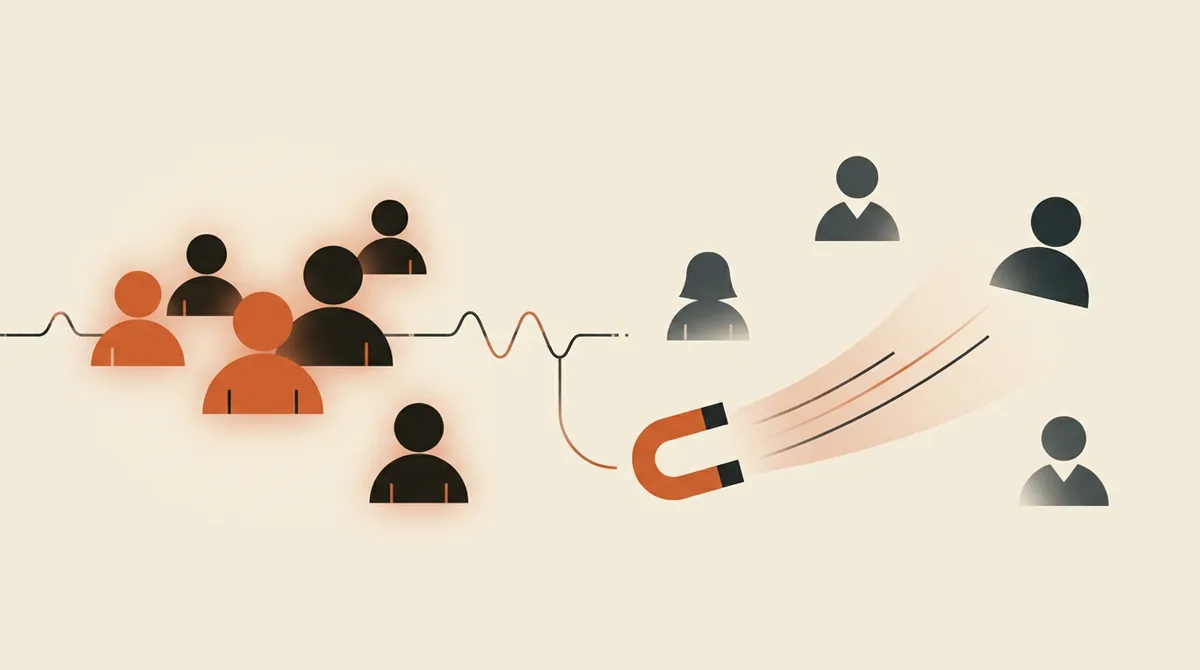
Lost customers vs. dormant customers: the distinction that changes everything
A dormant customer still has a relationship with you that's half-warm: they bought recently (weeks or a few months ago), still open your emails even if they don't click, and never unsubscribed. The relationship exists, it's just faded. We break down what dormant customers are and how to spot them in our dedicated guide on dormant customers and how to recognize them.
A lost customer, on the other hand, is a contact whose relationship with you broke off a while ago: no opens in months, no purchase in over a year, sometimes an explicit reason for leaving (a complaint, a price issue, a competitor). Here, you're not waking up a dormant relationship. You're rebuilding it from scratch.
The line between the two isn't a matter of opinion — it's measurable. The most solid method is RFM analysis (Recency, Frequency, Monetary), which scores every contact on how recently they bought, how often, and how much they spent. RFM segmentation automatically surfaces the clusters you need here: "About to Sleep" and "Hibernating" (dormant contacts to catch right away) versus "Lost" and "Can't Lose Them" (high-value lost customers worth winning back one by one).
Why the distinction is also a technical matter
There's a reason, rarely discussed, why you can't treat lost and dormant contacts the same way: deliverability. If you take 5,000 contacts who've been cold for 2 years and blast them with a burst of emails, providers (Gmail, Outlook) suddenly see a domain writing to addresses that haven't engaged in a long time. The result is a spam rate that spikes above the critical 0.3% threshold set by Google's and Yahoo's sender guidelines. And within a handful of sends, you've torched your domain reputation even with your good customers.
In practice: you can reactivate dormant contacts with more aggressive volumes, but lost contacts need to be warmed up carefully, with proper warm-up and clean lists. If you want to make sure a reactivation campaign doesn't land in the junk folder, read why emails end up in spam and how to protect your domain.
The playbook by contact temperature: 7 strategies
I've organized the 7 strategies across three increasing levels of coldness. Each level has its own goal, priority channel, and tone. Don't skip levels: the right strategy for a lukewarm dormant contact is the wrong one for a frozen lost contact.
Level 1. Warm contact (dormant 1-4 months)
Strategy 1. The "Are you still with us?" automated win-back sequence
This is the easiest, most profitable win. The contact knows you, still opens your emails, and has simply lost their buying rhythm. An automated sequence of 3-4 emails spaced a few days apart ("We miss you," a value reminder, an incentive, a last call) does most of the work. The number that matters: automated sequences generate up to 320% more revenue than a single broadcast send, because they catch each contact at the moment they're ready, not just on the day you hit "send." You'll find ready-to-use structure and copy in our guide to win-back email sequence examples.
Strategy 2. Re-engagement SMS with a sharp incentive
If you have the number and consent, SMS is the weapon for warm contacts who no longer open emails. SMS open rates exceed 98% and messages get read within minutes. A short text, a clear incentive, one link: SMS campaigns on dormant lists can return an ROI above 1,000%, because the cost per message is negligible compared to the value of a recovered customer. Rule of thumb: one SMS, one offer, no walls of text.
Level 2. Cold contact (dormant 4-12 months)
Strategy 3. WhatsApp Business to reopen the conversation
When email isn't enough anymore but the contact isn't lost yet, WhatsApp reopens a conversational channel. Not a promotional broadcast, but a message that invites a reply: a question, an update on the product they'd looked at, the chance to book directly. With AI-powered WhatsApp Business automation integrated with your CRM, the conversation can qualify the contact and get them to book an appointment without any manual work.
Strategy 4. RFM segmentation so you don't waste incentives
At this level, the classic mistake is sending the same discount to everyone. RFM segmentation tells you who's worth a 20% offer and who just needs a nudge. The "About to Sleep" and "Hibernating" segments need to be caught before they become "Lost" — that's where a minimal incentive has the biggest effect. Giving the most aggressive coupon to someone who would have come back anyway is money down the drain.
Strategy 5. Orchestrated multichannel (email + SMS + WhatsApp)
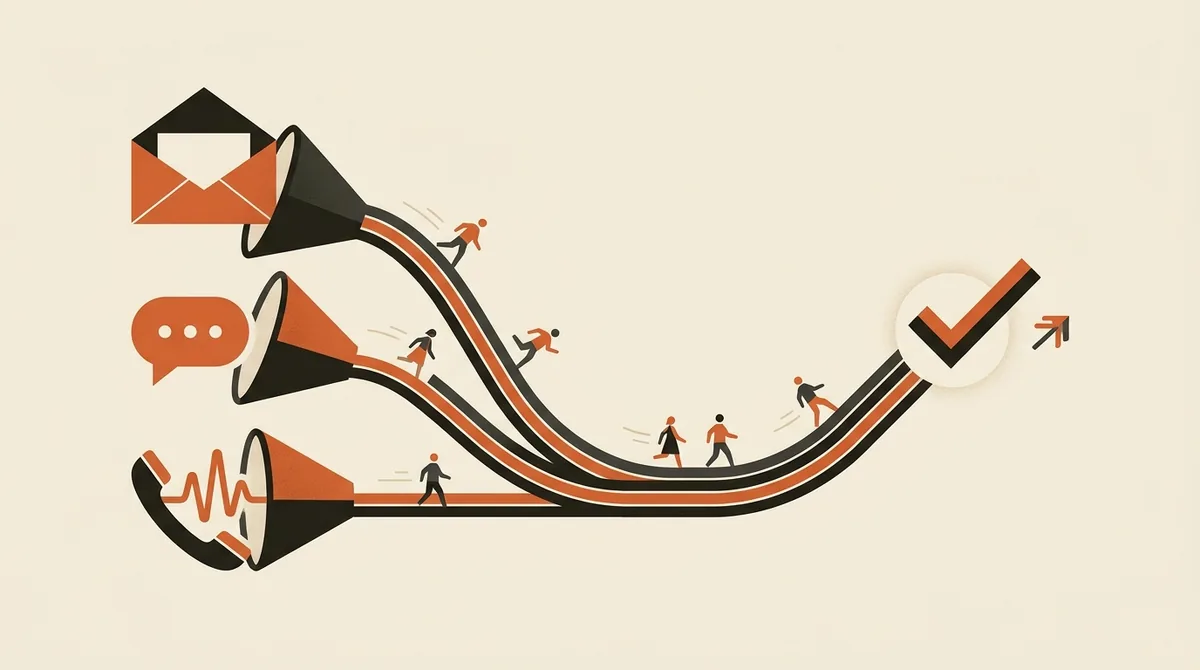
A single channel has a ceiling. Serious reactivation orchestrates channels into one funnel: start with email, anyone who doesn't open gets an SMS, anyone who replies enters a WhatsApp conversation that closes the sale or books an appointment. Not three disconnected campaigns, but one sequence that hands off the baton from channel to channel based on behavior. That's exactly the funnel we describe in the complete guide to reactivating dormant customers from your database, the hub to start from when building the system.
Level 3. Frozen contact (lost for over 12 months)
Strategy 6. AI voice agent for one-to-one recovery
For high-value frozen contacts, email often doesn't even land anymore. This is where a phone call beats everything, but calling thousands of lost contacts by hand isn't economically viable. An AI voice agent for reactivation outbound changes the math: roughly €0.40 per call versus €7-12 for a human agent, with positive response rates of 15-35% on cold databases. Don't use it on warm contacts (a waste), use it on lost contacts worth the call. Compliance note: since 2025, Italian law requires disclosing that the person on the other end is talking to an automated system, as clarified by law 132/2025 on the obligation to disclose AI on phone calls.
Strategy 7. Rebuild the relationship, don't sell right away
With frozen contacts, the mistake is asking for the sale on the first touch. With someone who left you years ago, you first need to rebuild permission: an honest message ("it's been a while, we've changed, do you still want to hear from us?"), a clearly visible one-click unsubscribe, and a genuine willingness to clean the list of anyone no longer interested. Paradoxically, offering an easy way out raises the quality of who stays and protects deliverability across the rest of your database.
The economics: recovery costs 5-7 times less than acquisition
Before launching any campaign, run the math almost nobody runs. Reactivating an existing customer costs on average 5-7 times less than acquiring a new one through advertising. A lost contact has already given you consent, already knows the brand, has already bought from you: you've skipped the most expensive part of the funnel.
Here's a concrete example. You have 10,000 contacts classified as dormant or lost. A well-orchestrated reactivation campaign realistically recovers around 10%: that's 1,000 sales opportunities at essentially zero advertising cost. Generating those same 1,000 opportunities from cold traffic would mean investing advertising sums that often don't pencil out on the P&L. That's why reactivation should be read as a financial lever that lowers your average CAC, not as a "promotion." The full argument, numbers included, is in our analysis of reactivation cost versus acquisition cost.
If you're interested in the math behind all this — how CAC, CPL, and LTV move once you add reactivation to the mix — you'll find it explained in acquisition KPIs and unit economics.
Want to know how many opportunities are sleeping in your database without spending a euro on advertising? Request a free analysis: we'll tell you how many contacts are recoverable and with what strategy.
Reactivating without risking a fine: the GDPR piece
There's a question that stops a lot of business owners: "can I really write again to a customer I haven't heard from in 2 years?" The short answer: it depends on the legal basis and the time window. In general, contacting a former customer requires either valid consent or a documented legitimate interest, and the most commonly cited prudent reference is a 24-month window from the last contact (EDPB guidelines included). Beyond that window, cold-reactivating a contact without a solid legal basis exposes you to fines from the Italian Data Protection Authority.
This isn't an abstract legal detail — it's part of the operational strategy: it decides who you can contact and how. Before launching, check your legal basis with the guide on how to reactivate old customers in compliance with GDPR. This is informational, not legal advice: for your specific case, always consult a professional.
Where to actually start
Customer recovery isn't a campaign you launch and forget — it's a system that runs continuously on your database. The logical sequence is simple:
- Segment with RFM: separate warm, cold, and frozen contacts. Skip this step and you're firing blind.
- Check the legal basis (consent, 24-month window) before writing to anyone.
- Apply the playbook by level: automation plus email/SMS for warm contacts, WhatsApp and multichannel for cold ones, one-to-one voice agent for high-value lost contacts.
- Protect deliverability: warm-up, clean lists, one-click unsubscribe, spam rate under 0.3%.
- Measure and iterate: recovery rate, revenue per reactivated contact, CAC saved.
Anyone selling services or working in B2B often has the most underrated database of all: few contacts, but extremely high value. If that's your situation, start with the guide on how to reactivate dormant customers in B2B, where a single recovery can be worth ten new acquisitions. And if your database is large but stagnant, the piece on how to monetize an underused customer database shows you just how much value you're leaving on the table.
The difference between a database that no longer buys and one that generates opportunities every month isn't the number of contacts. It's the method you use to treat them based on how cold they are.
Frequently asked questions
What's the difference between a lost customer and a dormant customer?
A dormant customer bought recently (weeks or a few months ago), still opens your emails, and hasn't unsubscribed: the relationship has faded but is still alive. A lost customer hasn't engaged in over a year, opens nothing, and may have an explicit reason for leaving. Dormant customers wake up; lost customers need to be won back almost from scratch. RFM analysis gives you the objective measure.
Is it better to recover a lost customer or acquire a new one?
Recovery almost always wins: reactivating an existing customer costs on average 5-7 times less than acquiring a new one through advertising. They've already given consent, already know the brand, and have already bought, so you skip the most expensive part of the funnel. On a database of 10,000 contacts, a 10% recovery rate means 1,000 opportunities at almost zero advertising cost.
Can I write again to a customer I haven't heard from in years without breaking GDPR?
It depends on the legal basis (valid consent or documented legitimate interest) and the time window. The most commonly cited prudent reference is roughly a 24-month window from the last contact. Beyond that, cold-reactivating without a solid legal basis exposes you to fines from the Italian Data Protection Authority. This is informational: for your specific case, consult a professional and verify the basis before sending.
What's the best channel to reactivate a cold contact?
There's no single channel — it depends on the temperature. For warm contacts, automated email sequences and SMS work well (over 98% open rate). For cold contacts, WhatsApp reopens the conversation. For high-value frozen contacts, an AI voice agent recovers them one-to-one at roughly €0.40 per call. The best strategy orchestrates multiple channels into one behavior-driven funnel.
Can bulk-reactivating an old database damage my email domain?
Yes, and it's an underrated risk. Mass-sending to contacts who haven't engaged in a long time pushes your spam rate above the critical 0.3% threshold required by Google and Yahoo, damaging your domain reputation even with your good customers. Lost contacts need to be warmed up with proper warm-up, clean lists, and gradual volumes — not a single blast.
What recovery rate is realistic to expect from a reactivation campaign?
A 10% recovery rate on a mixed database of dormant and lost contacts is a realistic target for a well-orchestrated, well-segmented campaign. Warm dormant contacts convert much better, frozen lost contacts much less. Automated sequences can generate up to 320% more revenue than a single broadcast, so the real lever is the method, not the send volume.
If your database has gone quiet and you don't know where to start, talk to us: we'll build the right reactivation funnel together, matched to your level of cold contacts.