From Lead Magnet to Sale: Building a Path That Converts
11 min read · AstraLoop Studio
An effective lead magnet isn't measured by how many emails it collects. It's measured by how many of those contacts become customers three weeks later. That distinction sounds obvious on paper, but almost nobody honors it in practice: everyone optimizes the download and forgets everything that happens afterward.
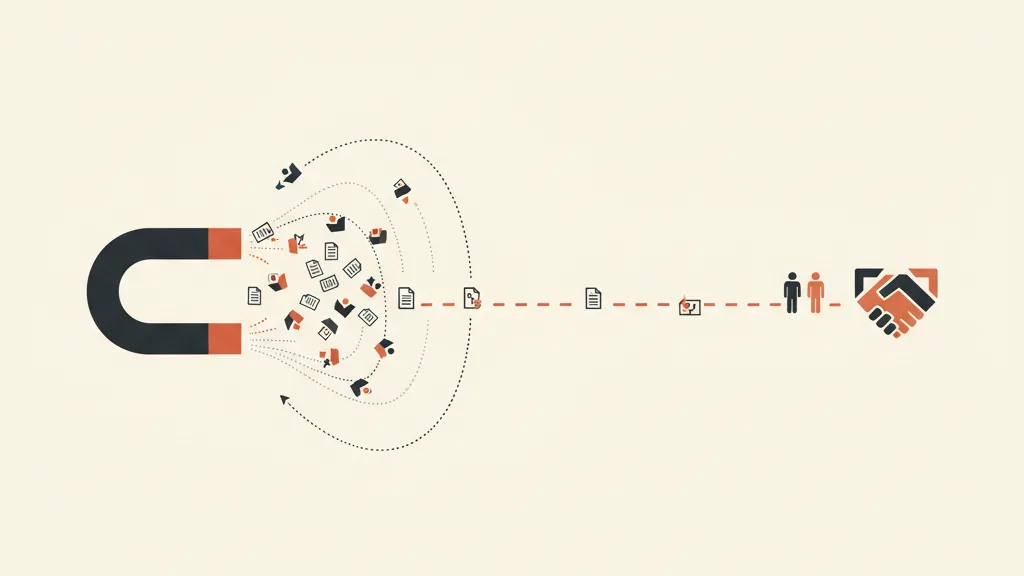
You see the result everywhere. Ebooks downloaded by the thousand that never produced a single quote request. Checklists handed out to anyone who passes by, filling the database with dead addresses. The magnet works great at attracting — and then the iron just sits there, stuck, going nowhere.
This article treats the lead magnet for what it really is: the first step of a path, not the finish line. First we'll look at how to design one that attracts the right people. Then, the part everyone skips, how to build the stretch that runs from download to signed deal, with nurturing and sales handoff managed automatically. Because a lead magnet with no path behind it is just a production cost with some nice graphics on top.
What a lead magnet actually is
A lead magnet is something of value that you offer for free in exchange for a contact. A guide, a checklist, a calculator, a video, a template, a short consultation. The exchange is simple: you give a piece of the solution, the person leaves you their details and permission to follow up.
That's the textbook definition. But the textbook definition is also the trap, because it makes you think the job is producing the object. It isn't. The object is 20% of the work. The lead magnet is just the moment a stranger raises their hand and says, "I have that problem too." What matters is what happens right after they raise it.
Put another way: the lead magnet lives inside your lead generation funnel, usually in the middle stage, when the person has realized they have a problem and is weighing how to solve it. It's not there to sell. It's there to turn anonymous traffic into contacts you can qualify and nurture.
Why most lead magnets don't convert
Before getting into how to do it right, it's worth looking at where it goes wrong, because the mistakes are almost always the same three.
1. It attracts the wrong people
A lead magnet that's too generic is a magnet for the curious. "10 tips to grow your business" attracts anyone with a business, which means no one in particular. Whoever downloads it has no precise intent, and a contact with no intent doesn't buy — they move on. A good lead magnet is specific enough to turn away people who aren't your customer. If it attracts everyone, it qualifies no one.
2. It's not connected to what you sell
This is the silent mistake, the one you don't notice you've made. You give away an energy-savings calculator but sell tax consulting. The contact is relevant to the magnet, not to your offer. The bridge between "I downloaded this thing" and "I'm buying your service" doesn't exist, and no email sequence will ever build it. The lead magnet has to be chapter one of the product you sell, not an unrelated freebie pulled off a different shelf.
3. It goes nowhere
The most common of all. The person downloads, gets the email with the attachment, and then... silence. No follow-up, no sequence, no sales rep reaching out. The warmest contact you'll ever get (someone who just acted on their own initiative) is left to cool off until they forget who you are. You paid to acquire them and you throw them away the same day.
Notice that two mistakes out of three have nothing to do with the object. They're about the path. That's where you win or lose, and that's what we'll focus on next.
How to design an effective lead magnet
A lead magnet that works has four characteristics. They're non-negotiable, and missing even one of them drags the performance down considerably.
- Specific. It solves one precise problem for one precise person. Not "improve your marketing," but "the template to calculate how many leads you need to close 5 clients a month." The narrower the cut, the warmer the person who downloads it.
- Useful right away. The person needs to get a result in a few minutes, not after studying 40 pages. A checklist gets used today, an ebook sits in the downloads folder. For the same topic, the format that gets consumed quickly converts better.
- Connected to the offer. It has to demonstrate, in practice, the expertise you'll later sell. If you sell custom CRMs, a good magnet is an audit of the current sales process: whoever fills it out is already telling you where the gaps are, and you already have the hook for your proposal.
- Low friction. Ask only for the data you actually need for the next step. Name and email for B2C. In B2B you can ask for company and role, since you need them to qualify, but every extra field drops a share of people. Every line on the form is a tax on conversions.
Which format to choose
Not all formats are equal, and the choice depends on how "warm" the person downloading it will be. Here's a practical map.
| Format | Production effort | Downloader intent | When to use it |
|---|---|---|---|
| Checklist / template | Low | Medium-high | You want action-ready contacts, fast |
| Calculator / tool | Medium | High | Your value shows in the numbers (ROI, costs, quotes) |
| Guide / ebook | Medium-high | Medium | The topic is complex and needs educating before selling |
| Webinar / video | High | High | Trust and a face are needed, typical of high-ticket services |
| Free consultation / audit | High (time) | Very high | You sell personalized services and close by talking |
The rule behind the table: the higher your service's price tag, the more your lead magnet can (and should) ask of whoever takes it. A free audit filters out the curious better than any ebook, because someone who gives up half an hour of their time is telling you they mean business. It's the same principle behind the questionnaire that qualifies while it collects: the exchange itself separates the good contacts from the useless ones.
The part everyone skips: from download to sale
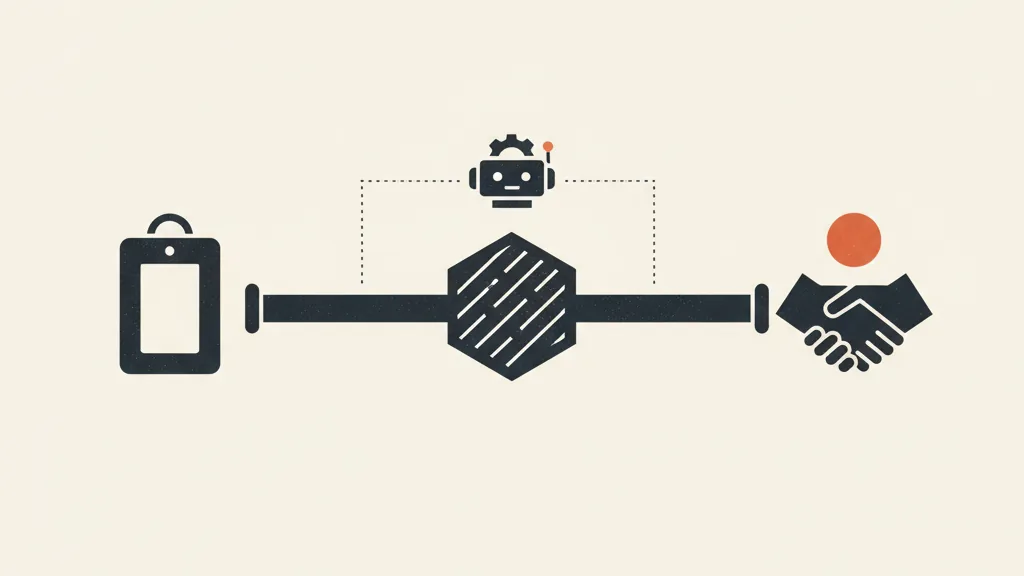
Here's the point. The lead magnet did its job the exact moment the person clicked "download." From there on, the object doesn't matter anymore: the path does. And the path has three stretches, all three necessary.
Stretch 1: qualification
Not all contacts are worth the same. Someone who downloaded an intro guide is far from buying; someone who filled out an audit with their company's data is one step away. Treating them the same is a waste: you bore the first group and neglect the second.
Qualifying means figuring out, as early as possible, who's ready and who needs nurturing. You can do it with a few targeted questions right after the download, or by letting behavior speak for itself (which emails they open, which pages they visit, whether they come back to the site). It's the logic behind lead scoring: you assign a score and surface hot contacts without having to sift through them by hand. If you want the full method for not wasting time on cold contacts, we covered it in how to qualify leads.
Stretch 2: nurturing
Most people who download aren't ready to buy today. That's not a problem, it's the norm. Nurturing exists for exactly this: staying present, useful and credible until the person reaches the right moment for them, not for you.
In practice it's a sequence of content that walks the contact from problem to solution. Not "buy, buy, buy," but one step at a time: go deeper into the lead magnet's topic, show a real case, answer a common objection, show how you work. Every message earns a bit of trust and moves the person one rung up. If you want the details on sequences, you'll find them all in our guide to B2B lead nurturing with AI, and the first building block to get right is almost always the email welcome flow.
Stretch 3: sales handoff
At some point the contact is ready. They've opened the right emails, gone back to the pricing page, their score is high. It's time to hand the ball to sales, or to a direct sale. And this is where the costliest disaster of all happens: the handoff comes too late, or doesn't come at all.
The contact is hot on Tuesday; the sales rep calls the following Friday, by which point they've cooled off or already talked to a competitor. The window in which a lead is truly ready is narrow, often just a few hours. Whoever catches it closes the deal, whoever misses it starts over from scratch.
If your lead magnet collects contacts that then go nowhere, the problem is in the path you put behind it. Tell us about it and let's design the sequence from download to sale together.
The AstraLoop angle: an AI agent drives the path
So far we've described three stretches (qualification, nurturing, handoff) that work great in theory. The problem is practice: they require perfect timing and constant attention, and no human team can guarantee that for every single contact, every hour, every day. That's why most paths break exactly at the handoff points.
Our answer is to put an AI agent in charge of the entire stretch from download to sale. In concrete terms, that means:
- It replies instantly. The moment a lead comes in, the agent starts the conversation (via WhatsApp, email or chat) while interest is at its peak. Zero wait, which is the difference between a hot contact and a lost one.
- It qualifies through conversation. It asks the right questions, figures out whether the contact is in target and assigns the score, without anyone having to fill out forms by hand.
- It nurtures without tiring. It sends the right content at the right time, remembers follow-ups, picks back up with contacts who stalled. Automated follow-up sequences keep working even while you sleep.
- It hands off the ball at the exact right moment. When the lead is ready, the agent delivers it to sales already warmed up and with full context (what they downloaded, what they asked, what's holding them back), or books the appointment directly on the calendar.
The point isn't to replace the salesperson. It's to make sure the salesperson only talks to ready, informed contacts, instead of wasting hours chasing and filtering by hand. All of this lives inside a CRM connected to the funnel, so there's just one path, from the first download to the deal, with no spreadsheets and no steps lost between tools.
How to measure whether it's working
You judge a lead magnet on three levels, not one. Looking only at the first is the mistake that makes you celebrate numbers that don't pay the bills.
- Download rate. How many people, among those who see the page, leave their contact. It's the only number most people look at, and the least important of the three. A good rate without the following two is worth zero.
- Qualification rate. How many of those contacts are actually in target. If you get lots of downloads but qualify few, the magnet is attracting the wrong people: go back to the "specific" point.
- Customer conversion rate. How many, in the end, buy. It's the only number that truly matters. A lead magnet with few downloads but high conversion beats one with a thousand downloads that produce nothing, every single day.
If you only optimize the first, you're fooling yourself. A magnet that collects 1,000 contacts and converts 2 is worse than one that collects 200 and converts 15. The right question isn't "how many emails did I get," but "how many customers came out the other end of the path." It's the same principle you use to read the rest of the funnel: if you want the number breakdown by stage, take a look at how B2B lead generation works end-to-end.
In summary
An effective lead magnet isn't a well-made ebook. It's a system in which the object is just the front door.
- Design the right object: specific, useful right away, connected to what you sell, low friction.
- Choose the format based on the price tag: the higher your service's price, the more the magnet can ask for commitment.
- Build the path behind it: qualification, nurturing, handoff. This is where you win, not in the design.
- Automate the handoff points: an AI agent that replies instantly, nurtures, and hands the hot lead to sales at the right moment.
- Measure all the way through: not the downloads, but the customers who come out the other end.
The lead magnet opens the door. The path you put behind it decides whether that door leads to a sale or to a dead contact in the database. If you want to see how it all fits into a single system, take a look at how an AI lead generation agency works and where a good contact database built to convert starts.
Frequently asked questions
What is a lead magnet and what is it for?
It's something of value (a guide, checklist, calculator, audit, video) that you offer for free in exchange for a contact. It's there to turn anonymous traffic into contacts you can qualify and nurture. It's not meant to sell directly: it's the first step of a path that leads to a purchase.
What are examples of the most effective lead magnets?
It depends on your service's price tag. For fast sales, checklists and templates work well (low production effort, high intent from downloaders). For complex, high-priced services, calculators, webinars, and above all free audits or consultations perform better, because they filter out the curious: whoever gives up their time means business.
Why does my lead magnet collect contacts but not bring in customers?
Almost always one of three reasons: it attracts the wrong people (too generic), it's not connected to what you sell, or it goes nowhere with no follow-up sequence behind it. The download is 20% of the work: the rest is the qualification and nurturing path that comes after.
How many fields should a lead magnet form have?
Only the ones you need for the next step. In B2C, name and email are usually enough. In B2B you can ask for company and role to qualify better, but every extra field drops a share of people. Less friction means more contacts, so ask for the bare minimum.
How do you go from a lead magnet to an actual sale?
Through three connected stretches: qualification (figuring out who's ready), nurturing (cultivating those who aren't yet with targeted content), and sales handoff (passing the hot contact to sales at the right time). An AI agent can oversee the whole path, replying instantly, nurturing automatically, and delivering only ready leads to sales.
How do I measure whether a lead magnet is really working?
On three levels, not just one: download rate (the least important), qualification rate (how many contacts are in target), and customer conversion rate (the only one that matters). A magnet with few downloads but high conversion is worth more than one with a thousand downloads that produce no sales.
Want a lead magnet connected to a path that qualifies, nurtures, and hands hot contacts to sales automatically? Request an analysis: we'll build the system with an AI agent and an integrated CRM.