AI Lead Generation Agency: How We Work and What Results to Expect
8 min read · AstraLoop Studio
Search for a lead generation agency and you'll run into two things almost every time. Lists titled "the top 10 agencies of 2026," where each one conveniently ranks itself first. And service pages that repeat "we generate qualified contacts" without ever explaining how. Zero numbers, zero timelines, zero uncomfortable truths.
This article tries to do the opposite. We'll walk you through how an AI lead generation agency really works: what happens week by week, what it costs, what results you can actually expect. Including the things nobody tells you before you sign.
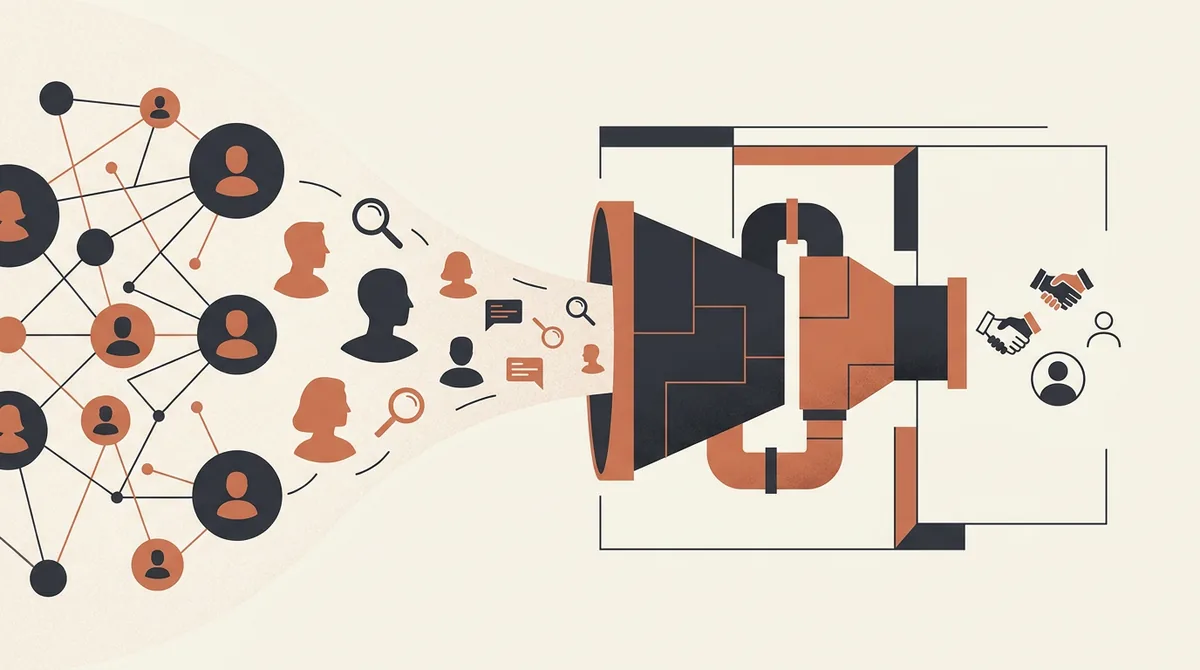
No sales pitch, just the method, the numbers and the boundaries. If you need the basics first, start with our guide to B2B lead generation. Here we go straight to the operational side.
What a lead generation agency does (and doesn't do)
A lead generation agency builds and runs the system that brings qualified contacts to your sales team. Not "traffic," not "likes," but contacts who can actually buy.
The confusion comes from the fact that very different things hide under the same label:
- Advertising agencies that launch Meta and Google campaigns and hand you the filled-out forms. That's it.
- Appointment-setting agencies that run LinkedIn and cold email outbound and put calls straight on your calendar.
- Inbound and SEO agencies that build demand over time through content and positioning.
- AI-native agencies that combine these channels into one automated system, with qualification and nurturing handled by AI agents.
A serious B2B lead generation agency doesn't sell you a channel, it builds you a predictable pipeline. And the difference is huge: it's the gap between "we got 40 leads this month" and "I know how many leads will come in next month and what they'll cost me."
There's one point that matters more than all the others. An agency doesn't close deals for you: it generates and qualifies, the sale stays yours (unless you delegate that too). Anyone promising you signed contracts is either cheating or simply buying lists.
How an AI lead generation agency works: our method
AI isn't a magic button, it's a lever. It's worth understanding where we actually use it and where a human head is still needed. For the full picture, dig into lead generation with AI.
1. Analysis and ICP (week 1)
Before spending a single euro we define the ideal customer profile: industry, size, decision-maker role, buying triggers. AI helps us build lists of target companies starting from real signals (hiring, tech stack, growth) rather than bought databases that end up in everyone's hands.
2. Message and offer (week 1-2)
The channel matters less than the message. We build the angle, the offer and the creative variants. AI generates dozens of copy and hook variants to test, we select and refine. This is where you win or lose, not in targeting.
3. System and automations (week 2-3)
We connect the pieces: landing page, form, CRM, follow-up sequences. Every lead enters an automated flow that warms them up until they're ready for sales. No contacts left to rot in an inbox. We've built over 140 automated systems on this exact logic.
4. Qualification with AI agents (ongoing)
This is where the leap over a traditional agency happens. An AI agent replies to leads in real time, asks them questions, filters them, and passes to the team only the ones that meet the criteria.
That way sales stops talking to the merely curious and starts talking to people with budget, need and timing. If you're not sure how to tell a ready contact from a cold one, read what makes a lead qualified.
5. Optimization on real data (ongoing)
Every week we look at the real numbers: cost per lead, qualification rate, appointment rate, closed deals. We cut what doesn't work and push what converts. Lead generation isn't a one-time launch, it's an engine you keep tuning.
Want to see what an AI lead generation system tailored to your industry would look like? Let's talk on a call: we'll tell you what's realistic to expect in your case, no smoke and mirrors.
What results to expect (and how long they take)
Here's the part no agency puts in writing. Results aren't linear and they don't all show up right away, because it depends heavily on the channel.
- Outbound and advertising (paid, cold email, LinkedIn): first leads in 2-4 weeks. It's the fast channel.
- Inbound and SEO (content, positioning): concrete results in 3-12 months. It's the channel that compounds over time and lowers cost per lead.
Not sure which one fits you? It depends on urgency and budget: here's the comparison between cold email and LinkedIn. An honest timeline, for a well-built system, looks something like this.
| Period | What happens |
|---|---|
| Week 1-2 | Setup: ICP, message, system. Zero leads, you're building. |
| Month 1 | First leads from the fast channels. Data still messy, tuning begins. |
| Month 2-3 | Stable volume, cost per lead dropping, first clear patterns. |
| Month 3-6 | Predictable system. Inbound starts contributing. |

Anyone promising "hundreds of leads in a few days" is either buying lists or inflating numbers with junk contacts. A lead who doesn't reply isn't a lead. To build quality volume over time, see strategies for generating qualified leads.
Across our projects average growth is 210%, with 370,000+ qualified leads generated. But the number to watch isn't how many leads come in, it's how many become customers. An agency that celebrates leads and ignores closed deals is optimizing the wrong metric.
How much a lead generation agency costs
There are three models on the market. None is "the best" in absolute terms, because it depends on how mature your funnel is.
Retainer (fixed monthly fee)
The most common one. For an SMB the 2026 market range is €1,500-5,000/month, on top of ad spend. Below €1,000/month you'll rarely get anything solid in B2B. The advantage is that the agency works on the system rather than the single lead, so it's predictable.
Performance-based (you pay for the result)
Sounds great, "I only pay if it works," but read the fine print. It really only holds up when the result is measurable and genuinely depends on the agency, like a qualified lead from a campaign. If the model pays for "appointment booked" but your sales team then fails to close, the problem just moves downstream and costs balloon. Always ask how the result you're paying for is defined.
Hybrid (lower fee + variable)
A lower base fee, plus a share of results. It aligns incentives better than the other two and is the fairest model when there's mutual trust.
On top of that add the costs nobody puts in the quote: tools (CRM, outreach software, tracking), initial setup, and your sales team's time to work the leads. Lead generation doesn't end when the contact comes in: that's where your job starts. For industry benchmarks see what a lead actually costs and how to frame the spend in our customer acquisition strategy guide.
Agency, freelancer or in-house team: how to choose
Not everyone needs an agency. Let's look at when each of the three options actually makes sense.
| Option | When it makes sense | Limit |
|---|---|---|
| Freelancer | A single channel, limited budget, you already know what you want | Limited coverage, you depend on one person |
| In-house team | High, continuous volumes, you want the know-how in-house | High fixed cost, months to hire and train |
| AI-native agency | You want a complete system, fast to launch, with no fixed structural costs | You need to pick the right one (see red flags below) |
The advantage of an external agency is immediate access to skills, technology and channels without maintaining an in-house department. What's specific to an AI-native agency is another thing entirely: automation handles the repetitive work, meaning qualification, follow-up and nurturing, at close to zero marginal cost. Something a human team can't sustain past a certain volume.
How to spot a serious agency: the red flags
The wrong choice burns months and budget. Here are the warning signs that should put you on alert:
- "Guaranteed results": nobody serious guarantees numbers in a market run by algorithms that keep changing. Whoever promises it is either lying or has a hidden clause.
- Blocks access to data: Google Analytics, Business Manager, CRM should stay yours and visible. If they won't give you access, you're not buying transparency.
- Zero verifiable references: case studies with no names or checkable numbers are worth nothing.
- The partners sell, the juniors deliver: whoever pitches you is often not who'll actually run the project. Ask who really works on your account.
- "Hundreds of leads in a few days": instant volume means bought lists, meaning contacts who don't reply.
- No clear pricing model: if they can't explain how and why they bill you, walk away.
The simplest test of all: a serious agency talks to you about qualification rate and closed deals, not just how many leads it generates. If the conversation only revolves around volume, they're selling you a vanity metric. Dig deeper in how to qualify leads without wasting time.
How we work at AstraLoop
We're an AI-native agency. We combine artificial intelligence and automation with lead generation and marketing. We don't "use AI" as a homepage slogan: we put it to work inside the system, where it creates real value.
In practice it works like this. We build the acquisition engine, AI agents qualify and warm up contacts, your team only receives leads ready to talk. You focus on selling, the system does the rest.
The numbers we bring to the table: 60+ companies and brands served, 370,000+ qualified leads generated, 140+ automated systems, €1.2M+ managed in ad spend, 210% average growth and 4.9/5 satisfaction. These aren't promises, they're measured results.
No magic formula, no "guaranteed result." A system we build together, tuned to your industry, with the data in front of you every week.
Frequently asked questions
How much does a lead generation agency cost in Italy?
The most common model is a monthly retainer: for an SMB the 2026 range is €1,500-5,000/month, plus ad spend. Below €1,000/month it's hard to get solid results in B2B. Performance-based and hybrid models also exist, on top of tool and setup costs that often don't make it into the quote.
How long does it take for a lead generation agency to deliver results?
It depends on the channel. With outbound and advertising (paid, cold email, LinkedIn) first leads arrive in 2-4 weeks. With inbound and SEO you need 3-12 months, but cost per lead drops over time. A predictable, stable system is usually reached between month three and month six.
What changes with a lead generation agency that uses AI?
AI automates the repetitive work: list building, copy variants, contact qualification and follow-up. AI agents reply to leads in real time and filter out only the ready ones, so the sales team only talks to people with real budget and need. The advantage is scaling qualification at near-zero marginal cost, something impossible for an all-human team.
Can a lead generation agency guarantee results?
No, and be wary of anyone who promises it. Nobody serious guarantees numbers in a market run by algorithms that keep changing. Performance-based models can make sense, but only when the result you pay for is measurable and genuinely depends on the agency. Always ask how the result is defined before signing.
Is an agency, a freelancer or an in-house team better for lead generation?
A freelancer makes sense for a single channel and limited budget. An in-house team pays off with high, continuous volumes, but comes with high fixed costs and months of training. An AI-native agency gives immediate access to skills, technology and multiple channels without maintaining an in-house structure: it's the fastest option to launch for a complete system.
If you want to stop chasing cold leads and build a predictable pipeline, tell us your goal. Write to us at astraloopstudio@gmail.com and let's see together if we can really help you.