The Lead Generation Funnel: Stages and the Numbers That Matter
9 min read · AstraLoop Studio
You've had the lead generation funnel explained a thousand times: a funnel shape, lots of people at the top, few customers at the bottom. TOFU, MOFU, BOFU. Awareness, consideration, decision. Anyone can get this far.
The problem is that almost everyone stops there. They describe the shape of the funnel and then leave you on your own, without telling you the one thing that actually matters: how many people need to go in at the top for one paying customer to come out at the bottom.
This article covers both halves. First the stages, explained properly. Then the numbers: real conversion rates, KPIs per stage, and the reverse calculation that tells you how many leads you need to hit your revenue target. A funnel without numbers, at the end of the day, is just a drawing.
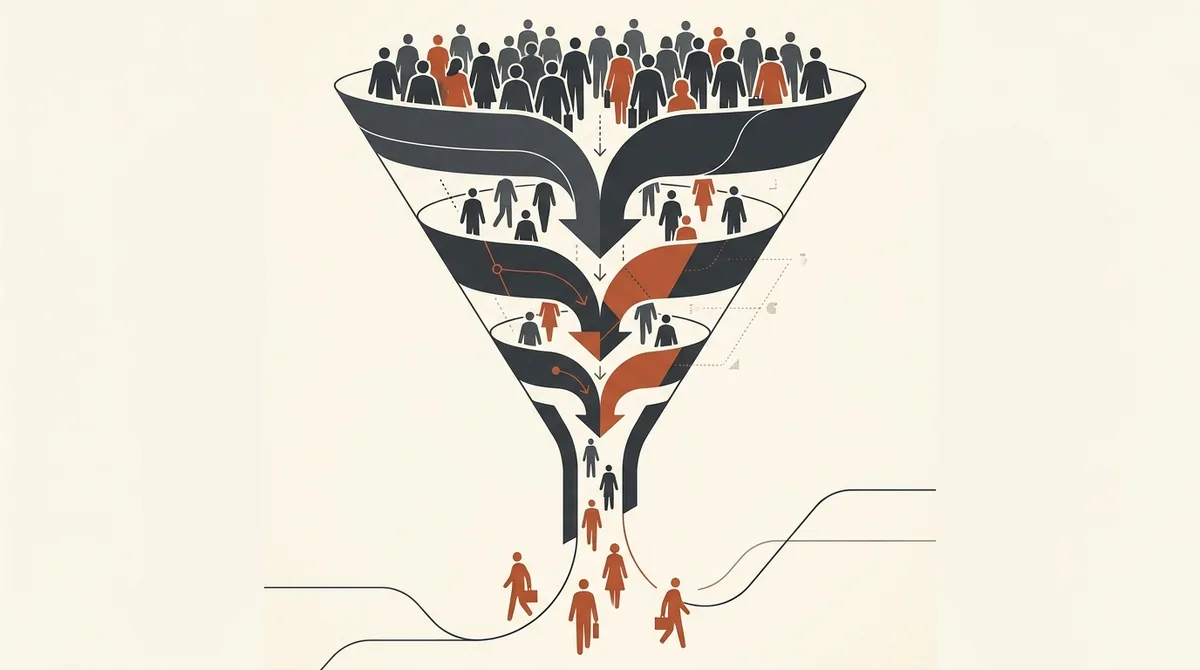
What a lead generation funnel actually is (no fluff)
A lead generation funnel is the path a person takes from stranger to customer. It's called a funnel because many people go in at the top and only a minority come out at the bottom. Obvious enough. The interesting part isn't the shape, it's the drop-off rate between one level and the next.
Every step loses people. People who visit but don't leave their details. People who leave their details but don't reply. People who reply but don't buy. The funnel exists to measure where you're losing people, how much you're losing, and how much each survivor costs you.
That holds whether you sell B2B software or gym memberships: the stage names change, the logic doesn't. A car dealership measures test drives that turn into quotes, an e-commerce store measures carts that turn into orders, a real estate agency measures viewing requests that turn into offers. If you're not measuring this, you don't have a funnel. You have wishful thinking with a nice graphic on top. If you want to start from the basics of the concept, we wrote a dedicated guide on what lead generation is and how it works.
The stages of the funnel: TOFU, MOFU, BOFU
The most common model splits the funnel into three blocks. Not because it's magic, but because each block corresponds to different content, different goals, and above all, different metrics.
TOFU, Top of the Funnel (awareness)
The wide part. Here the person doesn't know you and may not even know they have the problem you solve. Your job isn't to sell, it's to be found and to be useful.
Tools: SEO articles, videos, social posts, cold ads, guides. Content that informs without feeling like a pitch. For a gym it's the home-workout reel, for a car dealership it's the comparison video between two models. In TOFU you don't ask for a signature on a contract. You just ask for attention.
MOFU, Middle of the Funnel (consideration)
Here the person has realized they have a problem and is weighing up how to solve it. It's the most delicate stage, the one where you win or lose. Your job is to prove competence and capture the contact.
Tools: lead magnets (ebooks, checklists, calculators), webinars, case studies, nurture emails. A real estate agency offers a free property valuation, an e-commerce store offers a discount in exchange for signing up, a gym offers a free week's trial. This is where the anonymous visitor becomes a qualified lead, or stays a name on a list that will never open your email.
BOFU, Bottom of the Funnel (decision)
The narrow part. The person is ready to decide and is choosing between you and someone else. Here you need demos, quotes, trials, sales calls, testimonials. The test drive, the site visit, the cart with free shipping. A weak offer at this stage burns all the work done before it.
Rule of thumb: in TOFU you talk to everyone, in MOFU you talk to whoever has a problem, in BOFU you talk to whoever has already decided to solve it and just needs to choose who with.
The numbers that matter: conversion rates per stage
Here's the part other articles skip. A funnel isn't judged "by feel", it's judged by counting how many people move from one level to the next. These are realistic B2B benchmarks. They vary by industry, offer, and traffic quality, but they give you the right order of magnitude.
| Funnel step | Typical conversion rate (B2B) |
|---|---|
| Visitor → Lead (contact) | 1-3% |
| Lead → MQL (marketing-qualified lead) | 20-40% |
| MQL → SQL (sales-ready lead) | 15-35% |
| SQL → Opportunity (open deal) | 30-50% |
| Opportunity → Customer (closed) | 20-35% |
Run the math end-to-end and you find an uncomfortable truth: out of 1,000 visitors, roughly 2-4 become customers. That's not pessimism, it's arithmetic. In B2C the volumes are higher and the rates shift (a well-optimized e-commerce store converts 1-3% of visitors into orders), but the funnel logic stays identical. Anyone who tells you "just drive more traffic" has never looked at a real funnel.
The critical point is almost always the same: the MQL → SQL step. It's the bottleneck where marketing says "I've handed you the leads" and sales replies "yes, but they're cold". Improve that one step by a few points and you move revenue more than any new campaign added at the top.
The reverse calculation: start from revenue, not from traffic
This is the only serious way to design a funnel, and none of the top Google results explain it. You don't start from visitors. You start from the customers you need and work backwards.
Concrete example. You want 10 new customers a month. Average contract value: €3,000. Target: €30,000 in new monthly revenue. Apply the table's rates in reverse:
- You need 10 customers at the bottom.
- With opportunity → customer at 30%, you need about 33 opportunities.
- With SQL → opportunity at 40%, you need about 83 SQLs.
- With MQL → SQL at 25%, you need about 330 MQLs.
- With lead → MQL at 30%, you need about 1,100 leads.
- With visitor → lead at 2%, you need about 55,000 qualified visitors.
Now the funnel isn't a drawing anymore. It's a plan. You know how much traffic to generate, how many contacts to collect, and, cross-referencing it with the cost per lead for your industry, how much budget you need to get there. And you also know something more useful: if you're short on customers, you know exactly at which level the funnel is broken.
The same framework works for a car dealership starting from the cars it needs to sell, or a gym starting from the monthly memberships it needs to close. Change one number and the whole pyramid gets redrawn. Raise the average contract value and you need fewer leads. Improve qualification and you need less traffic. That's why working on conversion rates almost always beats "let's just buy more traffic".
Want to know how many leads you actually need to hit your revenue target, and at which stage your funnel is losing customers? Let's run the numbers together.
The mistake that makes any funnel pointless
Counting leads instead of qualified leads. It's the number one mistake, and we see it everywhere.
A funnel that spits out 1,000 contacts a month looks like a win. But if they're emails collected through a giveaway, résumés, students, and the curious, you've filled your CRM with dead weight. Sales runs into it, wastes time, gets demotivated. The MQL → SQL rate collapses and nobody understands why. It's true for B2B just as it is for the gym that collects 500 contacts at an event and finds out nobody lives within twenty miles.
A lead who can't or won't buy isn't a lead. It's noise. Better 100 contacts with 30 well-profiled than 1,000 with 20. Quality at the top of the funnel decides everything that happens below it. If you want the step-by-step method, we cover it in how to qualify leads without wasting time.
The KPIs to watch, stage by stage
- TOFU: qualified traffic, cost per visitor, visitor → lead rate.
- MOFU: lead magnet opt-in rate, lead → MQL rate, nurture email open rate.
- BOFU: SQL → opportunity rate, close rate, sales cycle length.
- Cross-cutting: cost per lead (CPL), customer acquisition cost (CAC), return on ad spend (ROAS).
If you only measure the final customer count, you're flying blind. You only notice something's off at the end of the month, when it's too late. Stage-by-stage KPIs tell you where to step in while you can still do something about it.

Where AI genuinely changes the rules of the funnel
Automation in the funnel isn't new: drip emails and lead scoring have been around for years. The difference with AI is that today you can work on the points where you used to stop for lack of time and people.
- Automatic qualification: agents that read every incoming lead, enrich it, and classify it, so sales only receives contacts that are ready. Hits the MQL → SQL bottleneck head-on.
- Instant follow-up: replying within minutes multiplies conversion odds. An agent doesn't sleep and doesn't go on vacation. A request that comes in at 11pm on a used-car site gets an answer right away, not on Monday morning.
- Personalized nurturing: messages tailored to each contact's behavior, not the same newsletter for everyone.
Our approach at AstraLoop starts exactly here: we combine AI and automation with lead generation, so the funnel doesn't just collect contacts, it qualifies them and moves them forward on its own. It's the method we used to generate over 370,000 qualified leads and build more than 140 automated systems for over 60 companies. If you want to see how it works in practice, read how AI-driven lead generation works or how we put AI agents to work in lead generation.
How to build a funnel that holds up under the numbers
Let's put it all together. A lead generation funnel that works isn't born from content: it's born from numbers, and the content comes after.
- Start from your revenue target and work backwards to calculate how many customers, opportunities, SQLs, MQLs, leads, and visitors you need.
- Define what a qualified lead is for you, before collecting a single contact.
- Build an offer for each stage: useful content at the top, a lead magnet in the middle, a trial or demo at the bottom.
- Measure every step with the right KPIs and find the bottleneck.
- Optimize the weakest step before adding new traffic.
- Automate qualification and follow-up so you don't lose leads you've already paid for.
That's the funnel, in full, with the numbers everyone else leaves out. If you want the full picture of B2B customer acquisition, you'll find the general map in our guide to B2B lead generation and practical tactics in how to generate qualified leads. And if you'd rather skip the theory and see who builds it for you, here's how an AI lead generation agency works.
Frequently asked questions
What are the stages of the lead generation funnel?
The three main stages are TOFU (Top of the Funnel, awareness), MOFU (Middle of the Funnel, consideration), and BOFU (Bottom of the Funnel, decision). Each has its own content, goals, and metrics: in TOFU you attract, in MOFU you turn the contact into a qualified lead, in BOFU you close the sale.
What's a good conversion rate for a lead generation funnel?
In B2B the typical benchmarks are: visitor to lead 1-3%, lead to MQL 20-40%, MQL to SQL 15-35%, SQL to opportunity 30-50%, opportunity to customer 20-35%. End-to-end, out of 1,000 visitors you get on average 2-4 customers. Values vary by industry and traffic quality.
How do I calculate how many leads I need to hit my revenue target?
You calculate it backwards. Start from the number of customers you need, divide by the close rate to get the opportunities, then work your way back stage by stage to visitors, applying the conversion rate at each step. That way you know exactly how much traffic and how many contacts to generate.
What's the most common mistake in a lead generation funnel?
Counting leads instead of qualified leads. A funnel that generates 1,000 unqualified contacts is worth less than one that generates 100 well-profiled ones: sales wastes time, the MQL to SQL rate collapses, and the cost of acquisition rises. Quality at the top of the funnel decides everything else.
Does AI actually help in the lead generation funnel?
Yes, where it hits the real bottlenecks: automatic qualification of incoming leads, instant follow-up within minutes, and personalized nurturing based on each contact's behavior. It's the point where traditional automation used to stop for lack of time and resources.
If your funnel collects contacts but doesn't turn them into customers, the problem is almost always at one specific step. Write to us and we'll find it: we build lead generation funnels with AI and automation that deliver numbers, not just charts.