AI Automation for Ecommerce: Chatbots, Cart Recovery, and Support
9 min read · AstraLoop Studio
If you run an ecommerce store, you already know where you're losing money every day: abandoned carts nobody recovers, pre-sale questions that go unanswered in the evenings and on weekends, repetitive tickets (where's my order, how do I return this) that eat up hours of support time. AI automation for ecommerce isn't about "adding AI" because it's trendy. It's about closing these gaps with processes that keep working while you sleep.
In this guide we look at the three areas where AI delivers measurable results for an ecommerce store (a chatbot that sells, cart recovery, and WhatsApp support), with realistic numbers, costs, and the traps to avoid. It's one piece of our broader work on AI automation for business processes: here we go deep into the ecommerce vertical.
An honest premise: not everything should be automated, and not everything labeled "AI" actually is. A rule-based chatbot is not an intelligent agent. Telling the two apart saves you money and embarrassing moments with customers.
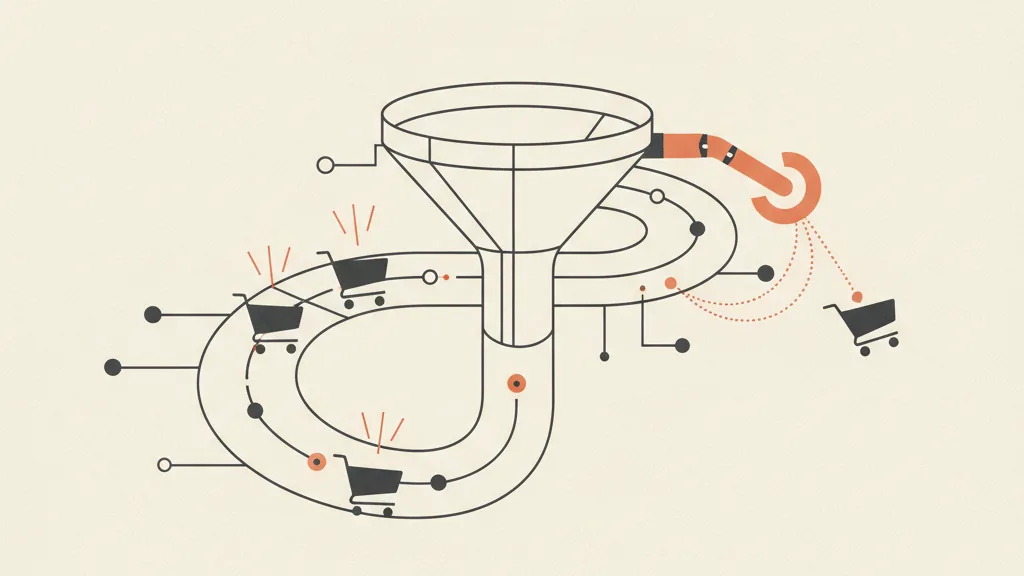
The three places where AI automation moves the numbers
Before we talk about tools, let's be clear on where to focus. For an average ecommerce store, the biggest impact comes from three levers, in this order of return:
- Abandoned cart recovery: this has the fastest ROI, because you're recovering sales that were already nearly closed.
- Conversational pre- and post-sale support (especially on WhatsApp): it lightens the load on your support team and unblocks purchases stalled by a single doubt.
- Sales chatbot on the site: it guides shoppers who don't know what to choose and lowers the bounce rate on product pages.
None of these replace your team: they lighten it of repetitive tasks and capture the opportunities you're currently missing for lack of time. If you want a full map of use cases for your industry, we've gathered the vertical scenarios in our article on AI for ecommerce and its use cases.
Abandoned cart recovery with AI
On average, between 65% and 75% of carts are abandoned. That's an estimate from international benchmarks (the Baymard Institute puts it around 70%), so check your own real number in analytics before running the math. Even recovering a modest slice of that moves revenue.
What AI changes compared to the classic automated email
The email recovery sequence has been around for years and it still works. The difference AI makes plays out on three fronts:
- Message personalization: instead of the usual "you forgot something," the copy adapts to the product in the cart, the price range, and the customer's history (first-time buyer or returning customer).
- The right channel at the right moment: email for the first touch, WhatsApp for the second if the customer has opted in. WhatsApp open rates top 90%, versus 20-30% for email. We cover this comparison in depth here: WhatsApp vs SMS marketing.
- Conversational replies: if the customer responds ("too expensive," "not sure about the size"), an AI agent handles the objection instead of letting the conversation drop.
A sequence template that converts
| Moment | Channel | Content |
|---|---|---|
| +1 hour | Simple reminder, product photo, direct link to checkout | |
| +24 hours | WhatsApp (if opted in) | Short message, limited availability or product reviews |
| +48 hours | Email or WhatsApp | Incentive (free shipping or a small discount) as a last lever |
Be careful not to burn your margin: the discount should only be used on the last touch, not on every cart, or you'll teach customers to abandon on purpose and wait for the coupon. AI helps here too, deciding who gets the incentive: customers who'd likely buy anyway don't get one.
WhatsApp support: where Italian ecommerce has the most room to grow
In Italy, WhatsApp is the dominant messaging channel, and Meta has pushed hard on conversational automation for business (with the Meta Business Agent launched in 2026, reported cases show double-digit increases in conversions). For an ecommerce store, this means being able to handle, on a single channel your customers already know:
- pre-sale questions (sizes, materials, delivery times, compatibility);
- order tracking ("where's my package?"), with the agent querying the courier in real time;
- returns and exchanges, guiding the customer step by step;
- proactive notifications (order shipped, out for delivery, review request).
The key is that an AI agent doesn't just answer: it takes action. It reads the order status from your back office, opens a return ticket, updates the CRM. It's the leap from a chatbot that "talks" to an agent that "does." If you want to fully understand the difference (it matters a lot for the outcome), start with chatbot vs. AI agent: the difference.
The consent and privacy issue
WhatsApp Business has strict rules: promotional messages require the customer's explicit consent (opt-in), and outside the 24-hour window from the last interaction you can only send templates approved by Meta. For cart recovery and marketing communications, then, you need to collect consent in a way that complies with GDPR (EU Regulation 2016/679) at checkout or sign-up. It's not a bureaucratic detail: sending without opt-in exposes you to reports and to your number getting blocked. You'll find the full mechanics in our guide to WhatsApp Business automation with AI.
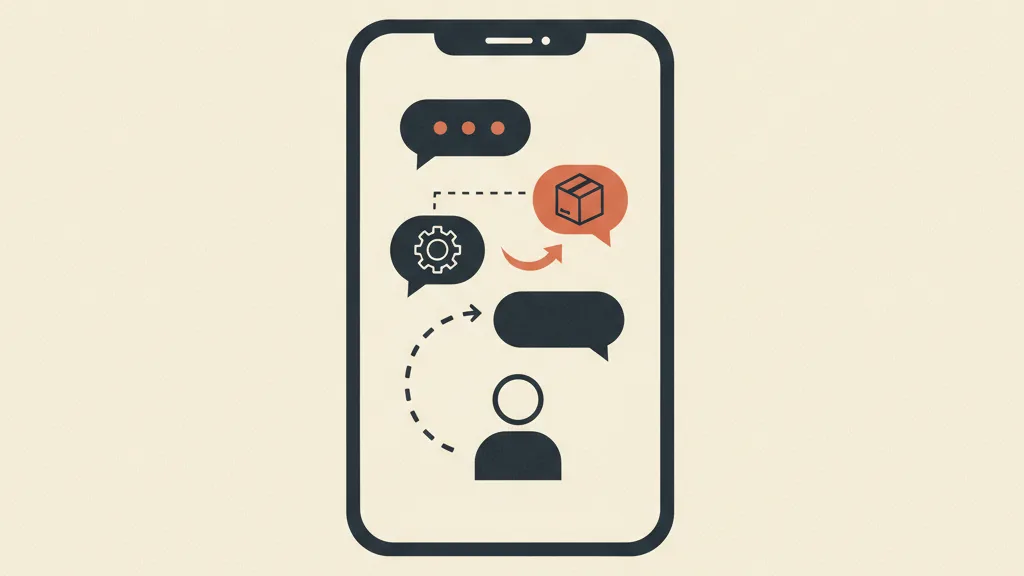
AI chatbot on your site: a sales assistant, not FAQ in disguise
The website chatbot has a bad reputation, and it earned it: for years these were rigid decision trees that just bounced the user to an FAQ page. A modern AI chatbot, built on an up-to-date knowledge base (a RAG approach, which pulls answers from your real data instead of making them up), does something different: it understands the question in natural language and guides the shopper to the right product.
Concrete examples of what it solves:
- "I'm looking for a gift for my mom around 50 euros" and it suggests 2-3 relevant products with a direct link;
- "Is this jacket good for the mountains?" and it answers based on the spec sheet and reviews;
- "What's the difference between model X and Y?" and it gives an instant comparison, so the shopper doesn't leave the site to look elsewhere.
For this to work, you need two things: a clean, up-to-date knowledge base (product sheets, policies, FAQs) and safety rules that stop the AI from promising discounts or availability that don't exist. We go into how to build that knowledge base in our article on building a company knowledge base with RAG. If you want to compare ready-made solutions, our overview of the best AI chatbots for businesses is a useful starting point.
When to hand off to a human
A good system also knows when to give up. Handoff to a human agent should be built in for complex cases, angry customers, and high-value requests. An agent that keeps trying to answer when it doesn't understand does more damage than a busy signal. The rule is simple: automate the repetitive 80%, leave the 20% that requires judgment to a human.
Want to know which automation would bring the biggest results to your ecommerce store without wasting budget? Request a free analysis: we start with the process that's costing you the most right now.
How much it costs and how to choose: ready-made SaaS or a custom build
Now for the question that really matters: buy an off-the-shelf tool or have a custom system built? The honest answer depends on your volume and how complex your processes are.
| Option | Approximate cost | When it makes sense |
|---|---|---|
| Ready-made SaaS (subscription chatbot/cart recovery) | About 30 to 200 EUR/month | Low volumes, standard processes, you want to launch fast |
| No-code automation on n8n/Make | One-off setup plus low hosting cost | You want to connect multiple systems (back office, CRM, courier) and keep control of your data |
| Custom AI agent | From a few thousand to tens of thousands of EUR | High volumes, proprietary logic, deep integrations |
Our practical advice: start with the most expensive problem (usually cart recovery), measure the return on that, then expand. Don't buy the priciest platform on day one. Many ecommerce stores solve 80% of it with no-code tools like n8n, which lets you self-host (useful for keeping data in-house for GDPR purposes) and is a great alternative to Zapier once volumes grow. To frame the AI-side costs, you can also check how much an AI chatbot costs.
The ROI math, made simple
Before signing any contract, run your own numbers. Example with real figures from an average ecommerce store:
- 200 abandoned carts a month, average value 60 EUR;
- you recover 10% with the AI sequence, meaning 20 orders, meaning 1,200 EUR/month;
- tool cost: 100 EUR/month.
The return is clear from month one, and that's before even counting the support hours saved. To set up the right metrics, see our guide on how to measure AI ROI. The bottom line: if you can't estimate the return, you're not ready to automate that process.
AI Act and transparency: what you need to know
A chatbot or voice agent talking to your customers must disclose that it's an AI. That's required by the AI Act (EU Regulation 2024/1689), whose transparency obligations for conversational systems are phasing in over time. In practice, for an ecommerce store, this means one simple thing: make it clear to the user they're talking to an automated assistant, don't pretend it's a human agent. It's also a matter of trust, not just law. For an operational checklist sized for SMEs, see the AI Act 2026 and SME obligations. This is informational: for the contractual side with your LLM provider (DPA, data processing), it's worth talking to your advisor.
Where to actually start
If we had to set a priority order for someone starting from scratch:
- Weeks 1-2: turn on a cart-recovery sequence (email plus opted-in WhatsApp). It's the fastest return.
- Months 1-2: put post-sale support on WhatsApp (tracking, returns, order FAQs). It immediately lightens your support load.
- Months 2-3: add the sales chatbot to your site, with a curated knowledge base and human handoff.
You don't need to do it all at once. Automate one process, measure it, stabilize it, then move to the next. It's the same approach we recommend for deciding what to automate in your business: start with the point that's losing you the most money, and expand from there.
AI automation for ecommerce isn't magic, but it's not an expense to put off either: it's a concrete way to recover sales you're currently leaving on the table and to give customers answers when they're looking for them, even at 11pm on a Saturday. The difference between a project that delivers ROI and one that becomes an expensive toy comes down entirely to starting with the right problem and measuring it.
Frequently asked questions
Does AI automation for ecommerce replace my customer service?
No. It automates repetitive requests (order tracking, FAQs, returns), which make up about 80% of the volume, and frees your team for complex cases and customers who need human judgment. A good system always includes handoff to a human agent when needed.
How much does it cost to start with AI cart recovery?
Ready-made SaaS solutions start at around 30-100 EUR a month. With an average cart value of 60 EUR and a 10% recovery rate on 200 abandoned carts, the return exceeds the cost within the first month. It's always worth running the numbers on your own data before choosing.
Can I send cart-recovery messages on WhatsApp without legal issues?
Only with the customer's explicit consent (opt-in), collected in a GDPR-compliant way at checkout or sign-up. Outside the 24-hour window from the last interaction, WhatsApp only allows templates approved by Meta. Without opt-in you risk reports and having your number blocked.
What's the difference between a chatbot and an AI agent for ecommerce?
A classic chatbot replies with pre-set text or decision trees. An AI agent understands natural language and takes action: it reads an order's status from the back office, opens a return, updates the CRM. It's the shift from AI that talks to AI that actually does things.
Do I have to tell customers they're talking to an AI?
Yes. The AI Act (EU Regulation 2024/1689) sets transparency requirements for conversational systems: the user must know they're interacting with an automated assistant. Beyond being a regulatory requirement, transparency builds customer trust.
Is a ready-made tool or a custom system better?
It depends on your volume. For most ecommerce stores it's best to start with ready-made SaaS or no-code automation (like n8n), measure the return, and only consider a custom agent if high volumes and proprietary logic justify it. Don't buy the priciest solution on day one.
If you want to set up cart recovery, WhatsApp support, or a chatbot that actually sells, let's talk: we'll help you decide what to automate first and how to measure the return.