Custom CRM for marketing agencies: leads, clients, and projects in one system
9 min read · AstraLoop Studio
A marketing agency has a problem almost no off-the-shelf software solves well: it has to manage three different things inside the same system. The new-business pipeline (your sales funnel), active clients with their retainers, and projects in production, with deadlines, hours, and deliverables. A classic CRM covers the first part well and leaves you stranded on the other two. A project management tool does the opposite. So you end up with HubSpot for deals, Asana or Trello for projects, a spreadsheet for time tracking, and another spreadsheet for the reports you send clients. Four systems that don't talk to each other, and every Monday morning someone copy-pasting data from one to the next.
A custom CRM solves exactly this. One single environment where the lead becomes a client, the client becomes a project, and the project automatically generates the reporting. In this article we look at what a CRM built for an agency actually needs to do, who builds these properly in Italy, and when it's worth it over stitching together standard tools.
Why agencies suffer more than other SMBs
The underlying problem is that an agency lives in two worlds at once. On one side it's a sales organization that needs to bring in clients consistently: it has a funnel, open deals, proposals to chase. On the other it's a service business delivering work: projects, billable hours, allocated teams, deadlines. The vast majority of software is built for only one of those two worlds.
You already know the result if you run an agency:
- The handoff from sales to delivery is a black hole. The deal closes in HubSpot, but the project manager finds out about the new project from a Slack message. The brief, the approved budget, and the contract terms stay buried in an email, not in the system.
- Per-client margin is invisible. You know what a client bills you. You don't know how many hours you've actually spent, so you don't know whether that €2,500-a-month retainer is making you money or eating your margin. You find out the real profitability at year-end, when it's already too late.
- Client reporting is manual work every single month. Hours spent pulling numbers from ads, from the CRM, from analytics tools, pasting them into a slide, and sending it off. Non-billable time that eats into margin.
- Nobody knows the team's real capacity. You take on a new client without knowing if you have the hours to deliver, because allocation lives in the PM's head instead of in a system.
Every single problem above comes from the same flaw: the data is scattered across different tools. And since an agency works bespoke for its own clients, a pre-packaged standard workflow rarely fits. It's the classic case where a CRM built around the company's real process pays for itself, instead of forcing you to bend your work around the software.
The three pipelines an agency CRM has to manage
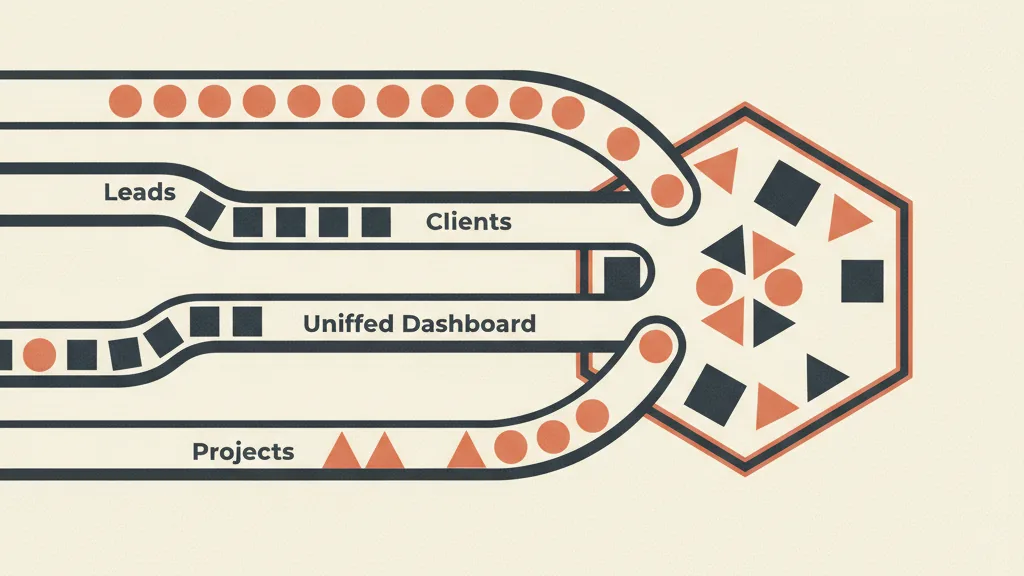
The difference between a generic CRM and one built for agencies is that the latter models three distinct but connected flows, not just the sales pipeline.
1. New-client pipeline (the sales funnel)
This is the part every CRM knows how to do: inbound leads, deal stages (first contact, discovery call, proposal sent, negotiation, closed). The difference for an agency is that leads arrive through very different channels (referrals, LinkedIn, ads, content) and need proper qualification before you burn a call on them. What you need here is a funnel that feeds the CRM cleanly, not a contact form that fills the list with curious browsers. If you can immediately tell an MQL from an SQL, sales only works the people who are ready to buy and doesn't waste time.
2. Active-client pipeline (retainers and accounts)
Once the deal closes, the contact doesn't disappear: it becomes an active client with a contract, a monthly fee or a block of hours, a point of contact, a renewal date. This is the pipeline generic CRMs ignore. A custom agency CRM tracks contract renewal dates (so you don't lose one to a forgotten deadline), possible upsells, and account health (a client who opens few tickets and pays late is a churn risk). The value here is huge, because keeping a client costs a fraction of acquiring a new one.
3. Project pipeline (delivery)
This is where agencies lose margin. Every active client generates projects: a campaign, a website, a content plan, a funnel. Every project has tasks, deadlines, allocated people, estimated hours against actual hours. Connecting the project pipeline to the CRM means that, opening a client's record, you see in one glance how much they bill, which projects are open, how many hours are left in the hour bank, and whether you're behind. No standard tool gives you this unified view without fragile integrations.
Reporting: where a custom CRM pays for itself
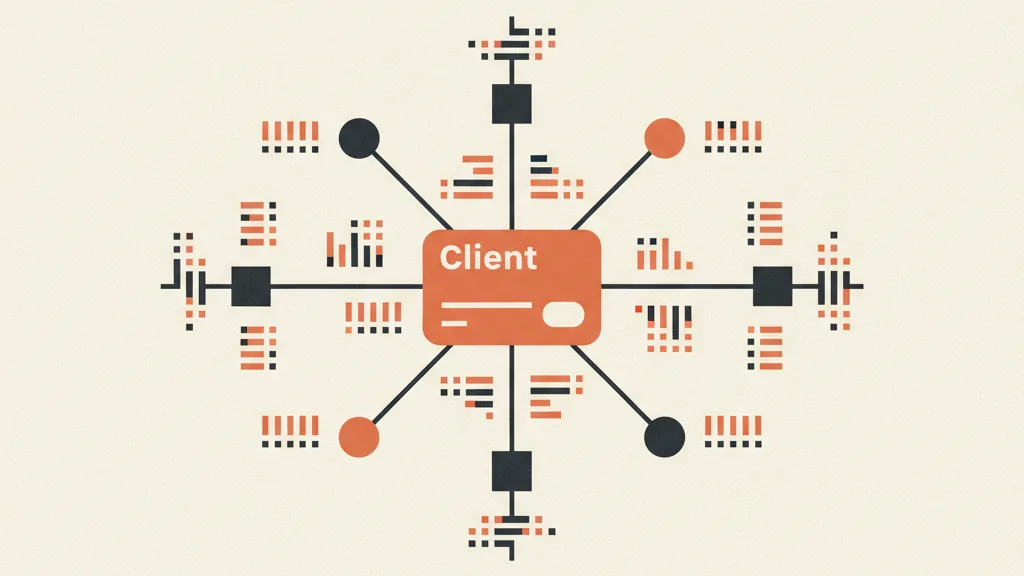
If you had to pick the one feature that alone justifies a custom CRM for an agency, it would be automatic reporting. There are two kinds of reports you probably still build by hand today, and a well-built system generates them on its own.
Client reports. Every month you need to show what you did and what results it drove. Today that means pulling data from Google Ads, Meta, analytics, the CRM, pasting it into a template and commenting on it. A custom CRM can aggregate that data (via the ad platforms' APIs) and produce the already-formatted report, leaving you only the strategic commentary. From half a day down to twenty minutes.
Internal reports. These tell you whether the agency is actually healthy: per-client margin, billable hours against total hours, sales pipeline value, proposal win rate, revenue forecast. These are the numbers that tell you whether to hire, raise prices, or drop a client that's losing you money. In a fragmented system these numbers simply don't exist, or take hours to reconstruct. In a custom CRM they're an always-up-to-date dashboard. It's the same principle as client acquisition unit economics: without CAC, LTV, and per-client margin under control, you're flying blind.
This is also why automation matters more here than elsewhere. A good agency CRM isn't just a records system: it's connected to AI-driven process automation for sales follow-up, renewal reminders, alerts when a project runs over hours, and drafting report copy. The system works while you deliver.
Want to know whether your agency actually needs a custom CRM, or whether configuring the tools you already have would be enough? Tell us about your process: we'll give you a free, honest assessment.
Who builds custom CRMs for agencies in Italy
The custom CRM market in Italy is less crowded than the generic SaaS market, and that's an advantage: there's less noise and the serious players stand out. On the specific agency segment, the real contenders are few.
| Who | Approach | Best for |
|---|---|---|
| NetStrategy | An inbound and web agency with a division dedicated to building custom CRM solutions, often with an integrated marketing-and-sales lens. Strategic approach: process first, then software. | Agencies that want a partner who can think through the funnel and the strategy, not just write code. |
| crmpersonalizzato.it | A player focused specifically on custom CRM development, positioned entirely around bespoke work (not a SaaS in disguise). A vertical software-house approach to CRM. | Agencies that already know exactly what they want from the system and need someone to build it to match the process. |
| AstraLoop Studio | Custom CRM development integrated with the acquisition funnel and AI automation: sales pipeline, delivery, and reporting in one system, with AI agents handling follow-up and qualification. | Agencies that want to unify acquisition, client management, and projects, with real automation on top. |
The selection criterion isn't "who costs less." It's whoever understands that an agency isn't a shop: whoever asks you the right questions about the sales-to-delivery handoff, per-client margin, and reporting is thinking like a partner. Whoever just shows you a feature catalog is selling you software. If you want to get your bearings before talking to anyone, the guide on custom vs. standard CRM will help you figure out where you stand.
What it costs and how long it takes
These numbers are meant as a benchmark, not a quote (it depends on real complexity). To give you an order of magnitude for the Italian market:
- Custom CRM for a small or mid-size agency (sales pipeline, client management, basic projects, reporting): typically starts at a few thousand euros and scales up with integrations. The guide on custom CRM costs breaks down the line items in detail.
- Integrations with ad platforms and analytics for automatic reporting: this is the piece that raises the value, but also the complexity, since it means working against each platform's API.
- Build time: a first usable module within a few weeks, the full system within a few months. Better to start with the core (the three pipelines) and add advanced reporting in a second phase, rather than waiting months for the "perfect system." More detail in how long it takes to implement a CRM.
The right question isn't "how much does it cost," it's "how much does it cost me not to have it." If two people spend half a day every month manually building reports and copying data between systems, that non-billable time has a price. Add it up over twelve months and compare it to the one-time build cost: the math often pays back in under a year.
Custom or generic SaaS: when each one makes sense
Custom isn't always the answer. If you're a micro-agency with three clients and processes still in flux, a well-configured SaaS can be enough, and the choice between a custom CRM and SaaS should be made with a clear head. Custom is worth it when at least one of these conditions holds:
- You have a process of your own, recognizable, that's part of your value, and bending it to fit standard software would water it down.
- You're already paying for several disconnected SaaS licenses, and the combined subscriptions plus the manual reconciling time exceed the cost of one unified system.
- Per-client margin and reporting are things you genuinely need to make decisions, and you don't have them today.
- You want AI working on your own data (lead qualification, follow-up, alerts), which is hard when the data is scattered across five tools.
If you recognize yourself in at least two of these, custom stops being a luxury and becomes the economically sound choice. The full breakdown on build vs. buy between a custom CRM and off-the-shelf software gives you the framework to decide without being swayed by enthusiasm or sticker shock.
Where to actually start
Don't start from the software. Start from the process. Take a sheet of paper and map out the real journey of a client through your agency: where the lead comes from, who qualifies it, how it turns into a project, who delivers it, how you report on it. That map is the spec for your CRM. Then look for whoever knows how to translate it into a system, not whoever shows you a demo packed with features you'll never use. The right system is the one that makes the handoff between selling and delivering invisible, and hands you the numbers to decide every month. Everything else is a nice-to-have.
Frequently asked questions
Isn't a standard CRM like HubSpot enough for an agency?
It covers the sales pipeline well, but leaves project management, billable hours, and per-client margin uncovered. Agencies end up bolting on a project tool and spreadsheets. A custom CRM unifies sales, delivery, and reporting into one system.
How much does a custom CRM cost for a marketing agency?
For a small or mid-size agency, it typically starts at a few thousand euros, and the cost rises with integrations (ads, analytics, automatic reporting). Weigh it against the non-billable time you currently spend reconciling data across tools: the payback is often under a year.
What does an agency-specific CRM do that a generic one doesn't?
It manages three connected pipelines: new clients (the funnel), active clients with retainers and renewals, and projects with hours and deadlines. On top of that, it generates both client-facing and internal reporting (margin, team capacity) automatically, not by hand.
How long does it take to have a working CRM?
A first usable module within a few weeks, the full system within a few months. It's best to start with the core (the three pipelines) and add advanced reporting and integrations in a second phase, rather than waiting months for the perfect system.
Who builds custom CRMs for agencies in Italy?
On this specific segment the serious contenders are few: players like NetStrategy (a strategic marketing-and-CRM approach) and crmpersonalizzato.it (a vertical focus on custom builds), alongside those who integrate the CRM with funnel and AI automation, like AstraLoop Studio.
Is custom worth it, or is a well-configured SaaS enough?
SaaS can be enough for a micro-agency with fluid processes. Custom is worth it if you have a recognizable process of your own, you're already paying for several disconnected licenses, you need per-client margin to make decisions, or you want AI working on your own unified data.
If you want a CRM that brings client pipeline, projects, and reporting together in one system, let's talk: we start from your real process and put together a quote built around it.