AI Receptionist vs. Human Secretary vs. Answering Service: What's Actually Worth It?
9 min read · AstraLoop Studio
Who answers when the phone rings at your business? Today you have three real options: a human secretary (in-house or outsourced), a classic answering service (the recorded message with the beep), or an AI receptionist, a voice assistant that talks, understands, and books appointments on its own. These are three profoundly different things, with costs ranging from a few dozen to a few thousand euros a month, and service levels worlds apart.
The problem is that most comparisons you find online are one-sided: either they sell you AI as a miracle fix, or they defend the human touch to the death. Here we run an honest comparison, with real numbers and the actual limits of each option. The goal is to help you figure out what pays off for your business, whether you run a dental practice, a restaurant, a repair shop, or an agency.
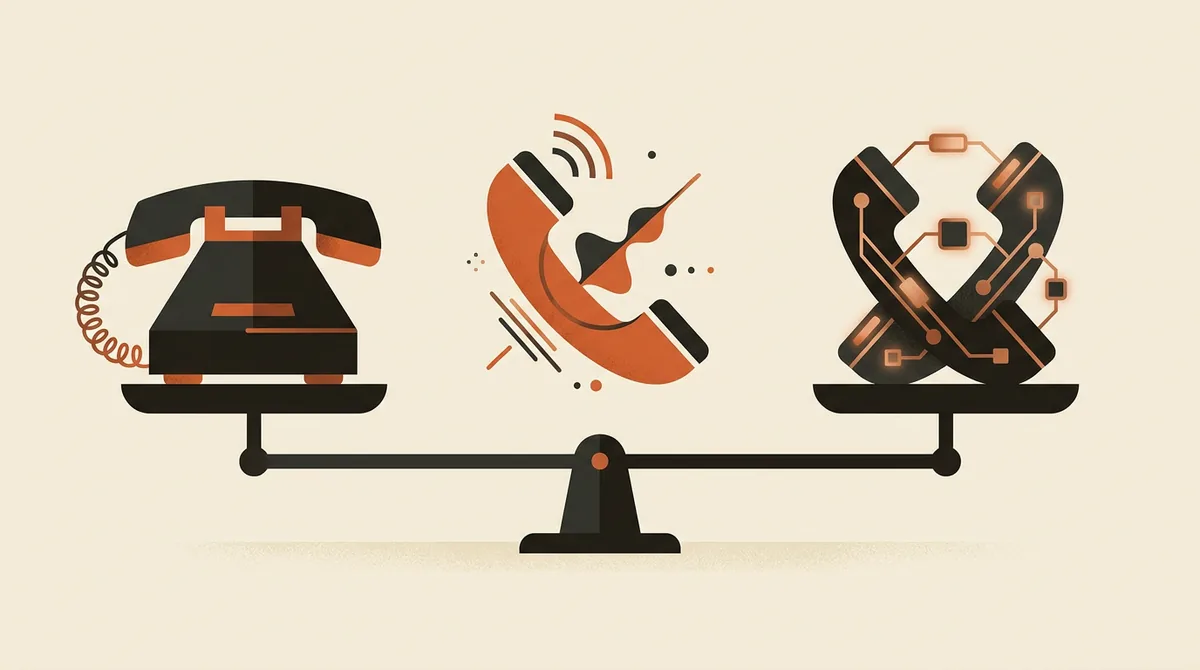
The three options, no fluff
Human secretary
The flesh-and-blood person who answers, screens calls, books appointments, and handles exceptions. It's by far the most flexible option: she reads context, calms down an angry caller, improvises when needed. She can be in-house (an employee) or outsourced (a call-answering service where several operators handle calls on behalf of multiple companies).
There's only one structural limit, but it's a heavy one: a person can't answer two phones at once, doesn't work 24 hours a day, and takes time off. If you're in the bathroom, in a meeting, or it's Saturday night, the phone just rings out.
Answering service
The recorded message. It costs almost nothing (often bundled into your phone plan), it's always on, and it never makes a mistake. The problem is that it doesn't solve anything: it just records. And the uncomfortable truth is that most people hang up without leaving a message. Someone who needs a quote or an appointment and hits the beep will often simply call your competitor instead. An answering service isn't a service, it's a container for lost opportunities.
AI receptionist
A voice assistant powered by artificial intelligence that answers with a natural-sounding voice, understands what the caller wants, answers frequently asked questions, books appointments straight into the calendar, and, when things get complicated, hands the call to a human or logs the contact for a callback. If you want to understand exactly how it works, we've walked through it step by step in how AI answers the phone and what a voice AI assistant is.
In 2026 the technology took a real leap forward: speech-to-speech systems (native audio, without the old text-to-voice detour) now run under 320 milliseconds of latency and handle interruptions gracefully. In practice, you can cut it off mid-sentence and it stops, just like a person would. That's why it actually works today, and why it's no longer the robotic voice of the switchboards from ten years ago.
The cost comparison, numbers on the table
This is the core of the decision. Let's put the three models side by side on a monthly basis, with realistic ranges for the market. These are estimates to calibrate against your industry and call volume.
| Item | In-house secretary | Outsourced answering service | Answering machine | AI receptionist |
|---|---|---|---|---|
| Monthly cost | €1,800 - €2,800 (gross salary + payroll costs) | €300 - €900 (usage-based/package) | €0 - €15 | €150 - €600 |
| Hours of coverage | Office hours | Extended, not always 24/7 | 24/7 | 24/7, 365 days a year |
| Parallel calls | 1 | Limited | Unlimited (but only records) | Unlimited |
| Books appointments | Yes | Yes | No | Yes, directly on calendar |
| Handles complex exceptions | Excellent | Good | No | Limited (escalates to a human) |
| Vacation / sick days / absences | Yes, needs coverage | Covered by the provider | Never an issue | Never an issue |
The number that jumps out: a full-time in-house secretary costs roughly ten times more than an answering machine and only covers office hours. The AI receptionist sits in between, but with 24/7 coverage and unlimited parallel calls. This isn't a price race, it's about matching the tool to what you actually need. If you want a more granular breakdown of pricing, we've broken down what a voice AI assistant costs line by line.
The variable everyone forgets: the missed call
The cost comparison is only half the story. The other half, the one answering-service vendors never mention, is how much it costs you not to answer.
Let's run real numbers for a local business. Picture a dental practice with an average ticket of €400 per new patient. If you miss 5 calls a week from prospective new patients (after hours, during lunch, while you're busy), and even just half of them would have booked an appointment, you're leaving roughly €4,000 a month on the table. For a restaurant with a €30 average check and 3 lost bookings of 4 people a week, that's over €1,500 a month in empty tables.
The point is that a missed call leaves no trace. It doesn't show up on your P&L, but it's there. We dedicated a full deep dive to what a missed call actually costs by industry, and another to why you're losing customers on the phone without even noticing. The short version: if your after-hours call volume is high, an AI receptionist isn't a cost, it's the recovery of revenue you were already losing.

The real pros and cons of each option
When a human secretary is worth it
It's worth it when calls require empathy, negotiation, or handling delicate situations (a law firm, an agency dealing with complex cases). A person reads nuance, reassures, improvises. No AI today matches how a human handles an emotionally distressed customer.
It falls short when volume is high, calls come in after hours, or they're mostly repetitive requests (hours, availability, prices, bookings). Paying a person to answer "yes, we're open until 7pm" twenty times a day is a waste. And she's still unavailable for half the day and the entire weekend.
When an answering machine (doesn't) pay off
It's only worth it as a zero-cost fallback if missed calls don't cost you much. In practice, for anyone selling services or appointments, it's the worst choice: it gives the illusion of being covered while you're actually handing customers to whoever picks up first. It's a "back in five minutes" sign hung on the door.
When an AI receptionist is worth it
It's worth it when you get a lot of repetitive, bookable calls, when they come in after hours, when peak times make you miss parallel calls (think a beauty salon on Monday morning), or when you want to free up your front-desk person from the phone so she can focus on the customers in front of her. Verticals where it works especially well: medical and dental practices, restaurants, beauty salons and hairdressers.
The real limit is that AI doesn't handle off-script or highly emotional situations well. That's why any serious system always builds in a handoff to a human: when a request gets complex, the call is forwarded or the contact is logged for a callback. We explain exactly how that mechanism works in our article on voicebot human handoff. It's not "AI instead of people," it's "AI that filters, and a person who closes what matters."
Want to find out whether a secretary, an AI receptionist, or a hybrid model pays off for your business? Request a free analysis: we start from your call numbers and tell you what actually makes sense.
The classic objection: "the robotic voice, older callers, accents"
It's the first thing every owner thinks, and it's a fair concern. The honest answer: in 2026 the voice isn't the problem it used to be. Speech-to-speech systems sound natural, handle interruptions, and can hold a fluid conversation. But real edge cases remain: an older caller unfamiliar with the technology, a strong accent, a thick regional dialect. A good system is tuned to recognize when it doesn't understand and hand off to a human right away, instead of making the caller repeat themselves three times.
We've tackled this head-on, without pretending it's fully solved when it isn't, in our article on AI voice, dialects, and older callers. It's worth reading before you decide, especially if your customer base skews older.
A legal obligation you need to know about
If you go with an AI receptionist, there's a regulatory point you can't ignore. Under the AI Act (EU Regulation 2024/1689) and Italian Law 132/2025, callers have the right to know they're speaking with an artificial intelligence rather than a person. In practice, your voice assistant has to state this at the start of the call.
The provisions on general-purpose AI systems and transparency obligations are being phased in progressively throughout 2026. This isn't a footnote for lawyers: it's a single line in the opening script, but it has to be there. Serious providers already build it in by design. You'll find the details in our article on the obligation to disclose AI use on the phone and a broader overview of the AI Act obligations for SMBs. Informational note: always check with a professional advisor for your specific case.
It doesn't have to be an either/or choice
The most common mistake is thinking "AI or human." The most effective setups we see are hybrid: AI answers everything first, handles standard requests and bookings, and hands off to a human only when it's actually needed. The secretary stops being a switchboard operator and goes back to doing work that matters. The answering machine disappears entirely, because it's no longer needed.
The real multiplier in this setup is integration with your CRM and calendar: if the assistant writes appointments straight into Google Calendar or your booking software, and logs contacts in the CRM, the phone stops being a black hole and becomes a data source. That's where the math really works out. For a full picture of how it works and what it costs, start with our complete guide to the AI phone system.
Bottom line: what's right for you
- Lots of repetitive, bookable calls, including after hours: an AI receptionist, almost always the option with the best ROI.
- Delicate, low-volume, high relational-value calls: a human secretary, AI doesn't replace her.
- Mixed volume and peak times: a hybrid AI-plus-human model, the best of both worlds.
- An answering machine on its own: pretty much never, if you sell services or appointments you're losing customers.
The deciding factor isn't the monthly cost, it's how much a missed call is worth in your industry. If that number is high, the math on an AI receptionist is simple.
Frequently asked questions
Does an AI receptionist really pay off compared to a secretary?
It depends on the type of calls. If they're repetitive, bookable, and come in after hours too, AI pays off: it costs less than a full-time secretary (€150-€600 vs. €1,800-€2,800 a month) and is active 24/7. If calls require empathy and complex case handling, a person remains irreplaceable. Many businesses go with a hybrid model.
How much does a human secretary cost compared to a voice AI assistant?
A full-time in-house secretary typically costs €1,800-€2,800 a month including payroll costs, but only covers office hours. An outsourced answering service runs €300-€900 on a usage basis. An AI receptionist falls between €150 and €600 a month, but with round-the-clock coverage and unlimited parallel calls.
Is a classic answering machine still useful?
As a standalone solution, almost never, if you sell services or appointments. An answering machine records but resolves nothing, and most people hang up without leaving a message, then call your competitor instead. It's fine only as a zero-cost fallback when missed calls don't cost you much.
Does the AI voice still sound robotic and cause issues with older callers or accents?
In 2026 the voice is no longer robotic: speech-to-speech systems sound natural and handle interruptions with latencies under 320 ms. Edge cases remain (thick accents, older callers unfamiliar with the tech), but a good system recognizes when it doesn't understand and hands the call off to a human operator right away.
Is it mandatory to disclose that an AI is answering?
Yes. Under the AI Act (EU Regulation 2024/1689) and Italian Law 132/2025, callers have the right to know they're speaking with an AI. In practice, the voice assistant has to state this at the start of the call. Serious providers already build this in by default in the script.
What happens when the AI doesn't know how to answer a question?
A well-configured system includes a human handoff: when a request is complex or off-script, the call is forwarded to a human operator, or the contact is logged for a callback. So it's not AI instead of people, it's AI that filters and a person who closes what matters.
If calls are slipping through after hours or during peak times, let's talk: we'll work out together how much that's costing you today and what you'd recover with a voice AI assistant.