What Is an AI Voice Assistant and How Does It Work (Explained Simply)
9 min read · AstraLoop Studio
If you run a business that gets phone calls, you already know this problem well: when the phone rings and nobody picks up, that customer doesn't call back. They call your competitor instead. An AI voice assistant exists to close exactly that gap. It's software that answers the phone for you, talks to the customer in natural language, understands what they want and, in most cases, resolves the request without ever handing off to a human agent.
In this guide I'll explain what it is, how an AI-handled call actually works (step by step, no technical jargon), and why 2026's technology has nothing to do with the robotic voices you remember. By the end you should walk away with a clear mental model, not a list of acronyms.

What an AI voice assistant is, in one sentence
An AI voice assistant is a system that handles spoken phone conversations using artificial intelligence. It's not a keypad menu ("press 1 for...", "press 2 for..."), and it's not an answering machine reciting a recorded message. It's something the customer talks to the way they'd talk to a receptionist: they ask a question, get a relevant answer, book an appointment.
The distinction that actually matters is between routing and resolving. A traditional switchboard, at best, forwards the call to the right department. An AI voice assistant actually completes the task: it books the slot on the calendar, answers questions about opening hours, tells the caller whether a product is in stock, collects a lead's details. If you want to go deeper on this distinction, we covered it thoroughly comparing voice AI vs. traditional IVR.
One terminology detail is worth flagging, because it causes a lot of confusion. "AI voice assistant" in a business context doesn't mean Siri or Alexa. Those are personal assistants. Here we're talking about a system built to answer a company's phone line, integrated with your booking system and calendar. If the technical term interests you, we explain what "voicebot" or "callbot" means in the dedicated guide.
How a call works, step by step
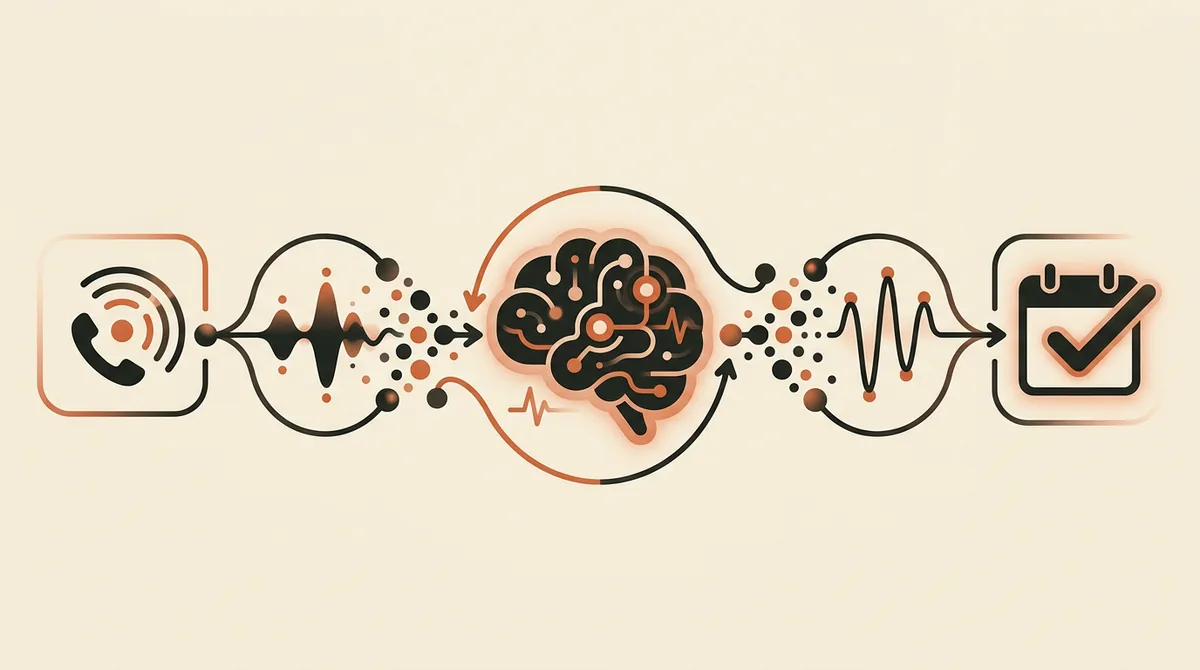
Now for the most useful part: what actually happens, in order, when a customer calls your number and the AI answers. It's five steps that unfold in a fraction of a second, one after another.
1. The call comes in and the AI answers
The customer dials your number the way they always have. They don't need to install an app, and they don't need to know in advance that they'll be talking to an AI (though, as we'll see, the law requires you to disclose it). The assistant answers with a natural greeting, often personalized with your business name.
2. The system transcribes what you say (speech-to-text)
While the customer talks, the audio is converted to text in real time. It's the same principle as voice dictation on your phone, but far more precise: it understands spontaneous speech, hesitations, "umms", sentences left half-finished.
3. The AI understands the intent and decides how to respond
This is where the "brain" comes in — a language model connected to your company's knowledge base: hours, services, price list, availability, FAQs. The system doesn't hunt for keywords; it interprets what the customer actually wants. "Are you open Saturdays?", "I'd like to move Thursday's appointment", "how much is a cut and blow-dry" all get understood no matter how they're phrased. This "company memory" the AI draws on is technically called a company knowledge base, and it's what makes the answers accurate instead of made up.
4. The AI replies with a synthetic voice (text-to-speech)
The generated response is turned into speech and spoken to the customer. Today's voices carry intonation, pauses, breath: they sound like a person, not a 2010 sat-nav. We'll come back to this shortly, since it's the point skeptics and older customers worry about most.
5. The AI takes action: books, logs, integrates
This is the step that separates a real assistant from a simple answering service. If the customer wants an appointment, the AI checks the calendar, offers an open slot, confirms it and writes it down. If it's capturing a lead, it saves the details to the CRM connected to the voice assistant. If it can't answer, it hands the call to a human or logs the message (more on that shortly).
Why it no longer sounds robotic in 2026
The number one objection I hear from business owners is always the same: "my customers will realize it's a robot right away and hang up." In 2020 you'd have been right. Today, much less so, and it's worth understanding why.
Until recently, AI voice worked in a chain: listen (speech-to-text), think, speak (text-to-speech). Each step added delay, and that delay made the conversation feel mechanical. In 2026, speech-to-speech (or voice-to-voice) models arrived, processing audio directly without converting it to text at every turn. The practical result:
- Latency under 320 milliseconds: the reply comes back almost instantly, without the awkward pause that used to give the robot away.
- Interruption handling (barge-in): if the customer talks over the AI, it stops and listens, just like a person would. No more unshakeable monologues.
- Natural intonation: emphasis, pauses, tone that adapts to context.
One issue still deserves an honest answer: thick dialects, very elderly customers, poor phone lines. It's not a 100%-solved problem, but serious systems handle regional Italian better than you'd expect and, when they struggle, they hand the call to a human. We talk about this without sugarcoating in our article on AI voice, dialects, and older customers.
What happens when the AI doesn't know the answer
No serious AI voice assistant promises to answer everything. The point isn't replacing a human 100% of the time — it's taking repetitive calls (hours, bookings, basic information) off their plate so they can focus only on the cases that actually matter.
When a request falls outside its scope (a complex complaint, an unusual technical question, a customer who explicitly asks for a person), the handoff to a human agent kicks in. The system can:
- Transfer the call live to an available team member.
- Take down the name, number and reason for the call, and notify you to call back.
- Book the appointment anyway and leave the complex issue to you.
This handoff mechanism is called human handoff, and it's the true sign of a well-designed system: it doesn't pretend to know everything, it knows when to stop. An assistant that makes up answers does more damage than one that simply transfers the call.
Want to find out how many calls you're missing and whether an AI voice assistant makes sense for your business? Request a free analysis: we start from your numbers, not the technology.
A legal requirement you need to know before you start
This part calls for precision, since it touches on regulation. As of 2026, Italy has a transparency requirement that directly concerns anyone using an AI voice assistant.
Italian Law No. 132/2025 (provisions on artificial intelligence) introduces the principle that users must be informed when interacting with an AI system. In parallel, the EU AI Act (Regulation (EU) 2024/1689) sets transparency obligations for systems that interact with people, with its provisions being phased in through 2026. In plain terms for your business: you must clearly disclose to the customer that they are speaking with an artificial intelligence.
This isn't a technicality to fear — it's an easy requirement to meet. A single sentence at the start of the call does it. It does need to be designed in from the start, though, not bolted on afterward. You'll find a practical rundown in our article on the obligation to disclose AI on the phone, and a broader overview of AI Act 2026 obligations for small businesses. This article is for informational purposes: for specific compliance requirements, always check the official sources (the text of Law 132/2025 and Regulation (EU) 2024/1689) or consult a professional.
But does my business actually need one?
The right question isn't "is this cool technology?" but "what does it cost me not to have it?" Every call a local business misses is a potential booking that never happens, or a lead that goes to a competitor instead. We ran the numbers in our analysis on what a missed call is really worth: for many small businesses, the yearly total runs into four figures.
An AI voice assistant makes the most sense if you recognize yourself in these situations:
- You get a lot of repetitive calls (hours, bookings, availability) that eat into the time of people who should be working.
- You lose calls outside business hours or during peak times, when you're with a customer and the phone just rings out.
- Your business runs on appointments: medical and dental practices, beauty salons and hairdressers, restaurants, gyms, auto shops.
It's no coincidence these are exactly the verticals where it performs best. If you run a practice, see how it applies to medical and dental practices; if you're in beauty, see the use case for salons and hairdressers. The common thread is fewer no-shows thanks to automated bookings and reminders.
How it fits into the bigger picture
An AI voice assistant rarely operates in isolation. It's the "phone" piece of a broader system that manages your switchboard, integrations, and data. For the full picture of how all these pieces fit together, start with our complete guide to the AI switchboard: it's the hub from which pricing, comparisons, compliance, and industry use cases all branch out.
From there you can get practical: how to evaluate the cost of an AI voice assistant, or how an AI switchboard actually works for your business day to day. The advice is to start from the problem, not the technology: how many calls you're missing, what each one is worth, and how much of that the AI can genuinely handle.
In short
An AI voice assistant is software that answers the phone, understands the customer in natural language, and resolves the request (booking, information, lead capture), escalating only the complex cases to a human. In 2026 the voice is realistic and the conversation flows naturally thanks to speech-to-speech models. There's a transparency requirement to meet, but it's simple. And the real question to ask yourself isn't a technology question at all — it's how much every unanswered ring is costing you.
Frequently asked questions
What exactly is an AI voice assistant?
It's software that answers your business's phone calls using artificial intelligence: it understands what the customer says in natural language and resolves the request (bookings, hours, information, lead capture), escalating only complex cases to a human agent. It's not a keypad menu or a recorded answering machine.
Is an AI voice assistant the same thing as Siri or Alexa?
No. Siri and Alexa are personal assistants on your device. A business AI voice assistant answers a company's phone number and is connected to its booking system and calendar to schedule appointments and manage customers.
Can customers tell they're talking to a robot?
2026's voices, built on speech-to-speech models, sound natural, with latency under 320 milliseconds and proper interruption handling. Edge cases remain, like thick dialects or poor phone lines. Either way, under Law 132/2025 and the AI Act, users must be told they're talking to an AI.
What happens if the AI voice assistant doesn't know the answer?
The handoff to a human agent kicks in: the system transfers the call to a person, or takes down the name, number and reason for the call and notifies you to call back. A well-built system knows when to stop instead of making up answers.
Is it mandatory to tell the customer they're talking to an AI?
Yes. Italian Law 132/2025 and the AI Act (Regulation (EU) 2024/1689) impose transparency obligations: users must be informed when they're interacting with an artificial intelligence system. A single disclosure sentence at the start of the call is enough. For specific compliance requirements, check the official sources or consult a professional.
Which businesses benefit most from an AI voice assistant?
Mainly businesses that run on appointments and get a lot of repetitive calls: medical and dental practices, beauty salons, hairdressers, restaurants, gyms, auto shops. The main benefit is not missing calls outside business hours and cutting no-shows with automated reminders.
If you think an AI voice assistant could stop you losing customers over the phone, let's talk: we'll assess your case together and tell you honestly whether it's worth it.