AI Consulting for SMEs: Services, Method and Costs (The Alternative to Big Consulting)
8 min read · AstraLoop Studio
The big consulting firms have discovered AI, and now they're selling projects worth hundreds of thousands of euros with gorgeous slide decks and 18-month roadmaps. But if you run an SME with 10, 50, or 200 people, that model wasn't built for you: it costs too much, moves too slowly, and almost always ends up as a pilot that never makes it into production. AI consulting for SMEs is a different job entirely, with different needs, budgets, and timelines.
Here we explain what you should actually expect: which services are worth buying, what method brings AI into a company without burning cash, and — above all — what it really costs, in concrete numbers. If you want the full picture of the industry first, start with our complete guide to AI consulting for businesses. On this page, though, we go straight to the point, for anyone working with limited resources who wants measurable results.

Why an SME needs a different kind of consulting
The problem isn't that SMEs are "behind." The problem is that consulting models copied from large enterprises don't hold up at a smaller scale. Three concrete reasons why.
The budget can't support cathedral-sized projects. A big consulting firm will propose an enterprise assessment, an AI center of excellence, a proprietary platform. For an SME, that means spending your entire annual innovation budget on a preliminary phase — before you've even automated a single process.
You don't have an internal team to carry the project forward. Large companies have a dedicated office that picks up the baton. In an SME, the IT manager is already stretched thin, marketing is doing three jobs at once, and nobody has time to manage a complex rollout. You need someone who actually does the work, not just someone who recommends it.
You need the return early, not a strategic exercise. A multinational can afford 12 months of "transformation." You need the first automated process to free up hours within the quarter. The payback has to be short and visible, or the project dies from internal fatigue.
That's why AI consulting for SMEs only works when it's vertical, hands-on, and honest about cost. Less theory, more processes actually running. If you want to understand when hiring an external consultant makes sense — and when it doesn't — we've dedicated a full piece to it: how much an AI consultant costs.
The services that actually matter for an SME
Not every AI consulting service delivers the same value for a smaller company. These are the ones that move the needle.
1. AI Assessment (process audit)
This is the starting point. You map out your business processes and identify the ones that are automatable with the highest return and the lowest risk. A good assessment doesn't hand you a list of 40 ideas — it gives you 3 or 4 "quick wins," with impact estimated in hours and euros, plus a risk classification of your AI systems by category (needed for the AI Act, more on that below). This is the phase where you decide where NOT to invest, and that's worth just as much as deciding where to. We go deeper on this in what to automate in your company with AI.
2. Pilot projects on real use cases
A well-run pilot takes ONE concrete process — customer care, sales follow-ups, data extraction from documents — and gets it working within 4-8 weeks. The goal isn't a demo that impresses the board; it's a workflow that runs every day and frees up time. Typical examples: AI-powered customer care automation, automated sales follow-up, document management.
3. Building AI agents and automations
This is where you move from chatbots that reply to AI agents that act: they read a document, query the CRM or ERP, draft a quote, update a record. It's the real step-change in value, but it has to be built with guardrails and human oversight — not left to run on its own. We explain the technical difference in the difference between a chatbot and an AI agent.
4. AI Act compliance and governance
This isn't optional. Starting August 2, 2026, obligations under EU Regulation 2024/1689 (the AI Act) come into force, and every company using AI tools also has to address staff AI literacy (Art. 4). A serious consulting engagement includes classifying your systems by risk level and putting an internal policy in place — not just the technical project.
5. Training and change management
The number one reason AI projects fail isn't technical — it's that people don't use them. Training and supporting your team is part of the service, not an add-on. 73% of companies list AI upskilling as a priority, but only 22% have structured programs in place: that's a huge gap to close. We cover this in AI training for employees.
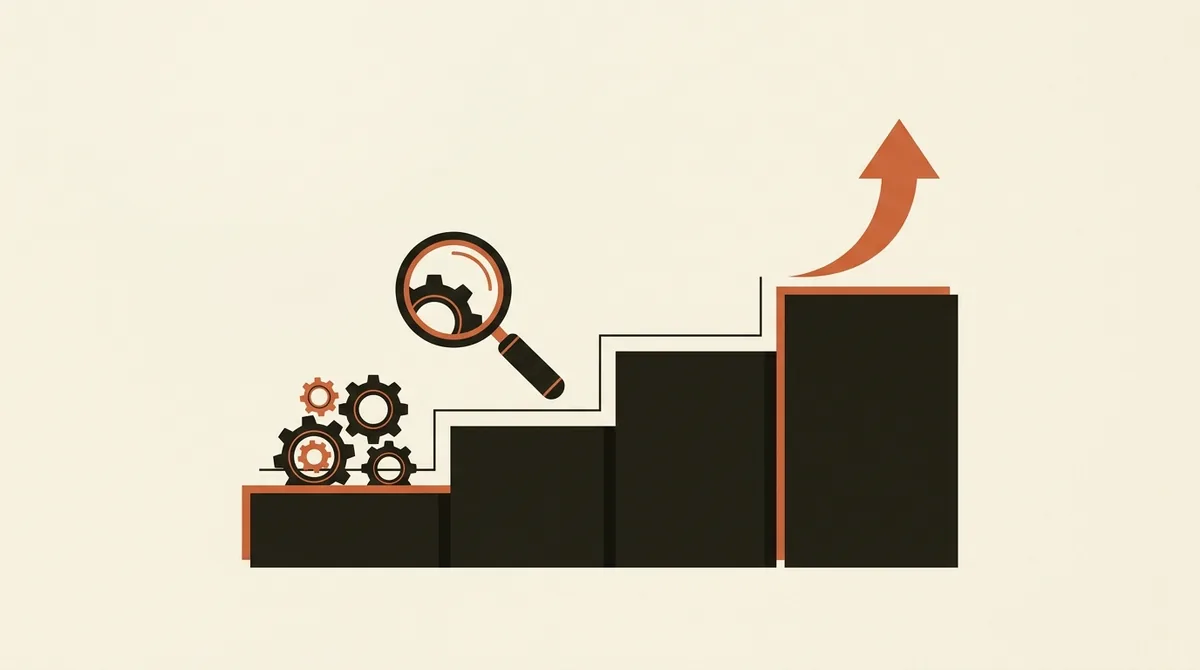
The AstraLoop method: 4 phases, not 18 months
Our method is the operational translation of the 4-phase AI adoption roadmap. No cathedrals: start small, measure, and scale only what works.
Phase 1: Assessment (1-2 weeks)
We map your processes, identify 3 or 4 quick wins, estimate the return, and classify systems by AI Act risk level. Concrete output: a roadmap with priorities, costs, and KPIs. Typical cost of this phase for an SME: between €1,500 and €5,000, depending on business complexity.
Phase 2: Pilot, the first quick win (4-8 weeks)
We bring the first process into production. One single use case, done well, with before-and-after metrics. This is where internal trust gets built: once the team sees 15 hours a week freed up, the rest of the journey sells itself.
Phase 3: Scale-up
We extend to the next processes only after the pilot has produced numbers. This is exactly the point where roughly 85% of AI pilot projects fail to make the leap to large-scale production: they scale too fast, without guardrails, without monitoring. We scale one process at a time. If you want to understand why so many projects die, read why AI projects fail.
Phase 4: Ongoing monitoring
AI agents need to be watched: model drift, errors, edge cases. You need human-in-the-loop oversight, guardrails, and a recovery plan for when the agent gets it wrong. This is a recurring phase, not a one-off, and it's the most underrated one among providers who sell the project and then disappear.
What it actually costs: real numbers, no vagueness
This is the question that matters most, and too many consultants dodge it. Here are realistic ranges for the Italian market, broken down by cost item.
| Item | SME Range | Notes |
|---|---|---|
| Initial assessment | €1,500 - €5,000 | One-off, output = roadmap |
| Pilot project (1 process) | €3,000 - €12,000 | Setup, development, and go-live |
| AI agent for a complex process | €8,000 - €25,000 | CRM/ERP integration and guardrails |
| Maintenance and monitoring | €200 - €1,500/month | Model drift, updates, support |
| Team training | €1,000 - €4,000 | AI Act literacy included |
There are two things most quotes hide. The first is recurring operating costs: an AI agent consumes tokens (the calls to the underlying models), needs maintenance, and has to be updated whenever the model changes or the process evolves. Anyone who only shows you the setup cost is telling you half the story. The second is model drift — the silent degradation of performance over time. Ignore it, and six months from now you'll discover the agent has been making worse decisions without anyone noticing.
For a detailed comparison of individual cost items, we have dedicated pieces on how much a business AI agent costs and how much automating business processes costs.
How to measure the return (ROI)
An AI project without KPIs is an act of faith. Calculating the return for an SME is simpler than it sounds:
ROI = (hours freed up × hourly cost) + extra revenue − costs (setup + operating)
Here's a concrete example. You automate sales follow-ups and free up 20 hours a week for a team member earning €25/hour: that's €500 a week, roughly €2,000 a month. If the project cost €8,000 to set up plus €400 a month to run, payback lands around month five. For an SME, a payback period of 4 to 12 months is the right territory: below that is excellent, above that needs a second look. The full method is in how to measure AI ROI.
Want to know which processes in your company are actually worth automating, and what it would cost? Request a free analysis: we'll give you 3-4 quick wins with impact estimated in hours and euros, no strings attached.
The AI Act and Shadow AI: two risks you can't ignore
There are two topics almost nobody translates into concrete action for SMEs, and yet they carry real weight.
The AI Act. EU Regulation 2024/1689 introduces obligations that phase in over time. Starting August 2, 2026, several provisions become operative, including those on general-purpose AI models and part of the penalty framework. Fines for the most serious violations reach up to €35 million or 7% of worldwide annual turnover. Since February 2025, the AI literacy obligation (Art. 4) has already been in force: anyone using AI tools must ensure their staff has adequate competence. An SME doesn't need an in-house legal department — it needs a consulting partner who can translate the obligation into a policy and a training path. You'll find the full timeline in AI Act 2026: obligations for SMEs. One caveat: this is informational material — for specific compliance requirements, always check with a legal advisor and official sources (the Regulation's text, and the Italian Data Protection Authority for GDPR matters).
Shadow AI. Between 68% and 76% of employees, according to various surveys, use AI tools on the sly, pasting company data into public chatbots with zero governance. It's a double risk: GDPR (personal data leaving the company perimeter) and the AI Act. The solution isn't banning it — it's providing approved tools and a clear policy. We cover this in what Shadow AI is and what risks it carries.
Big consulting or a vertical partner: how to choose
We're not knocking the big firms: for an industrial group with enterprise-scale needs, they can make sense. But for an SME, the comparison is lopsided.
| Aspect | Big Consulting | Vertical SME Partner |
|---|---|---|
| Average ticket | €100k and up | A few thousand euros |
| Time to first result | Months | Weeks |
| Who does the work | Junior staff on the project | Whoever ran the assessment |
| Cost transparency | Often opaque | Explicit line items |
| Maintenance | Heavy contracts | Modest retainer |
The practical rule is this: if the cost of the assessment exceeds what you'd save by automating the first three processes, you're buying the wrong package. A good vertical partner gets you your investment back on the first pilot, not in year three.
Where to actually start
If you're evaluating AI for your company but don't know where to begin, the sequence is simple. First: figure out which processes are most worth automating (start with AI in the company: where to start). Second: get an honest assessment done, with real numbers on the table. Third: pick ONE quick win and get it into production before thinking big. The rest follows, as you measure.
AI consulting for SMEs, done right, isn't a committee project: it's a practical path that starts small, proves the return, and grows only where it works. No 80-page slide decks, and no multinational-sized budget.
Frequently asked questions
How much does AI consulting cost for an SME?
An initial assessment typically runs from €1,500 to €5,000, a pilot project on a single process from €3,000 to €12,000, while an AI agent integrated with a CRM or ERP can reach €25,000. You also need to factor in recurring operating costs (tokens, maintenance, monitoring), often between €200 and €1,500 a month.
How long before you see the first results?
With a quick-win method, a well-structured pilot project brings a process into production in 4-8 weeks. Payback on the investment for an SME usually falls between 4 and 12 months, calculated as hours freed up times hourly cost, plus extra revenue, minus costs.
Does an SME need to worry about the AI Act?
Yes. EU Regulation 2024/1689 imposes staggered obligations, with operative provisions from August 2, 2026, and fines of up to €35 million or 7% of turnover. The AI literacy obligation for staff (Art. 4) has already been in force since February 2025. Even a small company using AI tools must classify its systems by risk and have an internal policy.
What's the difference between big consulting and a vertical partner for SMEs?
Large firms operate with tickets in the hundreds of thousands of euros, timelines of months, and junior staff executing the project. A vertical partner for SMEs works with budgets of a few thousand euros, delivers first results within weeks, keeps costs transparent, and has the same person run the assessment and do the actual work.
Why do so many AI projects fail?
Roughly 85% of pilots fail to make the leap to production at scale. The main causes are scaling up too fast without guardrails and monitoring and, above all, the human factor: people don't adopt the tool. That's why training and change management are part of the project, not an add-on.
What is Shadow AI, and why is it a risk?
It's the use of AI tools by employees without authorization or governance: between 68% and 76% of staff, according to various surveys, paste company data into public chatbots. The risk is twofold — GDPR and the AI Act. The solution isn't to ban it, but to provide approved tools and a clear policy.
If you're looking for AI consulting sized to your SME, with transparent costs and first results within weeks, let's talk: we start with an honest assessment of your processes.