Voice AI vs Traditional IVR: 30% vs 80% Containment
8 min read · AstraLoop Studio
If you have an IVR (the classic auto-attendant with "press 1 for bookings, press 2 for information"), you already know it well: it routes calls, but rarely closes them. The customer navigates menus, waits, and in most cases still ends up with an agent or hangs up. Voice AI starts from a different premise: it doesn't route, it tries to resolve the request by talking in natural language.
The difference isn't cosmetic, and it can be measured with a single number: the containment rate, meaning the percentage of calls fully handled without needing a human agent. With a traditional IVR it sits between 30% and 40%. With a well-configured voice AI it climbs to 60-80%. In this article we look at why, what actually changes, and how many months it takes for the upgrade to pay for itself for an SMB or a local business.
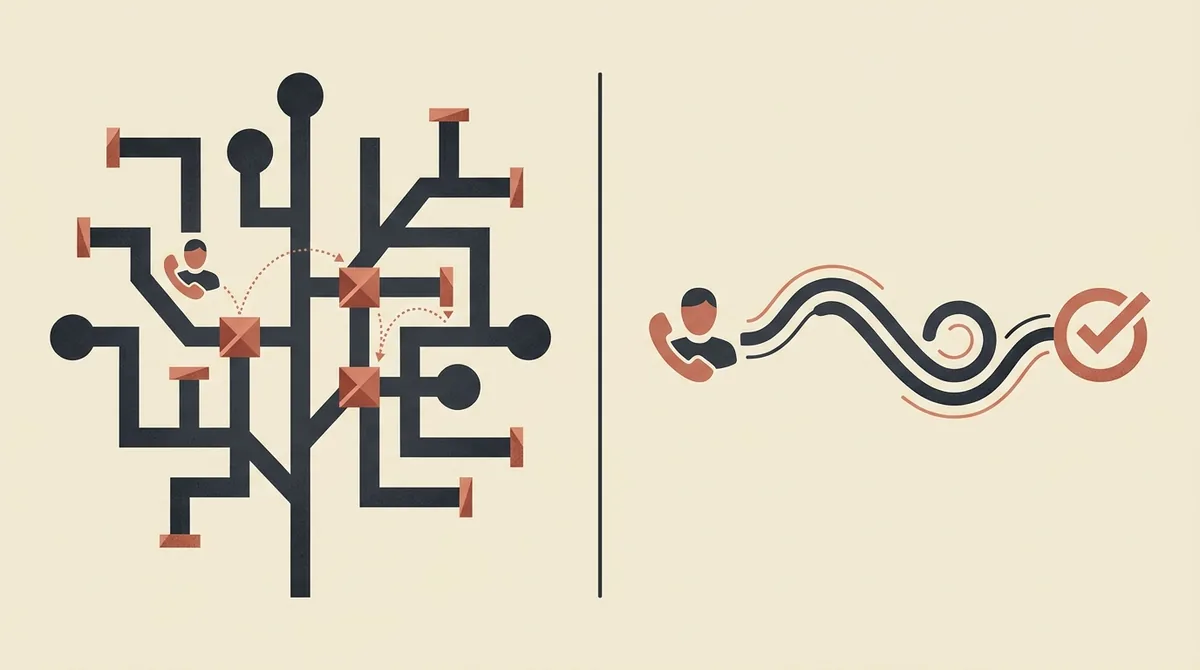
IVR and voice AI: two different philosophies, not two versions of the same tool
The most common mistake is thinking voice AI is "a smarter IVR." It isn't. They are two opposite ways of handling a phone call.
Traditional IVR: routing
IVR (Interactive Voice Response) has been around since the 1990s. It works on a tree-structured menu: you press a key or say a keyword, and the system moves you to a predefined branch. Its stated goal isn't to solve the customer's problem, but to direct them to the right queue or department. Three structural limits:
- Rigidity: if your request doesn't fit one of the menu options, you're stuck. "Press 0 to speak to an agent" is the most common escape route.
- Long paths: menus nested 3-4 levels deep drive people to abandon the call. Every extra level means more customers hanging up.
- Zero comprehension: the IVR recognizes DTMF tones or a handful of isolated words, not a full sentence. "I wanted to move Thursday's appointment" is just noise to it.
Voice AI: resolving
A modern voice AI listens to a full sentence, extracts the intent, and acts: it checks the calendar, proposes a slot, confirms the booking, updates the CRM. The customer talks the way they would to a receptionist, with no menus. If it can't answer, it hands the call to a human with the context already gathered (the so-called handoff to a human agent, or human handoff). If you want the full picture of how this technology works, we've dedicated a guide to how AI answers the phone.
Why voice AI actually works today (and didn't in 2019)
Until a few years ago the objections were legitimate: robotic voices, embarrassing latency, an inability to handle interruptions. In 2026 the technical picture has changed for three concrete reasons:
- Native speech-to-speech (voice2voice): the latest models work audio-to-audio without going through an intermediate text transcription step. The result is a natural-sounding voice, with real intonation, and latency that has dropped below 320 milliseconds, under the threshold at which the ear perceives an annoying delay.
- Interruption handling (barge-in): you can interrupt the assistant while it's talking, exactly as you would with a person, and it stops and listens. IVR doesn't allow this: you have to wait for the message to finish.
- Understanding of real speech: accents, hesitations, broken-up sentences. If you're worried about voice AI handling dialects and elderly customers, it's a fair objection we've addressed separately, but the technical bar today is far higher than most people assume.
This technological leap is why containment has gone from "nice on paper" to "measurable in production."
Containment head to head: the number that decides
The containment rate is the metric you need to look at when evaluating the upgrade. Everything else (average call duration, wait time, satisfaction) follows from it. Here's the realistic comparison, with the ranges we see in the Italian market:
| Metric | Traditional IVR | Voice AI |
|---|---|---|
| Containment rate | 30-40% | 60-80% |
| Natural language understanding | No (menu / keywords) | Yes (full sentences) |
| Interruption while speaking (barge-in) | No | Yes |
| Booking completed independently | Rare | Standard |
| CRM / calendar update | Manual, downstream | Real time |
| Active 24/7 | Routing only | Full resolution |
| Time perceived by the customer | Long (nested menus) | Short (direct conversation) |
Read the number carefully. An IVR with 40% containment doesn't mean it "solves 40% of problems": it means 40% of calls never reach an agent, but a good chunk of that 40% are people who simply got the opening hours or hung up out of frustration. Voice AI's containment is qualitatively different: inside that 60-80% are confirmed bookings, rescheduled appointments, closed requests. These are completed tasks, not calls that were merely offloaded.
What happens to the remaining 20-40%
No serious voice AI promises 100%. The value also lies in how it handles the calls it can't close. A good setup performs a clean human handoff: it passes the call to an agent with the customer's name, the reason for the call, and the data already gathered, so the human doesn't start from scratch. That's the difference between "the AI dumps you on a busy switchboard" and "the AI paves the way for you."

What the upgrade is worth in euros: the ROI of the migration
Higher containment isn't just a number to show off in a slide: it translates into revenue, for a precise reason. Every call the IVR doesn't close and that goes nowhere (after hours, agent busy, customer hangs up) is potentially a lost customer. For a local business this matters far more than it seems.
Let's run a simple calculation, then check your own numbers. Picture a dental practice that gets 40 calls a day. With the IVR, 25% come in after hours or while the front desk is on another line: that's 10 lost calls a day. If even just 3 of those were new-patient visits worth 80-120 euros for the first appointment (with a much higher lifetime value), you're leaving several hundred euros a day on the table. Voice AI recovers most of those calls because it answers 24/7 and in parallel. We've quantified this in detail in our analysis of what a missed call costs a local business, and in why businesses lose customers on the phone.
The key point of migrating from IVR to voice AI: you're not starting from zero costs, you're starting from an IVR you already pay for and that's already losing you customers. The upgrade doesn't add a new expense to a system that works, it replaces a system that's quietly draining appointments. That's why, on the numbers of an SMB with even modest call volumes, the investment typically pays for itself in a few months. If you want to set up the calculation correctly, start with how to reduce missed calls in your business and how to measure the ROI of artificial intelligence.
The real B2B lever: CRM and calendar integration
Containment only reaches its ceiling if the assistant can act on your systems. A voice AI that can talk but can't write to the calendar closes few calls. The leap happens when it integrates with Google Calendar, Microsoft 365, HubSpot, Salesforce or your industry software: then "move my appointment to Thursday" becomes a real action, not a promise. This is the topic we cover in how to integrate an AI voice assistant with your CRM, and it's often the deciding factor for anyone seriously considering the upgrade.
Want to know how much containment your business could reach, and how much missed calls are costing you today? Request a free analysis based on your real numbers.
Is there a "conversational IVR" in between? Watch the terminology
Confusing labels are everywhere. "Conversational IVR" sometimes refers to a genuine voice AI, and sometimes to a traditional IVR with a bit of extra word recognition bolted on ("tell me what you're looking for"). The practical difference is always the same: ask what the real containment is and whether the system takes action (books, reschedules, updates) or just routes. If it only routes, no matter how "conversational" the tone sounds, you're still stuck in IVR logic and its containment limits.
Don't confuse it with a chatbot either: the channel is different (voice vs. text) and so are the expectations. If you're weighing multiple options, our comparison of AI voice assistant vs chatbot will help you pick the right channel.
Something IVR never had to deal with: compliance
There's an aspect that applies only to voice AI, and you need to know it before migrating. From August 2, 2026, the rules of the AI Act (EU Regulation 2024/1689) apply to AI systems that interact with people, and in Italy Law 132/2025 reinforces the obligation to disclose to the user that they are talking to an artificial intelligence system. In practice, the assistant must state its AI nature at the start of the phone conversation.
It's not an obstacle, it's a simple best practice to configure (a clear opening line), but it needs to be done properly. An IVR never had this problem because no one mistakes it for a human. A natural-sounding voice AI does, and that's exactly why the obligation exists. We've dedicated two deep dives to this topic: the obligation to disclose AI on the phone under Law 132/2025 and the overview of AI Act 2026 obligations for SMBs. Note: this is informational material, not legal advice; for your specific situation check with a professional advisor and official sources (the AI Act text and the Italian Data Protection Authority).
When migrating makes sense (and when it doesn't)
It isn't always the right moment. An honest check:
- It's worth it if you get a steady volume of calls, lose calls after hours or during peak times, and the requests are repetitive (bookings, rescheduling, standard information). Here containment makes an immediate difference.
- It's especially worth it if you already have a calendar or CRM the assistant can act on: integration multiplies the value.
- Wait or think it over if your call volume is minimal, requests are all complex and not standardizable, or you don't yet have digital systems to build on.
To figure out where to start in an orderly way, the guide to how an AI phone system works is the fastest way to frame the whole migration without surprises.
In short
IVR routes, voice AI resolves. It's a difference in philosophy that comes down to a single number: containment of 30-40% versus 60-80%. That number is what the ROI is built on, because every call closed independently is an appointment booked instead of a customer lost. With 2026's speech-to-speech technology, integration with your systems, and simple compliance to set up, the upgrade from IVR is one of the few automations with such a direct and measurable return. For the full picture, start with our complete guide to AI phone systems.
Frequently asked questions
What's the difference between voice AI and traditional IVR?
IVR routes the call to a menu or an agent using tones or a handful of keywords. Voice AI understands full sentences in natural language and resolves the request (books, reschedules an appointment, updates the CRM). In short: IVR routes, voice AI closes.
What is the containment rate and why does it matter?
It's the percentage of calls fully handled without needing a human agent. It's the key metric: a traditional IVR sits at 30-40%, a well-configured voice AI at 60-80%. Higher containment means more requests resolved independently and fewer lost customers.
How long does it take for a migration from IVR to voice AI to pay for itself?
It depends on call volume, but for an SMB or local business with regular calls, the investment typically pays for itself in a few months. The reason: you're not adding a new cost, you're replacing an IVR you already pay for that's already losing you appointments after hours and during peak times.
Is a "conversational IVR" the same thing as voice AI?
Not always. Sometimes 'conversational IVR' refers to genuine voice AI, other times to a traditional IVR that recognizes a few more words. The test is simple: ask about the real containment rate and whether the system takes concrete actions or just routes calls.
Does AI voice still sound robotic, or can you tell it's an AI?
2026's speech-to-speech technology produces natural voices with latency under 320 ms and interruption handling. It sounds human enough that, from August 2, 2026, the AI Act and Law 132/2025 require disclosing at the start of the call that you're speaking with an AI.
What happens when voice AI doesn't know how to respond?
It hands the call to a human agent (human handoff) with the context already gathered: the customer's name, the reason for the call, and useful data. That way the human doesn't start from scratch and only handles the genuinely complex requests, that 20-40% outside containment.
If you're considering the upgrade from IVR to voice AI, talk to us: we'll help you estimate realistic containment and set up the migration without risk.