How an AI Phone Receptionist Works: From the Call to the Booked Appointment
9 min read · AstraLoop Studio
Imagine your business phone ringing at 8:45 PM, after you've already closed for the day. Today that call goes unanswered, and often so does the customer. With an AI phone receptionist, that same call gets picked up by the second ring, understood, handled, and turned into an appointment written straight into your calendar — without anyone lifting a receiver.
The question we get most isn't "do I need this?" but "how does it actually work?". In this article we follow a single phone call from start to finish, step by step, to see what happens in the few seconds between the ring and the appointment confirmation. No magic — just a chain of well-orchestrated technical components.
What an AI phone receptionist is (in one line)
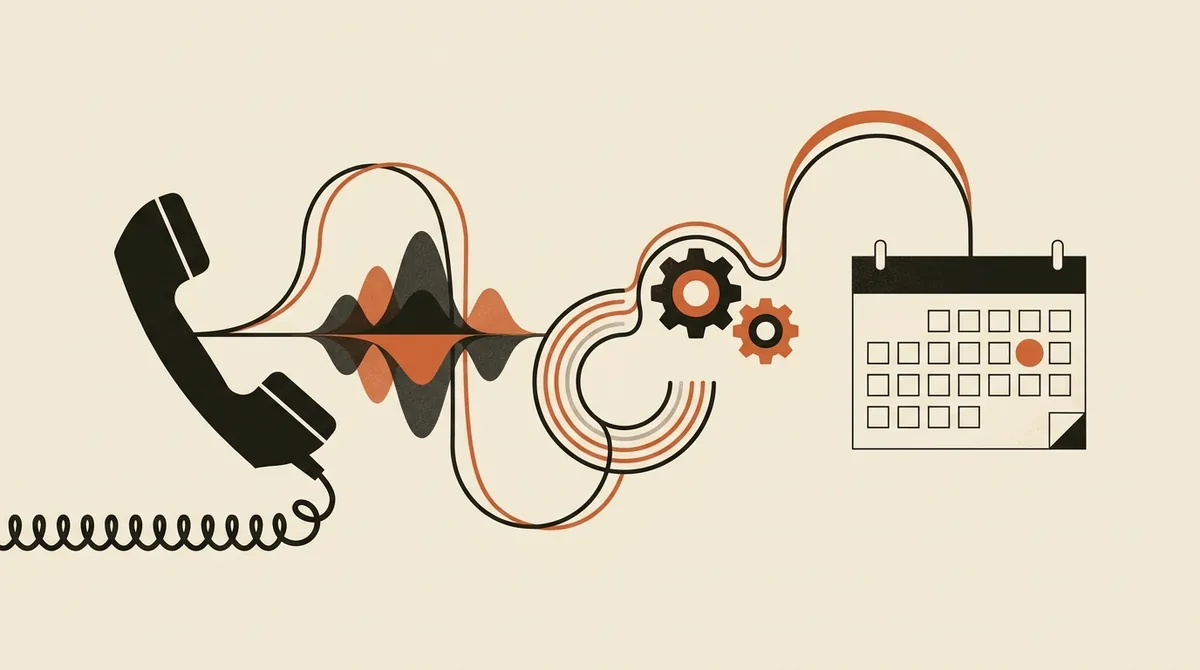
An AI phone receptionist is a system that answers calls with a synthetic voice, understands what the caller says, holds a natural conversation, and takes concrete action: it books an appointment, answers a question, routes the call to the right department, or transfers to a person when needed. It's not a simple voicemail, and it isn't the old IVR with "press 1 for...". It's a party that talks and acts.
For the full definition and the bigger picture, see the complete guide to the AI phone receptionist. Here we stick to "how it works", with a mechanic's eye. Let's pop the hood.
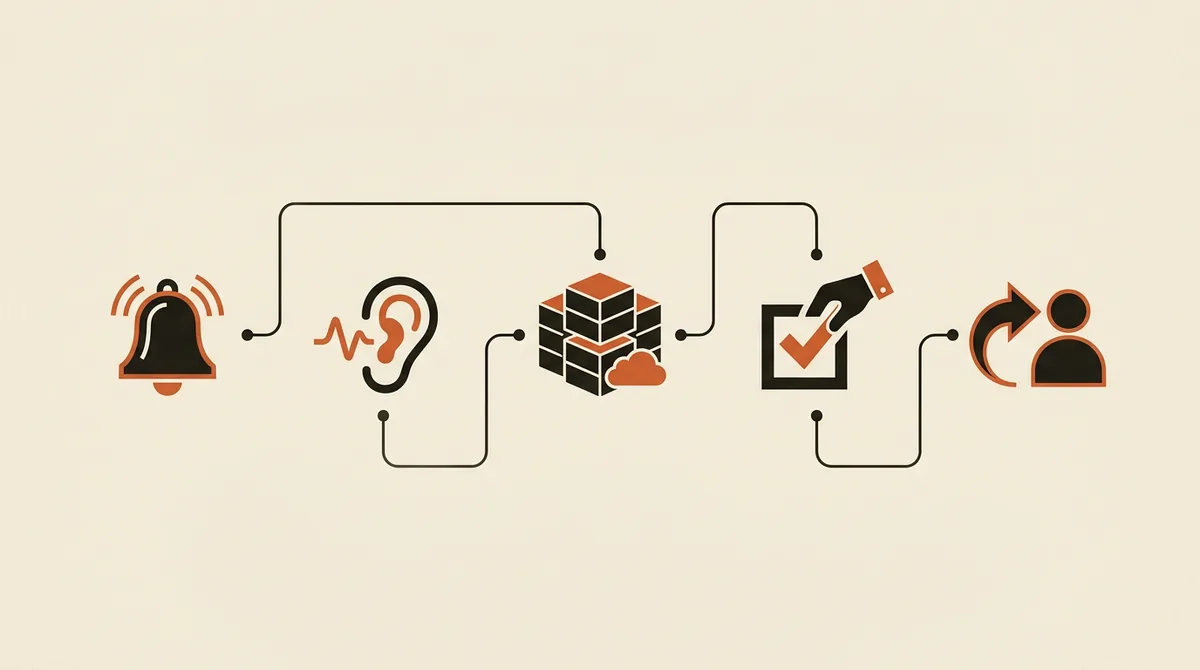
Anatomy of a phone call: the 5 stages
Every call goes through five stages in sequence. Each one takes just a few seconds, and the whole conversation flows like a call with a human. Let's go through them one by one.
Stage 1: the answer (0-2 seconds)
The call comes in on your business number. You can keep the same number you've always had: through your phone carrier (or a VoIP number), calls are routed to the AI phone receptionist. When it rings, the system answers within one or two rings, always, 24 hours a day, holidays included. No queue, no "all our operators are busy".
That alone accounts for half the value. A call you answer is a call you haven't lost. How much do missed calls actually cost you? We broke it down by industry in how much a missed call is worth for a local business, and the numbers surprise anyone who's never put a euro figure on it.
Stage 2: understanding (speech-to-text and intent)
As soon as the caller speaks, their voice is converted to text in real time (speech-to-text). But transcribing isn't enough: the system has to understand intent. "I wanted to book for Thursday afternoon" and "do you have anything free Thursday?" are different phrasings with the same goal. The language model extracts the meaning and the key details: what the person wants, for when, for how many people, under what constraints.
This is where old systems used to fail and new ones succeed. People don't talk in menus: they interrupt themselves, change their mind, add details. The AI phone receptionist handles all of this because it reasons over natural language, not rigid keywords.
Stage 3: reasoning and knowledge (the knowledge base)
Once it understands the intent, the system needs to know what to answer. This is where the knowledge base comes in: hours, services, prices, availability, procedures. Your business's information is loaded into a knowledge base that the AI consults so it only answers with real, your own data — never made up. This mechanism (technically called RAG, retrieval augmented generation) is what stops the assistant from "hallucinating" answers.
One example: the customer asks "do you also do men's haircuts on Saturdays?". The AI searches the knowledge base, finds that on Saturdays you only work by appointment until 2 PM, and answers accordingly. If the information isn't there, it doesn't make it up: it hands off (more on that shortly).
Stage 4: action (where the value is created)
Answering is useful, but the real leap is acting. The AI phone receptionist doesn't just inform: it books, routes, records. When the customer says "okay, Thursday at 4 PM then", the AI:
- checks real-time availability on your calendar or booking system;
- suggests the closest open slot if the requested one is taken;
- books the appointment by writing it straight into the schedule;
- sends confirmation (often via SMS or WhatsApp) with date, time, and summary.
This is the clear difference from the old IVR, which at best routed you to a department. It's the leap from "routing" to "resolving", which we compared head-to-head in voice AI vs. traditional IVR: the autonomous resolution rate (containment) goes from 30-40% for an IVR to 60-80% for a good AI phone receptionist.
Stage 5: wrap-up and handoff to a human
The call closes with a summary: "Perfect, I've booked you for Thursday at 4 PM, you'll get a confirmation in a moment". And when the AI can't handle a request (a sensitive complaint, an out-of-scope question, a complex case), it doesn't freeze or guess: it transfers the call to a person or collects the details so you can call back. This mechanism, handoff to a human operator (human handoff), is what makes the system reliable instead of frustrating. A good AI phone receptionist also knows its own limits.
Why it actually works now: latency and natural voice
If you tried an automated answering system a few years ago, you'll remember the robotic voice and the awkward pauses. What's changed? Two technical things, but decisive ones.
The first is the speech-to-speech architecture (native voice-to-voice). New-generation systems no longer translate voice into text, process it, and re-synthesize it slowly: they work the audio more directly, drastically cutting the time involved. The second is latency: today the best systems respond in under 320 milliseconds, below the threshold where a pause starts to feel "unnatural". The result is a conversation that flows, with interruption handling (barge-in). You can interrupt the AI while it's talking, exactly as you would with a person, and it stops and listens.
The most common objection remains: "what if the customer speaks in dialect, or is elderly and not very tech-savvy?". It's a legitimate concern and we address it directly in AI voice, dialects, and older customers. In short: today's Italian models handle regional accents and spontaneous speech well, and human fallback covers the edge cases. No one gets left behind.
System integration: where the AI phone receptionist becomes indispensable
An appointment booked "verbally" but written down nowhere is worthless. The piece that turns the AI phone receptionist from a toy into a working tool is integration with your systems. Here's what it typically connects to:
| System | What it lets the AI do |
|---|---|
| Google Calendar / Microsoft 365 | Read availability and write appointments in real time |
| CRM (HubSpot, Salesforce, Pipedrive) | Log the contact, the request, and the call history |
| Industry-specific software | Check slots, services, and prices specific to your business |
| WhatsApp / SMS | Send automatic confirmations and reminders |
This is the real purchase driver, especially from a B2B standpoint. An AI phone receptionist connected to your CRM feeds your sales funnel without manual data entry. If you want to understand how this connection is built, we've dedicated a guide to integrating an AI voice assistant with your CRM. This is where you see the difference between a nice demo and a system that actually saves you time every day.
Want to hear how your AI phone receptionist would sound with your business's hours and services? Request a free analysis and we'll show you a demo built around your case.
The compliance question: you're required to disclose it
A sensitive point vendors often gloss over. Starting August 2, 2026, the transparency obligation under the AI Act (EU Regulation 2024/1689) takes effect: when a user interacts with an artificial intelligence system, they must be informed of it. In Italy, Law 132/2025 adds to this, reinforcing the obligation to disclose to the caller that they are speaking with an AI on the phone.
In practice this means an opening line along the lines of "Hello, I'm the virtual assistant for [business]". It's not a cosmetic detail, it's a requirement. A well-designed AI phone receptionist is compliant by design, with the disclosure built in as standard. We go deeper into what changes in the obligation to disclose AI on the phone (Law 132/2025) and the wider picture in AI Act 2026 obligations for SMEs. One note: this is informational content, not legal advice. Check with a professional for your specific situation.
On the privacy side, recorded calls fall under GDPR: a clear privacy notice, the correct legal basis, and limited retention time. The Italian Data Protection Authority (Garante) is the reference authority. A good provider gives you the notice templates and manages data on compliant infrastructure.
A complete example, second by second
Let's put it all together. You run a beauty salon, it's 9:10 PM on a Tuesday, closed.
- Ring: the phone rings, the AI answers by the second ring and identifies itself.
- Customer: "Good evening, I wanted to book a waxing appointment, do you have anything free this week?"
- Understanding: intent equals booking, service equals waxing, window equals this week.
- Knowledge: the AI checks the service duration and available staff in the knowledge base.
- Action: it checks the calendar, and offers "Thursday at 5:30 PM or Friday at 10 AM, which do you prefer?".
- Closing: the customer picks Thursday, the AI writes the appointment into the schedule and sends a WhatsApp confirmation.
Total time: under a minute. Cost to you: zero missed calls, zero no-shows thanks to the automatic reminder, and your schedule filling up while you sleep. This scenario applies to hair salons, gyms, medical practices, restaurants, repair shops: only the knowledge base changes. You'll find the dedicated verticals starting from the hub of solutions for beauty salons and hair salons and the other connected industries.
What you need to get started
From the outside it looks complex, but the setup for a local business is leaner than you'd think. You need three things: the number to route to the AI phone receptionist, your business's information (hours, services, price list, FAQs) to build the knowledge base, and access to your calendar or booking system for the integration. The rest is configuration and testing the conversations.
If you're weighing the costs, we've broken them down in how much an AI voice assistant costs, and if you want to see how it stacks up against a person at the front desk, the comparison is in AI receptionist vs. human secretary. It's not either/or: in most cases the AI covers after-hours and peak times, while the person stays for what needs the human touch.
Frequently asked questions
Does the AI phone receptionist use the same phone number I already have?
Yes. Calls are routed to the AI phone receptionist from your current number (landline or VoIP), with no need to change it or give customers a new one. The routing is set up on the carrier or PBX side.
What happens if the AI doesn't understand or doesn't know the answer?
It doesn't freeze and it doesn't make things up. It recognizes its limit and triggers human handoff: it transfers the call to an operator or collects the details so you can call back. It's a mechanism built specifically for complex cases.
Does the voice sound robotic or natural?
2026 systems have a natural voice thanks to speech-to-speech architecture and latency under 320 ms. They handle interruptions (you can cut in while it's talking) and hold up well with spontaneous speech and Italian regional accents.
Does the appointment really end up on my calendar?
Yes, if the receptionist is integrated with your calendar or booking system (Google Calendar, Microsoft 365, CRM, industry software). The AI checks real-time availability and writes the appointment into the schedule, also sending confirmation to the customer.
Am I required to tell customers they're talking to an AI?
Yes. Starting August 2, 2026, the AI Act (EU Regulation 2024/1689) and, in Italy, Law 132/2025 require disclosing that the caller is speaking with an artificial intelligence system. A well-built receptionist includes the disclosure as standard.
How is it different from an old IVR with 'press 1 for...'?
An IVR routes through menus and autonomously resolves 30-40% of calls. The AI phone receptionist understands natural language and takes action (books, answers, logs), with autonomous resolution rates of 60-80%. It moves from routing to resolving.
If you're considering an AI phone receptionist that books appointments while you're closed, let's talk: together we'll assess feasibility, integrations, and compliance for your business.