5 Lead Generation Mistakes That Are Burning Your Budget
10 min read · AstraLoop Studio
You spend on campaigns, the leads come in, and then they vanish. You're not closing the sales you expected, cost per acquisition keeps climbing, and you convince yourself the channel is the problem: Meta doesn't work, Google costs too much, the market is saturated. In most cases, that's not it. The channel brings in contacts; it's what happens after the click that burns the budget.
Lead generation isn't "generate a lot of contacts." It's generating the right contacts and treating them the right way in the hours and days that follow. It's on this second piece that almost every small business loses money in ways it never even sees, because the costs are hidden inside the percentage of leads you don't call back, call back too late, or drop because "they weren't ready."
Here are the five mistakes we see most often when a company comes to us frustrated with its results, along with the real impact on budget and conversions and, for each one, what changes once qualification and follow-up stop depending on one person's memory and availability.

Mistake 1: Mistaking "lots of leads" for "good leads"
The first mistake happens upstream, in how you think about the problem. Many campaigns get judged on the number of contacts collected and cost per lead. Low CPL, plenty of forms filled in: looks like a win. Then the sales rep spends two weeks calling people who have no budget, no decision-making power, or who only left their number to download the free PDF.
Volume without quality is a trap because it eats up your most expensive resource: your salespeople's time. A junk lead doesn't just cost you the few euros of CPL. It costs the call, the wasted quote, the follow-up email, a CRM that gets clogged, and the team's trust, which erodes until they stop working contacts seriously because "they never close anyway."
The root cause is almost always the form and the offer. A form that only asks for name and email attracts anyone. A lead magnet that's too generic ("download the free guide") brings in the curious, not buyers. If you can't tell a qualified lead from one that isn't, you're paying to keep your sales team spinning its wheels.
What changes with automatic qualification
This is where AI makes a concrete difference. Instead of collecting a raw contact and handing it straight to sales, a qualification agent on WhatsApp or chat engages the lead within seconds, asks 3-4 targeted questions (rough budget, timeline, decision-making role, problem to solve) and assigns a score. Sales only receives contacts above the threshold, already enriched with the answers. Anyone who doesn't respond or doesn't qualify goes into a nurturing flow instead of the trash.
The result isn't less work for the team: it's the same work concentrated on the contacts that can actually close. If you want to understand the logic behind the scoring, lead scoring is the mechanism that makes this selection repeatable.
Mistake 2: Responding to the lead hours (or days) later
This is the single costliest mistake, and also the easiest to explain. A lead fills out the form at 3:40pm on a Tuesday. They're hot: they're thinking about your product right at that moment. But the sales rep is in a meeting, then has other quotes to send, then it's evening. They call back Thursday morning. By then the lead has already requested two quotes from competitors, or simply doesn't even remember filling out that form.
An online lead's window of interest closes fast. The research on lead response time has been unforgiving for years: reaching out within the first 5 minutes drastically increases the odds of actually speaking to them compared to waiting even half an hour. It's not a matter of politeness, it's the math of attention. Every minute that passes, the lead cools off and your real CPL (the one that matters, the cost per lead that actually closes) gets worse.
The problem is that no human team can guarantee a 5-minute response every day, including at 10pm, on Saturdays, and in August. It's physically impossible. And the lead spike often hits exactly in the evening and on weekends, when people have time to browse.
Instant follow-up that never misses a contact
This is exactly where an automatic follow-up system pays for itself. The instant the form is submitted, the lead gets a personalized message (WhatsApp, email, or SMS) that opens the conversation, confirms their interest and, in the best cases, already offers to book a call or a meeting. It's not a cold "thanks for reaching out": it's real engagement that keeps the contact warm until a person can step in.
Reaching back out within 60 seconds, every time, no exceptions, isn't a luxury: it's the single highest-return intervention across the entire pipeline. Many companies discover the channel was never the problem: it was the six hours of lag between the click and the first response.
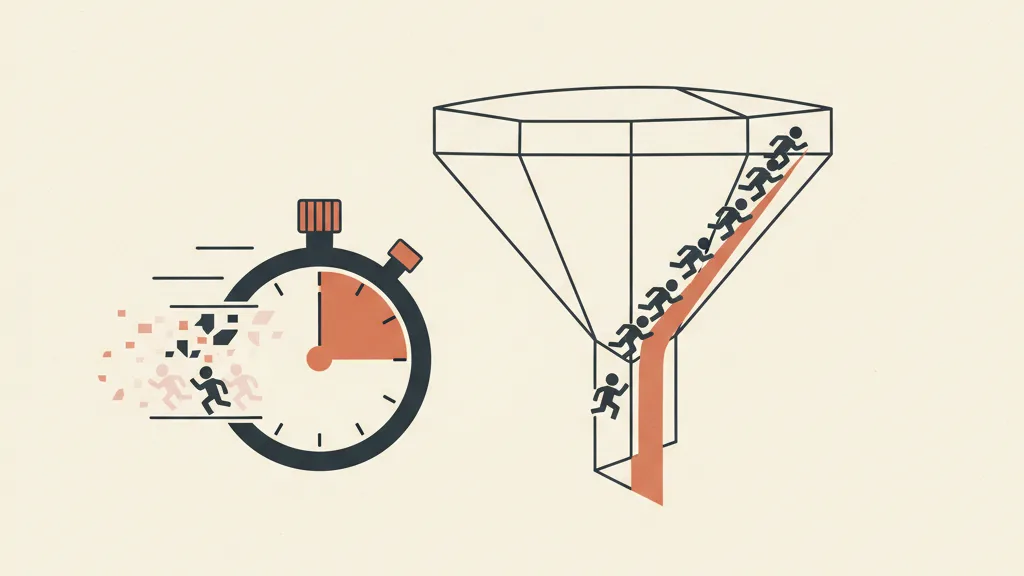
Mistake 3: One contact attempt and done
Related to the previous point, but different. Even when the team does call back, they often do it just once. The lead doesn't answer, the call goes to voicemail, and the contact gets silently marked as "not interested." Wrong: in most cases they don't answer because they're in a meeting, driving, or simply don't recognize the number.
The sales truth has been known forever: most sales close after several attempts, but most reps stop after one or two. Not out of laziness, but because manually tracking "who I called, when, how many times, what to say next" for hundreds of leads is unmanageable. So good contacts slip through the cracks.
Every lead dropped after a single attempt is budget you've already spent and are throwing away. You paid to acquire it; not calling back is like buying stock and letting it rot in the warehouse.
Contact sequences that run on their own
A structured follow-up cadence (for example: instant message, call at 10 minutes, email the next day, second attempt after three days, then a shift to nurturing) turns "one shot and done" into a process that forgets no one. Automated, the sequence starts on its own, adapts based on whether the lead opens, replies, or clicks, and stops the attempts as soon as the contact books a call or asks not to be contacted again. Sales reps step in on live conversations, not on tallying attempts.
Mistake 4: No nurturing for leads that "aren't ready right now"
Here's a fact almost no one accounts for: the vast majority of the leads you generate aren't ready to buy today. They're evaluating, comparing options, or simply have their budget locked until next quarter. They're not bad leads. They're the right lead at the wrong time.
The mistake is treating them as lost. The sales rep drops them because "they're not buying right now," and three months later, when that lead is finally ready, they've forgotten who you are and buy from the competitor who kept themselves top of mind in the meantime. You paid to generate that contact and handed it to the competition for lack of medium-term follow-up.
Nurturing is what monetizes this huge slice of contacts. A sequence of emails and messages that delivers value over time (case studies, answers to common objections, useful content) keeps the company on the lead's radar without pressure, so that when the real need kicks in, yours is the first name that comes to mind. It's the same principle behind reactivating dormant contacts in your database: the value is already there, it just needs nurturing.
How AI makes nurturing sustainable
The problem with manual nurturing is that it's tedious and always gets postponed. Nobody wants to write email number 7 of the sequence. With automation, flows kick off based on lead behavior: whoever downloaded a guide on a given topic enters the path related to that topic, whoever visited the pricing page gets content about return on investment. AI can personalize messages based on industry and the answers already collected, keeping a human tone across thousands of contacts. B2B nurturing with AI stops being the good intention you never get around to and becomes a flow that runs in the background.
If you recognize your business in any of these mistakes, we can help you close the gaps before you spend more on ads. Request an audit of your lead generation process: we'll show you exactly where you're losing budget and what to fix first.
Mistake 5: No data, no CRM, no single source of truth
The fifth mistake is the most insidious because it makes the other four invisible. If leads live scattered across the sales rep's spreadsheet, a shared inbox, WhatsApp messages on a personal phone, and whatever the person who was there that day remembers, you have no idea where you're losing money. You don't know which campaign brings in leads that close and which brings in just the curious, you don't know how many contacts were never called back, you don't know your real conversion rate per channel.
Without a CRM that pulls everything into one place, you're optimizing blind. You might be cutting the campaign that generates your best customers because "it costs more per lead," ignoring the fact that those leads close at triple the rate. The low CPL that makes you feel good could be the very thing bleeding you dry.
A properly set-up CRM ties every contact back to its source, tracks every interaction, and tells you in black and white which piece of your acquisition machine works and which doesn't. It's the foundation everything else rests on: without reliable tracking, qualification, follow-up, and nurturing all operate in the dark. It's worth understanding how to integrate your CRM with the sales funnel before you even push harder on advertising.
From chaos to a system
The underlying logic tying all five mistakes together is a single one: lead generation doesn't end when the contact arrives, it starts there. A serious customer acquisition system brings campaigns, qualification, instant follow-up, nurturing, and CRM together into a single flow, where every lead is tracked, engaged in time, qualified, and either handed to a human ready to close or kept warming until they are. No contact left behind, no budget burned on delays and forgetfulness.
The waste table: where your budget is going
Here are the five mistakes summarized, with the typical impact and the lever that fixes each one:
| Mistake | Where budget gets lost | What fixes it |
|---|---|---|
| Unqualified leads | Sales time spent on contacts that will never close | Automatic qualification + lead scoring |
| Slow follow-up | Hot leads that cool off in the first few hours | Automatic response within 60 seconds |
| Single contact attempt | Good contacts dropped after one missed call | Automated multi-step contact sequence |
| No nurturing | Leads "not ready today" handed to the competition | Behavior-based nurturing flows |
| No CRM | Blind optimization, the right channels get cut | CRM as the single source of truth |
Where to start, in practice
You don't need to overhaul everything at once. Here's the priority order we recommend, ranked by budget impact:
- Fix instant follow-up first. It's the highest-return intervention and the fastest to set up. Even just an automated message within a minute of form submission changes the numbers.
- Add qualification. Stop handing raw leads to the team. Filter first, so sales only works the hot ones.
- Build the contact sequences and nurturing. Whoever doesn't respond right away isn't lost: they enter a flow that keeps them warm.
- Centralize everything in a CRM. It's the only way to see what's working and stop optimizing by gut feeling.
Every step in this list recovers budget you're already spending and throwing away today. It's not "spend more on advertising": it's stop wasting what your advertising is already bringing you. If you want to go deeper on the upstream side, our guide on how to generate qualified leads completes the picture from the campaign side, while our pillar on B2B lead generation brings strategy, channels, and system together into a single view.
The right question isn't "how many leads am I generating?" but "how many of the leads I generate am I actually turning into customers?" If that answer makes you uncomfortable, the problem is almost never the number of contacts. It's the machine that's supposed to work them, and today, is letting them slip away.
Frequently asked questions
Which lead generation mistake costs the most?
Slow follow-up. A lead who's called back hours or days after filling out a form almost always cools off: interest peaks in the first few minutes. Responding within 60 seconds, automatically, is the highest-return intervention across the entire pipeline.
How do I know if a lead is qualified?
A qualified lead has budget, decision-making authority, a real need, and a compatible timeline. You can check this with a few targeted questions at the point of contact (even via automated chat or WhatsApp) and assign a score with lead scoring, so the team only works contacts above the threshold.
Why shouldn't I drop leads who don't buy right away?
Because most leads aren't ready today, but will be down the line. Dropping them means handing them to the competitor who keeps themselves top of mind in the meantime. A nurturing flow keeps them on your radar until the real need kicks in, monetizing contacts you'd otherwise lose.
How many times should I try calling a lead before giving up?
Most sales close after several attempts, not after one. A cadence of 4-6 touches across different channels (message, call, email) spread over a few days recovers many leads who simply didn't answer the first call. Automating the sequence keeps you from forgetting contacts.
Can AI really qualify leads in place of a salesperson?
AI doesn't replace the salesperson at the closing stage, but it handles the layer before that: it engages the lead within seconds, asks the qualifying questions, assigns a score, and passes only ready contacts to the human, already enriched with the answers. The rep gets time back to do what they do best: sell.
Do I really need a CRM for good lead generation?
Yes, if you want to stop optimizing blind. Without a CRM that captures every lead along with its source and every interaction, you don't know which campaign brings in real customers and which brings in just the curious. You risk cutting your best channel because it has a higher CPL, ignoring that it closes far more often.
Want a system that qualifies and follows up with every lead automatically, without leaving anyone behind? Let's talk: we'll build the acquisition machine tailored to your business together.