AI Voice Assistant for Real Estate Agencies: Qualify Every Lead Who Calls
9 min read · AstraLoop Studio
A real estate agent spends most of the day out of the office: viewings, site visits, signings at the notary, negotiations from the car. Meanwhile the phone rings. And whoever's calling, 90% of the time, is looking at a listing right now, maybe on your portal or on a major listings site, with three other listings open in as many tabs. If you don't answer within a few seconds, that contact calls the next number. They won't call you back.
This is the silent wound of the real estate business: you don't lose clients because of price or the quality of the properties, you lose them because nobody picks up the phone at the right moment. An AI voice assistant (an AI receptionist that talks, not a chatbot that types) solves exactly that: it answers every call, understands which listing it's about, qualifies the contact, and books the viewing straight into the calendar. Even at 9pm, even while you're mid-negotiation.
In this guide we look at how this works in detail for the real estate vertical, what it actually qualifies, what it costs, what the new Italian law requires, and where a human still needs to step in.

The real estate agent's specific problem: you're always unreachable
The real estate business has a work structure that makes missed calls almost inevitable. You're not sitting at a desk waiting: you're out among people, hands full, often in situations where answering is rude or impossible. Here's when they call:
- While you're showing a property: you have a client in front of you, you can't stop to answer a new lead. But that new lead, if you don't pick up, is gone.
- Evenings and weekends: house hunters browse listing portals after dinner and on weekends, exactly when the office is closed. The peak in inquiries hits right when nobody's there to answer.
- When you're juggling multiple listings: if you have 40 properties in your portfolio, you get calls for all of them, and every caller expects you to know exactly which property they mean.
The result is that a huge share of hot leads, people literally looking at your listing right now, evaporate. And it's not a theoretical problem: if you want to see what it actually costs you in euros, we ran the numbers in our deep dive on what a missed call is really worth for a local business. For an agency, where the average commission on a sale can run to several thousand euros, even one missed call a week is a serious hole in annual revenue.
The traditional answer to this problem, a receptionist or a switchboard with a voice menu, has obvious limits. An IVR menu routes but doesn't resolve: "press 1 for sales, press 2 for rentals" doesn't book a viewing and doesn't collect anything. A human receptionist works, but covers eight hours out of twenty-four, takes holidays, and costs a salary. If you want to understand the differences, we compared the two routes in AI receptionist vs. human receptionist and in voice AI vs. traditional IVR.
What an AI voice assistant actually does for an agency
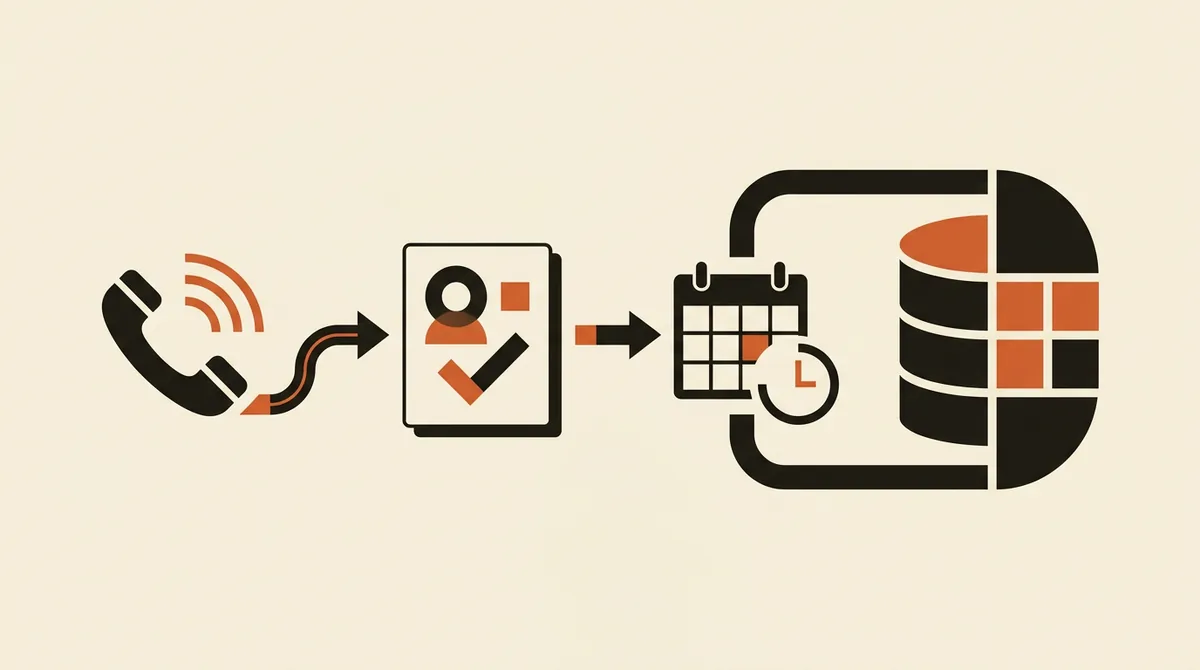
We're not talking about an answering machine that says "the office is closed, call back tomorrow." We're talking about a system that handles the entire conversation, in natural language, and delivers a result. Here's the typical flow of a call about a listing.
1. It answers and identifies the listing
The call comes in, the AI answers within a couple of rings. First thing (required by law, we'll get to that): it states that it's a virtual assistant. Then it figures out what the call is about. If the agency uses dedicated numbers for premium listings, the AI already knows the property. Otherwise it asks: "Which property are you calling about? Do you have the listing reference or the neighborhood address?" and matches the request to the right file.
2. It qualifies the contact
This is where the real value is. Instead of just taking down a number, the assistant asks the questions you'd ask yourself to figure out whether it's worth calling back:
- Budget and financing: mortgage already approved, cash, or do they still need to sell their current property?
- Timeline: looking to move within three months, or just "browsing"?
- Real requirements: number of bedrooms, garage, elevator, area. That way you immediately know whether the property they have in mind is a fit, or whether you have something better in your portfolio.
Within a few minutes you have a profiled contact, not an anonymous phone number. We cover what separates a raw lead from a qualified one in what makes a lead qualified, and for the practical method there's how to qualify leads.
3. It books the viewing on the calendar
If the contact is valid and wants to see the property, the assistant reads open slots straight from your calendar, offers them, and locks in the appointment. No back-and-forth, no "I'll call you back about timing." The viewing is on the calendar while you're still out.
4. It hands everything to the CRM and to the agent
At the end of the call, the qualified lead with full notes (property, budget, timeline, appointment) lands in the agency's management software or CRM, and you get a notification. The call can also be transcribed. This integration is the single most important lever: without a connection to the calendar and the CRM, the assistant is only half useful. We cover it in how to integrate an AI voice assistant with your CRM.
"But can you tell it's a robot?" The voice question (and older clients)
This is objection number one, and rightly so. A real estate salesperson lives on relationship and trust: a scratchy synthetic voice with a three-second lag would do more harm than good. The good news is that 2026 technology is nothing like the old answering machines.
Current systems use a speech-to-speech approach (native audio, without the intermediate text-to-speech step that used to slow everything down): latency drops below 320 milliseconds, the voice sounds natural, and the system handles interruptions. If the caller starts talking over it, the AI stops and listens, just like a person would. The result is a conversation that flows, not a stilted back-and-forth.
There's still the question of older clients, or callers using strong dialect, common in real estate where many sellers are over 65. It's a real point worth taking seriously: we did, in AI voice, dialects, and older clients. Short version: today's models understand real spoken Italian well, but for the hard cases a well-configured handoff to a human operator matters a lot, which we cover next.
The part nobody tells you: legal obligations
This is where the real estate sector needs to pay attention, because many agencies don't know it. In Italy, anyone using an AI that talks to customers on the phone has a precise transparency obligation.
Two regulatory references:
- Italian Law 132/2025: introduces the requirement to clearly tell the user that they are interacting with an artificial intelligence system. In practice: the assistant must say so at the start of the call.
- The AI Act (EU Regulation 2024/1689): the European regulation sets transparency obligations for AI systems that interact with people. Its provisions come into force in stages, with key deadlines set for August 2026.
Translated for your agency: a well-configured AI voice assistant states that it's an AI at the start of the call. This isn't a detail to ignore, and it's also a competitive advantage: doing it properly positions you as a serious, transparent agency. We have a dedicated deep dive on the obligation to disclose AI on the phone and a broader one on AI Act obligations for SMEs. On the privacy side, recorded calls fall under GDPR: you need to inform the caller and handle the data properly. This is informational, not legal advice: for your setup, it's worth checking with someone who knows the regulations.
Want to see how many leads your agency is losing on the phone, and how a voice assistant would recover them? Request a free analysis: we build it on your actual call volume.
When the AI hands off: human handoff
A good voice assistant doesn't pretend to know everything. If the caller asks a technical question about the property's cadastral status, wants to negotiate on price, or simply asks "put me through to Marco," the system needs to be able to transfer the call to you or schedule a priority callback. This is called human handoff, and it's the difference between a system people trust and one that frustrates callers.
In real estate practice, the sound rule is: the AI handles filtering, qualification, and booking (the repetitive work that eats your time), the human agent handles negotiation, relationship, and closing (where you're irreplaceable). We explain how to set up this handoff properly in managing the handoff to a human operator in a voicebot.
What it costs and when it pays off
Costs vary a lot depending on call volume and integrations, but as a rough order of magnitude: an AI voice assistant for a small agency typically starts at a few hundred euros a month, well under the cost of a full-time receptionist, with the advantage of covering 24 hours a day and weekends. The breakdown of pricing models (per minute, per call, flat fee) is in our guide on what an AI voice assistant costs.
The question to ask isn't "how much does it cost" but "how much do I get back." If the system saves you even one or two sales a year that you'd otherwise have lost to unanswered calls, it's already paid for itself many times over. The math on the value of missed calls is in how to cut missed calls, and the structural reason clients get lost on the phone is in why you're losing clients on the phone.
Where it fits in your acquisition funnel
The voice assistant isn't an acquisition strategy on its own: it's the piece that closes the gap between the lead coming in (from portals, campaigns, signage) and the first qualified contact. If you're working on acquisition further upstream, it's worth reading alongside lead generation for the real estate sector: generating more contacts is of little use if half the people who call never get an answer.
In summary
For a real estate agency, an AI voice assistant solves a very concrete and very costly problem: the fact that the agent is structurally unreachable exactly when the lead is hottest. It answers every call, understands the listing, qualifies the contact with the right questions, books the viewing on the calendar, and pushes everything into the management software. In 2026 the voice sounds natural, the law only requires disclosing that it's an AI, and the handoff to a human operator covers the cases that deserve your direct attention.
If you want the full picture before deciding, this article is part of a broader series: start with the complete guide to the AI switchboard for the general framework, and see how it applies to other local businesses in the voice assistant for beauty salons and hairdressers. The logic is always the same: stop losing the call that matters.
Frequently asked questions
Can the AI voice assistant really book a viewing on the calendar by itself?
Yes. Connected to your calendar (Google Calendar, Microsoft 365, or a real estate management platform), the assistant reads open slots, offers them to the caller, and confirms the appointment, with no back-and-forth. You get a notification and find the viewing already booked.
Can callers tell they're talking to an AI on the phone?
With 2026's speech-to-speech technology, the voice sounds natural and latency drops below 320 milliseconds, with proper handling of interruptions. On top of that, Italian Law 132/2025 requires disclosure: the assistant must state at the start of the call that it's an AI system. Transparency is mandatory, not a flaw.
What happens if a client asks a question the AI can't answer?
That's where human handoff kicks in: the assistant transfers the call to an available agent or schedules a priority callback with full notes. The sound rule is that the AI handles filtering, qualification, and booking, while negotiation and closing stay with the human agent.
Do I have to disclose to clients that I'm using an AI voice assistant?
Yes. Italian Law 132/2025 and the transparency obligations of the AI Act (EU Regulation 2024/1689) require that the user know they're talking to an AI. A properly configured assistant discloses this at the start of the call. Recorded calls then fall under GDPR and must be handled accordingly.
How much does an AI voice assistant cost for a small real estate agency?
It depends on volume and integrations, but a small agency typically starts at a few hundred euros a month, well under the cost of a full-time receptionist, with 24/7 coverage including weekends. The return comes from the sales you recover that you would otherwise have lost to unanswered calls.
Does it work with older clients or people speaking in dialect?
Current models understand real spoken Italian well, including informal speech. For the harder cases, a well-configured handoff to a human operator matters: if the AI doesn't understand, it transfers the call to you instead of pushing through. It's a real consideration worth testing on your typical clients before launch.
If you want a voice assistant that answers listing calls, qualifies contacts, and books viewings while you're out, let's talk: we'll map out the right flow for your agency together.