Zero-Party Data: What They Are and How to Use Them to Personalize Marketing
9 min read · AstraLoop Studio
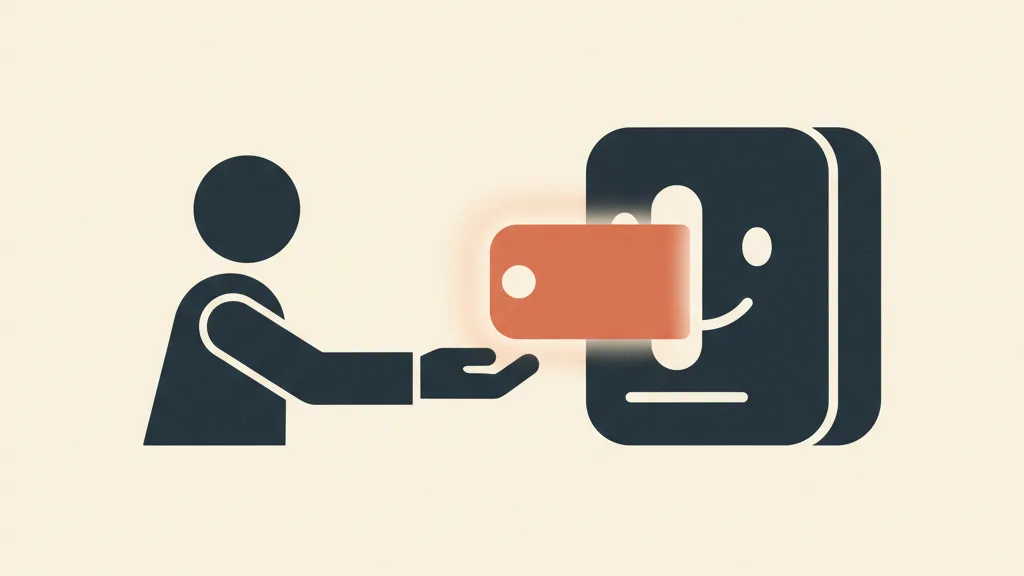
There's a type of data worth more than all the rest, and you don't need to steal it or infer it: the customer just gives it to you. They tell you their size, the problem they're trying to solve, their budget, the occasion. This is zero-party data, the cleanest fuel you can put into an automated marketing system.
Forrester coined the term to separate this data from everything else, and the definition is precise: it's the data a person intentionally and proactively shares with a brand. Stated preferences, purchase intentions, personal context, how they want to be recognized. It's not what your pixel observes while they browse (that's first-party). It's what the customer tells you, looking you in the eye, of their own free will.
The difference sounds subtle, but it changes everything. Observed data has to be interpreted: they looked at the boots page three times, so maybe they're interested. Declared data needs no interpretation: they told you "I'm looking for rain boots for construction work." Zero ambiguity. And for an automation system that has to decide what to send to whom, the gap between "maybe" and "certain" is the same gap between a message that annoys and one that converts.
Zero-party, first-party, third-party: let's sort it out
Before going further it's worth pinning down the three categories, because they get mixed up constantly.
| Data type | How it arrives | Concrete example | Reliability |
|---|---|---|---|
| Zero-party | The customer declares it on their own initiative | "I have sensitive skin," "I'm buying a gift," size, budget, goal | Maximum: it's an explicit statement |
| First-party | You observe it from their behavior | Pages viewed, products added to cart, emails opened, past purchases | High, but needs interpreting |
| Third-party | You buy it from an external aggregator | Purchased demographic segments, browsing data from other sites | Low and declining, often opaque |
An honest clarification, because the opposite is often claimed: in 2025 Google backtracked on removing third-party cookies from Chrome. The long-announced cookie apocalypse never arrived. So no, you don't need zero-party data because "cookies are disappearing tomorrow." You need it because it's qualitatively superior: third-party data tells you which demographic segment a person belongs to, zero-party data tells you what they want to buy right now. The former you share with half the market, the latter is yours alone.
If you want to go deeper on the intermediate layer, the data you collect by observing your own channels, we've dedicated a guide to first-party data in marketing. Zero-party and first-party data aren't competing: they work together, and it's precisely from their combination that real personalization is born.
Why zero-party data is the ideal fuel for AI
Here's the point that really matters. An automation system, and even more so an AI agent, is only as good as the data you feed it. Feed it ambiguous signals and it produces generic messages. Feed it explicit statements and it produces messages that look hand-written for that one person.
Take a practical example. A supplement e-commerce site sends the same promotional newsletter to everyone: low conversion rate, the usual unsubscribes. Now imagine that at sign-up a mini-quiz asked for the goal (energy, sleep, sports, immunity), the age range, and whether the person already takes other supplements. Three answers. At that point automation can:
- automatically segment anyone who answered "sleep" and send them content about magnesium, not the pre-workout offer;
- have the AI write an email subject line that names their specific goal, instead of a generic "New offers";
- exclude anyone who said they don't play sports from the pre-workout promo, so relevance isn't burned.
No magic, no esoteric predictive model. Just three declared data points that become orchestration rules. It's exactly the kind of logic that makes AI-driven email marketing personalization effective: artificial intelligence doesn't invent the customer's tastes, it amplifies what they've already declared.
The real step-change is here: zero-party data turns personalization from a "statistical guessing game" into the "execution of an explicit preference." And execution can be automated reliably; a guessing game can't.
How to collect it: the tools that actually work
Collecting zero-party data means giving the customer a reason to talk and a place to do it. These are the methods that pay off the most.
The quiz (product finder or value quiz)
It's the top performer, because it runs an honest trade: you answer three or four questions, I tell you exactly the right product for you. A skincare store asking for skin type, age, and main concern is collecting extremely valuable data while offering a real service, the recommendation. The customer doesn't feel like they're "giving data," they feel like they're getting advice. It works in B2C just as well as in B2B: a "which solution fits your company?" quiz qualifies the lead and gathers context in the same motion.
The preference center
This is the page where the subscriber decides what they want to receive and how often. In Forrester's definition, preference-center data is zero-party in every sense. It sounds like a compliance-office detail, but it's gold: someone telling you "just send me offers, not editorial content" is giving you a segmentation instruction worth more than ten guesses.
Post-purchase surveys and micro-questions
Right after an order, the customer is well disposed. A single question ("who did you buy this for?", "how did you hear about us?") captures context no tracking pixel could ever give you. The golden rule: one question at a time, never a form that feels like an interrogation.
Progressive profiling
This is the technique that saves your completion rates. Instead of asking fifteen questions in a single form (and watching 80% of people abandon it), you ask two or three per interaction, spread over time. First visit: email and goal. Second visit: industry. Third visit: company size. The profile grows richer with every touchpoint, without ever feeling heavy. It's a principle that pairs perfectly with a solid lead scoring system: every extra declared data point is one more signal for gauging how ready a contact is to buy.
One technical clarification that avoids a common mistake: data collected through these tools is worth nothing if it stays trapped inside the quiz or the form tool. It has to flow into a single place, and that's where activation comes in.
Want the data your customers declare to flow straight into your CRM and become tailor-made messages automatically, instead of sitting idle in a spreadsheet? Request an analysis of your collection and activation system.
Activation: from form to 1:1 message
Collecting zero-party data and leaving it sitting in a spreadsheet is the most common waste we see. The value isn't in the data itself, it's in what the data triggers. Here's the right path.
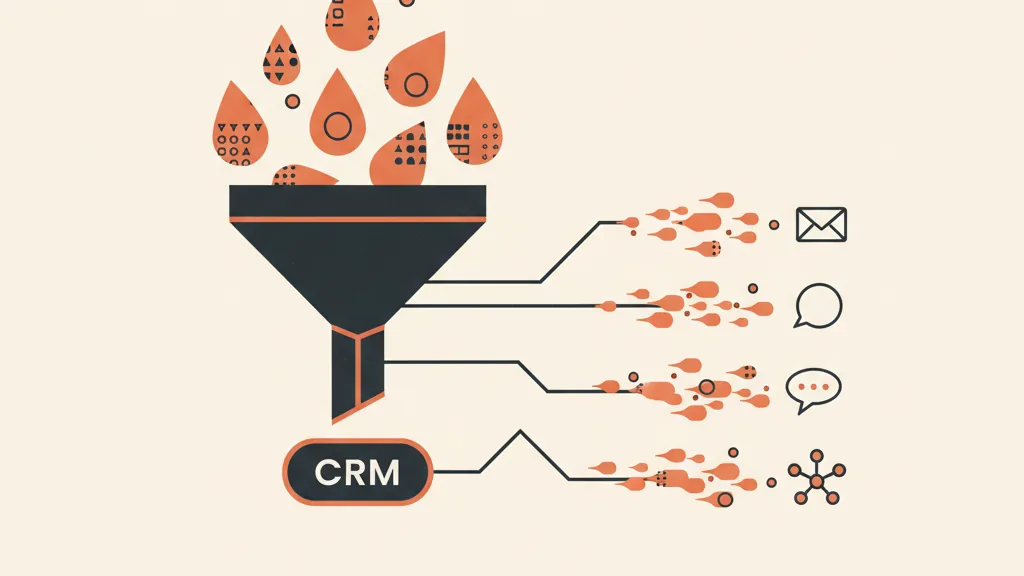
- Ingestion into the CRM. The quiz or form response lands as a structured attribute on the contact's profile (a "goal" field, a "size" field, a "budget" field). Not as a free-text note, but as a queryable field you can build segments on.
- Automatic segmentation. The CRM creates or updates segments in real time based on the declared values. Whoever answers "gift" enters the gift segment, whoever answers "personal use" doesn't. Zero manual work.
- Triggers and orchestration. Each segment fires a different flow: an email where the AI adapts tone and content, a WhatsApp message for those who chose that channel, exclusion from irrelevant flows. Consistent, multichannel, driven by declared data.
- Continuous updating. Every new interaction enriches the profile, which in turn sharpens the next messages. The system improves on its own as the customer keeps talking.
This is the heart of the matter: the data is the bridge between the moment the customer expresses themselves and the moment they receive a tailored response. If the bridge is broken (data that never reaches the CRM, unstructured fields, segments updated by hand once a month), personalization dies, no matter how sophisticated the downstream AI is. That's why the real bottleneck is rarely collection: it's integration. A custom CRM built for SMBs exists precisely to avoid this problem, because fields and triggers are modeled on your process instead of forced into a rigid template from an off-the-shelf tool.
Worth remembering: collection and activation are two halves of the same machine. A huge data library is useless if it never triggers actions; brilliant automations are useless without real data to work with. It's the same principle behind any marketing automation for SMBs: quality input, reliable orchestration, personalized output.
Zero-party data and GDPR: the hidden advantage
There's a reason zero-party data appeals to legal teams too. By nature it's the most privacy-defensible data there is: the customer provides it spontaneously, fully aware of what they're doing. Nothing hidden, nothing inferred behind their back.
That said, "spontaneous" doesn't mean "without rules." Zero-party data still falls under GDPR, and processing must rest on a valid legal basis. When that basis is consent, European regulators require it to be freely given, informed, unambiguous, and demonstrable: the person must understand what you're doing with their data, and you must be able to prove it. One technical point worth flagging: consent is often a residual basis, not the only route. For existing customers, for instance, marketing similar products to ones they've already bought can rest on other bases such as legitimate interest, under the applicable conditions. This is informational, not legal advice: check your specific case with whoever handles privacy at your company.
On the operational side, the good news is that compliance and activation run on the same mechanisms. Consent flags, suppression lists, and preference syncing in the CRM serve both purposes at once: complying with the law and personalizing well. Someone who said "no emails" is excluded because the law requires it and because sending them anyway would backfire. The two align perfectly.
Where to start, in practice
You don't need to rebuild your entire marketing stack. You need one collection point and a closed loop through to the CRM. A reasonable path:
- Pick one high-value question. The one whose answer would genuinely change the message you send. For an e-commerce store it's often "who is this for, or for what occasion." For a B2B service it's the main goal or problem.
- Build the lightest possible tool. A three-step quiz or one extra field on the opt-in. Better a little that gets completed than a lot that gets abandoned.
- Connect the data to the CRM as a structured field. This is the step almost everyone skips, and it's the one that makes the difference.
- Create a single differentiated flow. Two segments, two different messages. Measure the conversion gap against your previous one-size-fits-all communication.
From there you scale up: more questions through progressive profiling, more segments, more channels. But the first complete loop (question, data, CRM, message) is what proves the value and justifies the rest. If you're building the infrastructure from scratch, this topic fits into a broader conversation about a customer acquisition system: zero-party data is one of the fuels that makes it efficient, because every contact arrives already qualified by their own statements.
If you want to go beyond theory and see how an end-to-end collection-and-activation setup is actually built, we've dedicated a hands-on deep dive to zero-party data strategy, step by step.
The underlying idea stays simple: the best data is the data your customer hands you willingly, and it's only worth anything once you put it to work. Ask for it well, put it in the right place, and let automation do the rest.
Frequently asked questions
What's the difference between zero-party data and first-party data?
Zero-party data is explicitly declared by the customer (they tell you their size, goal, budget). First-party data is what you observe from their behavior (pages viewed, purchases, emails opened). The former needs no interpretation because it's a direct statement, the latter does. They're complementary and pay off best when used together.
How do you collect zero-party data in practice?
The most effective methods are quizzes or product finders (you give a recommendation in exchange for answers), the preference center (where subscribers choose what to receive), post-purchase surveys with one question at a time, and progressive profiling, meaning you ask for two or three pieces of information at a time, spread out over time, instead of one long form.
Is zero-party data still relevant now that Google hasn't eliminated cookies?
Yes. In 2025 Google backtracked on removing third-party cookies from Chrome, but zero-party data remains valuable not out of technical necessity but because of quality: data declared by the customer tells you what they want right now, a third-party cookie only tells you which segment they belong to. The former is exclusively yours.
Why is zero-party data useful for automation and AI?
An automated system is only as reliable as the data it receives. With ambiguous data it produces generic messages; with explicit statements it produces tailor-made ones. Zero-party data turns personalization from a statistical guessing game into the execution of a declared preference, and execution can be automated with precision.
Is zero-party data GDPR-compliant?
It's among the most privacy-defensible data because it's provided spontaneously and with awareness, but it still falls under GDPR. A valid legal basis must be identified: when that basis is consent, it must be freely given, informed, unambiguous, and demonstrable. For existing customers, other bases such as legitimate interest may apply to similar products. Check your specific case with whoever manages privacy at your company.
What does it mean to activate zero-party data?
It means feeding the declared data into the CRM as a structured field, using it to automatically segment contacts, and triggering personalized flows (email, WhatsApp, exclusions) consistent with what the person declared. Without this step the data just sits there, unused: the value is in the action it triggers, not in the data itself.
If you want to turn quizzes and forms into a personalization engine connected to your CRM, let's talk: we build the collection and activation setup tailored to your process.