Why Google Ads Is Essential to an SMB's Marketing Strategy
9 min read · AstraLoop Studio
If you run a small or medium business, sooner or later the question comes up: "is it worth spending on Google Ads, or am I just handing money to Google?" It's a fair question, and the honest answer isn't an enthusiastic "yes." It's: it depends. On what you sell, on how warm the audience you're reaching is, and above all, on what happens after the click.
There's one point that holds true for almost every Italian SMB, though, and that's where we'll start. While other channels (social, content, word of mouth) try to spark interest in people who weren't thinking about you, Google Ads does something different and rarer: it puts you in front of people who are already searching for exactly what you offer. You don't have to convince them the problem exists. They already have it, and right now they're typing the solution into the search bar.
In this article we'll look at why that mechanism is so valuable in a marketing strategy, where Google Ads fits with everything else (SEO, CRM, automation), and when it's actually not the first place to put your budget.
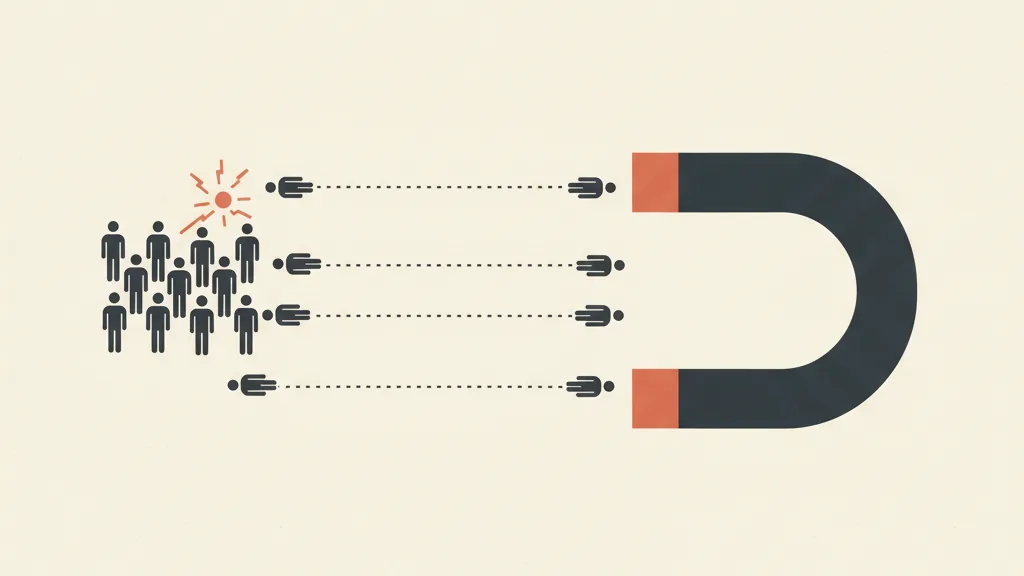
The difference between creating demand and capturing it
All marketing splits into two big movements, and understanding this distinction saves you from half the budget-allocation mistakes.
On one side there's latent demand: people who might want your product but aren't looking for it right now. You reach them through social, video, content. You interrupt the scroll, spark a desire that wasn't there before. That's the territory of Meta Ads and branding, and it's essential for filling the top of the funnel.
On the other side there's aware demand: people who already have the need and are actively searching for it. A plumber in Bologna, a CRM for their specific industry, a dentist open on Sundays. Here you don't need to sell the idea. You just need to show up at the exact right moment and give a better answer than the competition.
Google Ads (on the Search side) is the prime tool for aware demand. That's why, budget for budget, it tends to convert better than other channels: you're not talking to someone who "might, someday" - you're talking to someone who raised their hand today. If you want to dig into the distinction between these two worlds, we covered it in our comparison of branding and performance marketing.
Why this matters even more for an SMB
A large company can afford to spend years building brand awareness and wait for demand to mature. An SMB usually can't. It needs customers in the next 60-90 days, not in 2028. Capturing people who are already searching gives you exactly that: a channel that, when set up well, produces leads quickly and with measurable purchase intent.
It's no coincidence that when a company asks us how to build a steady flow of inquiries, paid search is almost always one of the first building blocks. Not the only one, but one of the fastest to switch on.
The advantage no other channel gives you: measurability
There's a second reason, less exciting but just as decisive, why Google Ads deserves a place in the strategy: you almost always know what you're buying.
With a billboard or a radio spot, you don't know who bought because they saw it. With Google Ads, if tracking is set up properly, you can get to: "this keyword brought me 12 inquiries, 3 of which became customers, for a spend of X euros." And that changes the very nature of the ad spend. It's no longer a bet - it's a system whose return you can calculate.
The metrics that really matter aren't clicks or impressions, but the economic ones downstream: cost per lead, customer acquisition cost, and the value each customer generates over time. If those numbers add up, you have a lever you can invest in with confidence. If they don't, you find out fast and correct course. To understand which numbers to watch without getting lost in the dashboard, we put together the key Google Ads metrics in a dedicated guide.
Careful: measurability isn't automatic
Here's the trap most SMBs fall into. Google measures the clicks and the "conversions" you tell it to track, but by default a conversion is often a filled-out form or a phone call. Not a customer. And between a form and a paying customer there's a chasm full of junk leads, curious browsers, and people you don't call back in time.
If you optimize campaigns for forms instead of real customers, you teach the algorithm to bring you more low-quality forms. This is where Google Ads stops being a standalone channel and needs to connect to the rest of the machine. Feeding the CRM data on who actually became a customer (so-called offline conversions) back into the system is the step that separates those who burn budget from those who make it pay off.

Google Ads doesn't work alone: the mix with SEO, CRM and automation
The most common mistake is thinking of Google Ads as a standalone switch: flip it on, customers arrive; flip it off, they stop. In reality it's a gear inside a bigger system, and its value depends on how it fits with the other pieces.
Google Ads and SEO: the pair that owns search
Many treat them as alternatives ("I'll do SEO so I stop paying for ads"), but they work on different timelines. SEO builds organic presence that matures over months and holds up long-term; Google Ads gives you immediate visibility and lets you claim competitive searches where you're not yet ranking first. On top of that, the two channels trade valuable data: the keywords that convert in ads tell you which content to prioritize organically. We go into detail in our guide on an integrated SEO and Google Ads strategy.
Google Ads and CRM: where clicks turn into revenue
A click doesn't pay the bills. A lead that comes in, gets called back in time, is followed up on properly, and is brought to a signed deal - that does. The CRM is where the leads generated by ads get qualified, tracked, and converted. Without this piece, you're filling a bucket with a hole in it: you pay to bring in leads that then get lost in an inbox or a forgotten spreadsheet. That's why a CRM built for SMBs isn't a tech luxury - it's what gives economic meaning to your ad spend.
Google Ads and automation: the speed that closes leads
One of the harshest data points in marketing: the odds of qualifying a lead drop sharply if you call back hours later instead of within the first few minutes. An SMB whose owner replies "whenever I get a chance" loses a huge chunk of what they paid for. Automating the follow-up (an instant reply, a reminder, a sequence that warms up the lead until they're ready) recovers exactly that money. That's why we treat sales follow-up automation as an integral part of any Google Ads strategy, not an extra.
The picture is this: Google Ads brings the intent, the CRM holds onto it, automation works it fast. Remove one piece and you weaken all the rest. And that's exactly how it should be framed inside a real customer acquisition system, where the ad channel is the fuel and everything else is the engine.
Want to find out if Google Ads makes sense for your industry and your margins before you invest budget? Request an analysis from AstraLoop: we'll look at the numbers together and tell you honestly where it makes sense to start.
When Google Ads is NOT the first move
It would be dishonest to paint it as the answer for everyone. There are cases where switching it on right away is a waste.
- If nobody is searching for what you sell. Products that are too new or purely discovery-driven have very little search volume. There, demand needs to be created first, and social is better suited. Google Ads comes later, once the category exists in people's minds.
- If you don't have a decent landing page. Sending paid traffic to a slow, confusing page with no clear call to action is like pouring water into a sieve. Fix the destination first, then open the tap.
- If nobody is calling leads back. Generating 30 leads a month that nobody handles isn't marketing - it's burning budget while holding a report that looks nice.
- If the margin can't cover the cost per customer. In sectors with very expensive clicks, if each customer earns you little, the math doesn't work. Better to check this with an estimate before you start.
The practical rule: Google Ads amplifies whatever's downstream. If there's a system downstream that converts, it amplifies the gains. If there's chaos, it amplifies the waste. Before scaling spend, it's worth thinking about how to set your advertising budget sustainably relative to your margins.
And AI? What changes in 2026
Anyone getting into Google Ads today keeps hearing that "the algorithm does everything now." That's half true. Google has shifted many levers into automation: bidding, keyword matching, deciding where to show ads. That doesn't make the channel less important - it just changes where your work goes.
Control has shifted upstream and downstream: the quality of the data you feed the algorithm (who's a good customer and who isn't) and the machine that handles the lead after the click. Paradoxically, in a world where the algorithm decides more and more, the competitive edge for SMBs isn't "knowing which buttons to click" - it's feeding the system clean data and closing leads fast. For the full picture of where things stand today, see our strategic guide to Google Ads in 2026.
In short
Google Ads is essential to an SMB's marketing strategy for three concrete reasons: it captures people who are already searching for you (warm demand, no convincing needed), it's measurable down to the last euro spent, and it produces results quickly compared to channels that build awareness over the long term.
But the key word is "system." On its own it generates clicks and leads; it's the landing page, the CRM and follow-up automation that turn them into revenue. Whoever treats it as a standalone switch wastes budget. Whoever builds it into a machine that welcomes and works the leads builds a predictable acquisition channel. The right question isn't "is it worth doing Google Ads?" but "what happens to the leads after I've paid for them?"
Frequently asked questions
Why should an SMB do Google Ads instead of social?
It's not either/or: they do different things. Social creates interest among people who weren't looking for you (latent demand), Google Ads captures people already searching for your solution (aware demand). For an SMB that wants customers quickly, paid search tends to convert better because it speaks to people who already have the need. Ideally you use both, each for its stage of the funnel.
How much budget do you need to start with Google Ads?
There's no universal number: it depends on your industry's cost per click and your margin per customer. The right approach is to start small, measure cost per lead and per real customer, and scale only once the numbers add up. A budget that's too small in a sector with expensive clicks, though, won't gather enough data to tell if it's working, so it needs to be calibrated to your own numbers, not a fixed rule.
Does Google Ads bring customers right away, or does it take time?
Compared to SEO, which matures over months, Google Ads gives immediate visibility: ads can appear the same day you launch them, and the first leads arrive quickly. It does take a few weeks, though, for the algorithm to gather data and optimize, and for you to figure out which campaigns and keywords bring real customers rather than just clicks.
Is it worth doing Google Ads if I already rank well in SEO?
Often, yes. SEO and ads occupy different spaces on the results page and cover competitive searches where you're not first organically. Plus, campaign data (which keywords convert) feeds your SEO content strategy. They should be read as complementary, not as alternatives where one rules out the other.
Why does Google Ads sometimes bring in low-quality leads?
Usually because campaigns are optimized for filled-out forms or phone calls, not real customers. So the algorithm learns to bring more leads that are easy to get but poorly qualified. The fix is to feed the system data on who actually became a customer (offline conversions from the CRM) and to refine targeting, negative keywords, and landing pages, so Google learns to find the right audience.
Is switching on Google Ads enough to get more customers?
No, and that's the most common mistake. Google Ads brings the intent and the leads, but revenue is generated after the click: you need a landing page that converts, a CRM that collects and qualifies leads, and fast follow-up (ideally automated) that closes them before they go cold. Without these pieces, you're paying to fill a bucket with a hole in it.
If you already have campaigns running but leads keep slipping through the cracks, talk to us: we build the system that connects Google Ads, CRM and follow-up automation to turn clicks into customers.